
Why Vision AI Matters Now: Scope, Stakes, and What This Guide Delivers
Imagine a computer that can "see" and understand the world just like us. That’s the core idea behind vision AI. This amazing technology lets machines look at pictures and videos to figure out what’s happening. From seeing faces to spotting problems on a factory line, vision AI helps computers make sense of visual information. It’s a huge deal in 2026, changing many industries and creating new ways for businesses to grow. For smart investors and people building new ai projects, understanding vision AI is a top priority.

The way these different types of ai can identify objects, track movement, or even read emotions means big changes for things like self-driving cars, medical tools, and how we shop online. Experts are always studying new ways to make these systems better, looking at things like how to train them with vast amounts of data or fine-tune models for specific tasks. For instance, new studies explore how "foundation models" are changing the game in computer vision, offering powerful new ways to tackle complex visual problems Foundation Models Defining a New Era in Vision: A Survey. This shows just how much is happening in ai stuff right now.
But keeping up with vision AI is tough. There’s so much new information coming out all the time, making it hard to know what’s truly important. It feels like a never-ending stream of news and research. Plus, turning cool ideas from research labs into real products that work well can be a big challenge. Many professionals struggle to bridge this gap between what’s possible and what’s practical. If you’re looking to understand the big picture, it helps to keep up with AI trends 2026: The crucial insights for leaders and investors.
This guide is here to help you cut through the noise. We will give you clear, factual ways to look at and start your own vision AI projects. You’ll learn how to make smart choices based on real evidence, helping you lead in this fast-changing world.
For daily, in-depth insights into AI and broader technology trends, make sure to get The AI Newsletter Worth Reading.
What Is Vision AI? Core Concepts, Models, and Data
To truly grasp vision AI and begin your own ai projects, it helps to understand its basic parts. Think of vision AI as building blocks.
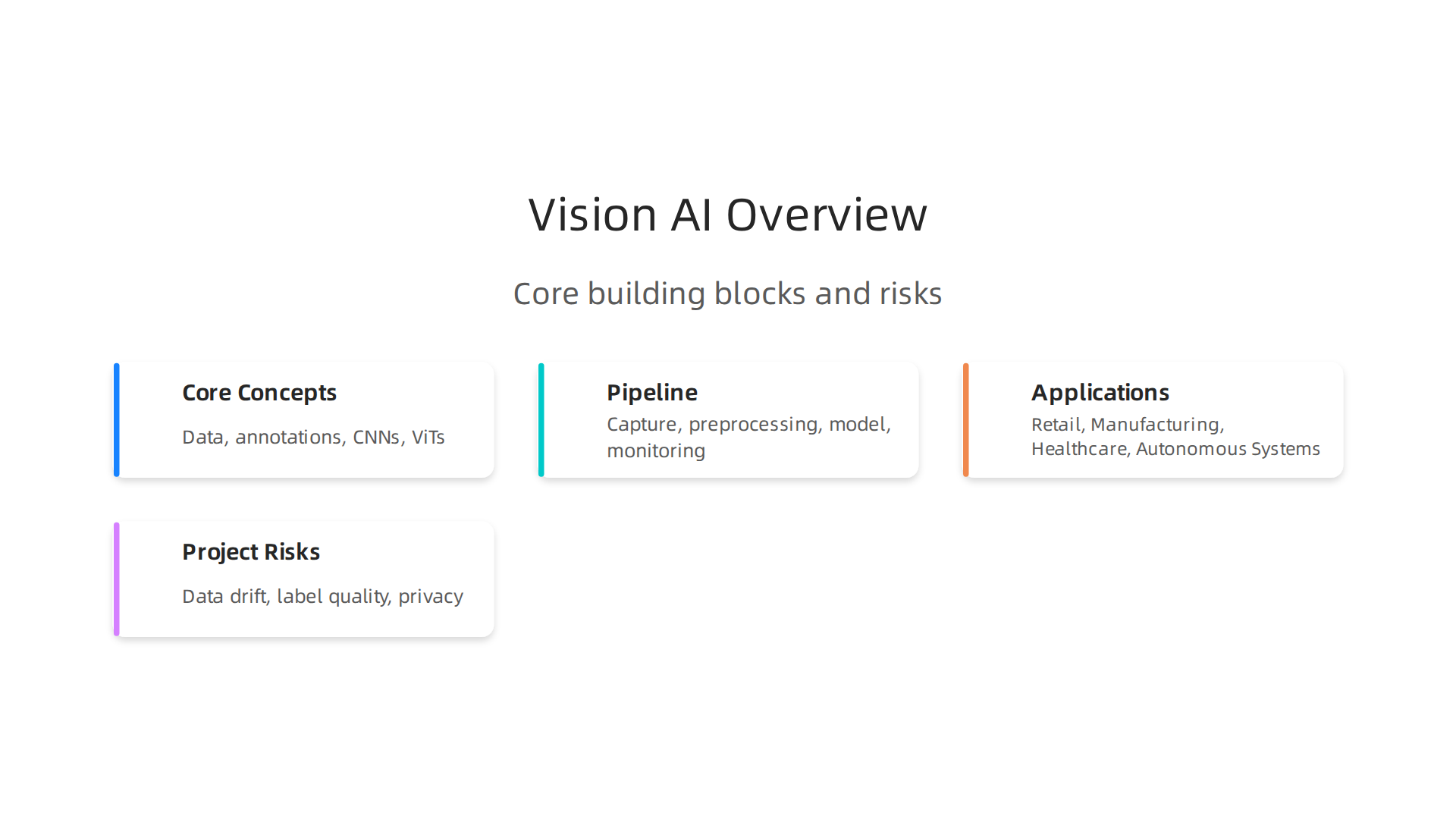
First, you need data. This means lots of pictures and videos, just like our eyes take in the world around us. This raw data is what the computer "sees."
Next, these pictures and videos need special labels, called "annotations." Imagine drawing boxes around every cat, car, or person in a photo and telling the computer what each thing is. This labeling helps the AI learn what to look for. The quality of these labels is super important because good labels help the AI learn well, and bad labels can confuse it. Often, a lot of human work goes into these annotations to make sure they are correct.
After getting the data ready, vision AI uses special computer programs called "models." These are like the "brains" that learn from the labeled pictures. There are a few main types of these models:
- CNNs (Convolutional Neural Networks): These models are great at looking at small parts of an image, like edges or corners, and then putting those pieces together to understand the whole picture.
- ViTs (Vision Transformers): Newer models like ViTs look at the whole picture at once, paying attention to how different parts relate to each other. Experts say that when trained on huge amounts of data, ViTs can sometimes do even better than CNNs for certain tasks A Short Review on Computer Vision: Visualizing the World ….
Often, these models start with "pretraining." This means teaching them with a very large set of general images and videos, helping them learn basic patterns. After pretraining, the models go through "fine-tuning." This is like teaching them a specific skill. For example, a model pretrained on millions of general images might then be fine-tuned to only spot types of medical issues in X-rays Parameter-Efficient Fine-Tuning for Pre-Trained Vision Models: A Survey and Benchmark. This helps the different types of ai become really good at one job without needing to learn everything from scratch. This idea of pretraining and fine-tuning is key to how many vision ai systems work today A comprehensive survey of Vision-Language Models.
When building ai projects, you also need to think about how much computer power you have. Big, powerful vision AI models need a lot of computing strength and can take longer to give an answer. Smaller models might be faster, but sometimes they are not as smart. It’s a balance between how fast you need the AI to respond (latency), how big the model is, and how much computing power you can use. Picking the right balance depends on what your ai stuff needs to do. For example, a self-driving car needs super-fast responses, so its vision AI must be efficient. For other tasks, a slightly slower but more accurate model might be fine. Understanding these trade-offs is crucial when you try to cut through AI noise and pick the right tools for your business.
To build powerful vision AI systems for your ai projects, you need more than just smart models. You also need the right equipment and a clear plan for how the AI will do its work. It’s like needing good eyes and a good brain to understand the world.
Capturing the World: Cameras and Sensors
First, vision AI needs "eyes" to see. These are cameras and sensors. Just like your phone camera, these devices capture pictures or videos. But for AI, there are many choices:
- Regular Cameras: These are common, capturing what we normally see. They work well for many tasks like identifying objects.
- Thermal Cameras: These cameras "see" heat, not light. They are useful for tasks in the dark or for finding things that give off heat, like people or animals.
- 3D Sensors: These can tell how far away objects are, creating a "depth map" of the scene. This is important for robots that need to move around or for measuring things accurately.
The quality of the pictures these sensors take is super important. Good lenses (optics) and proper lighting make a big difference. If the pictures are blurry or too dark, even the smartest vision AI model might make mistakes. High-quality input data means better results for your ai stuff.
Where the AI Thinks: Edge vs. Cloud Inference
After the camera captures data, the vision AI model needs to "think" about it. This thinking process is called "inference." Where this thinking happens is a big choice for any AI project:
- Edge Inference: This means the AI thinks right on the device itself, like on a smart camera or a robot.
- Good for: When you need very fast answers (low delay), like in self-driving cars. It’s also good for privacy because data doesn’t have to leave the device. Studies show that edge devices can offer much lower delays compared to sending data to the cloud for processing Comparative Performance and Cost Analysis of Computer Vision.
- Things to consider: Edge devices are usually smaller and have less power, so they can’t run the biggest, most complex AI models.
- Cloud Inference: Here, the camera sends its pictures over the internet to big computers far away (the "cloud").
- Good for: When you need to use very powerful AI models that require a lot of computing strength. The cloud can handle huge amounts of data and complex calculations.
- Things to consider: It’s slower because data has to travel over the internet. This can add a lot of delay, sometimes taking seconds for the AI to respond Enabling Vision Language Models on Edge Devices. It also needs a constant internet connection and can cost more.
- On-Premise Inference: This is like a mini-cloud setup in your own building. You buy and manage the computers yourself.
- Good for: Businesses that want full control over their data and don’t want to rely on outside companies or the internet. It can also offer a good balance of speed and power.
- Things to consider: You have to pay for and take care of all the computer hardware.
Choosing between these different types of ai inference setups depends on your project’s needs for speed, cost, and privacy.

For example, a system checking factory parts might use edge AI for quick checks, while a research project might use cloud AI for deep analysis. If you’re looking for guidance on choosing the right solutions, understanding how to evaluate AI companies can be very helpful. Learn more about evaluating AI companies in 2026 to make informed decisions.
The AI’s Journey: A Simple Pipeline
No matter where the AI thinks, the data usually follows a path, like a little pipeline:
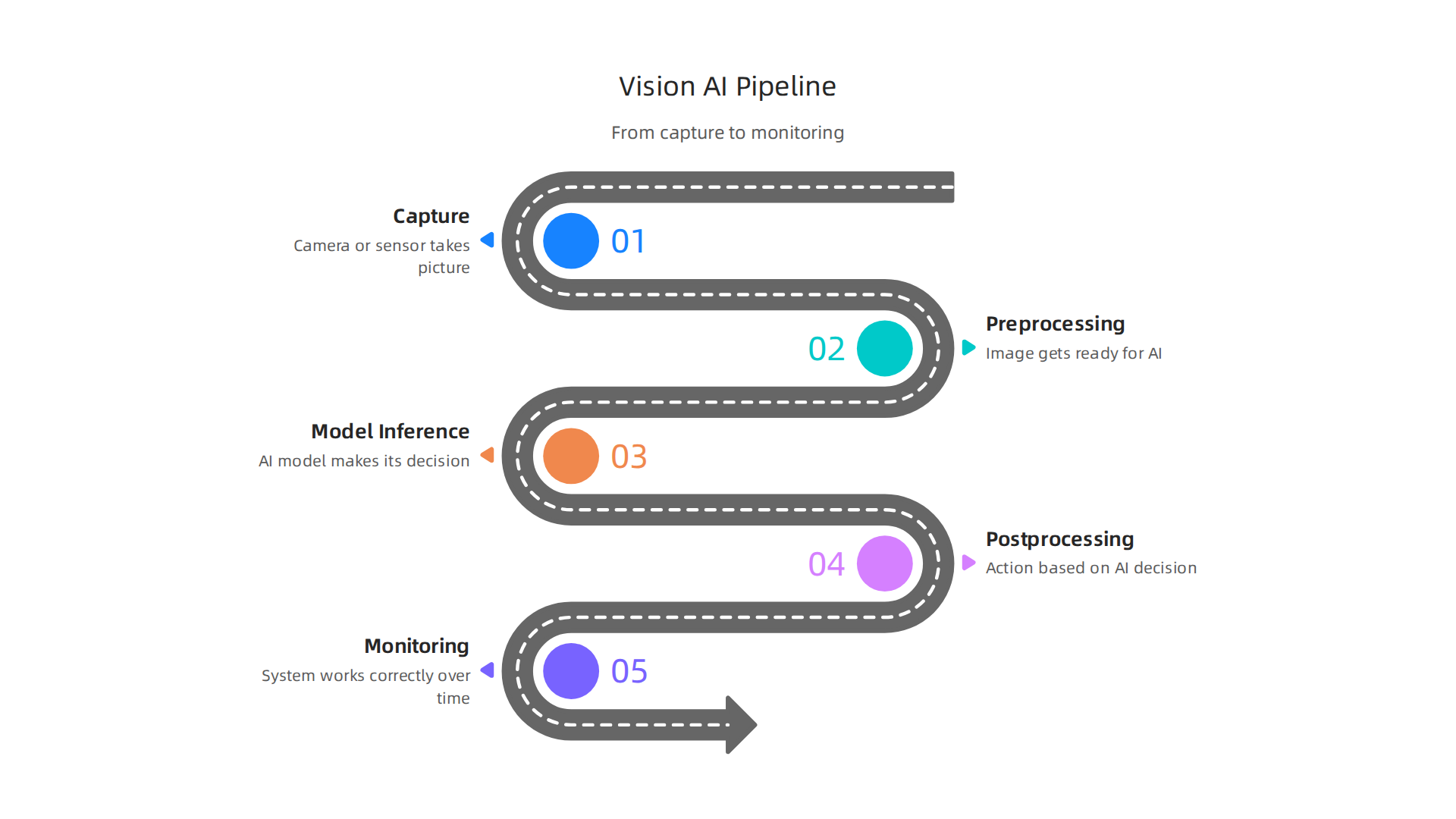
- Capture: The camera or sensor takes a picture or video.
- Preprocessing: This is where the image gets ready for the AI. It might be resized, brightened, or changed in other ways to help the AI model work best.
- Model (Inference): The prepared image goes into the
vision AImodel. The model then makes its decision, like "that’s a dog" or "this part is broken." - Postprocessing: After the AI’s decision, something happens next. Maybe a box is drawn around the dog in the picture, or an alert is sent about the broken part.
- Monitoring: It’s important to keep an eye on the whole system to make sure the AI is still working correctly and giving good answers over time. This helps catch any problems early.
After seeing how the vision AI pipeline works, let’s explore where these smart systems are making a big splash in the real world. From stores to hospitals, vision AI is changing how many ai projects are done every day. It’s truly useful ai stuff that helps businesses work smarter.
Main Application Areas: Retail, Manufacturing, Healthcare, Autonomous Systems, and Beyond
Vision AI is being used in many different places, showing real results for early adopters.
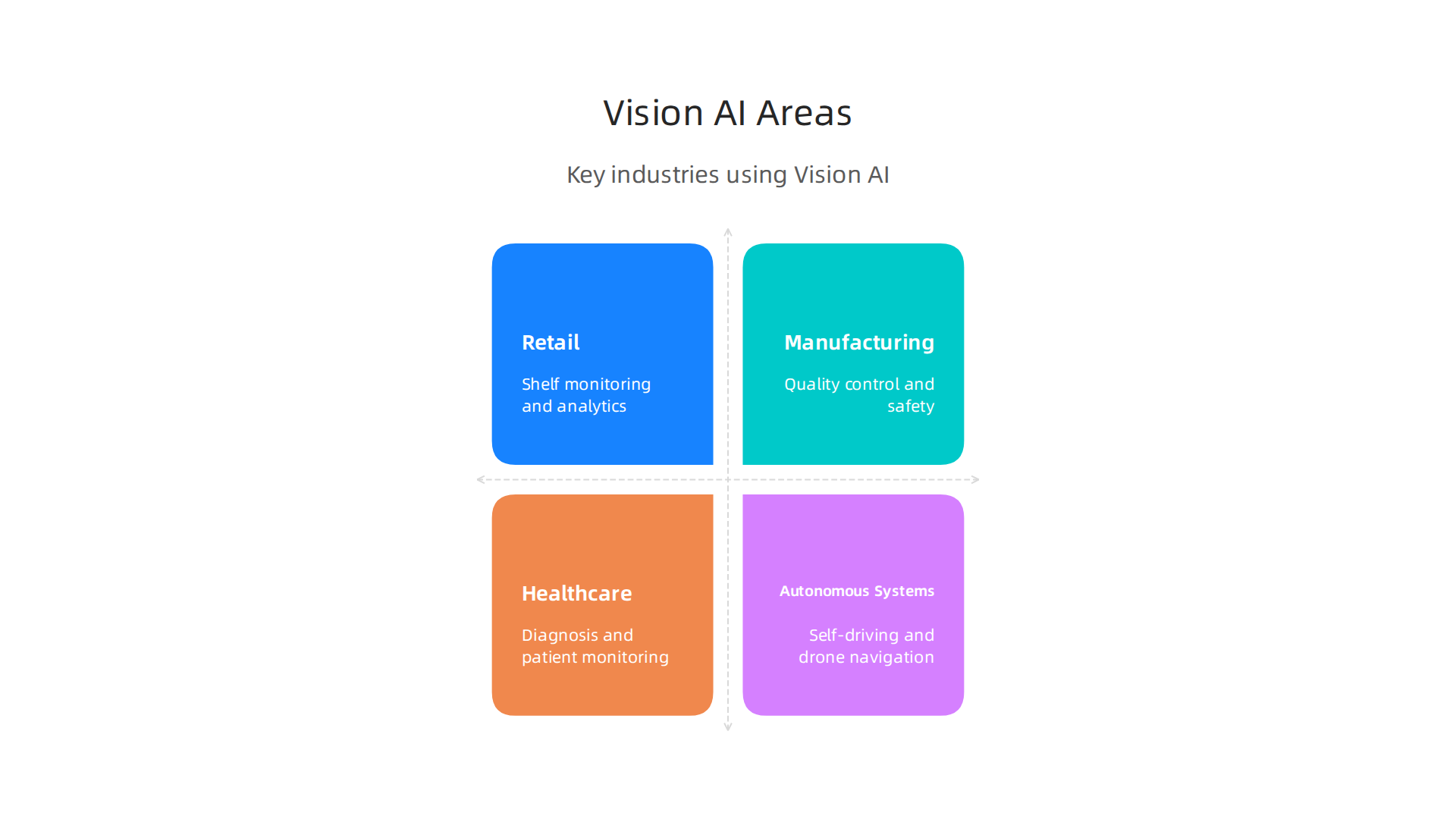
Here are some main areas:
Retail
In stores, vision AI helps with many tasks. It can keep an eye on how much stuff is on the shelves, stop theft, and even figure out how shoppers move around the store.
- Data Input: Cameras in the store that watch aisles and checkout areas.
- How Success is Measured: Less stolen goods, better sales numbers, and smarter store layouts.
- Challenges: Getting good pictures in tricky lighting, making sure people’s privacy is protected, and counting items accurately.
- Real Results:
Vision AIfor retail analytics can help improve sales by 10-20% just by making store layouts better Computer Vision Use Cases 2026 | Pharos Production. Retail businesses that use these tools early on often see long-term benefits AI, Computer Vision, and Robotics to Deliver Long-Term ….
Manufacturing
Factories use vision AI a lot for quality control. It helps find tiny flaws in products, checks if parts are put together right, and even makes sure workers are safe.
- Data Input: High-detail cameras that take pictures of products and parts on the assembly line.
- How Success is Measured: Fewer broken products, faster checks, and big savings on costs.
- Challenges: Dealing with new product designs, finding very small defects, or dirty camera lenses.
- Real Results:
Vision AIsystems can cut the costs of checking quality by 60% and make products more consistent Case Studies — AI Success Stories – Nirikshan AI. Some companies have reduced defects by 90% and cut inspection costs by 50-70% Computer Vision Use Cases 2026 | Pharos Production. For instance, an automotive supplier usedvision AIto save $18 million each year by catching defects earlier Computer Vision Business Applications: Implementation & ROI ….
Healthcare
In healthcare, vision AI helps doctors with diagnoses, screens for health problems, and monitors patients.
- Data Input: Medical scans like X-rays or MRIs, special images of eyes, or video from patient rooms.
- How Success is Measured: Quicker diagnosis, more accurate results, and less busy work for healthcare staff.
- Challenges: Making sure patient information stays private (following rules like HIPAA), ensuring the AI works fairly for everyone, and still needing human doctors to review important decisions.
- Real Results:
Vision AIis playing a big role in helping with diagnoses, especially in eye care Experts Break Down Wide Range Use of AI in the Optical Industry in ….
Autonomous Systems
This area includes self-driving cars, robots in warehouses, and drones. Vision AI is crucial for these systems to "see" and understand their surroundings.
- Data Input: Many types of cameras (regular, thermal, 3D) and other sensors like radar.
- How Success is Measured: Safe driving or movement, correctly identifying objects, and working reliably.
- Challenges: Bad weather like rain or fog, unexpected objects, or problems with the sensors themselves.
- Real Results: The need for
vision AIin this field is growing fast. The market for robotic vision is expected to reach $14.8 billion by 2030 Robotic Vision Market Report, Industry and Market Size & ….
And Beyond
Vision AI is also making a difference in many other different types of ai applications. This includes checking plants in farming, keeping places secure, and even analyzing how athletes play sports. The trends for 2026 show that many industries are adopting vision AI because it brings real business value Vision AI: Trends and Strategic Insights 2025. The most successful ai projects are those where the AI clearly helps solve problems and shows measurable improvements.

Understanding how strategic AI adoption drives business growth is key to making these systems work for you.
Stay informed on the latest developments in vision AI and other crucial ai stuff across industries. Get clear daily AI updates from The AI Newsletter Worth Reading.
Now, after seeing where vision AI is used, it’s important to know how to tell if these AI projects are actually good and helpful. It’s not just about if the vision AI system gets things right most of the time. We need to look at many things to really know its value.
Evaluating Vision AI Projects: Metrics, Benchmarks, and Risk Factors
When we look at vision AI systems, we need to go beyond simple accuracy. We want to know how well the system works in the real world and what problems it might cause. Here are some key ways to check if an ai project is truly good.
Metrics That Really Matter
- Robustness: This means how well the
vision AIworks even when things are not perfect. For example, if a camera image is blurry or has bad lighting, a robust AI can still understand it. Researchers often check how models perform with low-quality images to measure this A Survey on the Robustness of Computer Vision Models against …. A good AI system should handle real-world challenges like this Visual Robustness Benchmark for Visual Question Answering …. - Calibration: This is about how sure the AI is about its answers. If the AI says it’s 95% sure about something, it should actually be right 95% of the time. This helps people trust the AI more.
- Latency: This is how fast the
vision AIsystem gives you an answer. In self-driving cars or factory lines, a slow answer can be dangerous or costly. For example, moving AI tasks to the "edge" (closer to where the data is collected) can make systems much faster INTERNATIONAL JOURNAL OF ARTIFICIAL INTELLIGENCE. Sometimes, getting results from the cloud can take a long time Input-Aware Routing for Edge-Cloud Vision-Language Inference. - Throughput: This means how many tasks the
vision AIcan handle at the same time. A system might be fast for one task but struggle if it has too many things to do. - False-Positive Cost: What happens when the AI says "yes" but it should have said "no"? For instance, if a security camera
vision AIwrongly flags a shopper as a thief, that has a real cost for the store and the person. - Fairness: It’s super important that
vision AIworks equally well for everyone, no matter their background. We need to make sure the AI does not treat different groups unfairly. To learn more about this, you can read about uncovering AI bias origins detection and fairness solutions.
Benchmarks and What They Tell Us
Benchmarks are like standard tests for different types of AI. They use special datasets to see how well an AI model performs. There are leaderboards that rank ai projects based on these tests. This helps compare ai stuff from different companies or researchers. For example, there are benchmarks to test how well AI language models understand images VHELM: A Holistic Evaluation of Vision Language.
But sometimes, benchmarks can be misleading.
- Overfitting: This happens when an AI learns the test data too well but cannot handle new, real-world data. It’s like studying only for the test and not learning the general subject.
- Synthetic Data Mismatch: Sometimes, benchmarks use fake or "synthetic" data. If this data is not like what the AI sees in the real world, the benchmark results might not be useful.
Important Risks to Consider
When bringing any vision AI into a business, it’s wise to think about these risks:
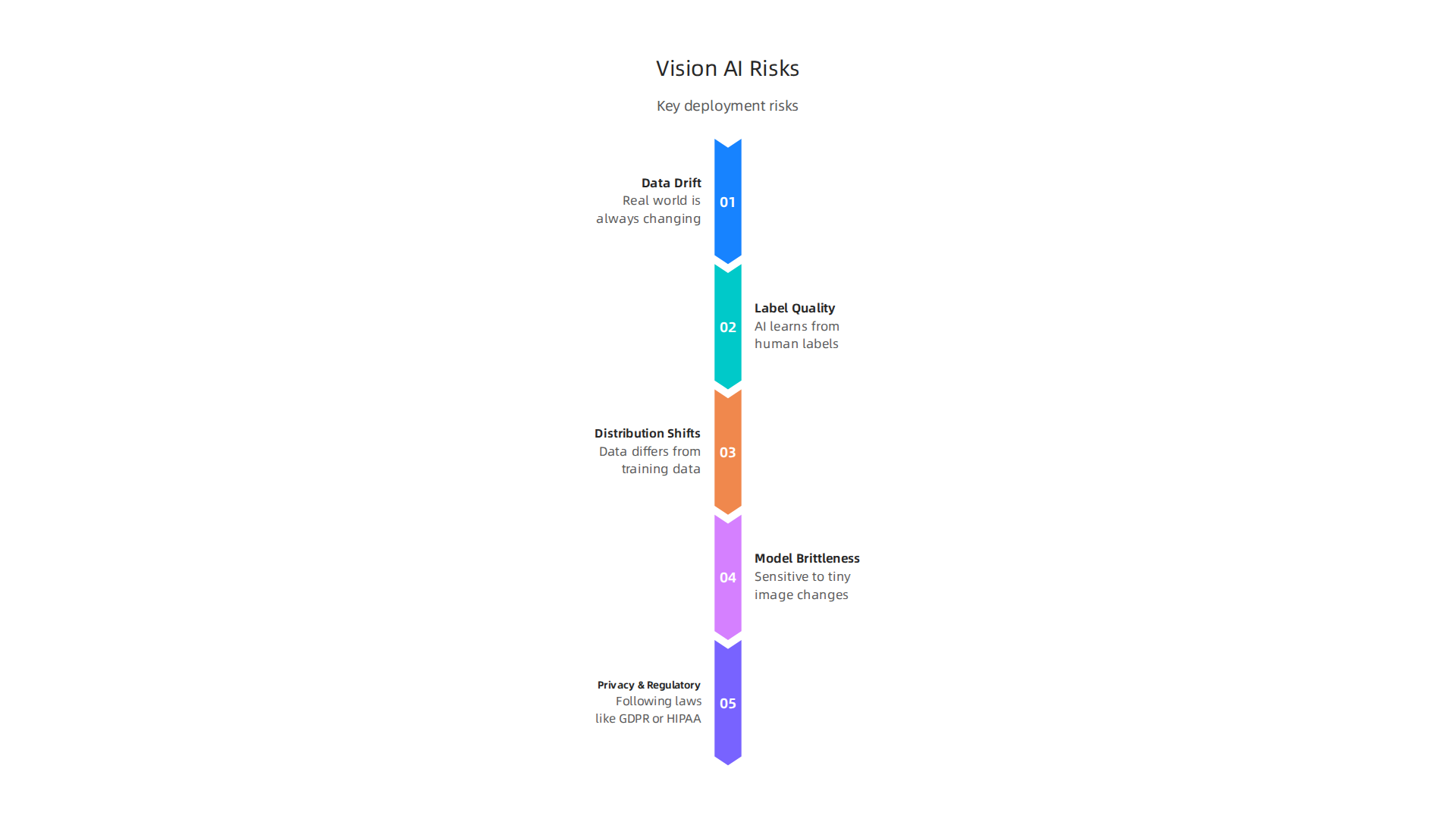
- Data Drift: The real world is always changing. What an AI was trained on last year might not be exactly what it sees today. For example, if a
vision AIidentifies car models, it needs to learn about new car designs over time. - Label Quality: AI learns from data that humans have labeled. If those labels are wrong or inconsistent, the AI will learn the wrong things.
- Distribution Shifts: This is when the data the AI sees in its daily use is very different from the data it learned from. This can make the AI less accurate.
- Model Brittleness: Some
vision AImodels are very sensitive. A tiny change to an image that a human would not even notice can make the AI completely wrong. - Privacy and Regulatory Exposure:
Vision AIoften deals with images of people or private places. It’s important to follow privacy laws like GDPR or HIPAA to avoid legal trouble. Understanding humane technology principles for ethical AI governance is key for ethical deployment.
Choosing the right vision AI for your needs means looking at all these different factors, not just how accurate it seems at first. It’s also important to know how to evaluate an AI development company in 2026 to make sure you’re getting a reliable partner for your ai projects.
After carefully checking how good a vision AI project is, the next big step is to actually put it to use. This means making a clear plan, from gathering data to making sure the AI keeps working well over time. It’s like building a house: you need a good blueprint and someone to keep it in good shape.
Implementation Roadmap: Data Strategy, Prototyping, MLOps, and Scaling
Bringing vision AI into a business needs a step-by-step approach.

It’s not just about building the AI model; it’s about making sure it fits the real world and grows with your needs.
Step 1: Laying the Groundwork
First, you need to be very clear about the problem you want to solve with vision AI.
- Problem Framing: What exactly should the AI see and understand? Is it sorting products, spotting defects, or helping self-driving cars? Being clear helps guide everything that comes next.
- Data Collection Strategy:
Vision AIlearns from images or videos. So, getting the right data is super important. You need to collect enough varied pictures that show what the AI will see in real life. This means thinking about different lighting, angles, and even bad weather if that’s part of the real world. A good data strategy ensures the AI has a strong foundation.
Step 2: Building and Testing the First Version
Once you have your data, you can start building.
- Prototyping: This is like making a rough draft of your
vision AIsystem. It’s about quickly building a basic model to see if the idea works. This first model helps you understand if your data is good enough and if the AI can actually learn what you want it to. - Prototype Evaluation: Test your early model with new data it hasn’t seen before. This helps you find problems early and make changes before you spend too much time and money. It also helps confirm if your AI is robust and fair, as we discussed earlier.
- Pilot Deployment: After the prototype looks promising, try it out in a small, controlled real-world setting. This "pilot" test shows how the
vision AIhandles actual operations and helps identify any surprises.
Step 3: Keeping AI Running Smoothly with MLOps
Once your vision AI is working, you need to keep it in top shape. This is where MLOps, or Machine Learning Operations, comes in. MLOps is about setting up systems to manage different types of AI models throughout their life.
- Labeling Pipelines: AI learns from labeled data. This means someone has to draw boxes around objects in images or tag what’s happening in a video. For
vision AI, you need a smooth way to keep labeling new data as your project grows. - Continuous Monitoring: The real world changes, and your AI needs to keep up. Continuous monitoring tracks how well your
vision AIis performing in real time. This includes watching for things like data drift, where the incoming data starts looking different from what the AI learned on MLOps Best Practices: Deploy, Monitor & Retrain Production ML …. You also need to watch for drops in accuracy or increased latency. Good monitoring helps you know when something is going wrong. - Retraining Triggers: When performance drops or new data becomes available, the AI needs to learn again. This is called retraining. MLOps sets up automatic triggers, like a specific drop in accuracy or a change in data, that tell the system when it’s time to retrain the model MLOps in 2026: Best Practices for Scalable ML Deployment. This keeps your
ai stuffup-to-date and effective. - Versioning for Models and Datasets: It’s important to keep track of every version of your AI model and the data it learned from. This way, if something goes wrong, you can go back to an older, working version. This also helps understand how changes affect performance. This versioning is a key part of good MLOps practices in 2026 MLOps Learning Road: Step by Step Guide (2026).
Step 4: Scaling Up Your Vision AI
If your vision AI project is successful, you’ll want to make it bigger.
- Labeling Scale: As you collect more data, you’ll need more people or better tools to label it. Automated annotation tools can help by doing some of the labeling for you, leaving complex cases for humans.
- Model Optimization: Making your AI run faster and use less computer power is important when you scale up. This might involve using simpler models or special hardware.
- Automated Annotation: Tools that can automatically label some data greatly speed up the process. This frees up humans to focus on trickier images, making the whole labeling process more efficient.
- Human-in-the-Loop Systems: For very important tasks, it’s often best to have humans check the AI’s work or handle cases the AI isn’t sure about. This "human-in-the-loop" approach helps build trust and keeps things running smoothly at a large scale.
Building and running vision AI requires a thoughtful plan and constant care. By following these steps, businesses can successfully implement their ai projects and make the most of this powerful technology. For daily, in-depth insights into AI and broader technology trends, make sure to Subscribe to The Deep View Newsletter today! To plan your AI journey, you might also want to design a global AI strategy for enterprise growth in 2026.
Understanding how to make vision AI work is one thing, but knowing the bigger picture of who is building what and where the best chances lie is another. The market for vision AI is growing very fast, with new ideas popping up all the time.
Market Landscape & Strategic Opportunities for Investment in Vision AI
Looking at the vision AI market in 2026, we see a mix of big, established companies and many clever new startups. These companies are all working to make different types of AI smarter and more useful.
Who’s Who in Vision AI
In this busy market, you’ll find:
- Big Companies: These are often large tech firms or industrial giants. They use
vision AIto improve their existing products or services, like making factories more efficient or helping cars drive themselves. - New Startups: Smaller, nimble companies are focusing on special problems. They might make
ai stuffthat helps specific industries, or they might invent brand new ways for AI to "see." Many computer vision startups have received significant funding in 2026, with hundreds of companies raising capital across different stages 505 Computer Vision Startups (2026) — Recently Funded. - New Kinds of Technology:
- Foundation Vision Models: These are powerful
vision AImodels that can do many different viewing tasks, not just one. Think of them as a base for many other AI tools. - Modality Fusion: This is when AI mixes vision with other senses or types of information, like understanding what it sees along with what someone says. This makes
ai projectseven more capable.
- Foundation Vision Models: These are powerful
Smart Chances for Investors and Companies
There are many good chances for people looking to invest or for companies wanting to grow with vision AI:
- Working Together (Partnerships): Big companies can team up with startups that have fresh ideas. This helps both sides grow faster.
- Specialized Automation:
Vision AIis very good at tasks in specific areas. For example, in manufacturing, it can check for defects, saving millions of dollars and improving product quality 2026 Top Vision AI Use Cases Across 10 Industries. In retail, it can help understand customer behavior or manage inventory. These focusedai projectsoften show a clear return on investment (ROI) Computer Vision for Business: 8 High-ROI. - Hardware for "Edge Inference": This means building special computer parts that can run
vision AIright where the action is, like on a camera or a robot, instead of sending all the data to a faraway cloud. This makes AI faster and more secure.
What to Look For in a Vision AI Company
If you’re trying to figure out if a vision AI company is a good bet, here are some things to watch for:
- Strong Data "Moat": Does the company have unique and hard-to-get data? A strong, special collection of images or videos gives them a big advantage that others can’t easily copy.
- Owning Labeled Data: Since
vision AIlearns from labeled data, it’s key that a company owns the rights to its carefully tagged datasets. This protects their learning advantage. - Clear Market Plan: Do they know exactly who their customers are and how they will sell their
ai stuff? A clear plan means they can turn their technology into real business success. - Understanding Rules: Are they aware of any laws or rules that might affect how their
vision AIcan be used? Knowing this helps avoid problems later on.
The vision AI landscape offers many exciting opportunities in 2026, from helping factories run better to making stores smarter. For daily, clear updates on AI and technology trends, you might find The AI Newsletter Worth Reading useful. Staying informed about the latest developments is key to making smart decisions in this fast-moving field. You can also learn more about evaluating AI companies in 2026 to better understand the market.
Summary
This guide explains what vision AI is, why it matters in 2026, and how to move from concept to scalable product. It covers the essential building blocks—high-quality images and annotations, model choices like CNNs and ViTs, and the trade-offs between edge, cloud, and on‑prem inference—so you can match architecture to use case. The article walks through real-world applications in retail, manufacturing, healthcare, and autonomous systems, showing where vision AI delivers measurable ROI and where it struggles. You’ll also find a practical evaluation framework—robustness, calibration, latency, throughput, fairness—and the main operational risks such as data drift and label quality. The implementation roadmap outlines problem framing, prototyping, MLOps practices (monitoring, retraining, versioning), and steps to scale labeling and optimization. Finally, the guide highlights market and investment signals to watch, including data moats, labeled datasets, partnerships, and hardware opportunities for edge inference.