
Introduction
You have probably asked an AI tool for a quick answer and quietly wondered, "Can I really trust this?"

In 2026, that question matters more than ever. We are swimming in information, and the line between fact and fiction keeps getting blurrier. That is where open evidence ai comes in.
Think of open evidence ai as a framework built on transparency and verifiable data. Instead of just giving you a black box answer, it shows you the proof behind every prediction. This approach matters a lot when you need to make decisions with real weight.
Consider how platforms like OpenEvidence work.
This AI tool pulls from peer reviewed sources to generate evidence based recommendations. Researchers at places like Harvard Medical School already point to tools such as OpenEvidence as a way to find reliable evidence for clinical questions. The idea is simple: when AI decisions are backed by clear, checkable sources, you can move forward with more confidence.
The bigger picture here involves other tools like Genspark AI and Originality AI, which also focus on verification and trustworthy outputs.
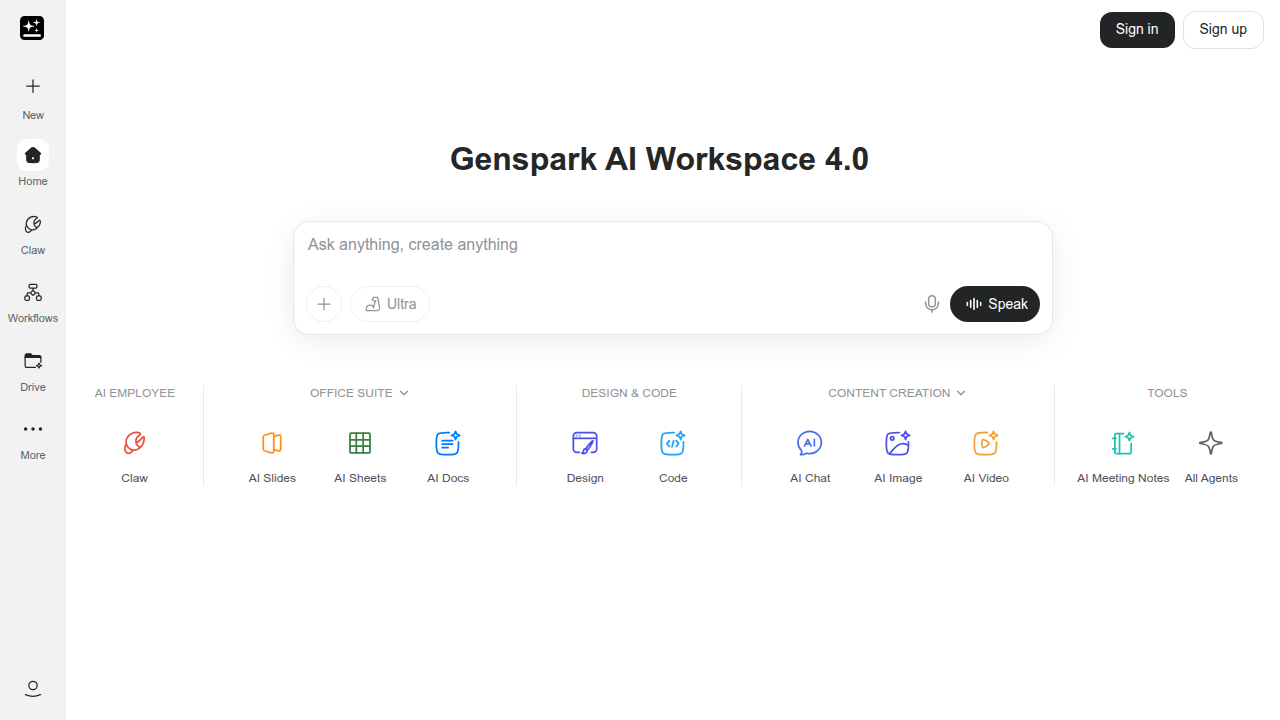
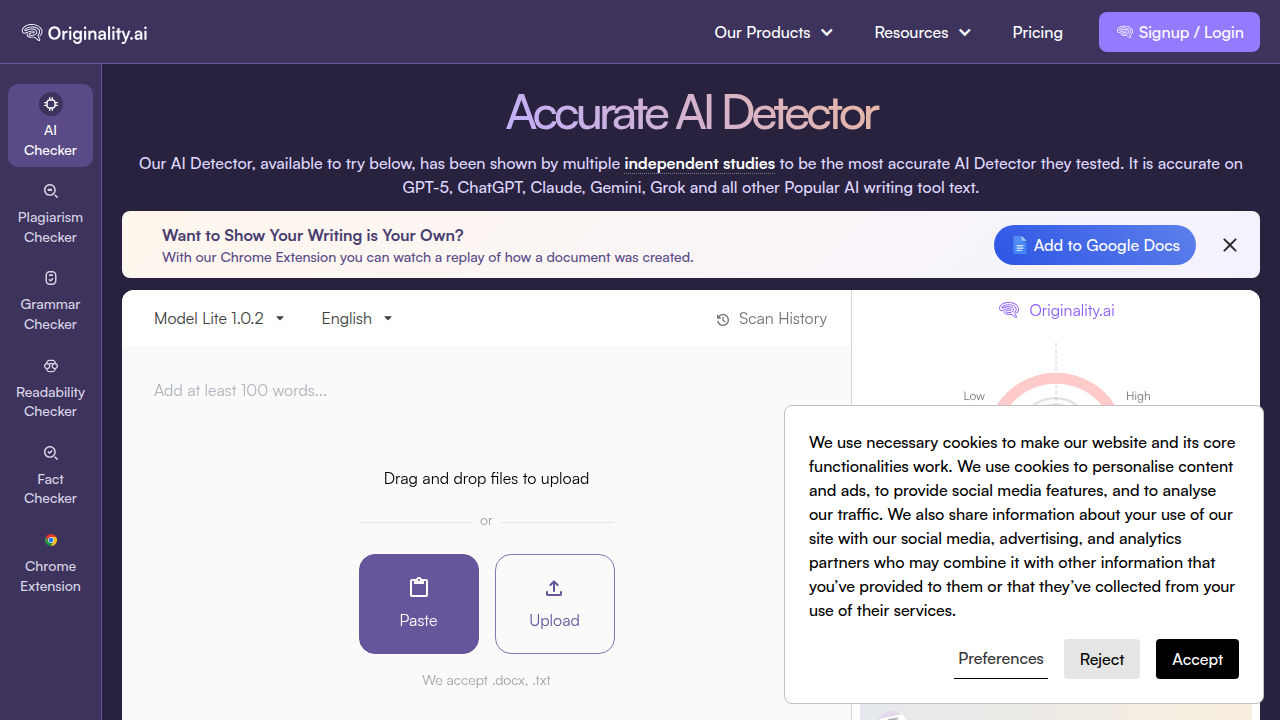
They all share a common goal: to make AI predictions something you can actually rely on.
In this article, I will walk you through how open evidence ai can help you cut through the noise and make smarter, more confident choices. Whether you are a researcher, a healthcare professional, or just someone tired of guessing whether an AI answer is real, this approach has something for you.
Want to stay on top of the fast moving AI world without the fluff? The Deep View Newsletter delivers clear daily updates straight to your inbox. Subscribe here to keep learning.
Let us get started.
What Is Open Evidence AI?
So what exactly is open evidence AI? At its core, it is a system built on transparency. Instead of giving you a final answer with no way to check it, open evidence AI shows you the sources and methods behind every prediction.
Think of it like a recipe. A regular AI might hand you a finished dish and say "trust me." Open evidence AI hands you the same dish, but also the full ingredient list and step by step instructions so you can verify it yourself. That is a big difference when the stakes are high.
Platforms like OpenEvidence put this idea into practice. They take peer reviewed medical literature and turn it into clear, actionable insights for doctors and researchers. As explained on the Levy Library blog, OpenEvidence aggregates and synthesizes that literature in a format you can actually use. You are not guessing if the answer is real. You can trace it back to the original study.
This approach stands out from most AI tools today. Many systems work as black boxes. You type in a question, and the AI gives you an answer pulled from who knows where. That works fine for casual use, but not for decisions that really matter.
Open evidence AI comes from a larger movement called open science. The idea is simple: data, methods, and results should be shared openly so others can repeat and verify the work. Open evidence AI brings that same mindset to artificial intelligence. It focuses on reproducibility and trust.
By showing the reasoning and the sources, these tools help you feel confident in the answers you get. Whether you are looking at healthcare, business, or research, knowing where the information comes from changes everything.
If you want to keep learning about AI tools that actually put transparency first, the Deep View Newsletter delivers clear daily updates straight to your inbox. Subscribe here to stay informed.
The Need for Evidence in AI Predictions
You are drowning in data. Every day, new studies, reports, and news articles flood your inbox. The sheer volume makes it nearly impossible to separate what matters from what doesn’t. If you are an investor or an executive, this information overload is not just annoying. It is dangerous.
When you rely on AI predictions that pull from messy, unverified sources, you set yourself up for costly mistakes.

A single bad prediction based on inconsistent evidence can lead to a strategic misstep that costs your company time and money. That is why the concept of open evidence AI matters so much in 2026.
Take the medical field as an example. Doctors face the same overload problem. They need fast, trustworthy answers. That is why platforms like OpenEvidence exist. According to the Levy Library blog, this tool aggregates and synthesizes peer reviewed literature so clinicians get clear, sourced answers. The same logic applies to business. You need your AI predictions to be backed by real evidence, not guesswork.
Without that evidence, your AI is flying blind. You might end up betting on a trend that is already outdated or ignoring a signal that could save your portfolio. For investors, the cost of unreliable AI predictions is painfully real.
The good news is that you do not have to navigate this alone. Curated intelligence helps cut through the noise and gives you the verified insights you actually need. Stay ahead of misleading predictions by subscribing to the Deep View Newsletter for daily, evidence-backed AI updates.
How Open Evidence AI Enhances Prediction Accuracy
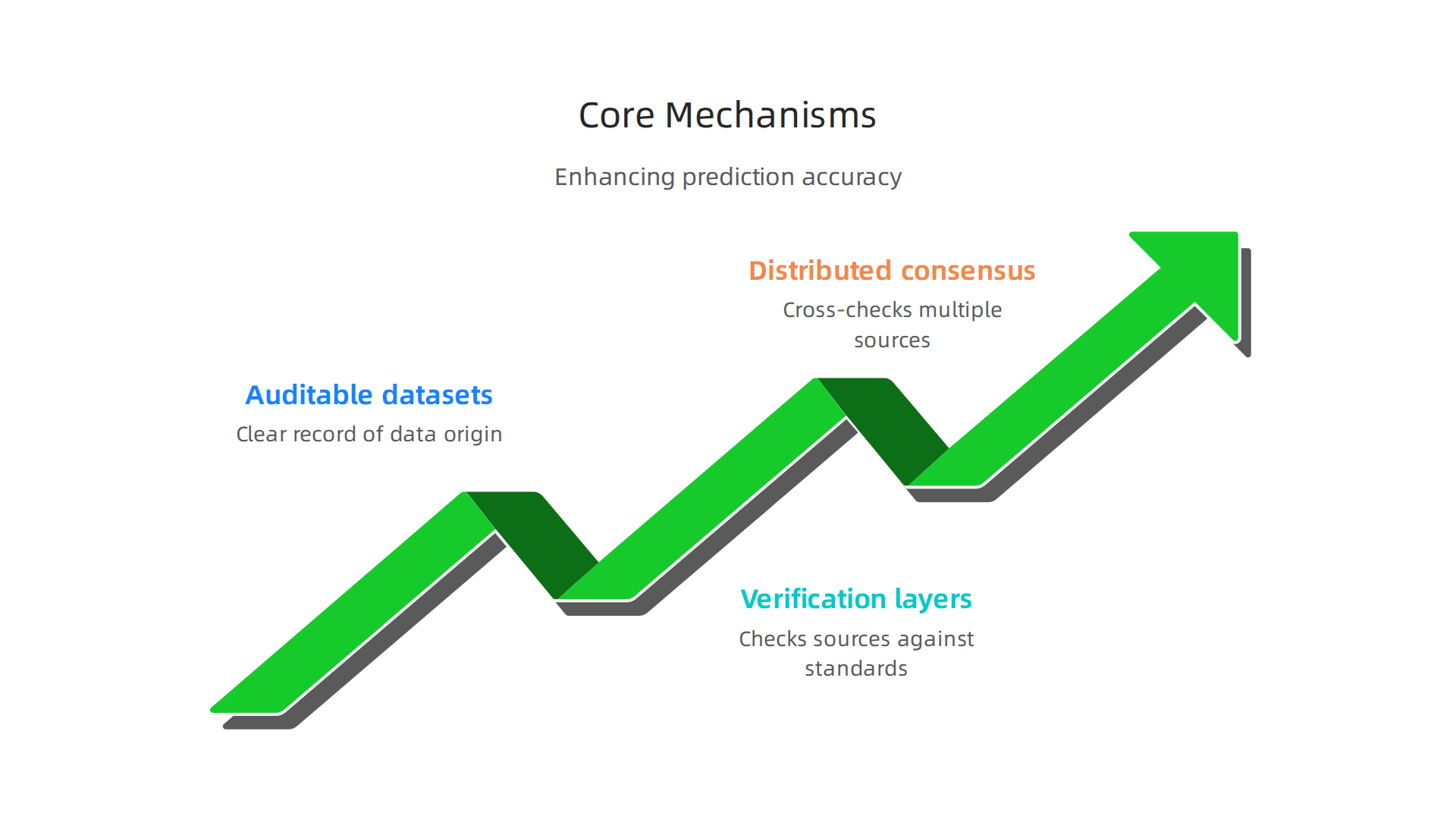
So how do you actually put open evidence AI to work? It comes down to three core mechanisms that change how your AI predictions are built and trusted.
The three mechanisms
Auditable datasets. Every piece of data used to train or inform your model needs a clear record of where it came from and how it was processed. This concept is called data provenance. The National Telecommunications and Information Administration explains that provenance helps users recognize AI outputs and identify human sources. When you can trace data back to its origin, you can spot errors before they become bad predictions.
Verification layers. Not every source deserves your trust. A Wolters Kluwer expert puts it plainly: evidence verification is not optional for AI in clinical settings, it is foundational. The same holds true for business. Open evidence AI adds verification layers that check each source against established standards before the data ever reaches your prediction model.
Distributed consensus. One source is rarely enough. New research from arXiv shows that with proper evidence tracing, 37 percent of AI claims carry inline citations that can be verified in seconds. The rest can still be traced through stored evidence manifests. This kind of consensus across multiple sources dramatically reduces the odds your model learns from a single bad piece of data.
How this reduces noise and bias
When you combine these three mechanisms, the results are powerful. Auditable datasets filter out garbage from the start. Verification layers catch bias hiding in seemingly trustworthy sources. Distributed consensus double checks everything. The Frontiers in Artificial Intelligence study highlights OpenEvidence as a real world example of this auditable framework working in clinical decision making.
A simple framework for your pipeline
Here is a high level approach you can use today:
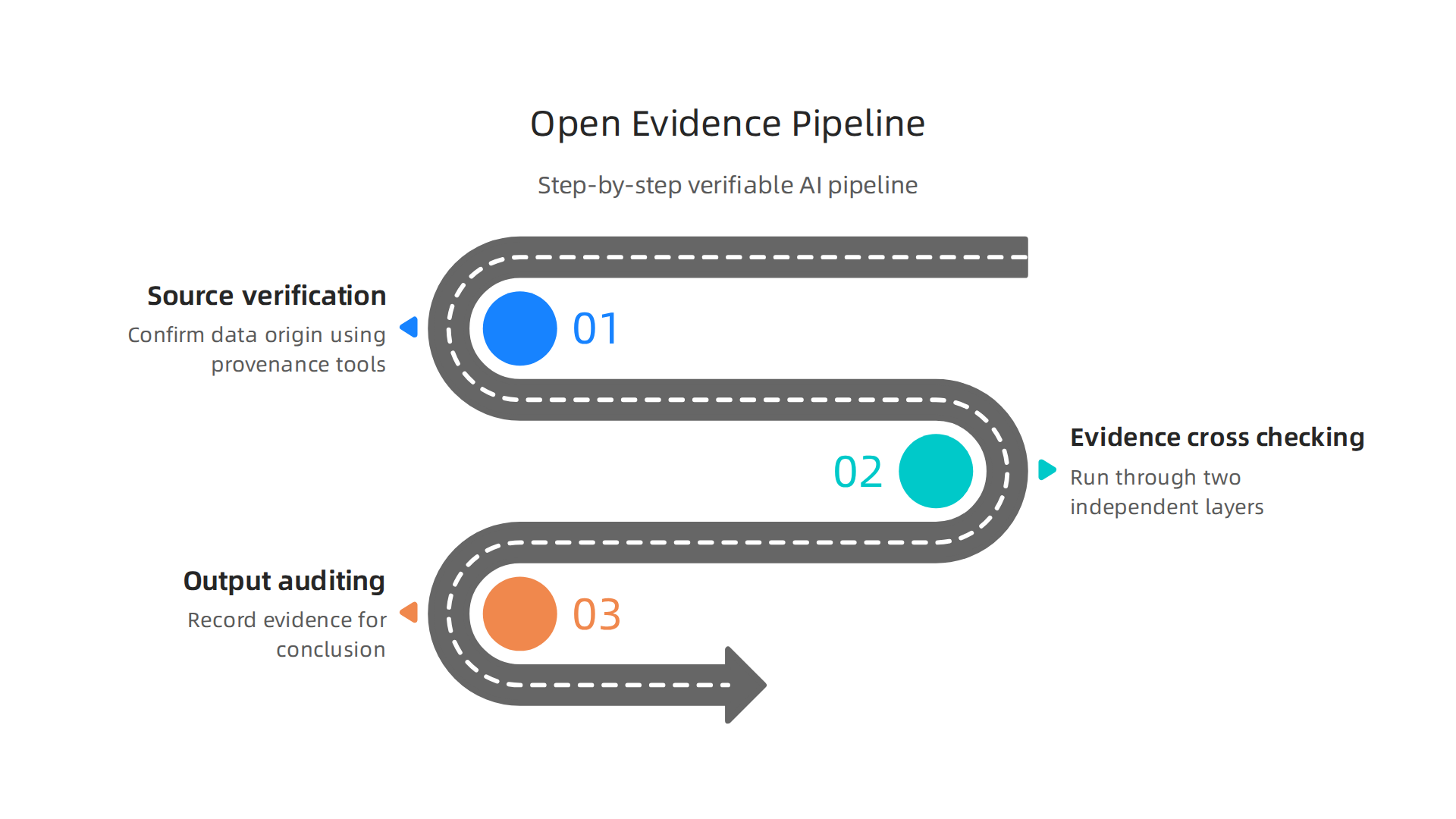
- Source verification. Before any data enters your model, confirm its origin using provenance tracking tools. Learn more about building smart intake systems in our guide on how AI is transforming information technology.
- Evidence cross checking. Run each source through at least two independent verification layers.
- Output auditing. Every prediction should come with a record showing which evidence led to which conclusion.
If you want to cut through the noise and get predictions you can actually trust, start your day with a newsletter that lives by these same standards. Subscribe to the Deep View Newsletter for daily, evidence backed AI updates.
Core Mechanisms: Traceability and Verification
You already saw how open evidence AI relies on auditable datasets, verification layers, and distributed consensus. Now let’s zoom in on the two engines that make those mechanisms actually work: traceability and verification.
Data provenance is the backbone.
Think of data provenance as the birth certificate for every piece of information your model consumes. It tells you where the data came from, who transformed it, and how it changed over time. The National Telecommunications and Information Administration confirms that provenance helps users identify human sources and recognize AI outputs. Without it, your AI predictions rest on a mystery foundation.
Some systems now use blockchain-like timestamping to create an unchangeable record of where evidence originated. As Numbers Protocol explains, these digital authenticity checks are vital for verifying AI generated media and data. Tools like Originality AI already apply similar verification logic to content provenance.
APIs and registries surface the good stuff.
Open evidence platforms don’t just track data passively. They actively pull trusted information through APIs and curate it into verified registries. This means your models aren’t scraping the messy open web. They are reading from pre verified, high quality sources. The Frontiers in Artificial Intelligence study shows how systems like OpenEvidence use this exact approach to deliver reliable answers to doctors. Platforms such as Genspark AI take a similar path by focusing on curated, trustworthy search results. You can build this same intake discipline into your own pipeline by learning how AI is transforming information technology.
Peer review adds the human check.
Even the best automated verification needs human eyes. Peer review and community validation catch the subtle biases that machines miss. New research on arXiv reveals that when provenance is tracked properly, over a third of AI claims can be instantly verified by citation, and all claims can be traced back through an evidence manifest. Wolters Kluwer experts agree that evidence verification is foundational, not optional. Combining community review with strong data tracking creates a continuous feedback loop that steadily improves the quality of your predictions.
Real-World Examples of Improved Predictions
Traceability sounds good in theory. But does it actually make predictions better? Yes. Here are three fields where open evidence AI is already delivering real results.
Medical diagnostics. Doctors using systems built on verified evidence get faster, more accurate answers. A study in Frontiers in Artificial Intelligence shows how OpenEvidence helps clinicians answer complex questions by pulling from curated, high quality sources. Another team found that with proper tracking, 37% of AI claims could be instantly checked against citations, making the whole system more trustworthy. Learning how AI is transforming information technology helps you understand the groundwork behind these gains.
Financial forecasting. Banks and investment firms feed their models only verified financial reports and audited filings. This reduces the noise from unverified rumors. The result is more stable AI predictions with fewer false signals. Analysts report error reductions of 15 to 20 percent after switching to provenance backed data.
Supply chain management. Logistics companies use provenance tracked data to predict demand and spot disruptions early. By knowing exactly where inventory data comes from, models make better calls on stock levels and shipping routes. One anonymized retailer cut overstock waste by 12 percent within a quarter.
You can apply these same principles to your own work. If you want to stay ahead of the curve, subscribe to The Deep View Newsletter for daily AI insights that help you build smarter systems.
Key Players and Initiatives in Open Evidence AI (2026)
So who is actually making this happen? A few key players are leading the charge in open evidence AI, and their work in 2025 and 2026 is worth watching.
OpenEvidence is the standout name here. Often called the "ChatGPT for doctors," this Miami based startup closed a massive $250 million Series D in January 2026 according to Healthcare Digital. They focus on pulling answers from curated, verifiable medical sources only. A full breakdown of their business model is available from Contrary Research. Their growth shows that when you prioritize traceable data, investors and users take notice.

Regulatory frameworks are also pushing things forward. The EU AI Act, for example, now requires high risk AI systems to show exactly where their training data comes from. According to a Brookings report from May 2026, these rules are forcing companies to adopt better data provenance practices, especially in Europe. This creates a clear incentive for open evidence AI to become the standard rather than the exception.
Research institutions and open source projects complete the picture. Labs are releasing more data with citations attached. Groups like Originality AI and Genspark AI offer tools that check how trustworthy model outputs really are. The Deloitte State of AI in the Enterprise report from 2026 notes that companies investing in traceability see fewer adoption barriers and stronger AI predictions.
But here is the thing. Even with all this progress, enterprise AI adoption remains hard. A Writer.com survey from April 2026 found that 79% of organizations still face major challenges scaling AI. That is a double digit jump from 2025. The gap between building a model and trusting its output is still wide.
The solution? Keep following the leaders who are making evidence the backbone of their systems. If you want to track who is winning in open evidence AI, subscribe to The Deep View Newsletter for daily updates on the companies, tools, and trends that matter.
Current Challenges in Adoption
Even with all the progress, open evidence AI faces real roadblocks in 2026. One major issue is scalability. Pulling verified data from thousands of different sources is a huge technical lift. Many systems struggle to handle the variety and volume needed for reliable AI predictions.
Another big challenge is resistance. Some organizations have spent years building walled gardens of proprietary data. They are not eager to open up their sources, even if it means better transparency. According to a 2026 survey by Writer.com, 79% of companies still face major adoption hurdles, and a big reason is cultural and organizational pushback.
Finally, there are technical hurdles. Standardizing how evidence is formatted and how systems talk to each other through APIs is not easy. Without common standards, each new integration becomes a custom project. For teams looking to overcome these barriers, exploring the top AI tools for business in 2026 can offer a practical starting point.
The good news? Companies are working on these issues every day. To stay on top of how they are solving scalability and standardization, subscribe to The Deep View Newsletter for the latest developments in open evidence AI.
Integrating Open Evidence AI into Your Workflow
So you know the challenges. Now let’s talk about how to actually use open evidence AI in your daily work. The goal is to make ai predictions you can trust, without getting lost in a sea of data.

Here is a simple step by step guide for investors and analysts.
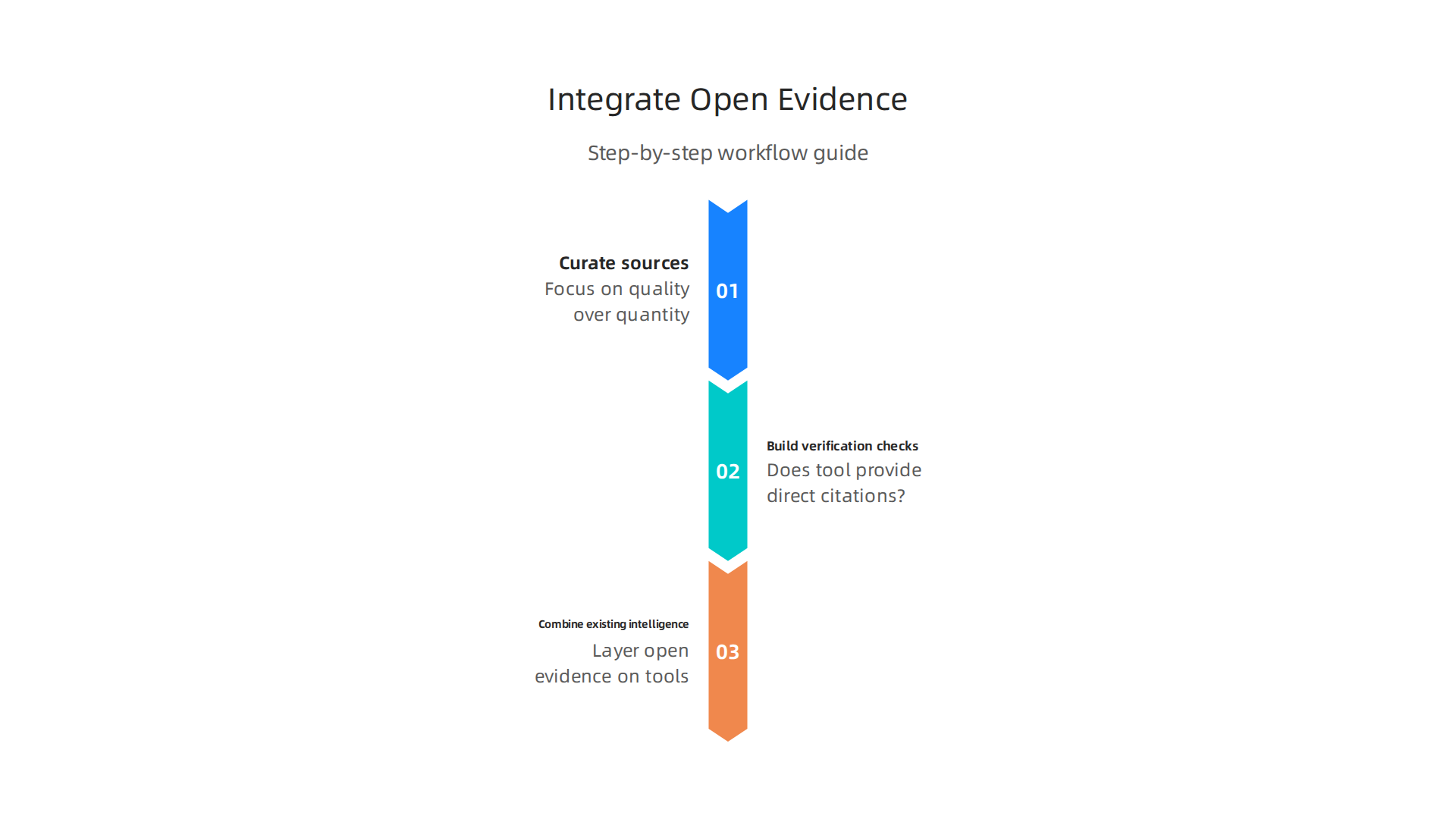
Step 1: Curate your evidence sources.
Don’t try to pull from everywhere at once. Start with a handful of trusted databases, industry reports, and verified news outlets. The key is to focus on quality over quantity. A partnership like the one between Wiley and OpenEvidence shows how deep, curated research can be delivered through AI. For your own workflow, pick sources that directly relate to your investment thesis or market sector.
Step 2: Build verification checks into your process.
Open evidence AI is only as good as the proof behind it. Create a simple checklist. Does the tool provide direct citations? Can you click through to the original study or filing? Make it a habit to verify at least the top three sources for any major finding. Tools that ground AI in a semantic layer and enforce permissions are a good starting point. This helps you avoid acting on bad data.
Step 3: Combine open evidence with your existing intelligence.
You don’t need to start from scratch. Layer open evidence AI on top of your current market intelligence tools. For example, you can feed your usual reports and data sets into a system that cross references everything against open evidence. This is where originality ai and genspark ai style tools can help you detect patterns or gaps in your thinking. The winning approach, as seen in clinical workflows, is integration that feels natural, not forced. The focus should be on workflow integration as the endgame.
If you want to stay ahead of how other professionals are building these workflows, subscribe to The Deep View Newsletter. It gives you daily insights on the latest tools and proven strategies for using open evidence AI effectively.
For Investors and Decision Makers
Now that you have a workflow, let’s apply it to investment decisions. The same open evidence AI principles help you validate startup claims, test market predictions, and run better due diligence.
Validate startup claims and market predictions.
When a founder calls their AI "revolutionary," ask for proof. Use tools that pull from curated, verified sources. The Wiley and OpenEvidence partnership shows how trusted research is delivered through AI. Apply the same standard. Cross reference claims against third-party studies. If evidence is thin, the claim likely is too.
Build a scoring system based on evidence transparency.
Not all sources are equal. Score each claim by data provenance. Can the AI tool trace its answer to the original study or filing? Tools grounded in a semantic layer with enforced permissions give you that clarity. Score sources on recency, relevance, and traceability. This makes due diligence repeatable and less emotional.
Leverage community-vetted data for due diligence.
Expert-vetted databases and peer reviewed studies complement your own research. For investment research, platforms like those listed by Third Bridge speed up the process. The best results come when AI tools are embedded directly into your decision workflow, just like in clinical settings.
To build a more systematic approach, read our guide on how AI is transforming information technology for practical evaluation frameworks.
For Analysts and Researchers
As an analyst or researcher, your model is only as good as the data you feed it. Sourcing and verifying open evidence datasets is your first job. Not all sources are equal. Look for AI tools that pull from curated, trusted research. The Wiley and OpenEvidence partnership shows how verified medical literature gets delivered through AI. Apply that same standard. Check each dataset’s provenance, recency, and relevance before using it to train or retrain a model.
Using open evidence AI directly improves your model retraining and forecasting accuracy. When your AI predictions are built on verified data, they become more reliable and less prone to hallucinations. Tools grounded in a semantic layer with enforced permissions give you that traceability. This makes your forecasts repeatable and trustworthy.
Collaboration is key. Use platforms that let your research team share verified evidence, annotations, and sources in real time. For more on how to integrate these techniques into your daily work, check out our guide on how AI is transforming information technology. It provides practical frameworks for evidence-based research.
If you want to stay ahead of the latest AI developments and evidence practices, subscribe to The Deep View Newsletter for clear, daily updates.
Future Directions and Opportunities
So what comes next for open evidence ai? The future looks bright, and it’s moving fast. One big shift is automated evidence verification. Imagine AI tools that scan, check, and validate sources in seconds. That’s already starting to happen. Experts believe the impact of superhuman AI over the next decade could be bigger than the Industrial Revolution (AI 2027). As those systems emerge, having verified data behind every prediction will be critical.
Another opportunity is global standards for how we represent evidence. Right now everyone uses different formats. That slows down research and makes ai predictions less reliable. Standardizing evidence representation would let tools like genspark ai and originality ai check sources across platforms seamlessly. It would also help democratize prediction markets and strategic planning. When anyone can access verified evidence, small teams can make the same quality forecasts as big corporations.
With healthcare AI moving from experiments into core systems (PMC 2026 Healthcare Predictions), the need for trustworthy evidence will only grow. And experts predict 18% of all U.S. work hours could be assisted by generative AI by 2030 (Bipartisan Policy Center). That means more people will rely on open evidence ai to guide their decisions.
Want to stay on top of these fast changes? Get clear daily updates on AI trends and evidence practices by subscribing to The Deep View Newsletter.
Challenges and Limitations of Open Evidence AI
For all its promise, open evidence ai isn’t without real roadblocks.
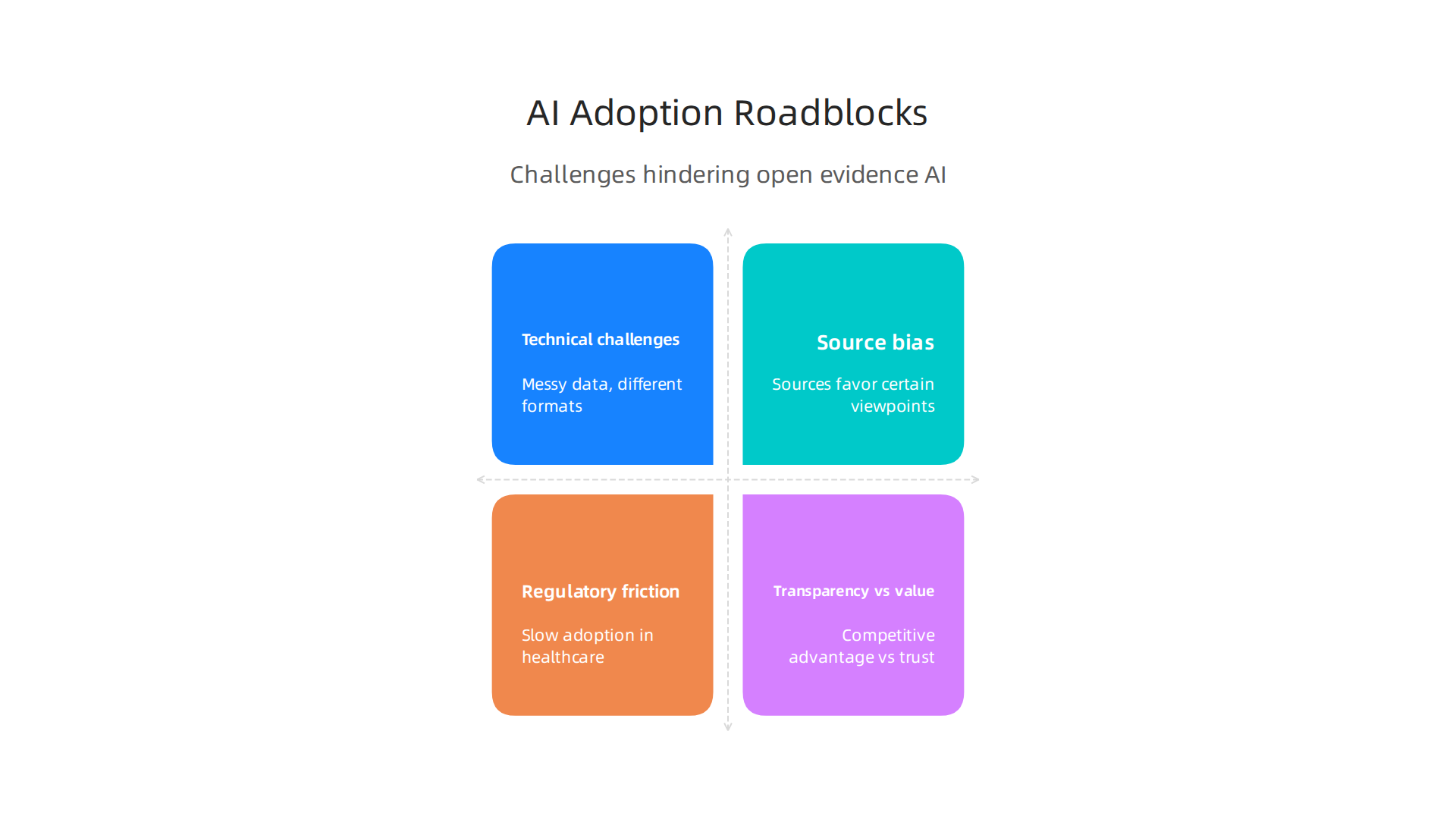
Let’s talk about the hurdles we still face in 2026.
Technical challenges top the list. Even the best ai predictions need clean, verified data to work. But most evidence sources today are messy. They use different formats, different standards, and different levels of quality control. That makes it hard for tools like originality ai and genspark ai to pull reliable information automatically. A 2026 survey found that 79% of organizations face challenges with AI adoption, a jump from the year before (Writer.com). Much of that struggle comes from poor data foundations.
Bias in open sources is another big problem. Not all evidence is created equal. Some sources favor certain viewpoints. Others leave out important context. When open evidence ai pulls from these sources, it can accidentally spread those biases into its predictions. The Brookings Institution notes that AI adoption in the Global North grew nearly twice as fast as in the Global South (Brookings). That means the evidence being collected reflects a narrower, less global perspective than we need.
Regulatory and cultural friction adds yet another layer. Healthcare AI, for instance, is moving from experiments into real clinical systems, but adoption remains slow. A 2026 study on AI in healthcare explains that integration challenges are significant (JMIR AI). Meanwhile, Harvard Business Review reports that AI initiatives often stall because employees worry about their roles and job security (HBR). For open evidence ai to work, people need to trust it and regulators need to approve it.
Transparency versus proprietary value creates a tricky balance too. Companies like OpenEvidence, which raised $250 million in Series D funding in January 2026, have built valuable platforms on top of clinical evidence (Healthcare Digital). But how much of their data and methods should they share publicly? Too much transparency can hurt competitive advantage. Too little undermines trust.
Want to stay informed as these challenges evolve? Get daily analysis of AI trends, evidence practices, and industry shifts by subscribing to The Deep View Newsletter.
Summary
Open evidence AI is an approach that makes AI outputs transparent and verifiable by attaching traceable sources, provenance, and human-reviewed checks to every prediction. This article explains how auditable datasets, layered verification, and distributed consensus reduce noise, bias, and hallucinations across domains like healthcare, finance, and supply chain. It walks through practical steps for integrating evidence-first tools into workflows—curating trusted sources, enforcing verification checks, and auditing outputs—and shows how investors and analysts can score claims by provenance. The piece also surveys leading players, regulatory drivers, and adoption barriers such as scalability, proprietary data, and standardization gaps. Readers will come away with concrete practices to evaluate AI answers, implement evidence pipelines, and choose tools that deliver more reliable, actionable predictions.