
Why the question ‘Who invented AI?’ still matters in 2026
When we talk about Artificial Intelligence today, many people might wonder, "who invented AI?" It’s easy to think there was one smart person who created it all, much like how we often credit single inventors for other big breakthroughs. But actually, the story of AI is much more like building a very large, complex house where many different builders added their skills and ideas over a long time. There isn’t just one inventor. Instead, AI came to be because many brilliant minds worked on different parts, slowly bringing together a new field of computer science.
This idea of many people contributing to AI’s birth is important, even now in 2026. For investors looking for the next big thing, for founders starting new AI companies, and for researchers pushing the frontiers of computer science, understanding this shared history is key.

Knowing the true origins helps us see how AI has grown and how it might keep changing.
For example, thinkers like Alan Turing laid down early ideas about machines that could "think" in the 1950s with his famous test The History of Artificial Intelligence: A Timeline from Turing to Today.

Then, the actual term "artificial intelligence" was first used at a special meeting at Dartmouth College in 1956 Artificial Intelligence (AI) Coined at Dartmouth.

These moments weren’t single inventions, but steps that built upon earlier thoughts and opened doors for new research.
Understanding these roots helps professionals truly grasp what AI is, how to use AI wisely, and how it’s different from simpler concepts like machine learning. This historical view provides a solid foundation for making smart choices in a world that is more connected to AI every day. Knowing where we came from helps us decide where to go next, and how to learn the right skills for future success in this fast-moving field. If you’re looking to deepen your understanding of this topic, you might find guidance in The Strategic Guide: How to Learn AI for Success in 2026.
With so much changing in AI daily, it can be hard to keep up. Get clear daily AI updates from The AI Newsletter Worth Reading.
Origins and Theoretical Foundations (Turing, Early Cybernetics, Logic)
Before the phrase "artificial intelligence" was even thought up, people were already dreaming about machines that could think.

Actually, the very first ideas that made AI possible go way back, long before any computer was built. It’s like building the foundation of a house before you even start drawing the blueprints for the rooms. These early ideas were about logic, how things compute, and how machines might control themselves.
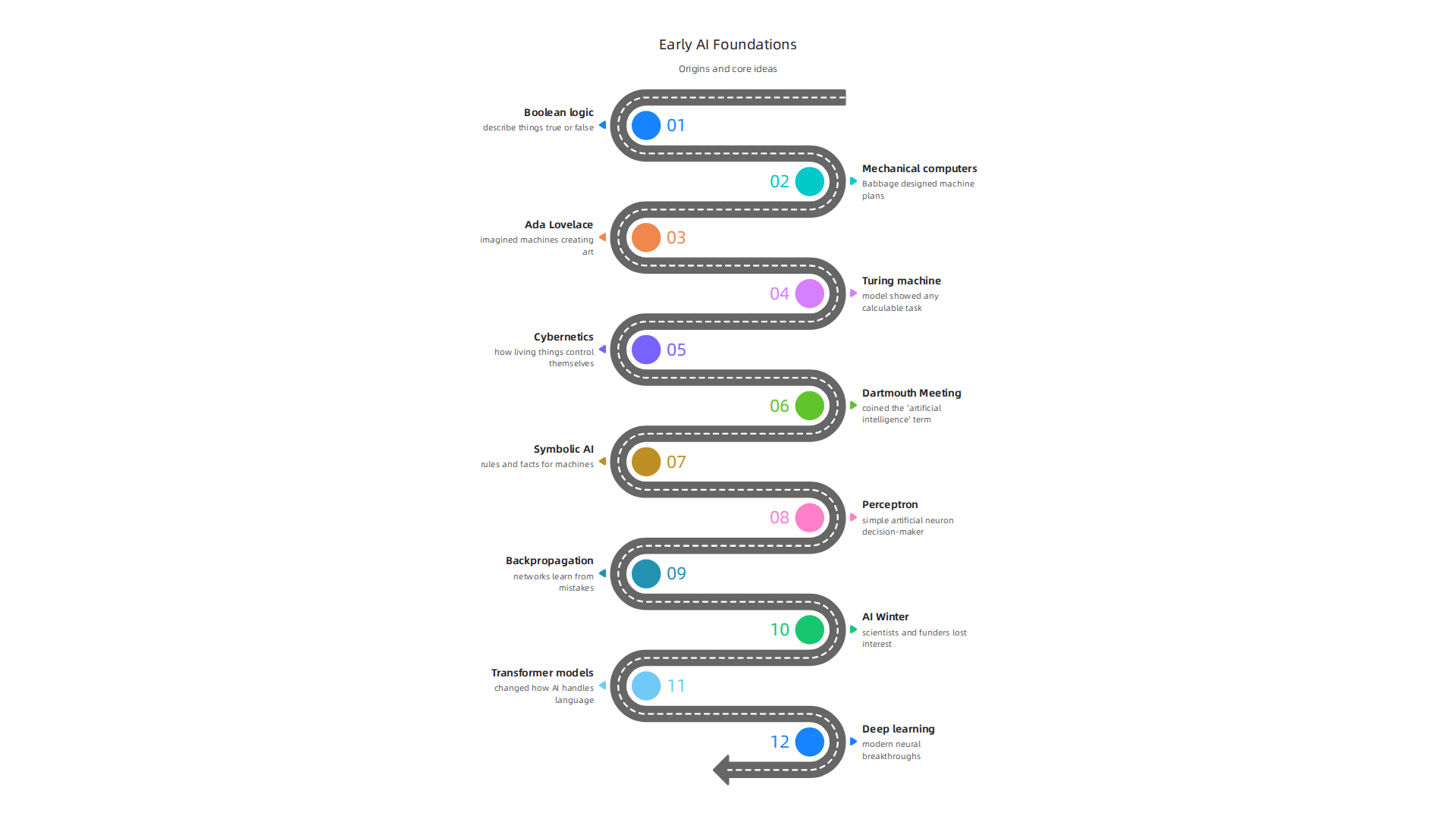
One important step came from thinkers like George Boole in the 1800s. He created a system of logic, called Boolean logic, that lets us describe things using just "true" or "false." This simple idea turned out to be super important for computers, as they work by turning things into "on" or "off" signals. This early way of thinking about logic helped set the stage for how computers would one day process information and make decisions, creating part of the framework for who invented AI, indirectly History of artificial intelligence.
Then, in the mid-1800s, people like Charles Babbage designed plans for mechanical computers. His helper, Ada Lovelace, even wrote about how these machines could do more than just math. She imagined them following long lists of instructions, which we now call algorithms, to create things like music or art. Her insights showed how machines could be programmed to do many different tasks, which is a core idea in modern AI.
Moving closer to the actual birth of AI, Alan Turing, whose famous test was mentioned earlier, also did very important theoretical work in the 1930s. He came up with the idea of a "Turing machine." This wasn’t a real machine back then, but a mental model that showed how any problem that can be solved step-by-step could be done by a very simple device. This concept of "computability" was huge because it proved that machines could, in theory, perform any calculable task. It gave researchers a clear idea of what computers could actually achieve, pushing the frontiers of computer science.
Around the same time, a field called cybernetics started to grow. Cybernetics looked at how living things and machines control themselves and communicate with their surroundings. Think about how your body keeps itself warm or how a thermostat controls a room’s temperature. These studies helped scientists understand how intelligent behavior might come from feedback loops and self-regulation, providing more puzzle pieces for how to use AI in smart systems.
These early thoughts about logic, computation, and self-control were crucial. They were the deep roots that allowed the field of artificial intelligence to sprout and grow into what it is today in 2026. Without these strong foundations, the amazing AI tools we use now wouldn’t exist. Understanding this history helps us truly appreciate the complexity and evolution of machine intelligence, and how it continues to transform our world. You can learn more about how these historical ideas connect to today’s world by exploring How AI is Transforming Information Technology.
Symbolic AI and the logic era: rules, search, and the Dartmouth moment
After all those early ideas about logic and how machines could work, it was time for a big step. This big step happened in the summer of 1956. A small group of smart scientists got together at Dartmouth College in New Hampshire.
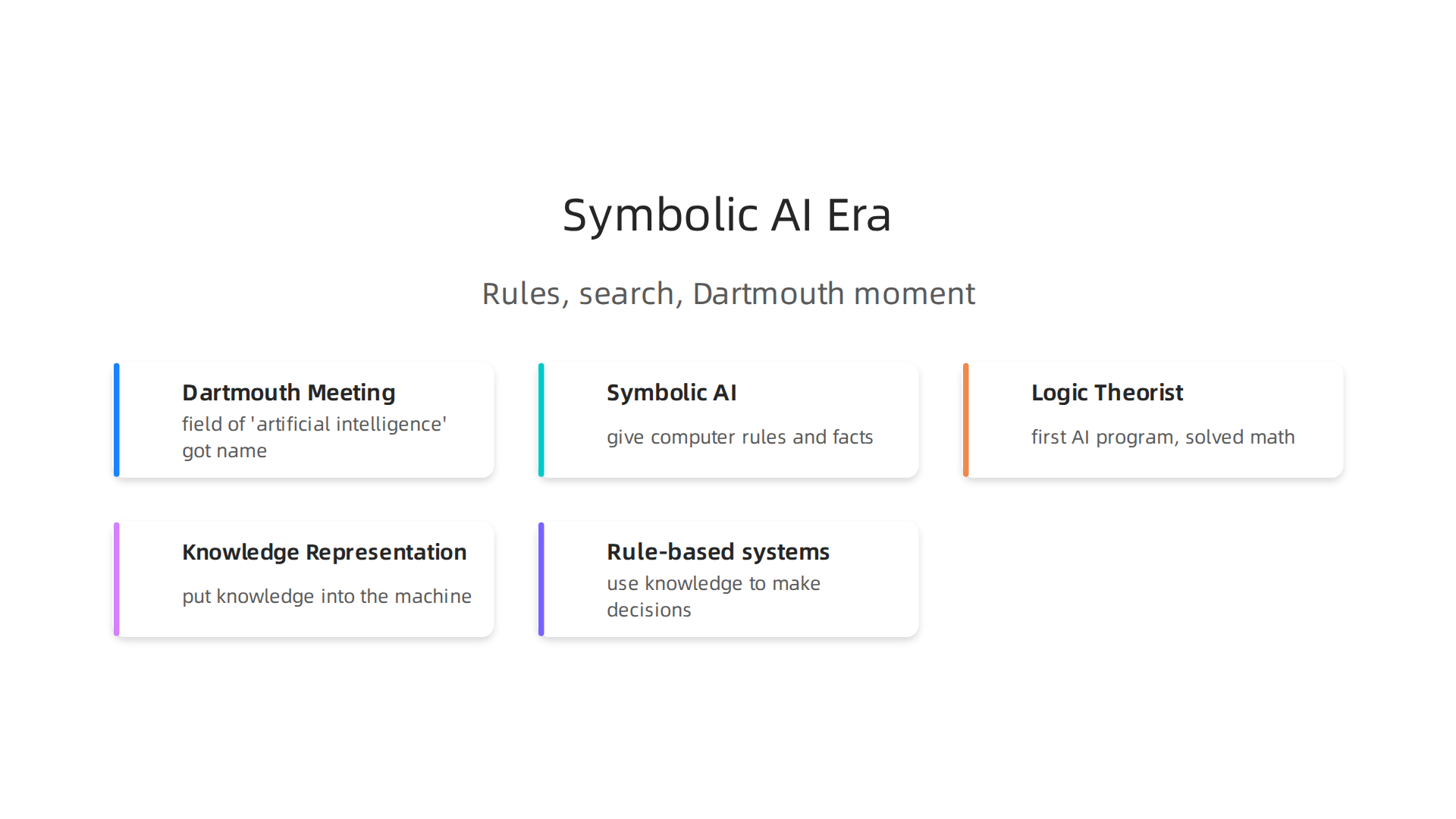
This meeting was very important because it was where the actual field of "artificial intelligence" got its name Artificial Intelligence (AI) Coined at Dartmouth. John McCarthy, one of the people there, came up with the name, and it stuck. This is often seen as the moment who invented AI as a recognized field of study.
At this meeting, and for many years after, a way of thinking about AI called "symbolic AI" was very popular. Imagine you want to teach a computer to play chess. With symbolic AI, you would give the computer a lot of rules, like "A knight moves in an L shape" or "If your king is in danger, move it to safety." You would also give it facts, like "The pawn is on square E2." The computer would then use these rules and facts to make decisions, much like how we use our own knowledge and rules to solve problems. This approach focuses on making machines think through logic and clear steps, like solving a puzzle. These early AI systems were designed to represent knowledge using symbols and then manipulate those symbols using rules Symbolic AI dominance in early AI landscape.
One of the first AI programs, called Logic Theorist, was shown at the Dartmouth workshop. It could solve math problems using logical steps, much like a person would. This showed how machines could do more than just simple calculations. They could actually follow rules to figure things out. This type of AI was all about "knowledge representation" and "rule-based systems." Basically, you put all the knowledge into the machine in a way it could understand, and then you gave it rules on how to use that knowledge.
After the Dartmouth meeting, different ways of doing AI started to grow. Some researchers kept focusing on these rule-based, symbolic systems. They believed that by giving computers enough rules and facts, they could make truly intelligent machines. Other researchers started looking at how machines could learn from data, which was a new direction and would eventually lead to what we call machine learning today. These different ways of thinking about how to use AI marked the start of various paths in the frontiers of computer science.
Understanding these early steps helps us see how the idea of intelligence in machines has grown. It also makes you wonder about the journey from those simple rule-based systems to the very complex AI tools we have in 2026. If you want to dive deeper into how these foundational ideas have shaped what’s possible now, you might find a guide on the AI innovation guide to strategy measurement and frameworks helpful.
The world of AI is always changing, and it’s important to stay up to date. Get clear daily AI updates from The AI Newsletter Worth Reading.
Connectionism and neural networks: perceptrons, backpropagation, and the lull
While some smart folks after the Dartmouth meeting were busy with symbolic AI, using rules and facts to solve problems, others explored a different path. This path looked at how the brain works, trying to make machines learn like humans. This idea is called "connectionism" or "neural networks"
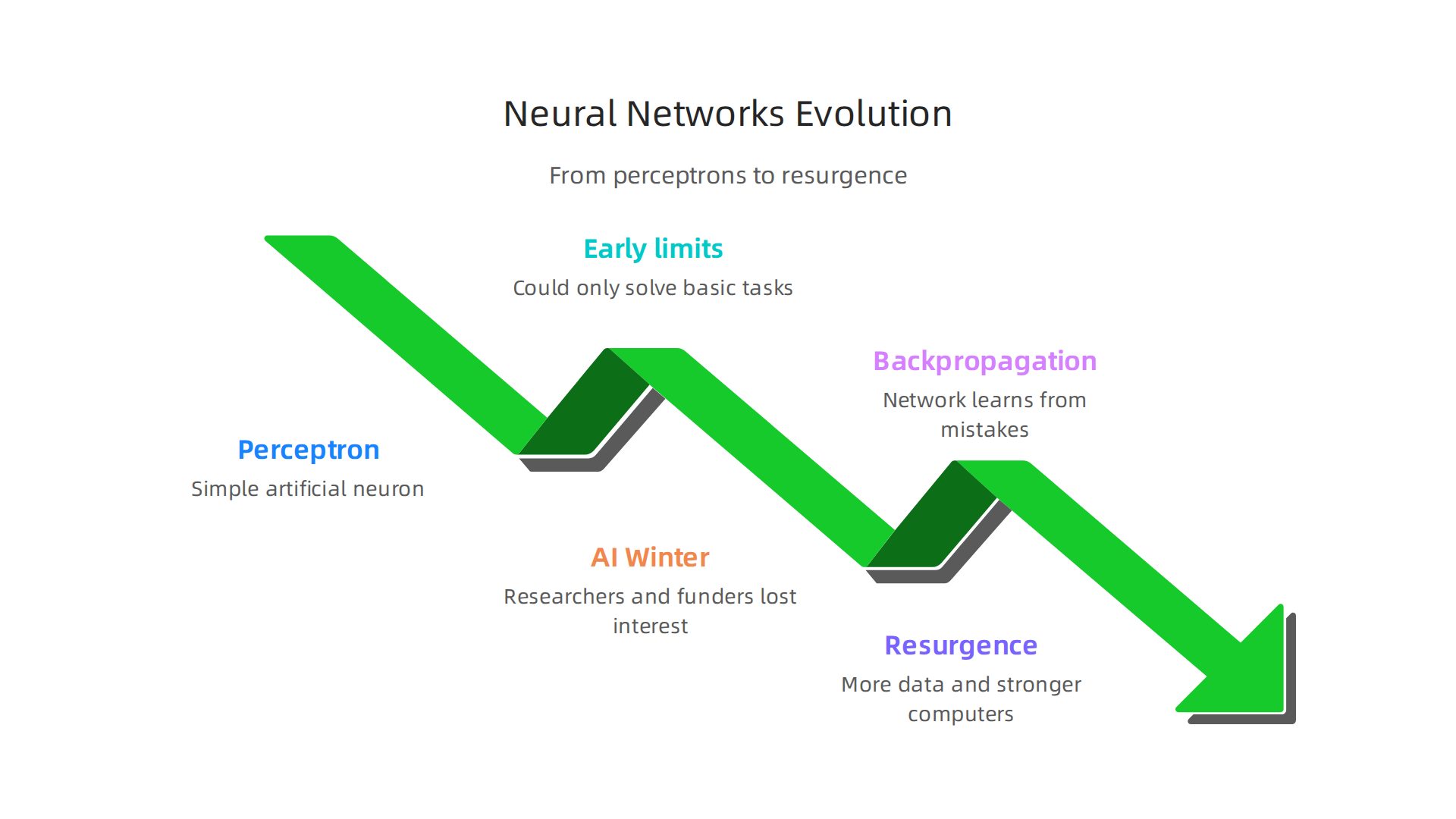
History of Computing: Neural Networks. Instead of giving a computer a list of rules, you’d show it lots of examples and let it figure out the rules on its own. It’s a key part of understanding the difference between AI and machine learning.
One of the earliest and most important ideas in this area was the "perceptron." Frank Rosenblatt invented the perceptron in 1957. Think of a perceptron as a very simple artificial neuron, like a tiny decision-maker History Of Neural Networks and Deep Learning.

It could take in some information, weigh it, and then decide something, like "yes" or "no." For example, you could train a perceptron to tell the difference between pictures of apples and oranges by showing it many examples. This was a big deal because it showed that machines could learn from data, not just follow strict rules given by a human.
However, these early neural networks, like the simple perceptron, had some big problems. They could only solve very basic tasks. For more complicated problems, they just didn’t work. For instance, a single perceptron couldn’t solve a simple "XOR" logic problem. This discovery, made public in 1969, cast a shadow over neural network research. Many scientists and funders lost interest, leading to what some call the "AI winter" for this type of research History of artificial neural networks. Research into neural networks slowed down a lot during the 1970s and early 1980s. People started to think that the idea of making computers learn like brains might not be practical.
But the story didn’t end there. In the mid-1980s, a breakthrough called "backpropagation" brought neural networks back into the spotlight. Backpropagation is a clever way for a neural network to learn from its mistakes. If the network gives a wrong answer, backpropagation helps it figure out which connections in its "brain" need to be adjusted to get closer to the right answer next time History and Development of Neural Networks in AI. This algorithm was actually created earlier, but its importance was rediscovered and published in 1986, ending the "first Dark Age of Neural Networks" and starting a new wave of interest A Brief History of AI with Deep Learning.
This new understanding, along with computers becoming much more powerful and able to handle huge amounts of data, completely changed what was possible. Suddenly, these connectionist approaches could tackle much more complex problems. This resurgence showed the world that learning from data was a powerful way to make AI. It was a major step forward in the frontiers of computer science and laid the groundwork for the advanced AI tools we see in 2026. Understanding these foundations is key to seeing how AI is transforming information technology today.
Statistical learning, data-driven methods, and the shift to probabilistic AI
The re-discovery of backpropagation and the rise of powerful computers were huge, but something else big was also happening. AI was changing from relying mostly on fixed rules to using "statistical learning." For a long time, AI was mainly about "symbolic AI," where humans gave computers strict rules to follow, like a recipe AI Watch Historical Evolution of Artificial Intelligence. Think of it like telling a child exactly how to sort blocks by color and shape.
But as the world got more digital, a lot more data became available. This meant computers could start learning from examples, much like how children learn by seeing many different things. This shift from rule-based AI to data-driven AI is a key part of understanding the difference between AI and machine learning.

Machine learning is a big part of how statistical AI works.
In the 1990s and early 2000s, this new way of thinking gained a lot of traction. Instead of giving AI a long list of rules, researchers fed it huge amounts of data. The AI would then find patterns in that data all on its own. This led to "probabilistic modeling," where AI uses chances and likelihoods to make decisions instead of rigid "yes" or "no" rules. This helped AI deal with real-world problems that are often messy and uncertain. Methods like "kernel methods" also became popular. These are clever ways for AI to find complex patterns in even very complicated data sets.
Another big change was the use of "evaluation benchmarks." These were like standard tests where different AI programs could compete. Researchers would create a task, like recognizing handwritten numbers or translating languages, and then see which AI could do it best. These benchmarks helped everyone see what worked and what didn’t, pushing the "frontiers of computer science" forward much faster. It created a healthy competition that improved AI quickly.
With more data and better ways to test AI, the focus of research and industry changed. Companies started to see how they could use these data-driven methods for many useful things. For example, statistical AI became good at understanding what people say, figuring out if an email is spam, or recommending products you might like. This period paved the way for the amazing AI tools we use every day in 2026, showing that the idea of "who invented ai" is less about a single person and more about a long, shared journey of discovery. To keep up with how AI is developing today, it helps to understand these key shifts.
Get clear daily AI updates from The Deep View Newsletter. The AI Newsletter Worth Reading
Deep learning and modern breakthroughs: architectures, scale, and practical impact
The journey of AI didn’t stop with statistical learning. After the 2000s, a big change was on the horizon: deep learning. This was like giving AI a turbo boost, taking the ideas of neural networks, which had been around for a while, and making them incredibly powerful. While concepts like neural networks had existed since the 1950s with things like the Perceptron History Of Neural Networks and Deep Learning, they often faced challenges that limited their use.
The real "resurgence" of neural networks and deep learning started gaining speed around 2010. People began calling the 2010s "the decade of deep learning" because of all the amazing progress
The 2010s: Our Decade of Deep Learning / Outlook on the 2020s. This new wave of AI used "deep" neural networks, which just means they have many layers. Imagine a cake with many layers; each layer helps the AI learn more complex things.
Several key ideas made deep learning take off:
- Better Algorithms: While backpropagation, a way to train neural networks, was rediscovered in the 1980s History and Development of Neural Networks in AI – Codewave, new tricks were found to make it work much better for deeper networks.
- New Architectures: Researchers created special kinds of deep networks for different tasks.
- Convolutional Neural Networks (CNNs) became super good at understanding pictures. They could spot objects, faces, and even tell if a cat was in an image.
- Recurrent Neural Networks (RNNs) were great for things that have a sequence, like words in a sentence or notes in music.
- Later, Transformer models arrived and completely changed how AI handles language, allowing for much smarter understanding and generation of text. These are the building blocks for many modern AI models you hear about today A Survey of Model Architectures in Information Retrieval.
But smart algorithms weren’t enough. Two other big things made deep learning truly powerful:
- More Data: The world was generating tons of digital information. Deep learning models needed this huge amount of data to learn effectively, much like a child needs many examples to understand a new concept.
- Stronger Computers: Graphics Processing Units (GPUs), which were first made for video games, turned out to be perfect for the intense math needed to train deep neural networks. This meant AI could crunch through vast datasets much faster than before.
This combination of clever algorithms, massive datasets, and powerful computers led to incredible breakthroughs. Suddenly, AI could do things that seemed like science fiction just a few years earlier.
Immediate Effects and Practical Impact
The impact of deep learning was immediate and widespread:
- Real-world Applications: We saw huge jumps in areas like image recognition, where AI could recognize objects in photos with near-human accuracy. Natural Language Processing (NLP) also improved, leading to better translation tools and voice assistants. Many of the helpful AI tools we use today, like smart assistants on our phones or the AI that helps filter spam from our emails, come from these advancements. Learning how to use AI effectively has become a key skill in 2026.
- Industry Investment: Companies quickly realized the potential. Tech giants and startups alike poured money into deep learning research and development. This led to a boom in AI products and services across many industries, from healthcare to finance. Businesses now seek strategic AI adoption to boost their growth.
- Research Priorities: The success of deep learning shifted the focus of AI research. Scientists began exploring even more complex neural network architectures and ways to train them more efficiently. This pushed the frontiers of computer science forward at an amazing pace.
This era showed that the question of "who invented AI" isn’t about one person, but a long chain of discoveries, with deep learning marking a crucial chapter. The ability to learn from data at scale truly unlocked the potential of artificial intelligence, bringing us to the advanced AI systems of 2026.
The quick growth of deep learning models truly changed things, moving AI from research labs into the daily lives of many people. This shift brought about a huge wave of commercial interest, venture capital funding, and, naturally, attention from governments and lawmakers. It quickly became clear that the question of "who invented AI" was no longer just about scientists in labs, but about an entire ecosystem of companies, investors, and policymakers.
The Rush to Commercialize AI
By the mid-2010s, with clear successes in areas like image recognition and language processing, businesses saw the massive potential of AI. Money started pouring in. Tech companies began buying up smaller AI startups, and new companies focused solely on AI solutions popped up everywhere. This led to a boom in AI products and services that we use every day, from smarter customer service chatbots to tools that help doctors find diseases faster. The 2026 AI Business Predictions from PwC highlight how important focused strategies and responsible innovation are for businesses using AI today 2026 AI Business Predictions – PwC.

Venture capitalists, who invest money in new businesses, poured billions into AI companies, hoping to find the next big breakthrough. This financial boost helped AI technology grow even faster, turning cutting-edge research into real-world applications at an amazing pace. For example, generative AI, which can create new content, reached almost 53% of people within three years, showing how quickly AI can be adopted Artificial Intelligence Index Report | Stanford HAI. Companies today are still looking for ways to use these tools to boost their productivity and save time, often turning to various top AI tools for business in 2026.
Policy, Ethics, and Governance Take Center Stage
As AI became more powerful and widespread, new questions arose. People started to worry about things like privacy, fairness, and how AI might affect jobs.

These worries led to ethical debates and pushed governments to think about how to manage this new technology.
In 2026, many countries and international groups are working on rules and guidelines for AI. For instance, reports like the New Jersey AI Task Force Report To The Governor provide expert advice and recommendations for how states can handle AI. The NIH has also created a Collaborative AI Assurance Research Laboratory, showing that government organizations are key in advancing AI standards and ethical rules NIH Collaborative AI Assurance Research Laboratory.
This push for rules and standards is about making sure AI is used safely and fairly. It’s about figuring out the best ways to ensure that AI helps everyone without causing harm. These discussions cover everything from how AI models are built to how they are used in sensitive areas like healthcare and finance. The goal is to build trust in AI systems and guide their development in a responsible way. This includes looking into how AI can be used for good, as highlighted in the AI for Good Impact Report 2nd edition, and understanding the wider impacts of AI on society.
The AI ecosystem in 2026 is a complex mix of rapid innovation, huge investments, and careful consideration of ethical guidelines. Staying informed about these changes is crucial for anyone interested in the world of artificial intelligence.
Want to keep up with the fast-changing world of AI, its breakthroughs, and its policies? Get clear daily AI updates from The AI Newsletter Worth Reading.
Summary
This article explains why the question