
Introduction: Why Computer Simulation Matters More Than Ever in AI
Imagine testing a self driving car without ever putting it on a real road. Or training a medical AI without a single patient. That is the power of computer simulation. In 2026, simulation technology is the hidden engine behind almost every major AI breakthrough. It allows developers to create safe, repeatable, and scalable environments where machine learning models can learn and improve without real world risks.

So what is computer simulation technology exactly? At its core, it is a computer program that uses mathematical equations to model a real system, then runs that model to see how it behaves. According to Britannica’s computer simulation overview, a simulation duplicates the functional relationships within a real system and presents the results as data. This definition might sound technical, but the idea is simple: you build a digital twin of something real, and you test it over and over.
For investors, founders, and analysts evaluating machine intelligence companies, understanding simulation is no longer optional. The companies that lead in AI are the ones that simulate better, faster, and more accurately. Simulation reduces costs, speeds up development, and unlocks possibilities that physical testing cannot match.
This guide gives you a research backed overview of computer simulation technology, its history, its key components, and why it matters strategically. We cover everything from the basics to the advanced concepts that power today’s AI engine.
To deepen your understanding of the broader AI landscape, check out our strategic guide to learn AI for success in 2026. And if you want to stay current with the fast moving AI world, consider The AI Newsletter Worth Reading, offering clear daily updates on the latest developments.
Now let’s dive into the fundamentals.
What is Computer Simulation? — Definition and Core Concepts
At its simplest, a computer simulation is a virtual model that copies how a real-world system behaves over time. You feed it data, press run, and watch what happens. According to the Built In definition of computer simulation, these programs use mathematical equations to model real-life scenarios and test many possible outcomes.
Think of it as a digital sandbox where you can experiment without breaking anything.
But not all simulations work the same way. They come in two main types based on how they handle chance and timing.
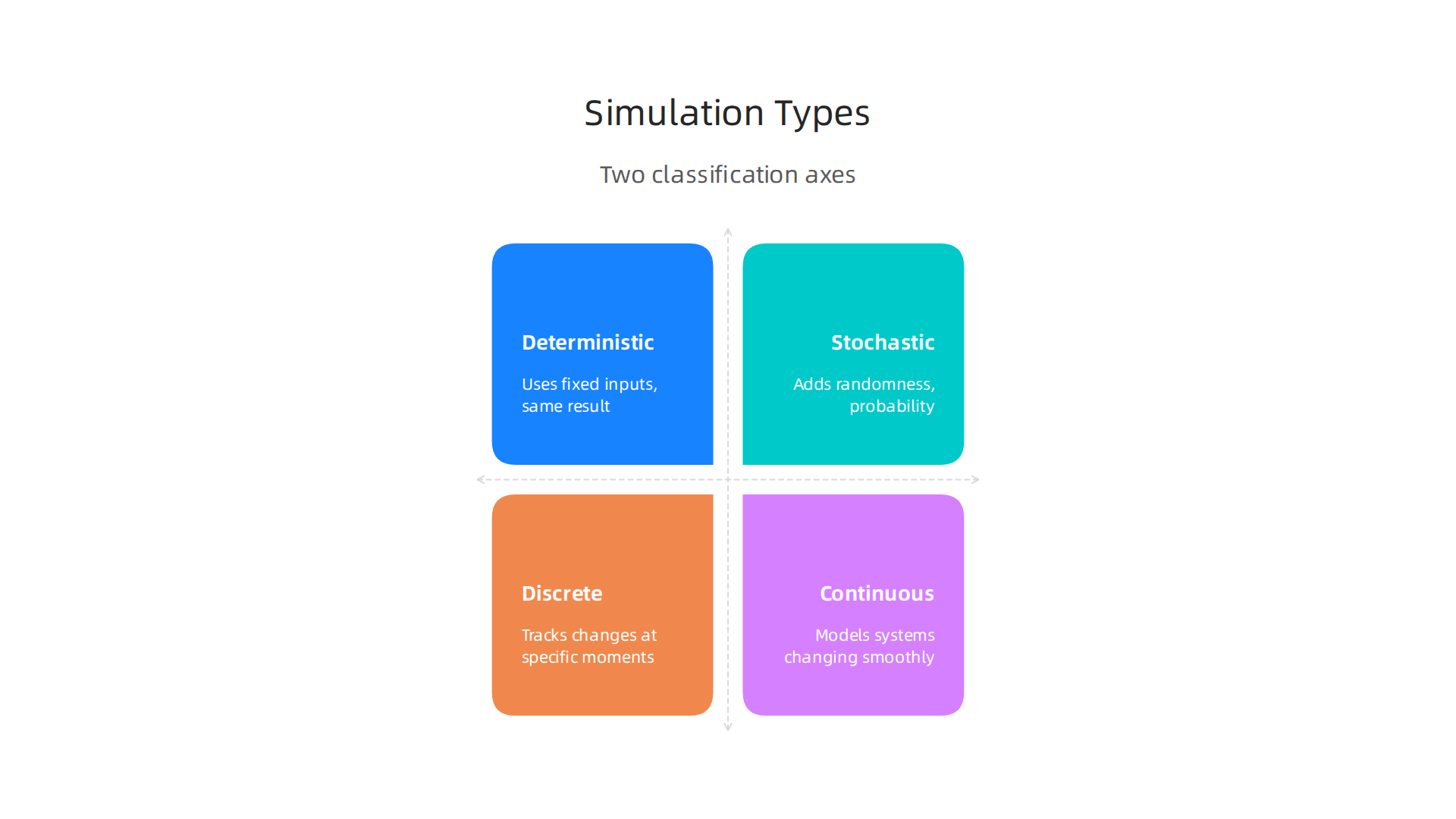
First, simulations are either deterministic or stochastic. A deterministic simulation uses fixed inputs and always gives the same result. A stochastic simulation adds randomness. For example, a weather forecast uses probability (stochastic), while a physics test for a bridge might use exact numbers (deterministic). The ScienceDirect overview of simulation types explains that stochastic models include random variables to mimic real-world uncertainty.
Second, simulations are discrete or continuous. Discrete-event simulation tracks changes that happen at specific moments, like customers arriving at a checkout line. Continuous simulation models systems that change smoothly over time, like water flowing through a pipe. Both types help engineers and scientists predict outcomes without costly physical tests.
These simulations are the foundation of advanced technology like digital twins. A digital twin is a living simulation that updates with real-time data from a physical object. For instance, a jet engine’s digital twin runs simulations alongside the real engine to predict maintenance needs. To see how simulation connects to broader AI trends, read our article on strategic AI adoption driving business growth.
Understanding these core concepts helps you see what is computer simulation technology really about. It is not just one tool. It is a method that blends math, computer science, and deep domain knowledge to create safe training grounds for AI models. If you want to stay on top of how simulation is reshaping machine intelligence, get The AI Newsletter Worth Reading for clear daily updates on the latest breakthroughs.
The Historical Evolution of Simulation Technology
You might not know this, but the roots of modern simulation stretch back to the 1940s. During the Manhattan Project, scientists needed to predict how nuclear chain reactions would behave. They could not run physical tests safely. So they created a new technique called the Monte Carlo method. This approach used random sampling to solve mathematical problems that were too hard for regular equations. It was the first time a computer was used at scale to model a real-world system. The full history of computer simulation on Wikipedia traces this exact moment as the birth point of modern simulation technology. This is a key part of understanding what is computer simulation technology and where it came from.
From there, the field grew fast. The 1950s brought better digital computers, making simulations faster and more useful. In the 1960s, graphical simulation appeared, letting researchers see their models instead of just reading numbers. Then came physics engines for gaming in the 1990s. That brought simulation into everyday life through video games like racing sims and flight simulators. These advancements in advanced technology allowed engineers to test everything from car crashes to airplane wings inside a computer. They saved millions of dollars and countless hours of physical testing.
The rise of AI engines changed everything again. Instead of just following fixed rules, modern simulations can learn and adapt. They become smarter the longer they run. This is where the real power lies. Simulations now produce huge amounts of training data for AI models, creating realistic environments where machines can learn safely without real-world risks.
To understand where we are today, it helps to know how we got here. The evolution of computer simulation from wartime math to AI training grounds connects directly to the rise of artificial intelligence itself. If you want to dig deeper into that connection, check out who invented artificial intelligence and see how the two fields grew together.
Key Components of Modern Computer Simulations
Understanding what is computer simulation technology means looking under the hood at what makes these models run. Three key pieces work together: hardware, software, and math.
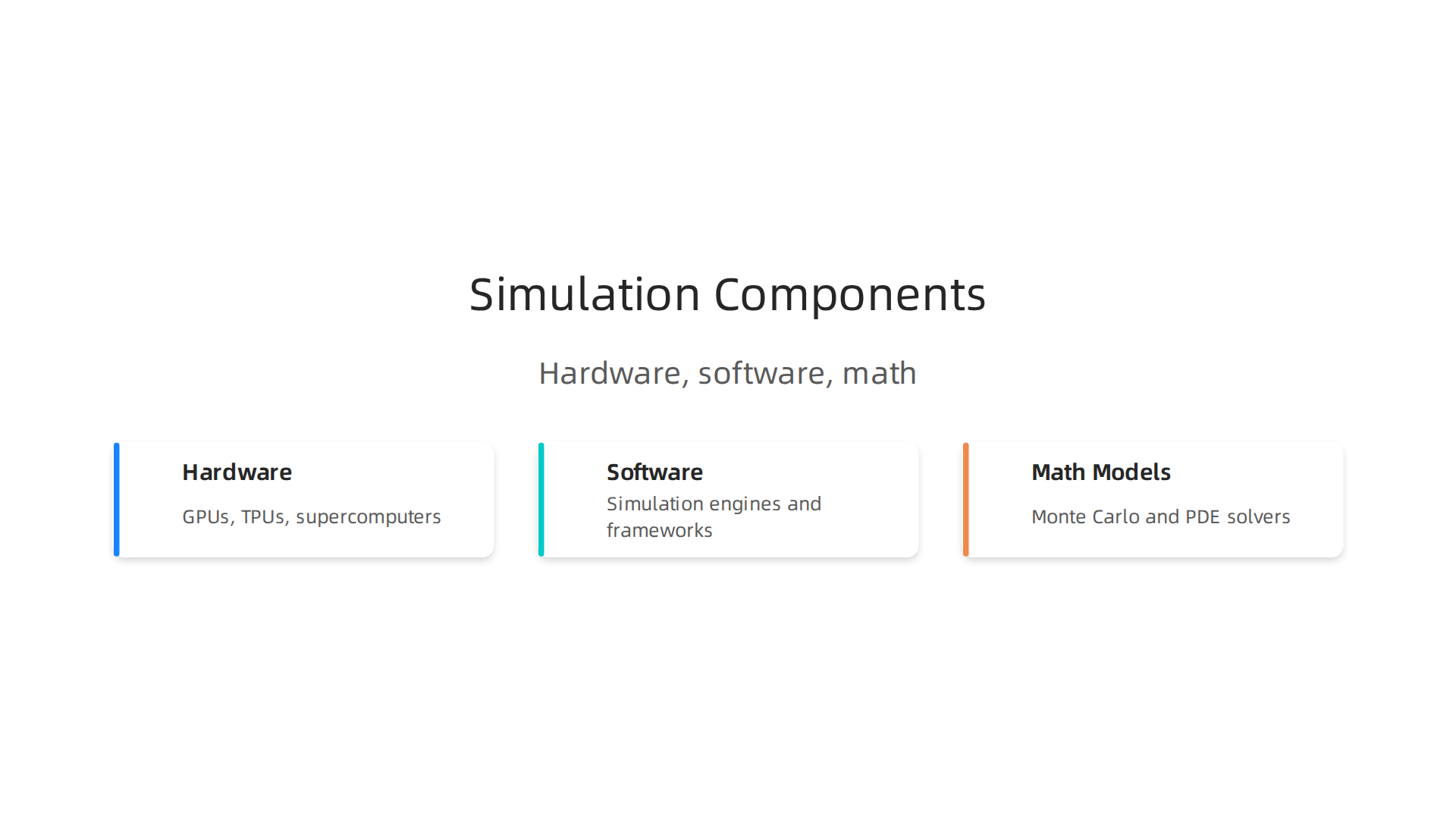
First, hardware. Modern simulations chew through massive amounts of data. That is where advanced technology like GPUs and TPUs come in. In 2026, running a simulation in software like SOLIDWORKS or Ansys Discovery requires serious graphics power.
For example, the detailed SOLIDWORKS 2026 System Requirements show that a high-end NVIDIA RTX Pro 6000 GPU and 128GB of RAM are recommended for large assemblies. Without that hardware acceleration, complex simulations would crawl.
Second, software frameworks like Ansys, Simulink, and open-source engines provide the backbone. They translate your problem into something the computer can solve, whether that is thermal analysis, fluid dynamics, or crash testing.
Third, the underlying math. Techniques like Monte Carlo methods (which we saw started simulation back in the 1940s) and partial differential equation solvers ensure accuracy. The mathematical models are what separate a good simulation from a bad one.
These three parts are the core of what makes simulations powerful. They let us test ideas in a virtual world before building anything real. If you want to stay ahead of the latest breakthroughs in AI-driven simulation and machine intelligence, subscribe to The AI Newsletter Worth Reading for clear daily updates. Also, learn how how AI is transforming information technology to see how simulation fits into the bigger tech picture.
Hardware: GPUs, TPUs, and Supercomputers
When you ask "what is computer simulation technology" at the deepest level, the answer always comes back to hardware. The most important piece? The graphics processing unit, or GPU. Unlike regular CPUs that handle tasks one after another, GPUs are built for parallel processing. They can crunch thousands of calculations at the same time. That is exactly what real-time simulation needs. For example, Mastercam 2026 R2 now runs GPU Simulation natively for complex CNC programming, and it requires a compatible GPU with at least 12GB of VRAM. Without that parallel power, simulations that take seconds today would take hours.
Then there is the TPU, or Tensor Processing Unit. Google built these chips specifically for AI workloads. They are optimized for the matrix math that powers deep learning models. In 2026, more simulation tools are using AI engines to speed up analysis. A TPU can train a surrogate model or run neural network predictions much faster than a general-purpose CPU. So if your simulation involves an AI-based solver, a TPU might be your best friend.
Finally, supercomputers. National labs like the Department of Energy (DOE) facilities run simulations so large they need custom hardware. For molecular dynamics, researchers use workstations with four or eight high-end GPUs to simulate drug interactions at the atomic level. These setups push the boundaries of what computers can do. The hardware inside them is a synonym for tech at its most extreme.
Understanding these hardware layers helps you see why simulation speed keeps improving. To stay ahead of how advanced technology like GPUs and TPUs drives innovation, learn more about how strategic AI adoption drives business growth.
Software: Simulation Engines and Frameworks
Hardware does the heavy lifting, but software tells it what to do. That is where simulation engines and frameworks come in. They are the brains behind any simulation. In 2026, these tools fall into three main types.
First, commercial engines. Programs like Ansys and Simulink are industry standards. Engineers rely on them for testing everything from car aerodynamics to embedded control systems. Many of these engines now use GPU acceleration to speed up calculations. One example is Mastercam’s breakthrough in native GPU simulation, which makes complex CNC programming much faster.
Second, open-source frameworks. These lower the barrier for researchers and hobbyists. Gazebo is popular for robotics simulation. OpenAI Gym helps train AI agents with reinforcement learning. Unity ML-Agents lets you create custom training environments for machine learning models. To see how AI is changing the wider tech world, check out how AI is transforming information technology.
Third, cloud-based platforms. AWS SimSpace Weaver and Azure Digital Twins let you run massive simulations on demand. You do not need to buy expensive hardware. You just pay for what you use. This makes advanced simulation accessible to smaller teams.
All these software tools rely on the hardware we covered earlier, and they keep pushing it forward. Simulation technology is evolving fast. Stay on top of the latest news with The AI Newsletter Worth Reading.
Mathematical Models and Numerical Methods
All that hardware and software has one job: to run mathematical models. So what is computer simulation technology really? It is math applied to real-world problems. A computer cannot just "guess" what will happen. It needs a set of equations that describe how things behave. Those equations are the mathematical model.
But real systems are continuous. A beam bends smoothly. Air flows in an invisible stream. To make these problems computable, engineers use numerical methods. Two of the most common are the finite element method (FEM) and the finite difference method (FDM). They break a continuous system into thousands or millions of tiny pieces, called elements or nodes. Then they solve simple equations for each piece and combine the results. That is how a program like SOLIDWORKS predicts stress in a car part. The 2026 SOLIDWORKS hardware recommendations provide specifics on the hardware needed for these calculations.
Another powerful approach is Monte Carlo simulation. Instead of solving equations directly, it uses random sampling to model uncertainty. You run the simulation thousands of times with slightly different inputs. Then you look at the range of possible outcomes. This method is popular in finance, risk analysis, and physics.
Finally, agent-based modeling simulates the actions of many autonomous agents. Each agent follows simple rules. When you let them interact, patterns emerge that you could not predict by looking at any single agent. This is used to study traffic flow, disease spread, and even social behavior.
If you are new to simulation and want to build your own models, check out how to learn AI for success. It will help you understand the basics of artificial intelligence and how it connects to the math behind simulation.
How Computer Simulation Powers Machine Intelligence
So where does all that math and hardware lead? Straight into the heart of artificial intelligence. When we ask "what is computer simulation technology" in the context of AI, the answer is clear: simulation is the engine that trains intelligent systems faster and safer than the real world ever could.
One of the biggest breakthroughs in 2026 is using simulation to create synthetic training data for reinforcement learning.
In reinforcement learning, an agent learns by trial and error. But training a robot to pick up objects in a real warehouse could take weeks and risk breaking expensive equipment. Simulation solves that. Engineers build a digital environment where the agent can practice millions of times without any physical cost. A recent study on an RL-based sim-real co-training framework showed that combining simulated and real data boosted real-world success rates by over 35 percent. That is a massive gain just from adding simulated practice.
Another powerful application is the digital twin. A digital twin is a virtual copy of a real system like a factory assembly line or a hospital patient monitoring setup. Sensors stream live data into the simulation. The AI engine inside the twin runs "what if" scenarios constantly. It finds ways to reduce energy use, predict breakdowns, or optimize workflows. This continuous monitoring and optimization is now common in manufacturing, logistics, and healthcare. Companies that adopt digital twins get early warnings and make smarter decisions without touching the real equipment.
Simulation environments also accelerate the development of autonomous systems. Self-driving cars learn to navigate thousands of virtual intersections before they ever hit a real road. Robots practice picking oddly shaped objects in simulated warehouses. By 2026, frameworks like NVIDIA Isaac Sim allow teams to train hundreds of robot instances in parallel, compressing months of learning into days. The result: safer, more capable machines that handle edge cases you cannot safely recreate in the real world. For a deeper look at how invisible navigational technologies power drones and robots, check out the latest analysis on navigational systems for smart cities.
These advances are changing what advanced technology can do. But they also create a flood of news and research you need to track. If you want to stay ahead of these fast-moving developments, getting clear daily AI updates from The Deep View Newsletter is a smart way to keep learning.
Simulation in Healthcare and Pharmaceuticals
You might wonder how new medicines get approved so quickly or how surgeons practice tricky procedures without risk to patients. The answer lies in computer simulation. In 2026, simulation has become a standard tool across healthcare and pharmaceuticals, making treatments safer and development faster.
In drug discovery, molecular simulations let researchers screen millions of chemical compounds in silico, without ever stepping into a wet lab. This process can cut years off development time by identifying the most promising drug candidates early. Instead of testing blindly on cells or animals, scientists first model how a compound interacts with a protein target at the atomic level. This AI engine driven approach reduces costs and increases the chances of success when trials move to the real world.
Surgical simulators are another big win. Trainee surgeons can practice complex operations on virtual patients before touching a real person.

These simulators provide immediate feedback, track progress, and allow unlimited repetition of rare or high risk scenarios. The result is more confident, better prepared doctors. Simulation also trains robots used in hospital logistics, from delivering supplies to assisting in surgery. In fact, simulation based robot learning is now deployed in hospitals to teach autonomous navigation and object manipulation safely before real use.
Perhaps the most exciting development is the digital twin of human organs. Using patient specific data, researchers build a virtual heart, lung, or kidney. Doctors can then run "what if" tests on the twin to see how a particular treatment might affect that individual patient. This enables truly personalized treatment planning, reducing trial and error in critical care.
These healthcare breakthroughs show just how versatile advanced technology can be. If you want to understand how AI is reshaping fields like medicine, check out how AI transforming information technology for a broader look at the change happening across industries.
Simulation in Autonomous Vehicles and Robotics
You have probably seen videos of self-driving cars cruising through city streets. But how do these vehicles learn to handle every possible situation without causing accidents? The answer is simulation. Companies like Waymo and Tesla use virtual environments to train their AI systems across millions of miles before a single real car hits the road.
In a simulation, the car’s AI engine experiences rain, fog, pedestrians jumping out, and even rare crashes. It learns how to react safely without any physical risk. This process is called reinforcement learning, and it relies on simulations to provide safe, repeatable training. Tools like CARLA let engineers control every variable, from traffic density to sensor noise, so the AI can handle anything the real world throws at it. One of the biggest breakthroughs in 2026 is the use of robot learning in simulation to train robots for warehouses, hospitals, and even your home.
Robots used to follow fixed scripts. Move here. Grab that. But in 2026, simulation changes everything. A robot arm can practice picking up hundreds of different objects in a virtual world before touching a single box. This sim-first approach speeds up skill development and reduces the need for expensive real-world testing. For example, NVIDIA Isaac Sim lets teams run thousands of robot training sessions at once, all in parallel. This is a great example of how invisible navigational technologies powering drones, robots, and smart cities in 2026 are making real-world deployments safer and more reliable.
Safety validation is another huge win. Regulators now expect companies to prove their autonomous systems are safe before they hit the market. Simulation makes this possible by letting developers test edge cases that would be too dangerous to try in real life. Think of a drone flying through a storm or a warehouse robot avoiding a falling shelf. Simulation covers these rare events so the real system is ready for anything.
Keeping up with these advancements is tough. The technology changes fast, and missing a single breakthrough can set you back months. That is why getting clear daily AI updates from The Deep View Newsletter is the easiest way to stay ahead of the curve.
Choosing the Right Simulation Platform for Your AI Research
Now that you understand how simulation drives innovation in robotics and autonomous vehicles, the next challenge is choosing the right platform for your own AI research. The best platform depends on several factors: how realistic the physics need to be (fidelity), how many scenarios you can run at once (scalability), how easily it connects to your machine learning pipeline, and your budget.
Different platforms shine in different areas. For engineering simulations, Ansys offers high-fidelity physics modeling. For control systems and embedded software, Simulink is a reliable choice. If you are building AI agents for games or interactive environments, Unity ML-Agents provides a flexible, free option. And for creating digital twins that mirror real-world systems, NVIDIA Omniverse is a top contender. A detailed comparison of top AI agent simulation platforms in 2026 can help you match platform capabilities to your specific project needs.
A systematic evaluation framework makes this choice easier. Start by listing your must-have features. Does your project need real-time rendering? Does it require multi-agent interaction? Then test two or three platforms with a small prototype before scaling up. This saves time and money.
Choosing the right simulation platform is just one step in staying ahead in the fast-moving AI field. Keeping up with breakthroughs across all areas of machine intelligence can feel overwhelming. That is why getting clear daily AI updates from The Deep View Newsletter is the simplest way to stay informed and save hours of research time.
Future Trends: The Convergence of Simulation and AI
As we look ahead, it is worth asking what is computer simulation technology really becoming. No matter the synonym for tech you prefer, the answer points to one big shift: simulation and AI are merging.
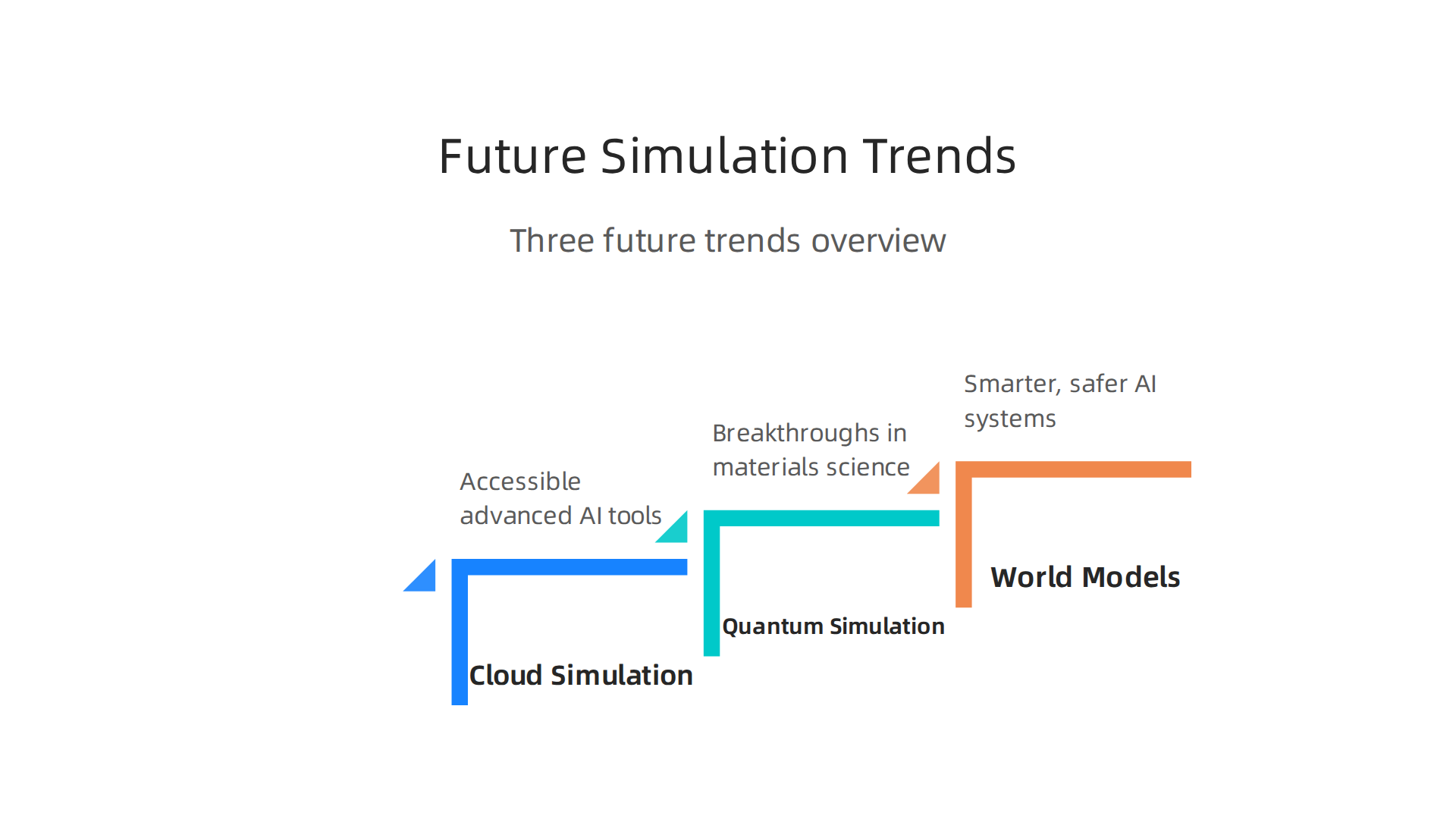
Let us break down three trends shaping 2026.
First, cloud-based simulation is making advanced technology more accessible. Services like "Simulation as a Service" (SaaS) let teams run high-fidelity models without expensive hardware. Engineers can now use AI-powered tools from any browser. This democratization means small startups can compete with big labs. A recent guide on AI-powered simulation tools shows how platforms like SimScale and Ansys SimAI use AI to cut simulation time from days to minutes. That is a huge leap.
Second, quantum simulation is unlocking breakthroughs in materials science and cryptography. Researchers use quantum computers to model molecules that classical machines cannot handle. This could lead to stronger batteries and unbreakable codes. It is a perfect example of advanced technology solving real-world problems.
Third, simulation-driven AI (often called world models) may create smarter machines. Instead of training AI engines on millions of real-life scenarios, future systems could learn entirely inside simulations. This is safer, faster, and cheaper. It also helps robots and self-driving cars handle rare events. The same idea powers the best AI tools for business in 2026, letting companies test ideas before building them in the real world.
These trends show that simulation is becoming the backbone of advanced AI research. As AI continues to transform information technology, staying updated matters.
That is why getting clear daily AI updates from The AI Newsletter Worth Reading is the simplest way to stay informed and save hours of research time.
Resources for Mastering Computer Simulation Technology
So you now have a clear picture of what is computer simulation technology. The next step is actually learning it. Whether you are a student, an engineer, or just curious about advanced technology, there are many solid ways to get started.
Online courses are one of the fastest paths. Platforms like Coursera offer a specialization in Computer Simulations that covers modeling fundamentals and hands-on projects. You will build simulations step by step, no prior experience required. It is a great way to turn theory into practice.
Books also remain essential. The classic textbook "Simulation Modeling and Analysis" by Law and Kelton gives you the math and logic behind the models. It is a trusted reference for anyone working in the field. Reading it alongside a course can deepen your understanding quickly.
Communities matter too. The Society for Modeling & Simulation International (SCS) runs conferences, journals, and networking events. Connecting with other learners and experts helps you stay motivated and discover real-world use cases. For a more informal starting point, the thread on where to learn about computer simulations contains advice from experienced practitioners.
If you are serious about building skills, pairing a structured course with a good book and an active community is the smartest way to go. And as you explore, remember that the same simulation techniques power the most exciting AI engines today. To keep up with how this advanced technology evolves, consider following a curated newsletter that cuts through the noise.
Conclusion: Simulation as a Strategic Asset in Machine Intelligence
By now, you have a solid grasp of what is computer simulation technology. You understand how it works, where it applies, and how to start learning it. But here is the real takeaway.
Simulation is not just a tool for testing ideas. It is becoming a core piece of infrastructure for machine intelligence. The Stanford Encyclopedia of Philosophy describes computer simulation as a rigorous method for exploring the approximate behavior of mathematical models. That rigor is exactly what makes simulation so valuable for training AI systems.
Think about it. Autonomous vehicles learn to navigate millions of miles of road in a simulated environment before they ever hit a real street. Drug researchers test thousands of molecular combinations inside a computer before a single lab experiment. Personalized medicine models rely on simulated patient data to predict treatment outcomes. These are not distant possibilities. They are happening right now in 2026.
The convergence of simulation and this advanced technology will unlock entirely new markets. Technology leaders who invest in simulation today will be better positioned to make strategic decisions about partnerships, products, and future capabilities.
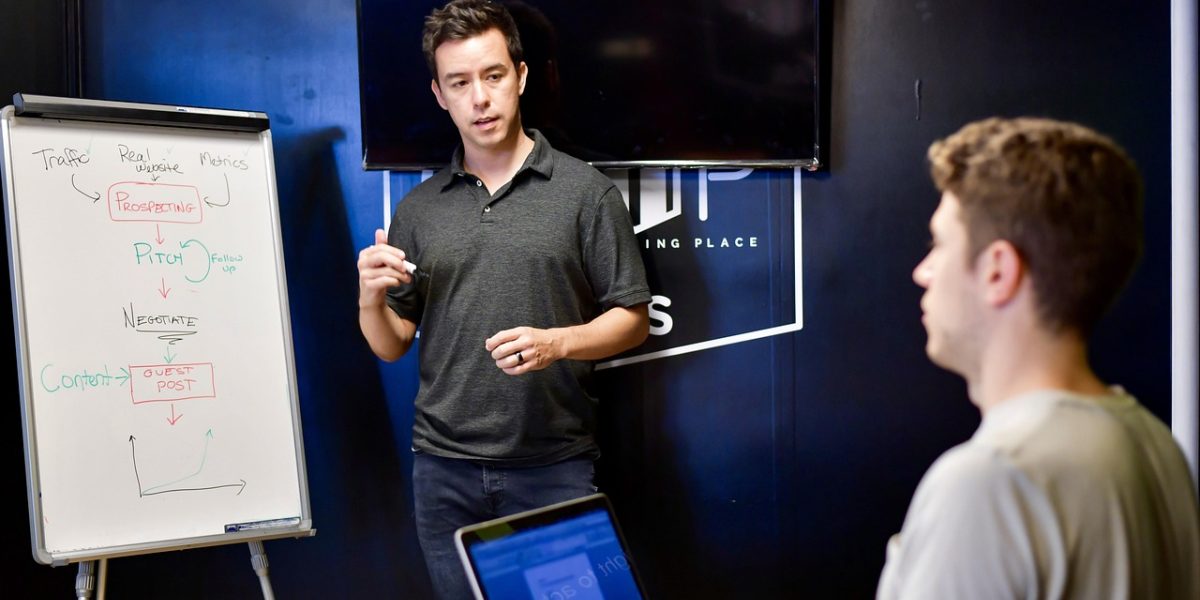
For a deeper look at how leading companies are using these capabilities to drive growth, check out our guide on strategic AI adoption.
And as the field keeps evolving at a rapid pace, staying informed on simulation and AI advances is critical. That is exactly why thousands of professionals turn to The AI Newsletter Worth Reading. It delivers clear daily updates from the machine intelligence landscape so you never miss a shift that matters.
Summary
Computer simulation technology creates virtual models that mimic real systems so engineers and researchers can test, train, and optimize without real‑world risk. This article explains what simulations are, the main types (deterministic vs stochastic, discrete vs continuous), and traces their history from Monte Carlo methods to modern AI‑driven simulators. It breaks down the three core components—hardware (GPUs/TPUs/supercomputers), software frameworks (Ansys, Simulink, Unity, cloud platforms) and the mathematical techniques (FEM, Monte Carlo, agent‑based models)—and shows how they combine to power synthetic training data, digital twins, and reinforcement learning. Practical use cases in healthcare, drug discovery, autonomous vehicles, and robotics illustrate real benefits, while guidance on choosing platforms and learning resources helps readers take the next step. The piece closes with future trends—simulation as a service, quantum simulation, and simulation‑driven world models—and argues that firms investing in simulation gain strategic advantage in machine intelligence.