
The world of artificial intelligence is growing fast. To run smart AI systems, we need powerful hardware. The global AI semiconductor market is set to reach $321.66 billion by 2033, according to a recent AI in Semiconductor Market report.

One company stepping up to meet this demand is Infineon Technologies. Infineon provides advanced power, sensor, and security chips that help AI systems work better and use less energy.
In this article, we look at how Infineon Technologies is shaping the machine intelligence hardware world. We will explore their key products and how they support the AI boom. For those looking to leverage AI in their operations, check out our guide to top AI tools for business in 2026. If you want to stay updated on the latest AI trends and company news, consider subscribing to Get clear daily AI updates from The Deep View Newsletter.

The AI Hardware Landscape and the Rise of Specialized Semiconductors
Running today’s AI models is no small task. A single large language model or computer vision system needs massive computing power. A few years ago, most AI workloads ran on standard central processing units (CPUs). But as models grew bigger and more complex, CPUs just could not keep up. The industry has now shifted toward domain-specific accelerators like graphics processing units (GPUs), tensor processing units (TPUs), and application-specific integrated circuits (ASICs). In fact, the AI Chip Market is projected to grow from $100 billion in 2026 to $2.1 trillion by 2040.
This shift brings a new challenge: power efficiency. AI chips run hot. Data centers that host them use enormous amounts of electricity. Keeping temperatures under control is critical. Without proper power management and thermal regulation, chips can overheat and fail. That is where Infineon Technologies comes in.
Infineon designs power management chips that regulate voltage and improve energy efficiency. Their sensor technologies also play a big role by monitoring temperature, current, and system health in real time.

These components are the unsung heroes inside the servers that power AI training and inference. They help keep the hardware running smoothly while cutting energy waste.
For professionals looking to understand how AI infrastructure is changing the broader tech landscape, our guide on how AI is transforming information technology offers deeper insights.
The move to specialized chips is not slowing down. And companies like Infineon that master the basics of power and sensing will remain essential to the AI revolution.
The Shift from General-Purpose to Domain-Specific Architectures
Standard CPUs were built for everything, not just AI. That makes them inefficient for running neural networks. Domain-specific architectures (DSAs) like ASICs and FPGAs deliver far better performance per watt for AI workloads.
They are designed for a single job, so they waste less energy.
Infineon Technologies supplies specialized power ICs and voltage regulators that squeeze even more efficiency out of these DSAs. Their chips manage voltage precisely, reducing losses and keeping temperatures safe. Real-world case studies from Infineon’s Scaling AI data center power delivery with Si, SiC, and GaN show significant energy savings when pairing DSAs with optimized power management. For more on the tech behind these systems, see our piece on computer simulation technology and how it powers AI.
To stay ahead of AI hardware trends, try The AI Newsletter Worth Reading for daily updates on infrastructure and semiconductors.
Why Power Efficiency Matters in AI Inference and Training
Running AI inference at scale eats up huge amounts of electricity. A 1 percent efficiency gain in a large data center can save millions of dollars each year.

Training massive models like GPT-4 requires megawatts of power. That is why efficient power conversion is critical.
Infineon Technologies tackles this challenge with its CoolSiC™ and CoolGaN™ technologies. These wide-bandgap semiconductors cut switching losses and heat dissipation. The industry shift to SiC and GaN helps data centers push power conversion efficiency beyond 96 percent. By adopting Infineon’s advanced power chips, operators lower energy costs and improve performance. For a deeper look at how AI reshapes tech infrastructure, see how AI is transforming information technology.
Infineon Technologies: A Key Player in Machine Intelligence Infrastructure
Infineon Technologies is much more than a power chip maker. Its full portfolio spans power management, sensors, and security solutions. All three are essential for modern AI systems.
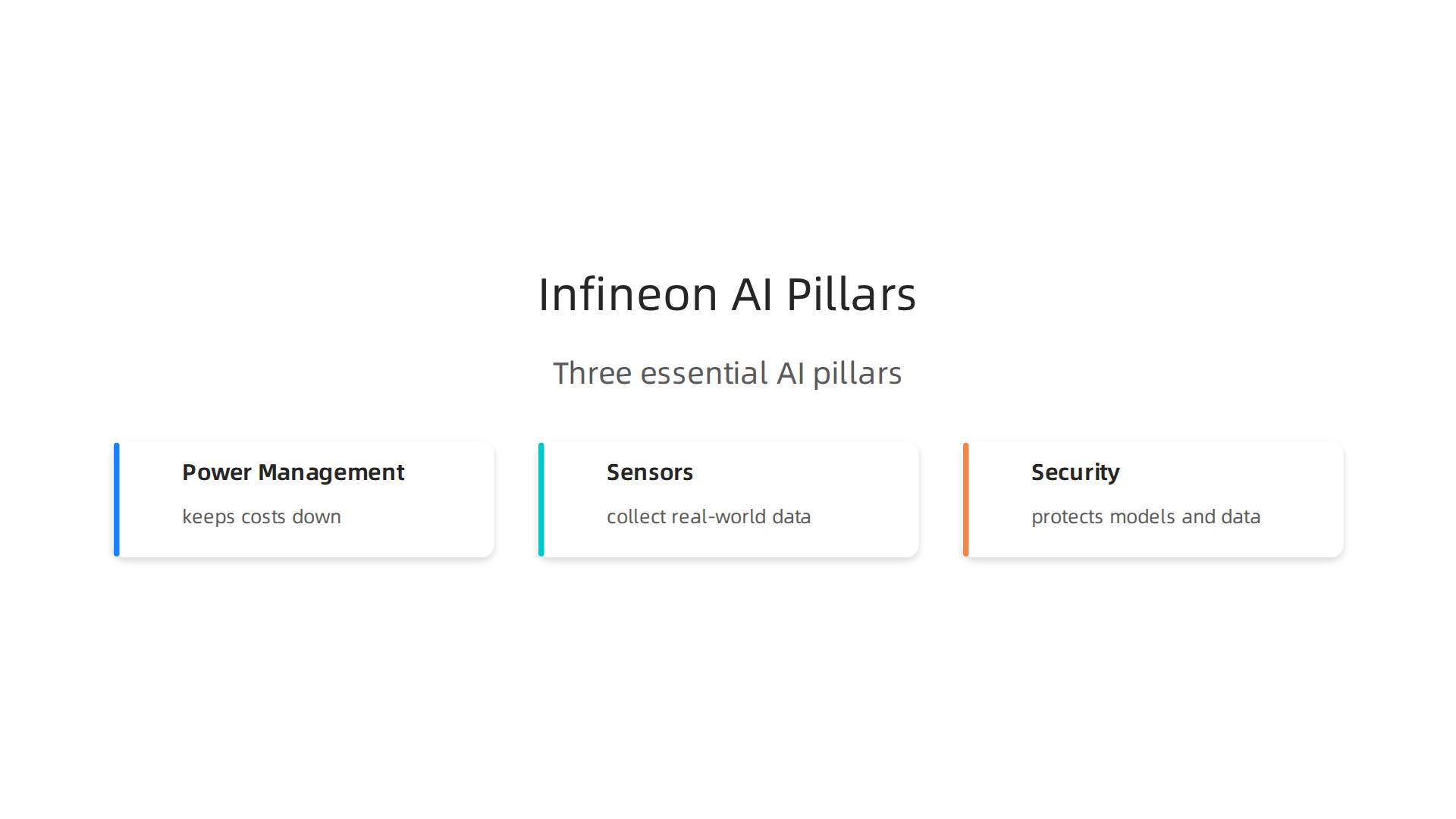
Sensors collect real world data. Security protects AI models and data from attacks. And efficient power management keeps costs down. Together, these pieces create the backbone of machine intelligence infrastructure.
The company has also grown through smart acquisitions. Buying Cypress Semiconductor back in 2020 strengthened its position in automotive and industrial AI. That deal brought in microcontrollers, wireless connectivity, and memory products. Now, Infineon can offer complete systems for self driving cars, smart factories, and robotics. For businesses looking to build on this foundation, understanding strategic AI adoption for business growth is key.
R&D is a top priority at Infineon. The company spends heavily on next generation hardware enablers like silicon carbide (SiC) and gallium nitride (GaN). It also develops advanced microcontrollers and edge AI platforms. According to Infineon’s official AI page, the company offers solutions from data and ML pipeline to chips and high performance, low power AI enabled MCUs.
This full stack approach covers everything from cloud data centers to tiny edge devices.
Staying current with rapid AI infrastructure changes is hard. That is why many professionals rely on curated intelligence. Get clear daily AI updates from The Deep View Newsletter to keep your edge.
Infineon’s Core Product Portfolio for AI
Infineon’s core portfolio targets three AI hardware challenges. Its power families – CoolMOS™, CoolSiC™, and CoolGaN™ – deliver efficient energy management from grid to processor core. Infineon’s CoolSiC MOSFET solutions for AI data centers improve efficiency in 24/7 server environments. OPTIGA™ provides hardware-level security for AI models and data. XENSIV™ sensors gather real-world inputs for edge AI, powering presence detection and gesture control. These components are built into leading AI platforms and edge devices. For a broader view of how AI hardware changes IT, read about how AI is transforming information technology.
Strategic Partnerships and Ecosystem Integration
Infineon doesn’t work alone. The company has built strong partnerships with major cloud providers and AI chip designers to make sure its power solutions work seamlessly in real-world systems. One key example is Infineon joining NVIDIA’s MGX AI Factory ecosystem, providing advanced power management for next-generation data centers, as detailed on the We power AI | Infineon Technologies page.

These partnerships focus on more than just compatibility. They drive joint development efforts that aim for holistic system-level efficiency, from the grid to the processor core. For leaders looking to build similar collaborative edge, explore our guide on building strategic open innovation networks. And if you want to stay ahead of these fast-moving industry trends, get clear daily updates from The AI Newsletter Worth Reading.
Power Management: The Unsung Hero of AI Performance
When you run an AI model, the GPU inside the server demands a huge amount of power. We’re talking hundreds of amps. Getting that power delivered cleanly and efficiently is a big challenge. That’s where power management becomes the unsung hero.
Infineon Technologies has built integrated power stages and multi-phase controllers designed for this exact job. These parts provide stable, clean power to GPUs and ASICs, which is essential for keeping them running at peak performance without glitches. Without proper power management, you face slowdowns, crashes, and wasted energy.
What really makes a difference is the use of advanced materials like gallium nitride (GaN) and silicon carbide (SiC). These wide-bandgap semiconductors cut energy losses way down. As a result, power supplies can be smaller, run cooler, and still deliver the high currents that AI accelerators need. The industry is shifting toward these materials to break through the so-called "AI power wall." You can read more about this shift in the TrendForce analysis of SiC and GaN in data centers.
These improvements aren’t just technical details. They directly affect your electricity costs and how hot your data center gets. Efficient power management means you can pack more computing power into the same space, a huge win for AI workloads.
For leaders building AI infrastructure, understanding these power technologies is key. If you want to see how these solutions fit into broader business strategy, check out our guide on strategic AI adoption.
High-Efficiency Power Modules for Data Centers
Inside every AI server, DC-DC converters and voltage regulators do a critical job. They must keep power flowing smoothly even when the workload changes in an instant. If the voltage wavers, the GPU can crash or slow down. That is why components like Infineon Technologies’ TDA215xx family matter so much. These power modules deliver industry-leading power density and efficiency, handling the huge current demands of modern AI chips.
Real data centers see real results. When operators switch to Infineon power solutions, they often report better PUE (Power Usage Effectiveness). Less energy is wasted as heat, and more goes directly to computing. You can explore more about these advanced power designs on the Infineon data center power solutions page.
For leaders who want to stay ahead, keeping up with industry shifts is key. Check out how AI is transforming information technology for a broader view. And if you want daily insights on AI infrastructure and trends, consider subscribing to The AI Newsletter Worth Reading.
Gallium Nitride (GaN) and Silicon Carbide (SiC) Innovations
Standard silicon has limits. That is why Infineon Technologies is turning to two advanced materials: gallium nitride (GaN) and silicon carbide (SiC). These wide-bandgap semiconductors switch at much higher frequencies while wasting less energy as heat. The result? Power supplies that are smaller, cooler, and more efficient.
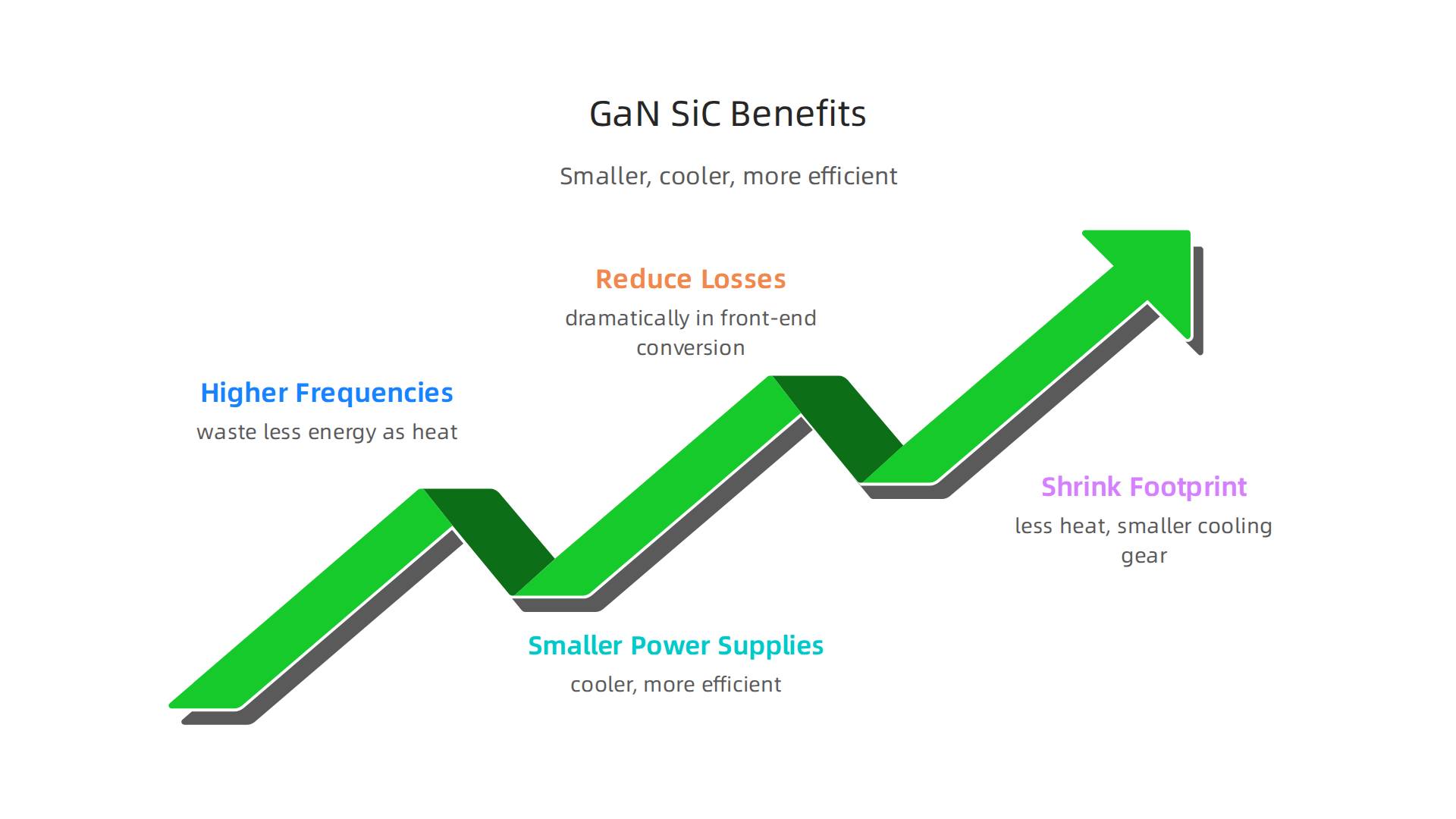
Infineon’s CoolGaN™ and CoolSiC™ MOSFETs sit at the heart of modern AI server power units. They handle both AC-DC and DC-DC conversion stages with ease. GaN devices can push conversion efficiency past 96% in rack-level power supplies. SiC devices manage the highest voltages in front-end conversion, reducing losses dramatically. According to a Breaking Through the AI Power Wall analysis, GaN and SiC are key to overcoming the physical limits of today’s data centers.
These innovations also shrink the physical footprint of power systems. Less heat means smaller cooling gear, freeing up space for more compute. As AI workloads grow, GaN and SiC are becoming essential building blocks. To stay on top of such rapid shifts, leaders should build strategic open innovation networks for tech breakthroughs.
Infineon’s Sensor Solutions for AI-Driven Systems
Autonomous machines need a rich set of senses to navigate and interact safely. Think of a humanoid robot sorting packages or a self-driving shuttle moving through city streets.

These systems rely on radar, lidar, ultrasonic sensors, and environmental monitors. Infineon Technologies provides the hardware that makes this possible.
The company’s XENSIV™ sensor portfolio includes 60 GHz radar modules, MEMS microphones, and pressure sensors. The 60 GHz radar can detect motion, gestures, and even vital signs through walls. MEMS microphones capture sound for voice control and acoustic analysis. Pressure sensors help with altitude measurement and airflow monitoring in industrial systems. These sensors feed data to AI models running at the edge, where low latency matters most.
Infineon integrates analog front-ends and digital interfaces directly into these sensor solutions. That means less external circuitry and faster signal processing. The result is a compact, power-efficient package ready for edge AI applications. You can see the full range of Infineon’s sensor offerings on their Artificial Intelligence | Infineon Technologies page, which covers condition monitoring and predictive maintenance for Industry 4.0.
These sensors pair naturally with other emerging technologies. For example, invisible navigational technologies for smart systems are helping drones and robots find their way without GPS. Infineon’s radar can contribute to that by providing precise short-range proximity data.
The sensor market is moving fast, and staying informed is key. The AI Newsletter Worth Reading delivers daily updates on breakthroughs in hardware, sensors, and AI so you never miss a shift.
RADAR and LiDAR for Autonomous Machines
Autonomous machines need to see the world around them. Infineon’s 60 GHz radar sensors make this possible in ADAS systems and robotics. These sensors can detect objects, measure distance, and even sense micro-movements. The company’s 60 GHz radar sensors for automotive are AEC-Q100 qualified, meaning they can handle the tough conditions inside a vehicle or on a factory floor. Infineon also offers 24 GHz radar modules for shorter range detection.
Beyond radar, Infineon supports LiDAR systems with laser driver ICs and specialized signal processing chips. These components help LiDAR sensors send and receive light pulses accurately, which is critical for high-resolution 3D mapping.
The real power comes from sensor fusion. Infineon microcontrollers combine data from radar, camera, and LiDAR into a single view of the environment. This gives autonomous machines a richer, more reliable understanding of their surroundings. To see how these sensing technologies connect to broader AI capabilities, check out our guide on computer vision companies leading 2026.
Environmental and Proximity Sensors for Edge AI
Edge AI devices need to sense temperature, humidity, air quality, and occupancy to make smart decisions. Infineon Technologies provides XENSIV environmental sensors that deliver accurate data for smart building and industrial AI systems. These sensors help optimize energy use and improve comfort without human input.
For proximity detection, Infineon’s 60 GHz radar sensors for IoT can detect motion and presence with high precision. The same sensors also enable contactless human-machine interfaces through gesture recognition and touchless control. This makes devices like smart thermostats and building automation systems more intuitive.
To explore how AI tools can boost your business operations, check out our guide on top AI tools for business. And for clear daily AI updates, subscribe to The Deep View Newsletter.
Security and Reliability: Hardware Trust for AI Deployments
AI systems cannot just be smart. They must also be secure. When you deploy a machine learning model in a self-driving car, a factory robot, or a medical device, you need to protect the model itself, the data it uses, and the secrets (like encryption keys) inside it. Software alone is not enough. You need hardware-level security.
That is where the Infineon Technologies OPTIGA family comes in. The OPTIGA Trusted Platform Module (TPM) is a dedicated security chip that sits separate from the main processor. It stores keys, verifies system integrity at boot, and cryptographically signs updates. In June 2026, Infineon announced its certified OPTIGA TPM SLB 9672 integration with the NVIDIA Jetson Thor platform. This solution provides a quantum-resilient root of trust for Physical AI systems like robots and autonomous vehicles.

You can read more in the Infineon press release about the certified TPM for NVIDIA Jetson Thor.
For even stronger protection, the OPTIGA Trust M security controller goes further. It stores AES-256 keys in tamper-resistant hardware, so even if a device is lost or disassembled, the AI model remains safe. This is critical for edge AI deployments where devices live in the field for years.
For systems like autonomous cars, reliability standards like ISO 26262 and SAE J3016 require rigorous testing. Hardware security chips help developers meet those requirements by providing a verified, certified foundation. The result is an AI deployment you can actually trust.
To see how trust plays out across the AI industry, check out our guide on making AI predictions verifiable and trustworthy.
Hardware-Based Security with OPTIGA™
Beyond edge devices and robots, AI servers in data centers also need hardware-level protection. The OPTIGA TPM family provides a standardized security foundation for these systems. It ensures secure boot by checking that only trusted software loads. It also supports remote attestation, so operators can verify that the server’s software stack has not been tampered with. This is especially important for AI workloads that handle sensitive data or critical decisions.
For deeper integration, Infineon’s secure elements enable trusted execution environments (TEEs) on the main processor. In a TEE, AI models and encryption keys run in a hardware-isolated zone, safe from the main operating system and any malware.
All OPTIGA TPM chips carry Common Criteria EAL4+ and FIPS 140-2 certification. These certifications give organizations the assurance they need for regulated industries. You can read more about these OPTIGA TPM security certifications.
Building a secure AI infrastructure starts at the hardware level. To see how strong security supports broader business goals, explore our guide on strategic AI adoption for growth.
And if you want daily insights on AI security and industry trends, subscribe to The AI Newsletter Worth Reading.
Reliability Standards for Mission-Critical AI
Security is only half the picture. AI systems in cars, factories, and medical devices must also survive harsh conditions without failing. That is why Infineon Technologies follows design for reliability (DFR) principles from the start. Its chips undergo AEC-Q100 and AEC-Q101 qualification tests, which simulate years of heat, vibration, and voltage stress. The company also performs FIT rate analysis to predict how many failures can be expected over a device’s lifespan.
A zero-defect philosophy drives every production batch. Built-in self-test (BIST) features let chips check their own health during operation and catch problems early. This is vital for robotic fleets and autonomous vehicles where a single crash could cause major damage. Infineon’s work with platforms like NVIDIA Jetson Thor includes the OPTIGA TPM for physical AI security, ensuring both security and reliability across the system’s full lifecycle.
To see how these reliability principles support real-world automation, read about navigational technologies for drones and robots.
Future Horizons: Infineon’s Roadmap for Next-Gen Machine Intelligence
Infineon Technologies is already looking past today’s chips. The company’s roadmap points to three big shifts that will shape machine intelligence over the next several years.
First, Infineon is investing in neuromorphic computing and analog AI accelerators. These designs mimic the human brain’s structure to run inference tasks using a fraction of the power of digital chips. That matters for edge devices like smart sensors and battery-powered robots that need to make quick decisions without draining energy.
Second, sustainability is becoming a core design goal. Infineon plans to move toward carbon-neutral manufacturing and develop recyclable packaging for its chips. As the semiconductor industry grows rapidly to meet AI demand, greener production methods will be essential. The broader AI-driven market saw semiconductor revenues jump 25.6% in 2025, and 2026 is expected to continue that climb, according to analysis of AI-driven semiconductor growth.
Third, the company is integrating AI directly into power and sensor ICs. Instead of treating AI as a separate task, future Infineon chips will include intelligent control on the same die as power management or sensing functions. This means faster response times and simpler system designs for automotive and industrial applications. For businesses looking to adopt these kinds of smart systems, learning how strategic AI adoption drives business growth is a useful next step.
Keeping up with these fast-moving hardware shifts can be tough. To stay informed about AI developments across chips, software, and markets, consider subscribing to The Deep View Newsletter for clear daily updates.
Neuromorphic Computing and Analog AI Accelerators
Infineon’s analog compute-in-memory approach is one of its most exciting projects. Instead of constantly moving data between memory and processor, the chip does calculations right where the data lives. This cuts energy use dramatically for edge AI tasks like voice recognition or predictive maintenance in factories.
The company is also partnering with research labs to build spiking neural networks on mixed-signal chips. These networks fire only when needed, much like neurons in the brain. That means even less power wasted.
The payoff is huge. Analog accelerators could use 100 times less power than digital chips. For battery-powered devices and always-on sensors, that changes everything. According to an AI chip market forecast, the global market is expected to grow from USD 100 billion in 2026 to USD 2.1 trillion by 2040. Businesses wanting to adopt smart edge systems can explore top AI tools for business to begin integrating intelligent capabilities today.
Sustainability in AI Hardware Manufacturing
Beyond performance gains, Infineon is also focused on making AI hardware more sustainable. The carbon footprint of AI goes beyond just running models. Manufacturing the hardware itself uses huge amounts of energy and materials. Infineon has set a target to reach carbon neutrality by 2030 across its own operations.
The company designs with the environment in mind. That means using PFAS-free materials and lead-free packaging in its chips. These choices reduce toxic waste and make recycling easier later on.
Infineon also builds efficient power semiconductors that directly cut down the electricity used in data centers. Less wasted power means lower emissions for every AI workload. For businesses that want to grow responsibly, understanding strategic AI adoption helps align sustainability goals with technology investments.
Stay up to date on AI industry trends like these by subscribing to The AI Newsletter Worth Reading.
Conclusion: The Verdict on Infineon’s Role in the AI Hardware Revolution
Infineon Technologies sits at a strategic intersection. The company excels in power efficiency, advanced sensing, and hardware security. These three pillars make it a vital player in the AI hardware ecosystem. According to recent projections, the AI semiconductor market growth could reach $321.66 billion by 2033. Infineon’s focus on innovation and partnerships keeps it relevant for the long haul. Its commitment to sustainability and cutting-edge chip design positions it as a bellwether for the industry. For professionals tracking machine intelligence, keeping an eye on companies like Infineon offers a clear window into where hardware innovation is heading. To stay ahead of these trends, explore more on open innovation networks that drive tech breakthroughs.
Summary
This article explains how Infineon Technologies supports the AI hardware revolution by supplying power management, sensor, and security chips that boost performance while cutting energy use. It describes the industry shift from general-purpose CPUs to domain-specific accelerators (GPUs, TPUs, ASICs) and why power efficiency and thermal control are critical for AI training and inference. The piece details Infineon’s CoolSiC™, CoolGaN™, CoolMOS™ power families, XENSIV™ sensors, and OPTIGA™ security solutions, and shows how these products improve data center PUE, enable reliable edge sensing, and protect AI models. It also covers Infineon’s partnerships, reliability testing, and R&D priorities—neuromorphic chips and on-die AI for power and sensors—plus its sustainability goals. After reading, professionals will understand which Infineon components matter for data center and edge AI deployments, how they reduce costs and risk, and what to watch on the company’s product roadmap.