
Introduction: The Growing Need for Humanized AI Content
Have you ever read an article that felt a bit too perfect? The sentences were clean. The grammar was flawless. But something felt off. It sounded robotic.

That is because more and more content online comes from AI tools. In fact, 97% of content marketers plan to use AI this year, according to 2026 data. But here’s the thing: readers can tell. They are starting to spot machine-made text, and they trust it less.
That is where the need for an ai rewriter comes in. An ai rewriter helps take stiff, robotic output and turn it into something that sounds like a real person wrote it. The market for these tools is already big and growing fast. The AI text humanizer market is now worth $520 million, making up about 11% of all AI writing tools. As more people use AI to create content, the demand to humanize ai text will only get stronger.
If you are an investor, founder, or analyst in the AI space, understanding how these tools work is key. You need to know the methods that make machine text sound human. You also need to know the best tools, how to measure quality, and where the ethical lines are.
This guide covers all of that. We will walk through the core techniques, review leading tools, and look at what makes good rewriting in 2026. If you are also exploring which AI text generators to use in the first place, check out our expert comparison of the best AI text generators of 2026.
The world of AI content is changing fast. Staying informed is the best way to stay ahead. For daily, clear updates on the latest in AI and machine intelligence, consider subscribing to The Deep View Newsletter. It delivers simple insights straight to your inbox so you never miss what matters.
What Is AI Rewriting and Why Humanization Matters
So what exactly is AI rewriting? At its core, AI rewriting means using language models to take existing text and transform it while keeping the original meaning, style, and tone intact. Think of it like a smart editor that can rephrase sentences, swap out dull words, and smooth out awkward phrasing. But here is the key difference: good AI rewriting does not just swap synonyms. It actually reshapes how the text flows.
Humanization goes much deeper than basic paraphrasing. It means injecting natural language patterns into the output. It avoids the repetitive sentence structures that AI tools often fall into. It adds rhythm, pauses, and a touch of personality. A tool designed to humanize ai text will break up long robotic strings, mix in casual transitions, and make the copy sound like it came from a real person rather than a machine.
For example, if you feed an AI generator a prompt like "write a story about a lost dog," the raw output might be stiff and predictable. But when you run that through an ai rewriter designed for humanization, the result feels warm and genuine. This matters a lot for things like marketing copy, blog posts, and even creative projects like using an ai story generator.
Why the Technology Behind the Tool Matters for You
If you are a founder, investor, or analyst evaluating AI rewriting tools, you need to look under the hood. The best tools in 2026 do not just swap words. They use advanced language models that understand context, tone, and audience. According to a 2026 market analysis, the AI text humanizer market is now worth $520 million and represents about 11% of all AI writing tools. That is a fast-growing slice of a huge pie.
Understanding how these tools work helps you judge quality. A tool that only does surface-level paraphrasing will fail the human test. A tool that truly rewrites with natural cadence and variety will keep readers engaged. In fact, 97% of content marketers now use AI, but readers are getting better at spotting machine-made text. That is why the demand for humanization is exploding.
AI Rewriting in Practice
Let us look at a quick example. Raw AI output might say: "The product offers many features that are beneficial for users." A humanized rewrite could say: "This product comes with plenty of useful features that actually help you get things done." Notice the difference? The second version feels more direct and conversational.
If you are curious about which AI text generators produce the most humanlike raw output in the first place, check out our expert comparison of the best AI text generators of 2026. That can help you choose a starting point that needs less rewriting.
Staying Informed on the Shift
The world of AI rewriting is changing fast. New tools, techniques, and ethical questions pop up every week. For daily, clear updates on everything from AI rewriting to market trends, consider subscribing to The Deep View Newsletter. It delivers simple insights straight to your inbox so you never miss what matters.
Key Techniques for Humanizing AI-Generated Text
Now that you understand what humanization really means, let us get into the practical stuff. How do you actually make AI text sound like it came from a person?
The good news is that you do not need to be a tech wizard. With a few solid techniques, you can transform robotic output into something that feels natural and engaging. Let us walk through the most effective methods.
Start with Contextual Rewriting
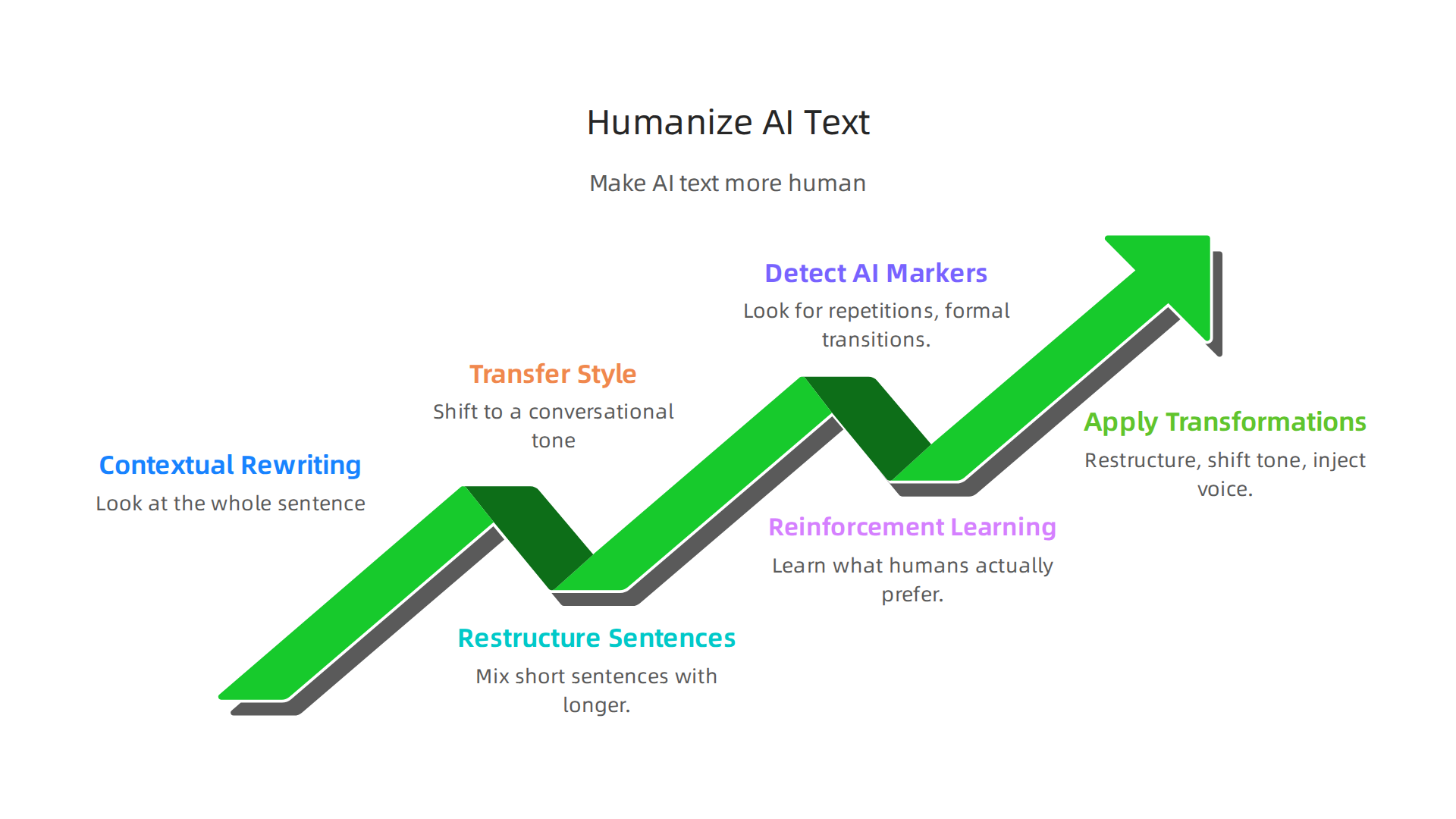
This is the foundation. Instead of just swapping one word for another, you want to look at the whole sentence. Ask yourself: does this phrase fit the situation? For example, if you are writing a friendly blog post, cut the formal transitions like "furthermore" or "consequently." Replace them with casual connectors like "plus" or "the thing is."
Synonym substitution only works when you understand the context. A word like "great" might work for a product review, but it sounds flat in a story. Pick replacements that match the tone and audience.
Restructure Sentences for Rhythm
AI often falls into the same pattern: long subject, long verb, long object. Over and over. Your job is to break that up. Mix short sentences with longer ones. Start some sentences with a verb. Throw in an occasional one-word sentence for emphasis. This is where you humanize ai text by giving it natural rhythm.
According to a 2026 systematic survey published in IJETT, humanized text tends to use more varied sentence lengths and informal discourse markers compared to raw AI output. That is the secret sauce.
Transfer the Style
This is a big one. If the original AI output sounds like a formal report, you can shift it to a conversational tone. Drop the passive voice. Use "you" and "I." Add small personal touches like "honestly" or "you know what I mean?"
Think about the difference between "The results indicate a positive outcome" and "The results look good. Really good." The second version feels alive.
Use Reinforcement Learning from Human Feedback (RLHF)
This is the advanced stuff. The best ai rewriter tools in 2026 use RLHF to learn what humans actually prefer. The model gets trained on feedback: what sounds natural, what sounds stiff. Over time, it learns to align its rewrites with human taste.
A 2026 study from Aga Khan University tested tools like Writesonic and WriteHuman on academic text. The ones using human feedback techniques scored higher on naturalness. That is the direction the industry is moving.
A Practical Workflow You Can Use Today
Here is a simple three step process you can apply right now:
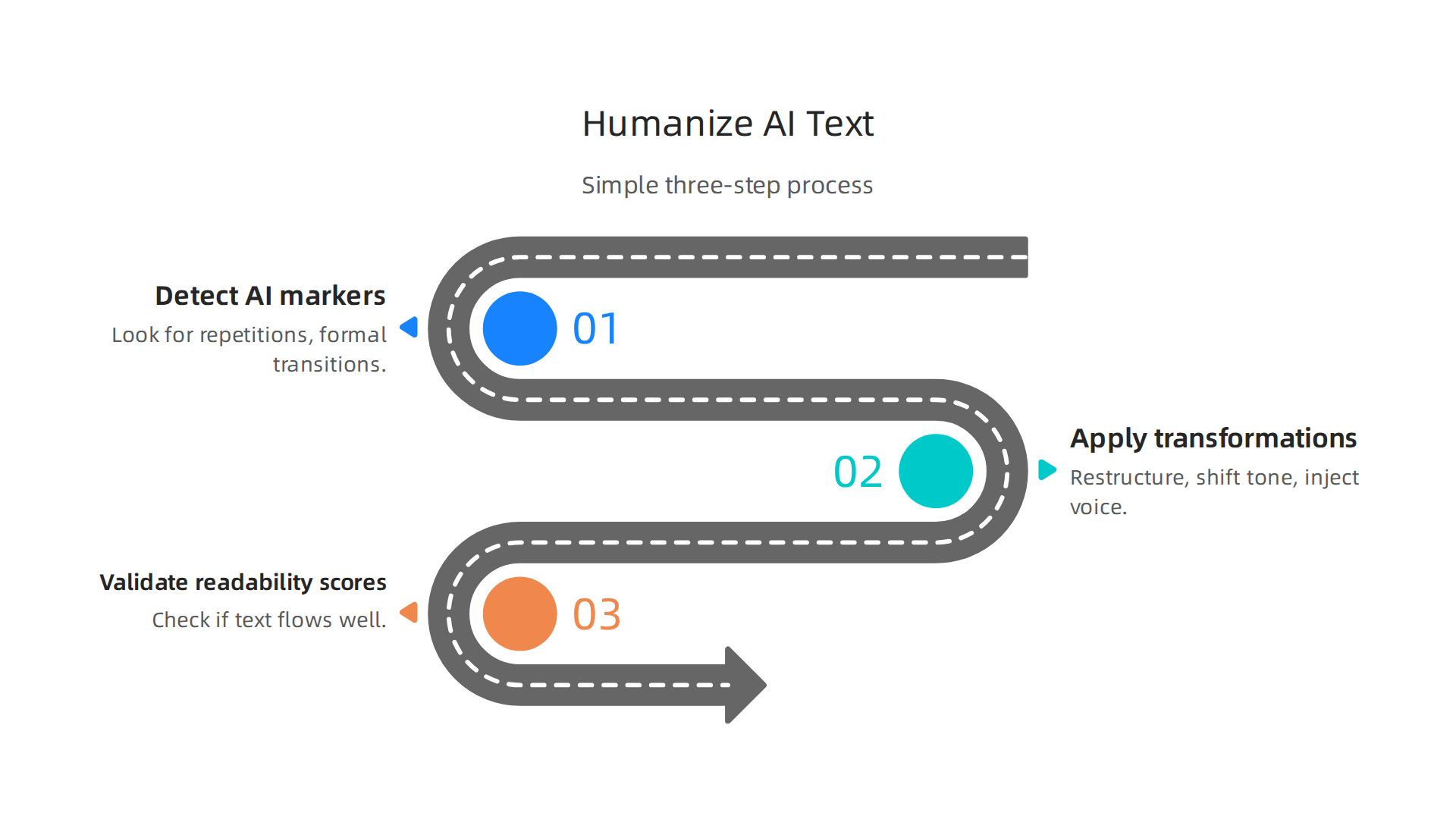
- Detect AI markers. Look for repetitions, formal transitions, and filler phrases that sound like a robot. AI loves words like "leverage," "harness," and "synergize." Cut those.
- Apply targeted transformations. Restructure sentences, shift the tone, and inject your own voice. If you need inspiration, the quetext guide suggests asking a peer for feedback on awkward phrasing.

- Validate with readability scores. Tools like the Flesch Reading Ease test can tell you if your text flows well. Aim for a score that matches your audience: around 60 to 70 for general readers.
If you want to start with AI writing tools that already produce more natural output, check out our expert comparison of the best AI text generators of 2026. Picking a good starting point cuts down the rewriting work.
Final Thought
Humanizing AI text is not about hiding the machine. It is about making the words serve the reader. And the reader wants something that feels real.
For daily insights on AI rewriting and market trends, subscribe to The Deep View Newsletter. It delivers clear updates straight to your inbox so you always stay ahead.
Comparative Analysis of Top AI Rewriting Tools in 2026
So you know the techniques to humanize AI text. But which tools actually do the heavy lifting for you? The market in 2026 is packed with options. Picking the right one can feel overwhelming.

Let me break down the leading tools and what makes each one stand out. I will compare them on the things that matter most: speed, naturalness, pricing, and how easy they are to add to your workflow.
The Top Contenders
Based on hands on tests and verified user reviews, these are the tools you should know about. A detailed comparison by eesel AI from January 2026 highlights several top platforms including Jasper and Copy.ai for their strong rewriting features. Meanwhile, a test of 12 tools conducted by Zemith in February 2026 put ChatGPT against Jasper and found that each has distinct strengths depending on your goal.
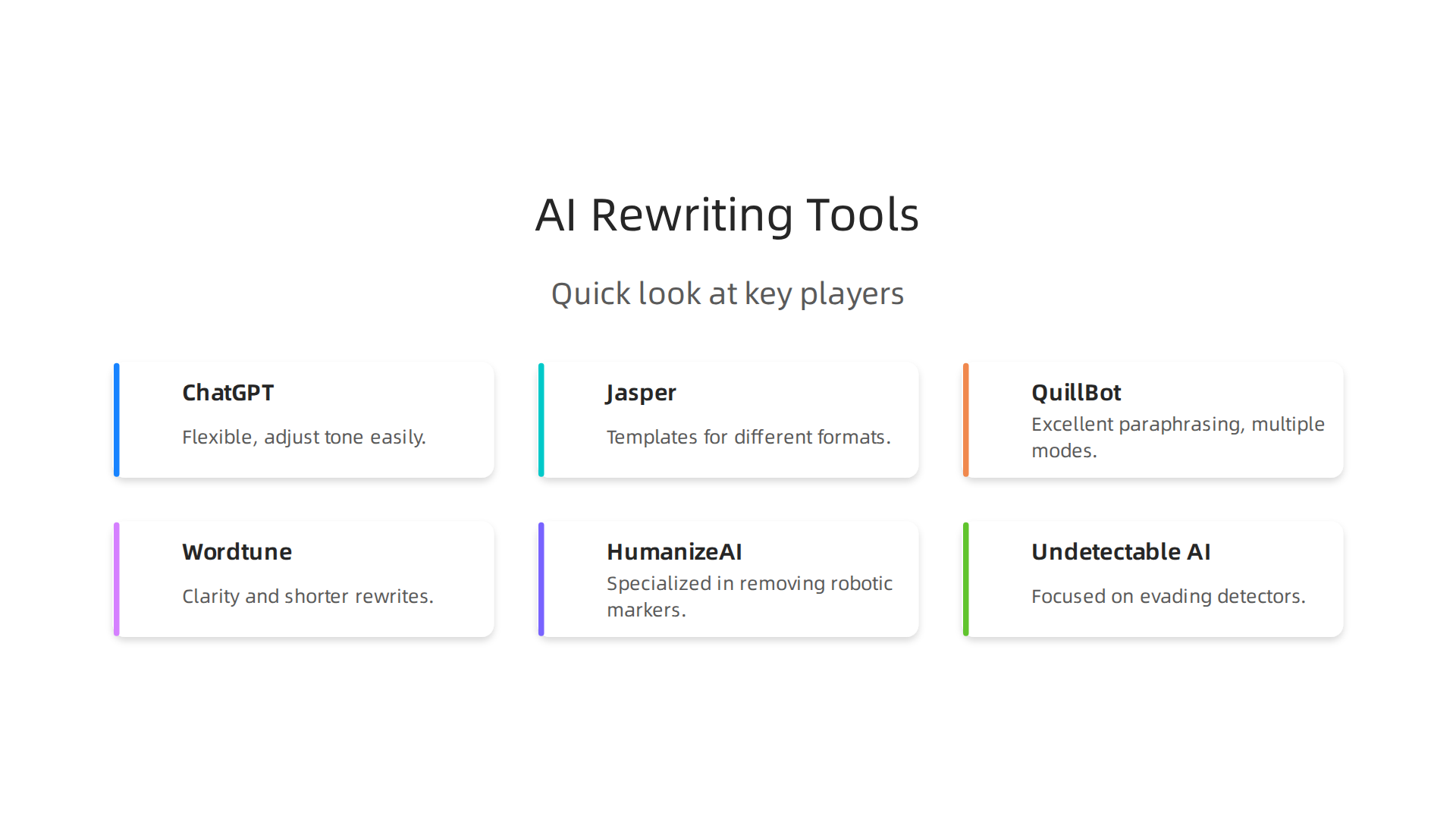
Here is a quick look at the key players:
| Tool | Best For | Key Strength | Starting Price |
|---|---|---|---|
| ChatGPT | General rewriting and conversation | Very flexible, can adjust tone easily | Free tier available |
| Jasper | Marketing and brand content | Built in templates for different formats | Around $49/month |
| QuillBot | Academic and student writing | Excellent paraphrasing with multiple modes | Free tier, premium around $10/month |
| Wordtune | Refining existing sentences | Great for clarity and shorter rewrites | Free trial, paid from $10/month |
| HumanizeAI | Making raw AI output sound natural | Specialized in removing robotic markers | Varies by plan |
| Undetectable AI | Bypassing AI detection | Focused on evading detectors while staying readable | Subscription based |
What to Look for When Choosing
Everyone wants a tool that sounds human. But there are other factors to weigh too.
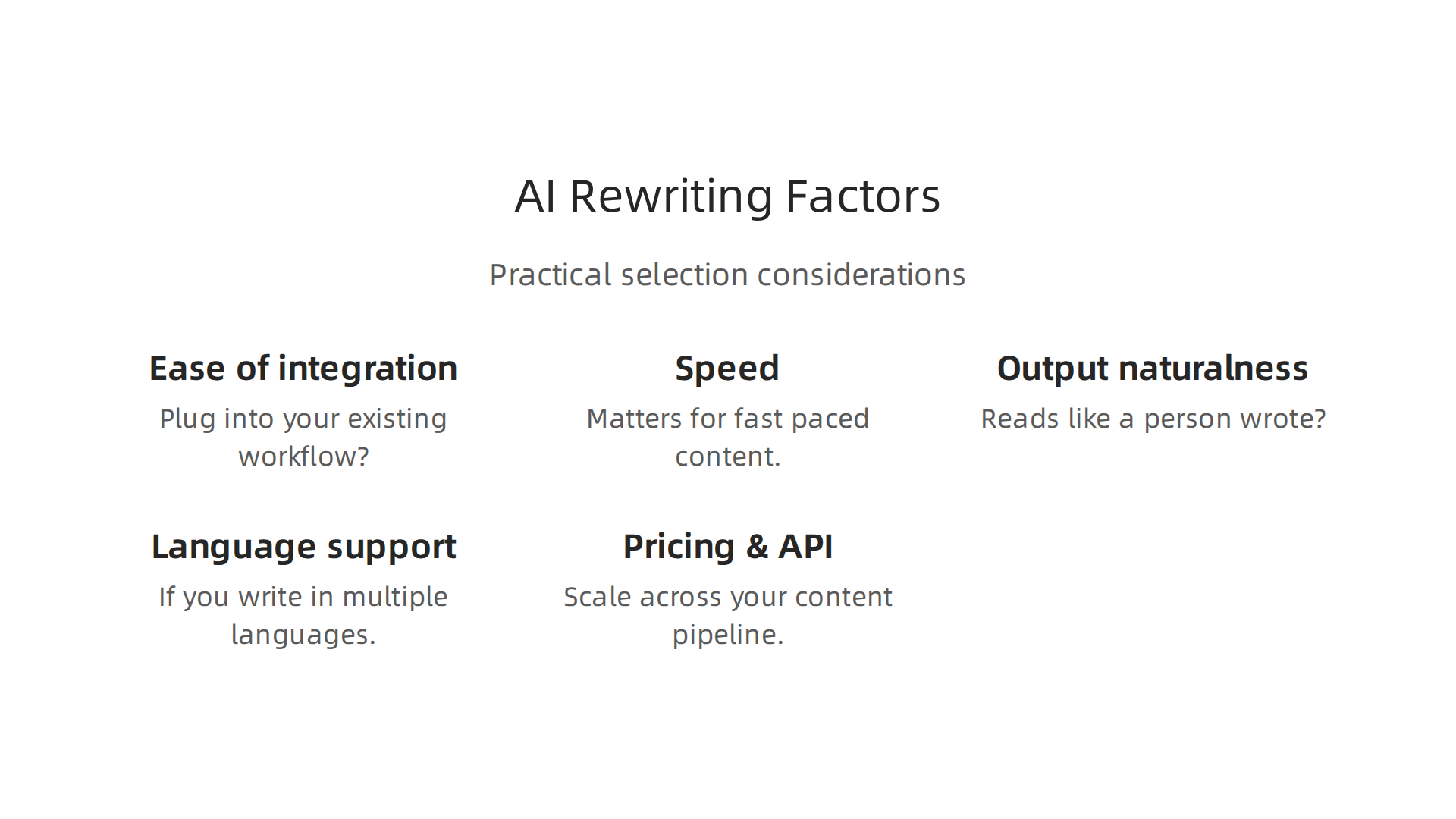
Ease of integration. Can you plug it into your existing workflow? Tools like Jasper and Wordtune offer browser extensions and API access. G2 user reviews from May 2026 show that enterprise teams prioritize seamless integration.
Speed. Some tools rewrite a paragraph in seconds. Others take longer but offer deeper analysis. For fast paced content creation, speed matters. The G2 enterprise AI writing assistants category lists over 1780 user reviews, and speed is a top complaint among slower tools.
Output naturalness. This is the big one. Does the rewritten text actually read like a person wrote it? The best ai rewriter tools in 2026 use advanced language models trained on human feedback. According to Conductor’s April 2026 review of AI writing tools, output quality varies widely even among top rated platforms.
Language support. If you write in multiple languages, check for support. Wordtune and QuillBot offer several languages, while some specialized humanizers only work in English.
Pricing and API availability. For solo creators, a monthly subscription works fine. But for startups or enterprise teams, API access is crucial so you can scale rewriting across your content pipeline.
Why This Matters for Investors and Founders
If you are investing in or building in this space, knowing the landscape helps you make smart moves. Tools like Undetectable AI and HumanizeAI are gaining traction fast because they solve a specific pain point: making AI content undetectable while keeping it readable.
The broader market for writing tools is growing. The Ryne AI guide from January 2026 notes that new entrants are appearing constantly, which means there is room for innovation. If you want to dive deeper into how these tools stack up against each other, check out our expert comparison of the best AI text generators of 2026 for a full breakdown with pricing and feature tables.
The Bottom Line
The right tool depends on your specific need. A college student needs something different from a marketing agency. An investor evaluating companies looks at market fit and scalability.
To stay on top of which tools are gaining market share and which are falling behind, you need reliable daily intelligence. That is why I recommend you subscribe to The Deep View Newsletter. It delivers clear updates on tool trends and industry shifts straight to your inbox. Join now so you never miss a critical shift in the AI rewriting landscape.
How to Evaluate Rewriting Quality: Metrics and Benchmarks
So you have your list of tools. But how do you know if they actually deliver human-quality results? You need to measure rewriting quality the right way. Let me walk you through what actually matters in 2026.
The Automated Metrics That Matter
Numbers can tell you a lot, but only if you know which ones to watch. The classic metrics still play a role. BLEU and ROUGE measure how closely rewritten text matches reference text. METEOR goes a step further by looking at synonyms and sentence structure. The Microsoft Learn evaluation framework groups these into clear categories so you can track what each one measures.
Newer metrics like MAUVE and HUSE focus on something different: how human-like the output feels. These compare the statistical patterns of rewritten text against real human writing. According to the 2026 AI Index Report from Stanford HAI, frontier models now meet or exceed human baselines on many text tasks. But that does not mean every tool is equal. You still need to check.
Perplexity is another helpful number. It measures how predictable a piece of text is. Lower perplexity usually means more natural flow. But here is the catch. Numbers alone miss a lot. A detailed guide from Toloka AI explains that automated metrics cannot capture nuance, tone, or context.
The Human Evaluation Factor
This is where you step in. No algorithm can fully replace a human reader.
The best approach is A/B testing. Take your rewritten text and put it side by side with text written by a real person. Can you tell which is which? If you can, the tool needs work.
Fluency ratings help too. Read the output out loud. Does it sound like something you would say? Look for n-gram diversity. Robotic text repeats the same short phrases. Human text varies word patterns naturally.
Research from Galileo AI shows that 74% of production agents already rely on human-in-the-loop evaluation instead of automated benchmarks alone. That is a huge number. It tells you that real people making real judgments still matter more than any score.
Domain-Specific Benchmarks
Generic metrics are fine for general content. But if you write in specialized fields, you need tighter standards.
Legal writing needs precision. Every word carries weight. The metrics for legal content should focus on fact preservation. A paper on regulatory writing from ACRP in April 2026 highlights how factual accuracy demands different evaluation standards than creative text.
Medical content requires clarity and safety. Rewriting a patient education sheet is different from rewriting a marketing email. The benchmarks for medical text should check for meaning preservation above all else.
Technical documentation needs consistency. If you are using an ai rewriter to make technical manuals clearer, the output must keep all specific terms and instructions intact.
For founders and investors evaluating tools, understanding these metrics helps you pick the right solution for your specific content type. You can explore more about how different tools perform across these metrics in our full comparison of the best AI text generators of 2026.
The Simple Way Forward
Here is my honest take. Automated metrics give you a starting point. Human evaluation gives you the truth. And domain-specific benchmarks make sure the output actually works for your audience.
The landscape changes fast. New human-likeness scores appear every quarter. To keep up with which methods are actually working and which are falling short, you need reliable daily updates. That is why I recommend you subscribe to The Deep View Newsletter. It cuts through the noise and delivers clear, practical insights on AI evaluation and tool quality straight to your inbox.
Use Cases Across the AI Ecosystem
You now know how to measure rewriting quality. But where do these tools actually shine? In 2026, the adoption of AI across enterprises is accelerating fast. A report from Claritus Consulting highlights seven key enterprise use cases transforming operations, from customer experience to data analytics. The same trends are driving how different people use an ai rewriter to make their work better and faster.
For AI Startups: Humanizing Everything
If you are building an AI startup, you know the struggle. Your product might be brilliant, but if your website copy, customer support responses, and marketing emails sound robotic, people will not trust you. Using an ai rewriter lets you take generated content and make it sound human. You can humanize ai text for landing pages, onboarding emails, and support tickets. The result is a brand voice that feels real. According to IBM’s 2026 tech trends analysis, AI is becoming embedded in every business process. Startups that use rewriting tools to polish their output stand out because they sound like people, not machines.
For Investors: Faster Digestion of Complex Information
Investors in the AI space deal with a firehose of information: pitch decks, research reports, market analyses, and news.

The top enterprise AI trends for 2026 from Tovie AI show that agentic workflows and AI governance are reshaping how companies operate. To make sense of all this, investors use rewriting tools to reframe dense reports into digestible summaries. An ai rewriter can take a 50-page market analysis and produce a clear two-paragraph executive brief. It keeps the key facts but changes the language so you can share it with your team or include it in a memo. This saves hours every week.
For Analysts: High-Fidelity Summaries at Scale
Analysts need to process large text corpora, whether from regulatory documents, customer feedback, or research papers. The challenge is maintaining accuracy while making the output readable. Using rewriting tools, analysts generate human-like summaries that preserve every critical detail. For example, a financial analyst might run earnings transcripts through an ai rewriter to produce clean executive summaries. The tool must keep numbers, dates, and specific language intact. The 2026 CIO strategy trends from Jade Global emphasize that AI investments must drive ROI. For analysts, that ROI comes from faster, more reliable synthesis of information.
Which Tool Should You Choose?
Different use cases call for different tools. Some platforms specialize in marketing copy, while others excel at technical or legal content. To find the best fit for your specific needs, check out our full comparison of the best AI text generators of 2026. It breaks down which tools work best for startups, investors, and analysts.
Stay Ahead of the Curve
The AI ecosystem changes fast. New use cases emerge every month. To keep up with what is working for companies like yours, you need reliable daily insights. That is why I recommend you Subscribe Free to The Deep View Newsletter. It delivers clear, practical updates on AI tools, trends, and evaluation methods straight to your inbox. No hype, just what matters.
Ethical Considerations and Detection of AI Rewriting
Using an ai rewriter can save you time and make your content sound natural. But with that power comes real responsibility. If you are not careful, you could cross ethical lines without even realizing it.
The biggest ethical risks include plagiarism, spreading misinformation, and losing transparency. Some people also use rewriting tools to bypass AI detection systems, which is a form of deception. This matters more than ever because a report from the Europol Innovation Lab predicts that as much as 90 percent of online content may be synthetically generated by 2026 according to Ohio University. That is a staggering number. If nearly everything online is machine-made, trust becomes the scarcest resource.
How Detection Tools Work
Schools, publishers, and employers are fighting back. In 2026, professors and editors use classifiers like GPTZero and Originality.ai to spot machine-written text.
According to a guide from Thesify, these tools analyze patterns like sentence predictability and repetition. They are not perfect, but they keep improving. Another method is watermarking, where the AI model embeds a hidden signal in the output. Adversarial training also helps detection systems get smarter. So if you try to use an ai rewriter to hide that your content came from a machine, you might still get caught.
The Legal Landscape
Regulation is catching up too. The European Union’s AI Act is a big deal. Its transparency rules will take effect in August 2026 according to the official EU policy page.
That means if you publish AI-generated or heavily rewritten content, you may be required to label it. Other countries are passing similar laws. You can track the fast-moving rules with the Global AI Regulations Tracker from RecordPoint. These regulations affect how businesses use any ai rewriter or text humanization tool.
What This Means for You
Whether you are a startup founder, investor, or analyst, you need to use rewriting tools ethically. Always be transparent when content is AI-assisted. Do not use ai rewriter tools to cheat or mislead. If you want to learn which tools prioritize ethical features and compliance, check out our full breakdown of the best AI text generators of 2026. It covers tools that offer transparency and help you stay within legal boundaries.
The rules are changing fast. To keep up with new regulations, detection methods, and best practices, I recommend you Subscribe Free to The Deep View Newsletter. You will get clear, daily updates on AI ethics, tools, and market shifts straight to your inbox. No fluff, just what you need to know.
Future Trends in Rewriting and Humanization
The world of AI rewriting is changing fast. And I mean really fast. The tools you use today will look basic compared to what is coming next. Here is what is on the horizon and why it matters for your strategy.
Real-Time Style Adaptation and Multilingual Humanization
Soon, an ai rewriter will not just swap words. It will adapt your tone, voice, and rhythm in real time. Imagine typing a rough draft and seeing it instantly shift from casual to professional or from corporate to creative. That is not a fantasy. According to IBM’s 2026 trends report, AI models are getting better at understanding context and nuance. They can match the style of a specific writer or brand without losing the original meaning.
Multilingual humanization is another big leap. Instead of translating text and then rewriting it to sound native, future tools will handle both steps in one go. They will humanize ai text across dozens of languages while keeping cultural tone and local idioms intact. This is huge for global teams and international marketing campaigns.
Integration with Voice and Multimodal Systems
Rewriting will not stay inside text boxes. By 2026, we are seeing ai rewriter capabilities baked into voice assistants, video generation tools, and even augmented reality platforms. You might speak a draft out loud and have the tool rewrite it for a blog post, a script, or a social caption. The lines between writing, speaking, and visual content are blurring. The ai story generator space is also growing, where entire narratives are rewritten on the fly based on reader feedback.
Foundation Models Are Getting Smarter
Here is the thing. Advanced models like GPT-6 and Claude 4 are becoming so good at producing natural output that the need for a separate rewriting step may shrink. These models already understand tone, narrative flow, and emotional warmth. They can produce a first draft that sounds remarkably human. A report from Claritus Consulting shows that generative AI is being embedded directly into enterprise workflows, reducing the need for third-party humanization layers.
What This Means for Investors
If you are investing in this space, you need to think carefully. Standalone ai rewriter tools that only swap synonyms may lose their value. But tools that offer deep style adaptation, multilingual support, and seamless integration into voice and video systems are positioned to grow. The smartest bet is on platforms that embed rewriting as a feature, not the whole product. To see which tools are leading the pack this year, check out our full comparison of the best AI text generators of 2026.
The market is moving fast. If you want to stay ahead of these trends and know where to put your attention next, Subscribe Free to The Deep View Newsletter. You will get daily, no-fluff updates on the tools, companies, and shifts that matter most.
Summary
This article explains why AI rewriting and humanization matter as AI-generated content becomes ubiquitous and increasingly detectable. It defines AI rewriting, contrasts simple paraphrasing with true humanization, and outlines concrete techniques—contextual rewriting, sentence rhythm, style transfer, and RLHF—that make machine text read like it was written by a person. The guide compares leading 2026 tools, highlights what to evaluate (speed, naturalness, integration, pricing), and gives a practical three-step workflow for turning raw output into reader-friendly copy. It also covers how to measure quality with automated metrics and human evaluation, domain-specific benchmarks, and common use cases for startups, investors, and analysts. Finally, the article discusses ethical concerns, detection methods, evolving regulation, and future capabilities such as real-time style adaptation and multilingual humanization. Readers will finish able to choose tools, apply humanization techniques, and evaluate outputs responsibly.