

The Innovation Imperative in Machine Intelligence
If you feel like the world of artificial intelligence is moving faster than ever, you are not imagining things. In 2025, global corporate AI investment more than doubled according to the Stanford HAI 2026 AI Index Report. That same report shows generative AI reached nearly 53% population adoption within just three years. A 2024 McKinsey survey found that 78% of companies already use AI in at least one business function, up from 55% the year before. These numbers tell a clear story.
Innovation in machine intelligence is no longer a nice-to-have. It is the central competitive differentiator for enterprises, investors, and researchers in 2026. The question is no longer whether to adopt AI, but how fast and how smart your strategy can be.
Here is the problem. The speed of change creates a real headache for high-level professionals. You are drowning in news, research papers, product launches, and funding announcements. Sources are scattered across Twitter, LinkedIn, blogs, and academic journals. Every week brings new debates about which jobs will disappear, which industries will transform, and which companies will win or lose. It is overwhelming.

That is where this guide comes in. We have cut through the noise to give you a curated, evidence-based look at what actually matters. No fluff. No hype. Just actionable frameworks and insights you can use to stay ahead.
And if you want to keep getting clear, daily updates without the clutter, you can subscribe free to The Deep View Newsletter. It is the simplest way to stay informed as innovation reshapes the entire landscape.
Redefining Innovation in the AI Era
The previous section made it clear: the pace of AI change is brutal. But here is the thing. If you still think innovation in the AI era means only building new models in a research lab, you are already behind. The whole definition has shifted.
Innovation today is about three interconnected things.
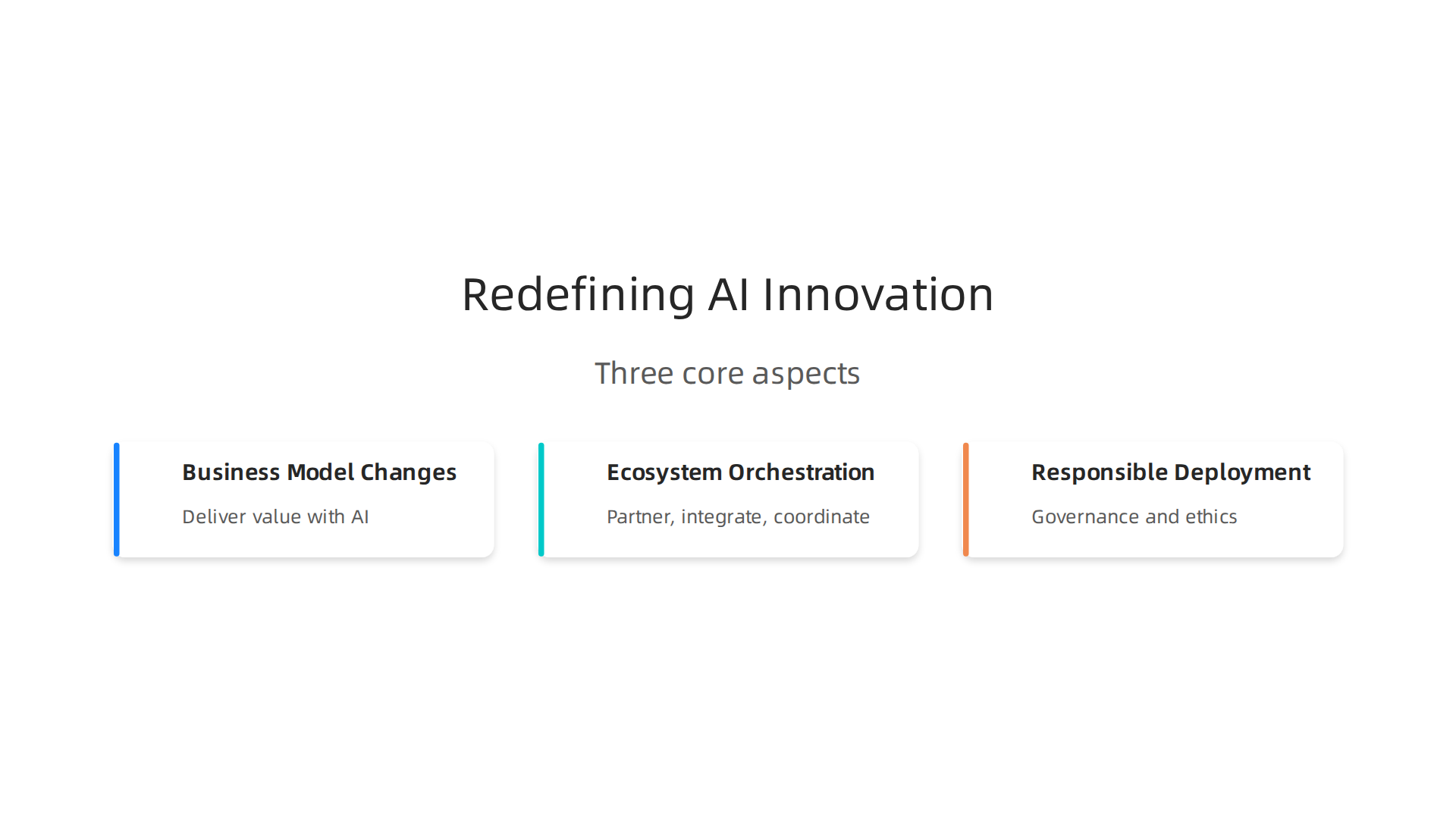
First, it is about business model changes. How do you actually deliver value with AI? Companies like those highlighted in PwC’s 2026 AI predictions show that real innovation comes from rethinking how you operate, not just what you build. Second, it is about ecosystem orchestration. No single company owns the full stack anymore. You need to partner, integrate, and coordinate across platforms, data sources, and models. Third, it is about responsible deployment. Governance and ethics are not afterthoughts. They are core to sustainable innovation, as the MIT Sloan Management Review points out in its analysis of the emerging agentic enterprise.
Here is the real shift. Foundation models have blurred the old line between incremental and disruptive innovation. Why? Because these models let you recompose capabilities almost instantly. You can take a foundation model, add your own data, tweak a few parameters, and launch a product that feels completely new. That was unthinkable just a few years ago. The tools that make this possible are growing fast. For example, the platforms reviewed in our guide to the best AI text generators in 2026 show how teams can prototype and deploy ideas at speed. The boundary between a small improvement and a category killer is now razor thin.
For investors and executives, this new paradigm changes everything. You cannot judge a company by its R&D budget alone. You have to look at how it orchestrates partners, how it builds trust, and how quickly it can remix foundation models into real products. Yet a 2026 survey by Writer found that 75% of executives admit their AI strategy is more for show than actual guidance. That is a dangerous gap. Understanding what real AI innovation looks like is no longer optional. It is the core skill for anyone betting on machine intelligence.
The landscape is shifting fast. You need a clear, daily signal to keep your strategy sharp. Subscribe Free to The Deep View Newsletter and get the essential updates that cut through the noise.
The Measurement Challenge: Quantifying Innovation in AI Companies
So we know innovation in AI is about more than just building new models. But here is the hard question. How do you actually measure it? If you cannot measure it, you cannot manage it. And right now, most companies are flying blind.

The old ways of measuring innovation just do not work for AI. For years, leaders looked at R&D spending or patent counts. Those numbers still matter, but they miss the real story. The Stanford HAI 2026 AI Index Report shows that global corporate AI investment more than doubled in 2025. Revenue at leading frontier companies grew fast too. Yet a shocking disconnect remains. According to the State of AI 2026 report from Vention, only 19% of companies saw AI boost their ROI by more than 5%. A full 75% reported low-to-zero gains so far. That is a massive gap between inputs and outcomes.
The core problem is this. Innovation in AI is not linear. You cannot just spend more money on research and expect a predictable result. You need to measure how quickly ideas turn into real products, how well you integrate with partners, and how much trust you build with users. A 2026 survey by Writer found that 70% of AI leaders struggle to link their innovation spending to actual business results. That is a crisis of measurement.
New Ways to Measure: Innovation Accounting
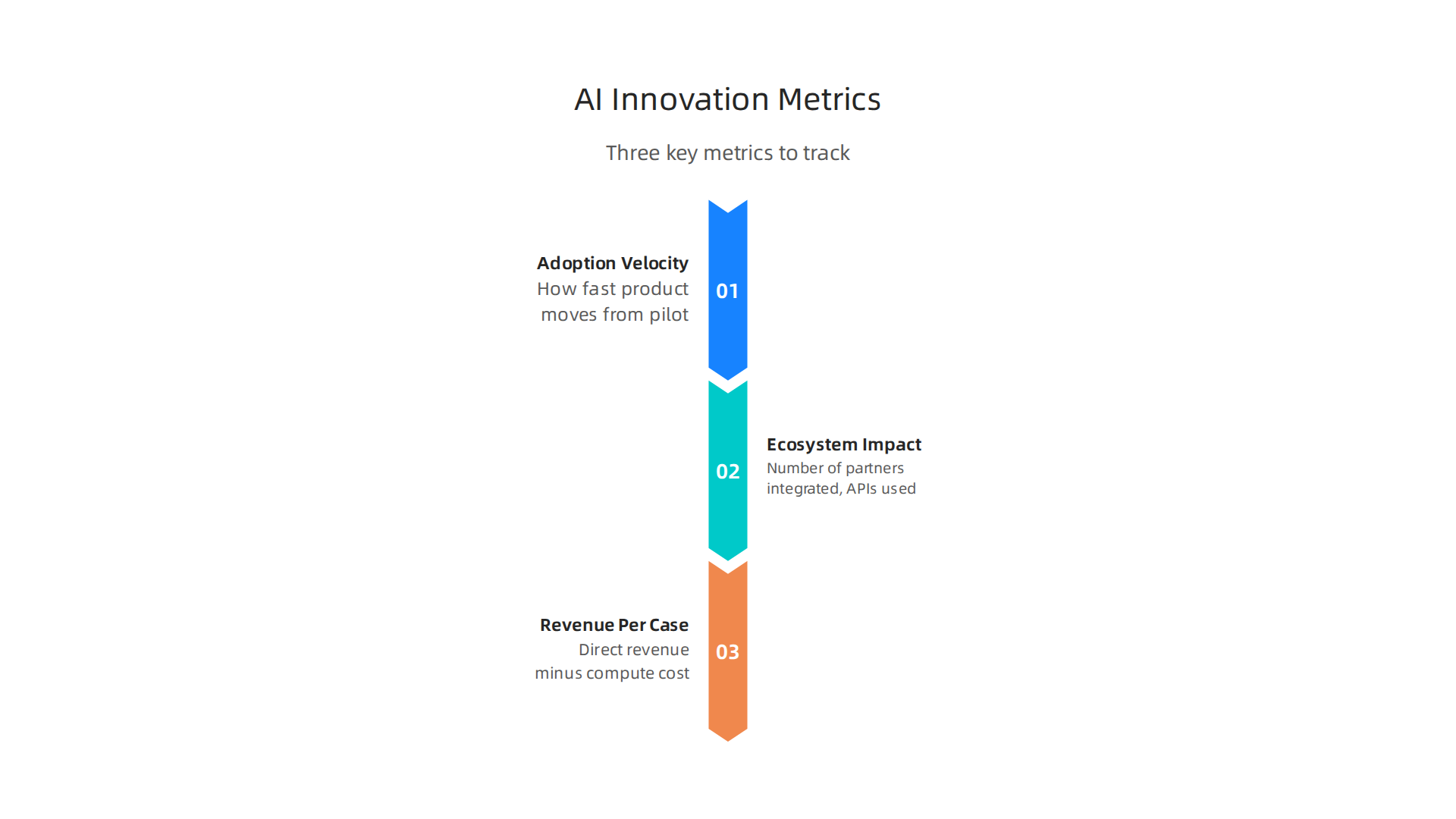
The good news is that new frameworks are emerging. Experts call this "Innovation Accounting" for AI. It moves beyond old metrics and focuses on three things.
Here are the key metrics to track:
| Metric | What It Measures | Why It Matters |
|---|---|---|
| Adoption Velocity | How fast a new AI feature or product moves from pilot to company-wide use | Shows if your team can actually deploy innovation, not just build it |
| Ecosystem Impact | Number of partners integrated, APIs used, and open source contributions | Reflects how well you orchestrate the full AI stack |
| Revenue Per AI Use Case | Direct revenue from AI products minus the cost of compute, data, and talent | Tells you if your innovation actually makes money |
These metrics are not just theoretical. The Stanford Digital Economy Lab’s Enterprise AI Playbook highlights that companies using these kinds of measures are better at linking AI investments to strategic goals.
Tools to Help You Track
To put innovation accounting into practice, you need the right tools. Teams often start by measuring how quickly they can turn ideas into content or prototypes. That is where tools like the best AI text generators in 2026 come in. They help you track content velocity and test new messaging ideas fast. Measuring how fast your team can generate and test new concepts is a real part of innovation accounting.
The bottom line is simple. If you cannot measure your AI innovation, you cannot improve it. The old metrics are broken. The new ones are still forming, but they are far more useful. Stay ahead of this shift.
Get Free Updates from The Deep View Newsletter for clear, daily insights on measuring AI innovation and the latest machine intelligence trends.
Key Innovation Frameworks Driving AI Business Strategy
Now that you know how to measure your AI innovation, the next big question is this. What framework should you use to guide your strategy? The old playbooks still work. But AI changes how you apply them.
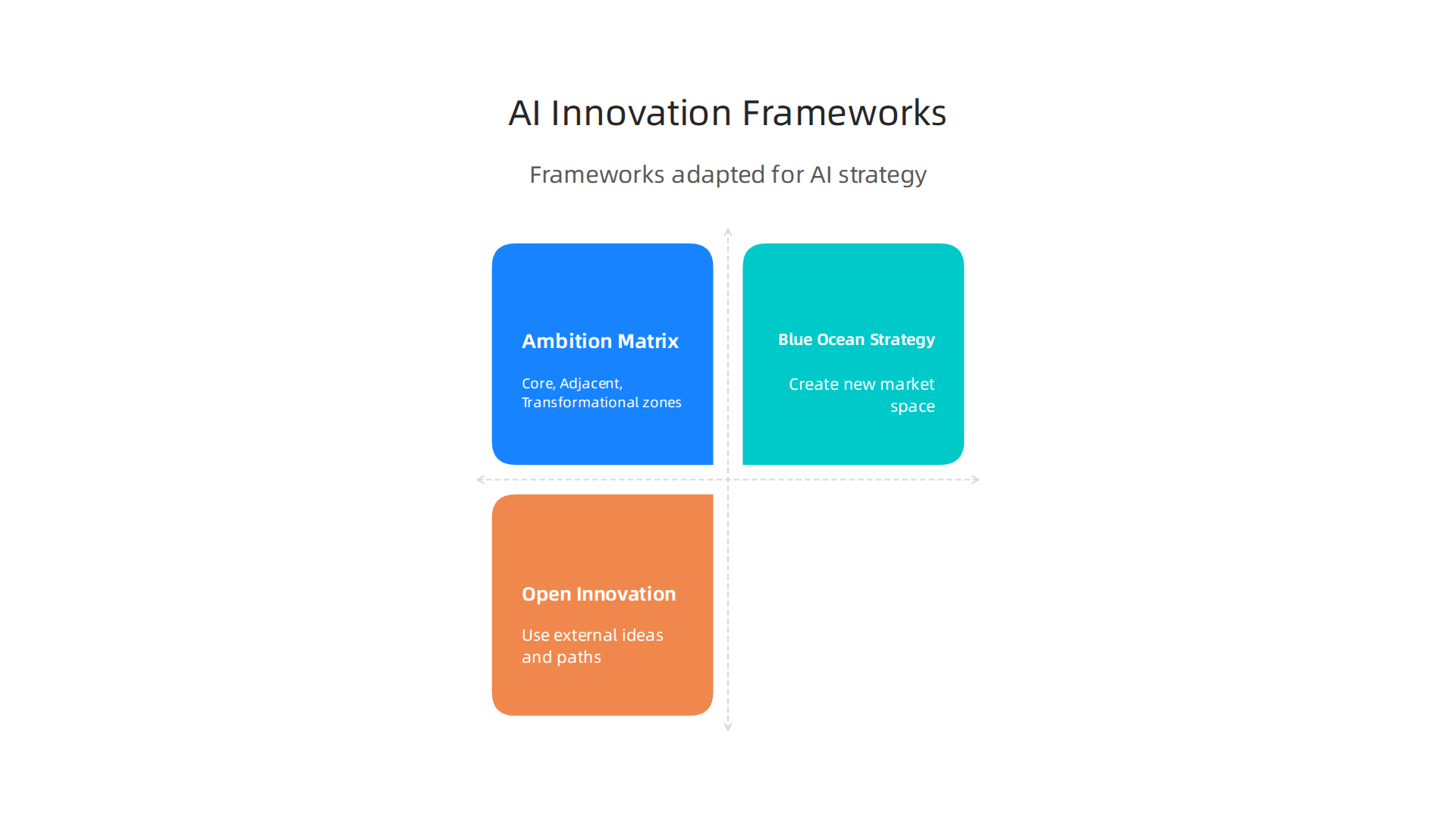
Three classic frameworks are getting a serious upgrade in 2026.
Let’s look at each one.
The Innovation Ambition Matrix Meets AI
This matrix splits innovation into three zones. Core (improve what you have). Adjacent (expand into new areas). Transformational (create entirely new markets). AI supercharges all three.
In the core zone, you use AI to automate workflows or improve customer service. Think chatbots or fraud detection. In the adjacent zone, you launch new products powered by generative AI. In the transformational zone, you build agentic systems that act on their own.
The trick is balancing your bets. The PwC 2026 AI Business Predictions report says focused strategies and responsible innovation are what drive real value. If you put all your money into core improvements, you miss the big leaps. If you only chase moonshots, you run out of runway.
Blue Ocean Strategy Goes Autonomous
Blue Ocean Strategy is about creating new market space instead of fighting in crowded ones. AI makes that easier than ever. With agentic AI, companies can create services that were impossible before. Think of a personal AI assistant that handles your entire travel booking, calendar, and expense reporting without you lifting a finger.
The MIT Sloan Management Review article on the emerging agentic enterprise warns that many companies are adopting agentic AI without a clear strategy. That is a recipe for trouble. You need a framework like Blue Ocean to deliberately carve out new demand, not just add AI to an existing product.
Open Innovation Becomes Ecosystem Innovation
Open Innovation means using external ideas and paths to market. In AI, that is critical. No single company can build everything. The top models come from a mix of labs, open source communities, and cloud providers.
The NVIDIA State of AI 2026 report highlights how growing enterprise adoption depends on ecosystem partnerships. You cannot innovate in isolation. You need to plug into APIs, share data with partners, and contribute to open source. The companies that do this well scale faster.
Which Framework Should You Choose?
Your choice depends on your company’s maturity and market.
- Early-stage startups: Focus on Blue Ocean. Find an uncontested space where AI gives you a unique advantage.
- Growth-stage companies: Use the Innovation Ambition Matrix. Balance quick wins with bold bets.
- Large enterprises: Prioritize Open Innovation. Build an ecosystem of partners and platforms.
No matter which framework you pick, remember that AI innovation is not just about technology. It is about how you organize your team and measure progress. The human side matters too. That is where tools that help you humanize AI text come in. They bridge the gap between machine output and genuine human connection.
The right framework turns innovation from a guessing game into a repeatable process. Pick one and start applying it today.
Subscribe Free to The Deep View Newsletter for daily insights on the frameworks and strategies driving machine intelligence companies.
Innovation in Practice: Lessons from Leading AI Organizations
Theory is great. Frameworks give you a map. But the real magic happens when you see how top AI labs and companies actually get things done. So what do they do differently?
First, they treat innovation as a system, not a moment. Companies like Google DeepMind and OpenAI run internal incubators where researchers can chase wild ideas without immediate pressure to ship a product. This separation between exploration and exploitation matters. When a breakthrough happens, a separate product team takes it to market. That pipeline from lab to launch is clear and fast.
Second, they build interdisciplinary teams. You do not just need data scientists. You need domain experts, ethicists, and product designers sitting together. The 2026 AI Index Report from Stanford HAI shows that industry now produces over 90% of notable frontier models. That speed comes from diverse teams that spot problems early.
Third, they prototype fast and iterate. Instead of perfecting a model for months, leading organizations ship a minimum viable product. They test it with real users and improve in cycles. The Adobe AI and Digital Trends report reveals that brands using rapid prototyping for generative AI saw higher customer satisfaction. Speed beats perfection.
Fourth, they bake responsible innovation into the process from day one. The PwC 2026 AI Business Predictions emphasize that focused strategies paired with responsible guardrails drive real value. Companies that fail on ethics pay later. Those that build it in win trust.
Now, the ROI numbers. According to an Itransition study, 64% of companies cite innovation as the main benefit from AI use. That is not a vague claim. The NVIDIA State of AI report shows that enterprise AI adoption directly drives revenue growth and cost cuts across every industry. One example from the case studies in this industry overview shows a logistics company that cut delivery time by 30% after moving from experimentation to a dedicated AI innovation unit.
The pattern is clear. Interdisciplinary teams plus fast prototypes plus responsible guardrails equals real results. These lessons work for any size company. If you want to start generating your own AI content fast, check out our comparison of the best AI text generators in 2026 to find tools that match your workflow.
Get Free Updates from The Deep View Newsletter for daily stories on how leading organizations turn AI innovation into measurable success.
Cutting Through the Noise: Strategies to Overcome Information Overload
You learned how top organizations turn innovation into real results. But here is the problem. The sheer volume of AI news, research papers, funding announcements, and product launches can overwhelm anyone. Even the best strategies fall flat if you cannot separate signal from noise.
The numbers tell the story. According to the Stanford HAI 2026 AI Index Report, generative AI reached nearly 53% population-level adoption within three years. That explosion means thousands of new articles, pre prints, and press releases every week. A Writer survey in early 2026 found that 75% of executives admit their AI strategy is more for show than actual guidance. One reason? Too much noise, not enough clarity.
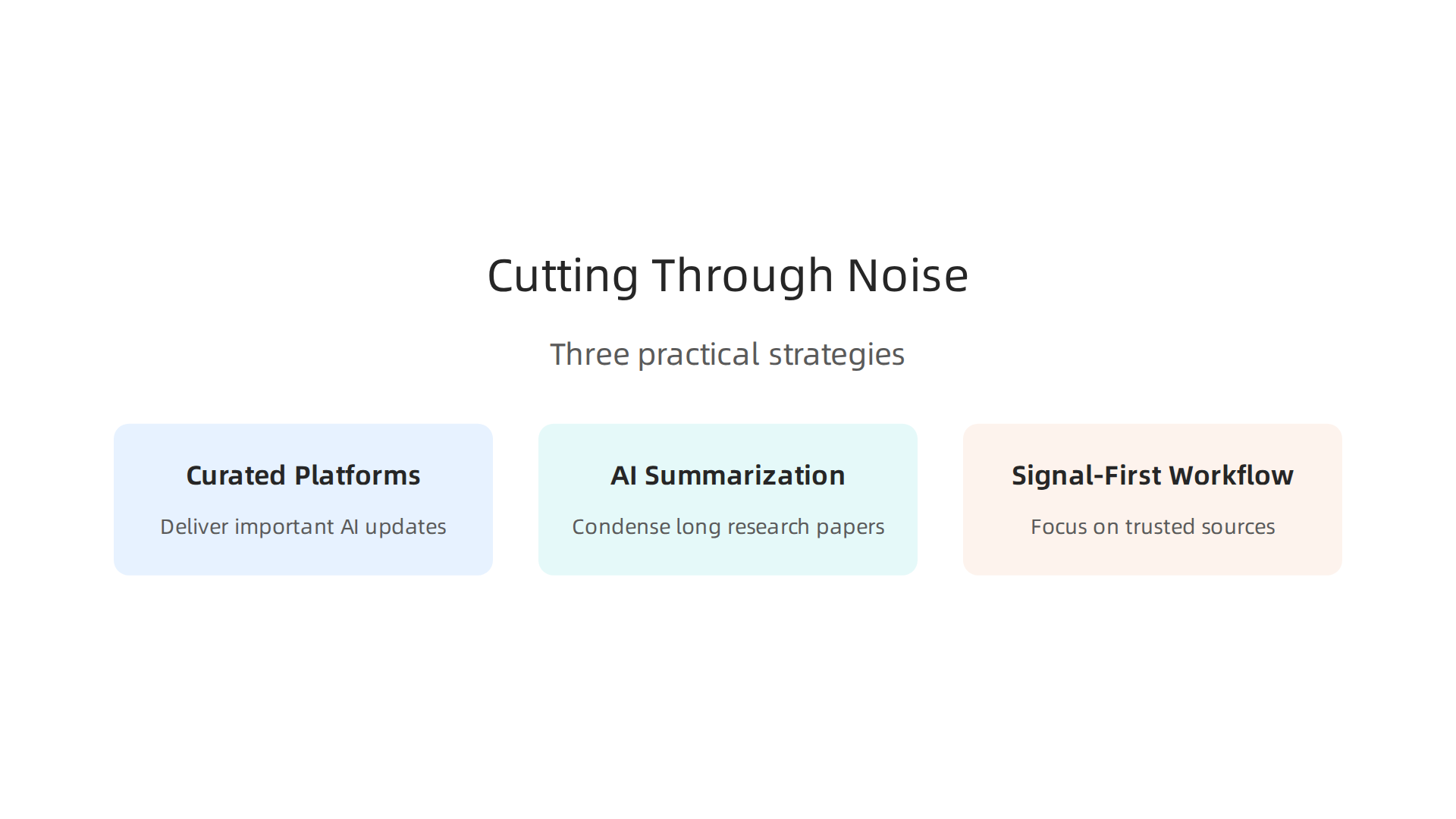
So how do you cut through the noise without burning out? Here are three practical strategies that busy professionals use in 2026.
1. Rely on curated intelligence platforms
Stop trying to monitor every source manually. Curated platforms like The Deep View Newsletter deliver the most important AI industry updates straight to your inbox. Instead of chasing dozens of blogs, you get a distilled, human-edited snapshot of what matters. A recent Expertfile report confirms that senior leaders already use AI tools to summarize meetings and condense documents. Curated newsletters are the next logical step for staying current without the clutter.
2. Use AI to summarize the AI news
Ironically, the very technology causing the overload can help you manage it. AI powered summarization tools condense long research papers, earnings calls, and technical blog posts into digestible takeaways. If you are generating content or reports, learn how to humanize AI text using AI rewriters in 2026 so your summaries feel natural and trustworthy. The key is to let AI handle the first pass, then apply your own judgment.
3. Build a signal-first workflow
Set boundaries. Pick two or three trusted sources and commit to them. Block time each morning for a quick scan. As the Stanford Digital Economy Lab’s Enterprise AI Playbook notes, every week brings new forecasts and debates. You cannot read them all. Instead, focus on sources that align with your role. Investors need funding data. Operators need deployment case studies. Researchers need technical benchmarks. Know your lane.
One more tip. Use AI tools for monitoring and evaluation. An Evalcommunity article breaks down how AI can help with data collection, analysis, and reporting in 2026. Apply that same logic to your own information diet. Set up alerts for key terms. Let the machine flag what deserves your attention.
If you are ready to stop drowning in AI news and start focusing on what actually matters, check out our comparison of the best AI text generators in 2026 to find tools that can help you process information faster.
Subscribe Free to The Deep View Newsletter and get curated AI insights delivered daily. No noise, just what you need to stay ahead.
Future Innovation Trends Shaping AI in 2026-2027
Now that you know how to cut through the noise, let’s look at what actually matters. The real innovation in AI is not about more chatbots. It’s about three big shifts: autonomous agents, multimodal models, and on-device intelligence. These trends will define the next 18 months.
Agents and multimodal models are taking center stage. An AI agent can plan, use tools, and take actions on your behalf. Multimodal models understand text, images, audio, and video together. According to the AlphaSense AI Trends and Outlook for 2026, these capabilities are driving the next wave of enterprise adoption. Instead of just answering questions, AI can now complete entire workflows. For example, a single agent could read an email, summarize a report, and schedule a meeting without human help. And with multimodal skills, it can analyze a chart and explain it in plain language. If you use these models to generate content, you’ll want to humanize AI text using AI rewriters in 2026 so your output feels natural and trustworthy.
On-device AI changes the game for speed and privacy. Running models directly on your phone or laptop avoids sending data to the cloud. This innovation means faster responses, lower costs, and better security. The global AI market is projected to grow from $375.93 billion in 2026 to $2,480.05 billion by 2034, according to Fortune Business Insights. On-device AI is a big part of that growth because it makes AI useful everywhere, not just in data centers.
Regulation will reshape how you innovate. The EU AI Act and the NIST AI Risk Management Framework are setting new rules. These standards force companies to build transparent, safe systems. A PwC responsible AI survey found that 60% of companies say AI boosts ROI, but nearly half still lack proper governance. The Stack Overflow Blog notes that governance approaches like deploying models inside approved platforms are becoming standard. For investors and founders, this means startups that bake compliance into their products early will have a huge advantage. Real innovation now includes responsible design.
How to position yourself. Investors should look for startups building agents for specific industries or on-device AI tools. Founders should focus on solving real problems with multimodal or agentic capabilities, not just slapping AI on old features. The Writer 2026 AI adoption survey found that 75% of executives admit their AI strategy is mostly for show. That means there’s still room for teams that deliver actual results.
Stay ahead of these shifts without the noise. Subscribe Free to The Deep View Newsletter and get clear, daily AI insights that help you spot the real innovation.
Summary
This article explains why innovation in machine intelligence is the decisive competitive advantage for companies, investors, and researchers in 2026, and it cuts through the hype to offer practical guidance. It redefines AI innovation as a mix of business-model change, ecosystem orchestration, and responsible deployment, and argues that foundation models make small improvements or disruptive leaps equally possible. The piece shows why traditional metrics like R&D spend are insufficient and introduces ”innovation accounting”—metrics such as adoption velocity, ecosystem impact, and revenue per AI use case—to link investments to outcomes. It also reviews upgraded strategic frameworks (Innovation Ambition Matrix, Blue Ocean, Open Innovation), operational lessons from leading labs (interdisciplinary teams, fast prototyping, built-in guardrails), and tactical ways to avoid information overload. Finally, it previews near-term trends—autonomous agents, multimodal models, on-device AI, and evolving regulation—and offers concrete next steps leaders can use to measure, organize, and scale AI innovation responsibly.