The world of information technology is moving faster than ever. If you work in IT, you have probably felt the pressure. New tools pop up overnight, and old methods stop working. That is because artificial intelligence is not just a buzzword anymore. It is fundamentally reshaping how data centers run, how security teams defend networks, and how companies build their systems.
This is not a small shift. AI is changing the core of information technology itself. From automating routine server tasks to spotting cyber threats in real time, the changes are everywhere. We are seeing an AI overview that covers everything from predictive maintenance to intelligent cloud management. And the best part? These are just early examples of AI in action. The technology keeps pushing forward, and it shows no signs of slowing down. It can feel like AI with no limits, and that can be both exciting and overwhelming.
For IT professionals, adapting is no longer optional. You need to understand how to work alongside these tools.

You also need to keep real people at the center of the conversation. That is where human centered AI comes in. It is about designing systems that help people, not replace them. If you are looking for practical ways to get started, check out our guide on top AI tools for business in 2026. It covers tools that can save time and boost productivity right now.
This article will explore the key areas where AI is transforming IT. We will look at infrastructure, security, operations, and what it all means for your career. The goal is to help you stay ahead without the noise.
Want to keep up with the latest AI trends without the fluff? Subscribe to The Deep View Newsletter for clear daily updates that actually matter for your work.
1. The AI-Driven Evolution of IT Infrastructure
So, where is the rubber really meeting the road in information technology? The biggest changes are happening in the backbone of every company: IT infrastructure.
From a high-level ai overview, it is clear that data centers are feeling the shift first. Managing a modern data center is incredibly complex. Servers create massive amounts of heat. Power costs keep rising. And downtime costs millions of dollars per minute. According to an analysis by the MIT Sloan School of Management, AI workloads have sent data center emissions way up, but clear solutions are emerging.
AI is now stepping in to optimize nearly everything.
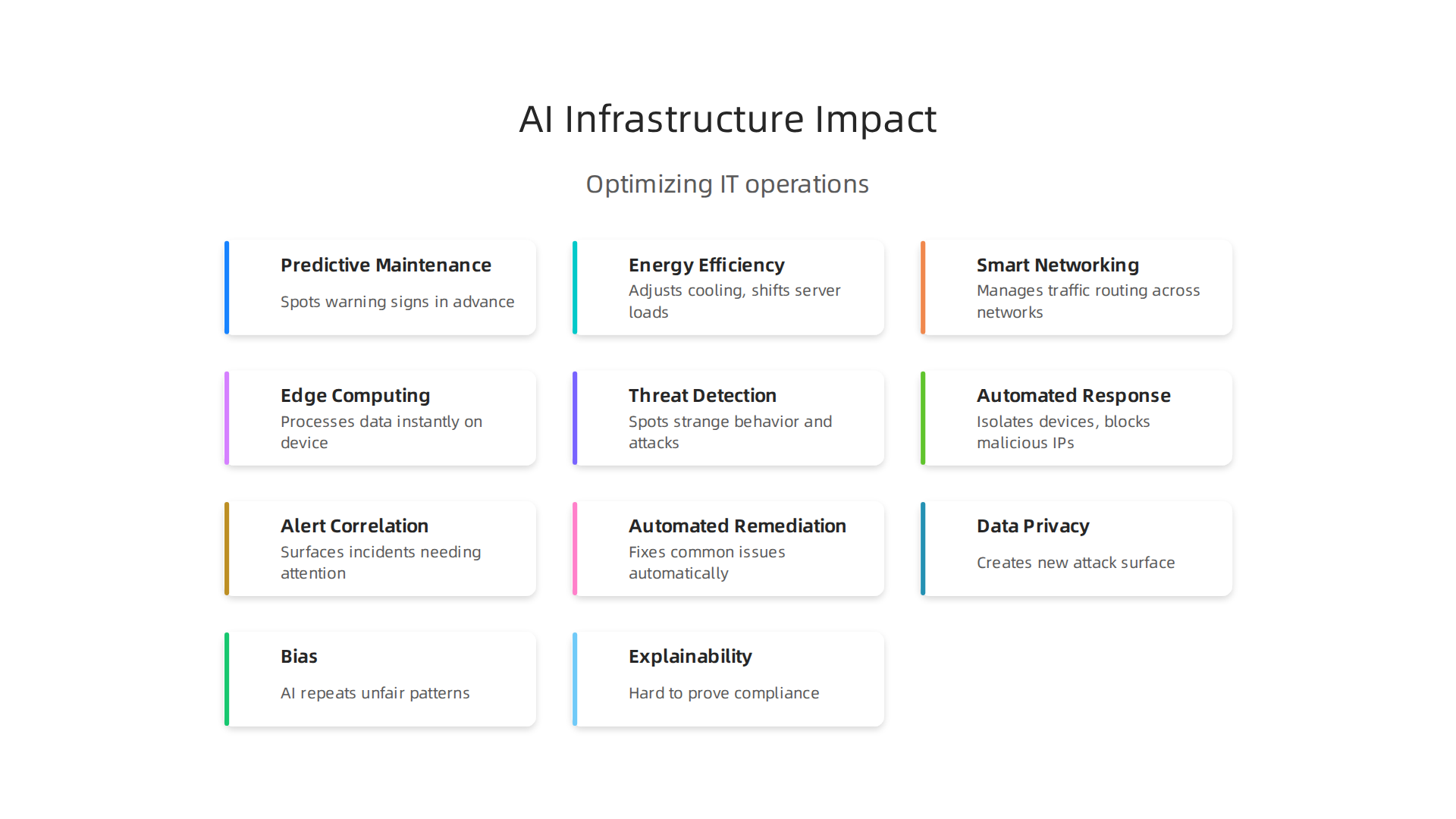
Think about predictive maintenance. Instead of waiting for a hard drive to fail, an AI model watches thousands of server metrics. It spots the warning signs days or even weeks in advance. This is human centered ai at its best. It gives IT teams a clear heads-up so they can fix problems before users ever notice a glitch. The same goes for energy efficiency. AI automatically adjusts cooling systems and shifts server loads to use less power. This saves the company money and helps reduce environmental impact all at once.
Smart networking is evolving fast too. AI tools now manage traffic routing across global networks. They detect strange behavior in real time, which stops cyber threats before they spread. They fix network bottlenecks instantly without a human having to log in. If you want to see how these tools work in real business settings, check out our list of the top AI tools for business in 2026.
Edge computing is also getting a major boost. Many devices need to process data instantly without sending it to a central cloud. AI makes this possible. A smart factory sensor or a self-driving car has to make decisions in milliseconds. It can feel like ai with no limits when you see how fast these systems react. These are powerful examples of ai working behind the scenes to keep our world running smoothly.
The market for AIOps (AI for IT operations) is exploding. A recent report from Straits Research projects it will grow from $8.14 billion in 2026 to $28.97 billion by 2034. Companies are investing heavily because the results are clear: less downtime, lower costs, and faster performance.
But what does this mean for your daily work? It means you are no longer just keeping the lights on. You are becoming a strategist. You guide the AI, set the rules, and step in when the machine gets confused. That is a much more interesting job than rebooting servers at 3 AM.
The AI landscape moves fast. Staying informed is a job in itself. That is why thousands of professionals rely on The Deep View Newsletter to get clear, daily AI updates straight to their inbox. It helps you cut through the noise so you can focus on what actually matters for your infrastructure.
2. AI’s Role in Cybersecurity: From Detection to Response
So, we have seen how AI is reshaping IT infrastructure. Now let us talk about the other side of the coin. The threat landscape is changing just as fast. Attackers are using AI too. They launch attacks at machine speed. According to a 2026 report from the World Economic Forum, 77% of organizations have already adopted AI for cybersecurity. The main reason is to detect phishing and intrusions faster.
Here is the thing. Old security tools relied on signatures. They could only catch known threats. But AI models learn what normal behavior looks like. So when something strange happens, the system spots it right away.
This is where we see powerful examples of ai in action. Machine learning algorithms analyze millions of data points every second. They spot patterns that no human team could ever see.
Take zero-day exploits. These are brand new attacks that have never been seen before. Traditional defenses miss them completely. But AI tools find them by noticing small changes in how files or network traffic behave. A study from SQ Magazine found that 58% of professionals say AI helps them handle large volumes of data for threat detection. That is a huge jump in capability.
Detection is only half the battle. The real game-changer is automated response. In 2026, AI agents do not just raise alarms. They take action. They isolate infected devices. They block malicious IP addresses. They even start the cleanup process. This reduces response times from hours to seconds. You can think of it as human centered ai at its best. The machine handles the repetitive, urgent tasks. The human team steps in for the big decisions.

But attackers are also getting smarter. A report from Darktrace shows that 87% of security leaders say AI is significantly increasing the number of threats.
Attackers use generative AI to create convincing deepfakes and phishing emails. The arms race is real.
This makes AI a must-have tool for any security team. If you are looking at the broader ai overview of business technology, this is a critical shift in information technology. You cannot rely on manual processes anymore. You need systems that can think and react at AI speed. To build a smart strategy, check out our guide on AI innovation strategy and frameworks.
The threats are only getting faster. So your response has to be faster too. AI is the only way to keep up.
Staying ahead of these threats means staying informed. That is why so many security leaders subscribe to the The Deep View Newsletter. It gives you clear daily updates on AI and cybersecurity trends so you can protect your organization.
3. AI in Data Management and Analytics
Data is everywhere. But messy data is useless. Most companies sit on piles of information scattered across different systems. Cleaning it up and making sense of it used to take huge amounts of time and people power. That is where AI changes everything for information technology teams.
Here is the thing. AI automates the boring, repetitive work of data cleansing and integration. Machine learning models scan through millions of records. They spot duplicates, fix formatting errors, and fill in missing values. They also pull data from completely different sources and put it all together in one place. This gives you a single source of truth. No more fighting over which spreadsheet is correct.
Think about predictive analytics. Instead of just looking at what happened yesterday, AI helps you see what is coming next. The algorithms study patterns in your historical data. Then they make forecasts with surprising accuracy. For example, a retailer can predict which products will be in demand next month. A hospital can forecast patient admissions. This kind of decision-making support is a powerful example of ai in action that directly improves business outcomes.
Natural language processing takes things even further. You no longer need a SQL expert to ask questions of your database. With AI tools, you can simply type or speak a question like "Show me sales by region for last quarter." The system understands you and returns the answer instantly. This makes data accessible to everyone in your organization. It is a great example of human centered ai because it puts power in the hands of regular people, not just data scientists.
Of course, all of this AI work needs serious computing power. Data centers are the backbone. According to a report from MIT Sloan, AI workloads have pushed data center energy use way up. But smart companies are finding sustainable solutions. As S&P Global highlights in its 2026 trends report, the industry is adapting with more efficient infrastructure. That is part of the broader ai overview of how technology evolves.
If you want to see the full picture, check out our guide on top AI tools for business in 2026. It covers specific tools that handle data management and analytics so you can start using them today.
The pace of change in AI and data is relentless. To keep your skills sharp and your strategy on track, subscribe to the The Deep View Newsletter. It delivers clear daily insights straight to your inbox so you never miss a shift in the landscape.
4. AI-Powered Advances in Software Development and DevOps
Software developers spend way too much time writing repetitive code, hunting down bugs, and babysitting deployment pipelines. It used to be a huge drag on productivity. But AI is changing that fast across the entire field of information technology.
AI coding assistants like GitHub Copilot have gone mainstream. According to a 2026 survey, a full 84% of developers now use or plan to use AI tools in their work, up from 76% a couple of years ago (Uvik). These tools do not just autocomplete lines. They generate whole functions, suggest tests, and even refactor messy code. Some engineers who use them deliberately see productivity gains of 2 to 3 times (Dev Note). That boost is one of the clearest examples of ai directly helping a business.
Beyond writing code, machine learning models now automate testing and bug detection. AI can scan your codebase, find patterns that often lead to errors, and suggest fixes before you even run a test. It also generates and runs thousands of test cases in seconds. That cuts down the time teams spend on quality assurance. For IT leaders, this means faster releases with fewer nasty surprises in production.
DevOps pipelines are getting smarter too. AI monitors your continuous integration and delivery workflows. It predicts which builds are likely to fail, automatically rolls back bad changes, and optimizes resource usage in the cloud. This reduces downtime and frees up your team to focus on building features instead of fighting fires. It is a perfect case of human centered ai because the technology handles the boring operations while people focus on creative problem solving.
The pace of change is wild. We are starting to see ai with no limits in terms of what agents can do autonomously. If you want to understand the bigger picture of how AI transforms software teams, check out our AI innovation guide to strategy and frameworks. It helps you build a plan that actually works.
To stay ahead of the rapid shifts in AI and DevOps, you need reliable daily insights. Subscribe to The Deep View Newsletter. It delivers clear updates straight to your inbox so you never miss what matters in information technology.
5. AI for IT Operations (AIOps): Automating Management
IT operations teams have a tough job. They are flooded with alerts from servers, networks, and applications. Most of those alerts are false alarms. Sorting through the noise to find the real problems takes hours. That is where AIOps comes in.
AIOps stands for Artificial Intelligence for IT Operations. It uses machine learning to correlate events from different sources and figure out what actually matters.
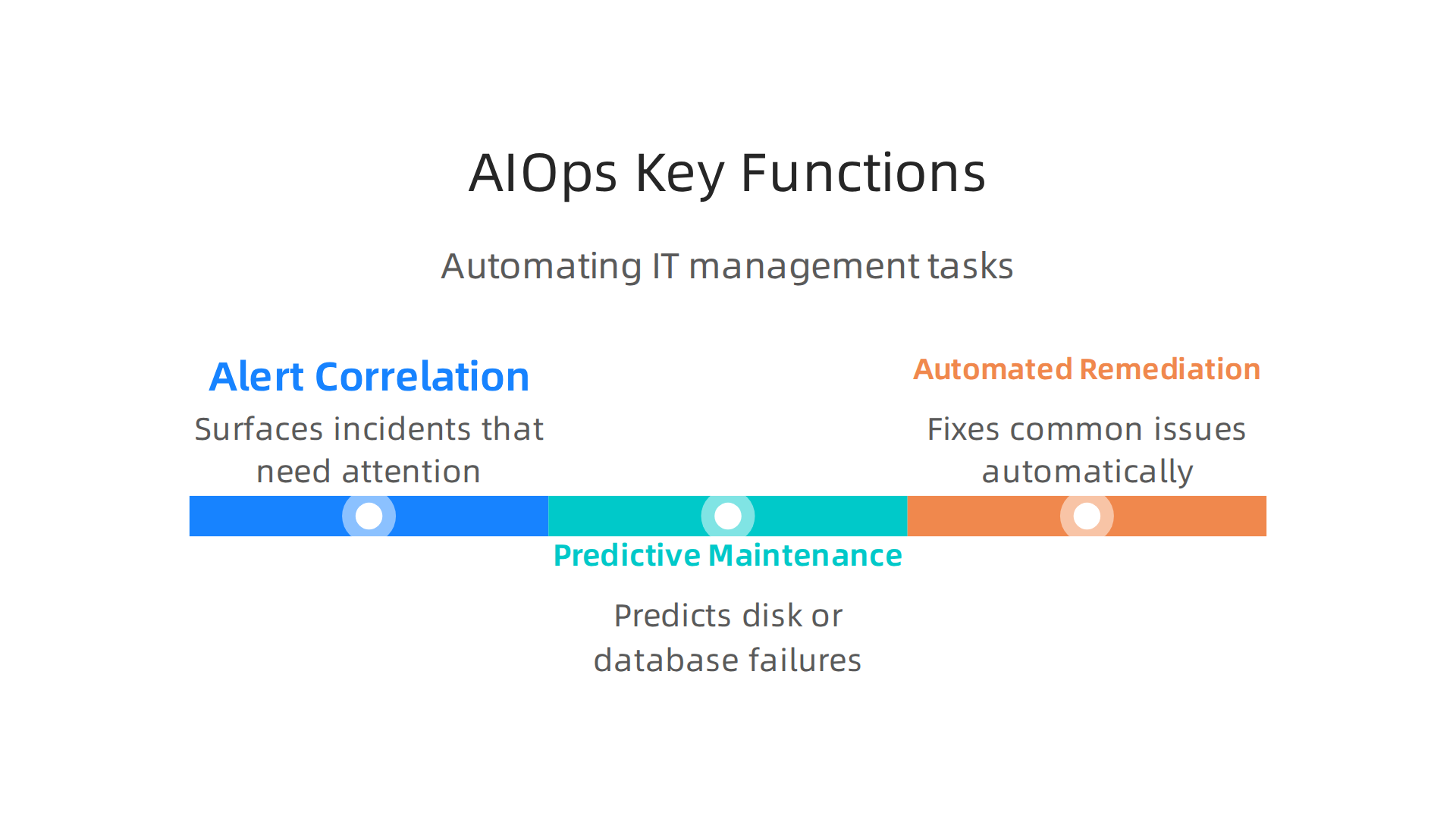
Instead of your team digging through thousands of alerts, the AI surfaces the one or two incidents that need attention right now. This cuts down on wasted time and helps you resolve issues faster. The market is growing fast for a reason. The global AIOps platform market size is projected to grow from $8.14 billion in 2026 to nearly $29 billion by 2034 (Straits Research).
Predictive maintenance is another huge benefit. AI analyzes patterns in your system logs, CPU usage, memory trends, and past failures. It can predict when a disk is about to fail or when a database is going to run out of space. Then it alerts you before the outage happens. This minimizes downtime and keeps your services running smoothly. It is one of the most practical examples of ai directly saving money for a business.
When common issues do pop up, AIOps can fix them automatically. For example, if a server starts running low on memory, the system might restart a service or spin up a new container without any human involved. This automated remediation frees up your IT staff to work on more strategic projects. Instead of spending all day restarting services, they can focus on improving architecture or building new features. That is a perfect case of human centered ai where the machine handles the repetitive stuff and people do what they do best.
According to Gartner, by 2026 over 60% of large enterprises will have moved toward self-healing systems powered by AIOps (Ennetix). That trend is only accelerating. When you look at the broader ai overview, AIOps stands out as a mature and practical application.
If you want to see how AI tools can transform your entire IT operation, check out our guide to the top AI tools for business in 2026. It covers solutions that can help your team work smarter.
To stay current on the rapid developments in AIOps and information technology more broadly, you need a reliable source of daily insights. Subscribe to The Deep View Newsletter. It delivers clear updates straight to your inbox so you never miss what matters.
6. Challenges and Ethical Considerations in AI-IT Integration
Bringing AI into your IT operations sounds great on paper. And it is powerful. But it is not a magic fix.
As information technology teams rush to adopt these tools, some serious problems pop up. If you ignore them, you could end up with more headaches than you started with.
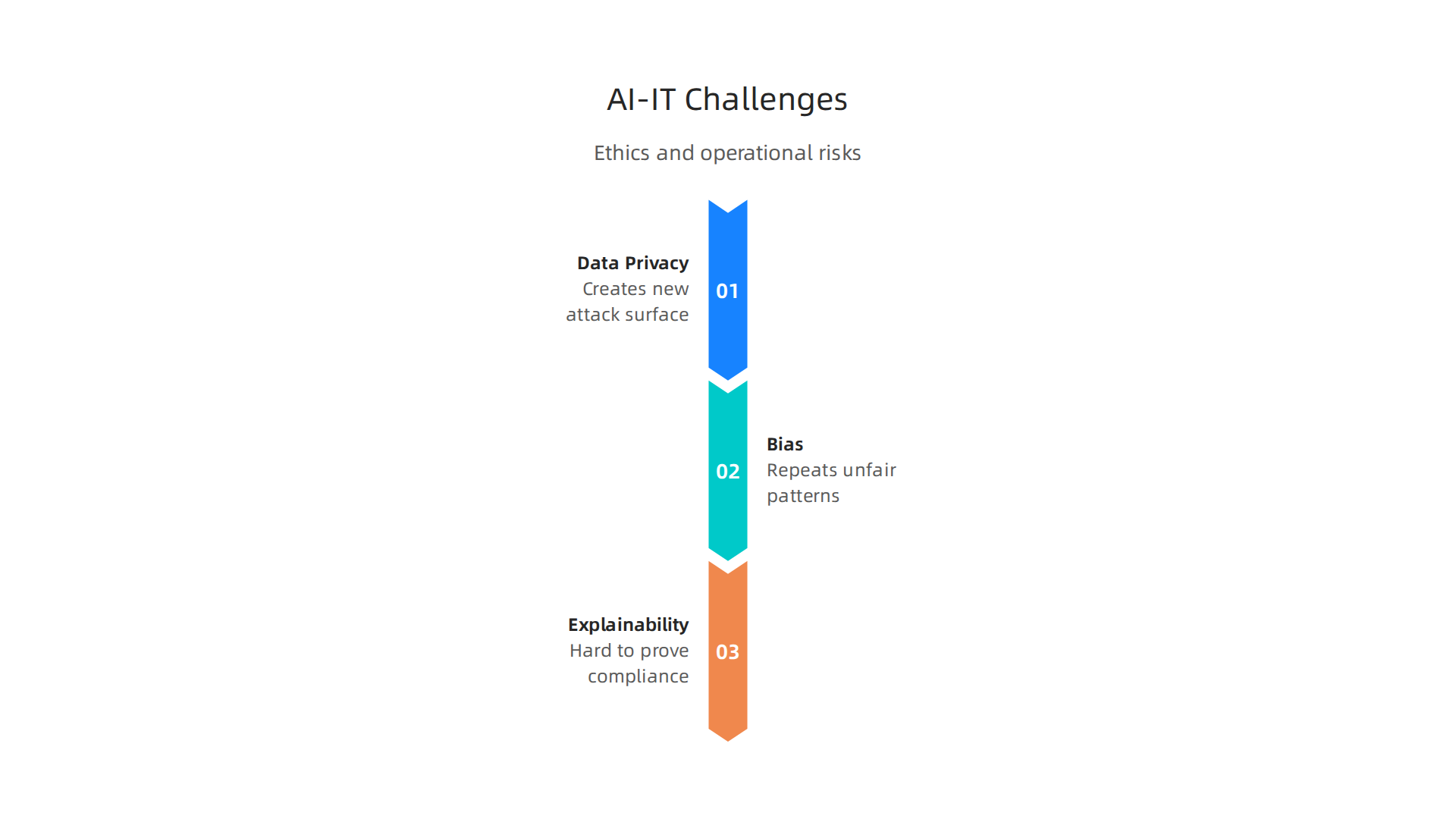
The biggest worry is data privacy. AI systems need huge amounts of data to work well. That data often includes customer records, employee details, and internal communications. When you feed all that sensitive information into an AI model, you create a new attack surface. A 2026 survey found that 92% of security leaders are worried about the security risks that come with using AI agents (Darktrace). And those worries are grounded. More than half of security leaders say AI-powered attacks will be their biggest challenge this year (SentinelOne). If your AI tool gets compromised, everything it touches could leak.
Then there is bias. AI models learn from historical data. If that data contains unfair patterns, the AI will repeat them. In IT, this can show up in weird ways. Maybe an automated system denies access to certain users because of biased training data. Or a resource allocation tool gives more power to some teams over others for no good reason. These are real examples of ai creating unfair outcomes. A human centered ai approach means you need to audit models regularly and fix bias before it causes harm.
Another big problem is explainability. Many AI models are black boxes. They give you an answer but they cannot tell you why. That makes it hard to prove compliance with regulations like GDPR or industry standards. If a regulator asks why your system flagged a customer transaction or denied a service request, you need a clear answer. Without explainability, you open yourself up to fines and lawsuits. This is part of the broader ai overview that every IT leader should understand before deploying.
These challenges do not mean you should avoid AI. They mean you need to build guardrails.

Use data masking, conduct bias audits, and choose explainable models when possible. The promise of ai with no limits sounds exciting, but responsible integration is what keeps your business safe.
Want to stay ahead of these risks and learn how top teams manage them? Subscribe to The Deep View Newsletter. It delivers daily insights on AI trends, ethics, and best practices straight to your inbox.
7. Future Trends: AI and IT Convergence in 2027 and Beyond
The challenges we just covered don’t stop progress. In fact, they push it forward. As information technology teams tackle issues like bias and explainability, the next wave of AI integration is already taking shape. By 2027, the line between AI and IT will blur even more. Here are three big trends to watch.
AI meets quantum computing for IT tasks
Quantum computing is still early, but AI is speeding up its application. In the next few years, AI will help IT teams run simulations, optimize network traffic, and solve complex problems that normal computers cannot handle. Think about it: AI could help design better encryption or find security holes faster. Right now, close to 90% of developers use AI coding assistants daily (SD Times). Those same skills will soon extend to quantum tasks. The combination of AI and quantum will give information technology a huge boost in power.
Autonomous IT systems that heal themselves
Imagine an IT system that fixes its own problems before you even notice them. That future is closer than you think. Autonomous IT systems will use AI to monitor performance, detect failures, and apply patches without human help. They will learn from past issues and prevent them from happening again. This is part of a broader ai overview where machines take on more decision-making. Engineers who use AI tools deliberately already see 2-3x productivity gains (Dev Note). Autonomous IT takes that efficiency and applies it to operations. These systems will reduce downtime and free up your team for bigger projects.
AI and IoT create new IT challenges and opportunities
The Internet of Things (IoT) already connects billions of devices. Add AI to the mix, and you get smarter factories, smarter cities, and smarter hospitals. But more devices means more data and more security risks. AI will help manage this flood of information, finding patterns and spotting threats that humans would miss. At the same time, IT teams will need to build new rules for data privacy and device management. This is where a human centered ai approach matters most. You need AI that puts people first, not just machines. The tools that write 41% of all code in 2026 (Fungies) will also help automate IoT integration.
These trends show that information technology is moving toward a future where AI handles the heavy lifting. But success still depends on smart planning and ethical choices. To keep learning about these trends and how they affect your work, explore our top AI tools for business in 2026. And if you want daily insights on where AI is heading, subscribe to The Deep View Newsletter. It delivers clear, actionable updates so you never fall behind.
Summary
This article explains how artificial intelligence is transforming information technology across infrastructure, security, data, development, and operations. It covers practical AI uses—like predictive maintenance, energy optimization, smart networking, automated threat detection and response, data cleansing and forecasting, and AI-assisted software development—that reduce downtime, cut costs, and speed delivery. The piece also describes AIOps platforms that correlate alerts and enable self-healing systems, and it explains why humans must remain central through human-centered AI design. It warns about real risks such as data privacy exposure, model bias, and lack of explainability, and it recommends building guardrails and audits before large-scale deployment. The article outlines near-term trends—AI at the edge, quantum-assisted tasks, and tighter AI–IoT convergence—and shows how roles in IT will shift from firefighting to strategy and oversight. Readers will get a clear picture of where to start, what tools and frameworks matter, and how to plan responsible adoption so teams can harness AI benefits without unnecessary risk.