
Why embedding AI is the next strategic priority for leaders
In 2026, many business leaders are excited about Artificial Intelligence, or AI. You’ve likely seen it make big promises, and maybe your company has even started a few AI projects. But here’s the thing: are these projects really changing how your business works? Are they adding a lot to your bottom line?
Often, companies try out small AI tools, like an AI personal assistant for one team or an AI analysis tool for a specific task. These small wins are good, but they don’t always turn into big, lasting improvements across the whole company. In fact, a 2026 report by KPMG showed that while 95% of companies have an AI strategy, only 8% actually report clear returns on their investment from these efforts Global AI Pulse Q1 2026. Another study found that even with 88% of businesses adopting AI in some way, only about 25% achieved the results they expected Enterprise AI Adoption Benchmarks 2026. This shows a clear gap between trying AI and truly benefiting from it.
This is where embedding AI comes in. It’s not just about doing small AI tests. It’s about taking AI beyond those early projects and making it a core part of how your business operates every day. Think of it like building a new engine into a car, instead of just adding a small helper gadget. When you focus on embedding AI, you’re looking to create systems that use AI to drive real revenue and make a lasting difference.
For leaders, this means moving away from isolated experiments and towards a plan.

It’s about having a clear way to find the best places for AI, put it into action smoothly, and then grow its use across the company. The goal is to get measurable results that help your business succeed. This structured approach to embedding AI helps turn good ideas into practical tools that work consistently. It’s how you make sure your AI investments don’t just look good on paper but actually help your company grow and innovate. This kind of strategic planning is key to understanding how strategic AI adoption drives business growth in 2026.
To stay on top of how leading companies are successfully integrating AI and turning these challenges into opportunities, consider a reliable source of daily insights.
Get clear daily AI updates from The AI Newsletter Worth Reading.
1) Defining ’embedding AI’ — scope, patterns, and business value
After understanding the need for a smart AI plan, it’s time to get clear on what "embedding AI" truly means. It’s more than just trying out a new program. When we talk about embedding AI, we mean weaving AI deep into the very fabric of your business. It’s about making AI a core part of how your company runs, not just a small side project.
Think of it this way: many companies start by using an AI personal assistant for a team or an AI analysis tool for one special task. These are like adding a new, fancy gadget to your home. But embedding AI is like rebuilding your home’s main systems, like plumbing or electricity, to be smarter and more efficient everywhere.
The big goal of embedding AI is to make sure AI helps your whole company achieve its most important goals. This includes everything from making your products better to improving how you talk to customers, and even helping you find new chances to grow. It’s about moving from small, separate AI uses to a system where AI works together across all parts of your business. This wider view is key to truly changing how you do business.
When companies successfully embed AI, they often see value in a few main ways:
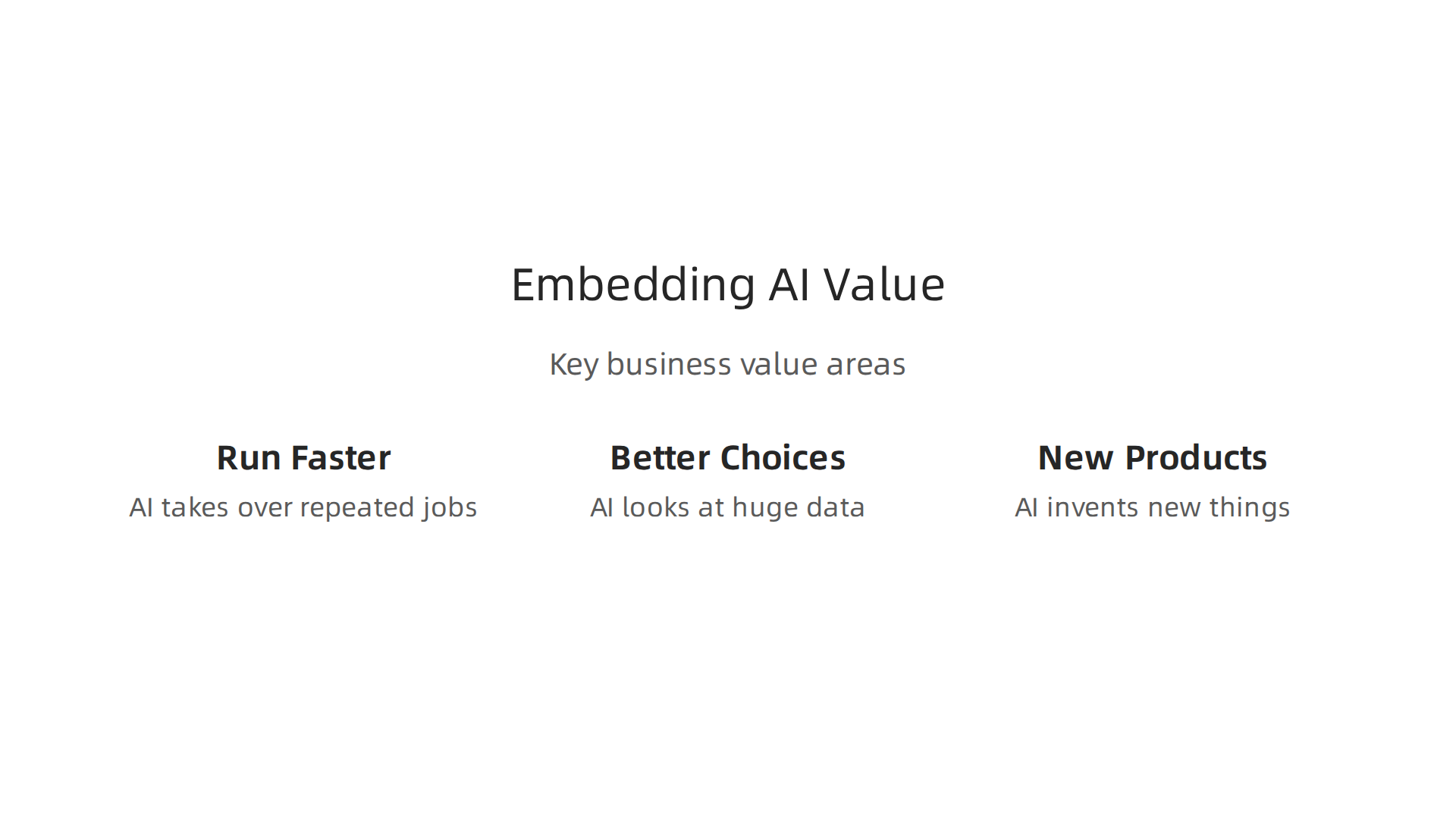
- Making things run faster and smoother: AI can take over simple, repeated jobs, freeing up your team for more important work. This often leads to big improvements in how quickly and well things get done. For example, a 2026 Deloitte report found that two-thirds (66%) of companies that adopted enterprise AI saw gains in productivity and efficiency The State of AI in the Enterprise – 2026 AI report.
- Helping make better choices: With AI, businesses can look at huge amounts of data very quickly. This helps leaders make smarter decisions about everything from what to sell next to how to reach new customers.
- Creating new products and services: Sometimes, embedding AI can even help companies invent completely new things that weren’t possible before. This is especially true for companies that use "outbound AI" to directly interact with customers or shape market trends.
The true business value of embedding AI comes when it’s not just a fancy tool, but a reliable part of your day-to-day operations, always working to make your company better and more profitable. It’s how you ensure your AI efforts lead to lasting success. For a deeper look at how to measure this impact, consider reviewing Smart AI capabilities evaluation and strategic business impact.
2) Prioritizing embedding opportunities: a framework to find high-impact use cases
Now that we know what embedding AI truly means, the next big step is to figure out where in your business AI will do the most good. You can’t just put AI everywhere and expect great results. It’s smarter to pick the spots where AI can have the biggest positive impact. This is where a clear plan, or "framework," comes in handy. It helps you find the best places to embed AI and get a good return on your investment (ROI).

Many companies in 2026 are looking closely at how to make their AI efforts count. In fact, while many invest millions in AI, not all see big returns right away. A good framework helps you look at your business with fresh eyes to see where AI could really shine.
Here are some simple ways to evaluate where embedding AI will give you the most bang for your buck:
- How often something happens (Frequency): Think about tasks that your team does over and over again. If a task happens many times a day, week, or month, then even a small improvement from AI can add up to huge savings or gains over time. For example, if you process thousands of customer requests daily, embedding AI to help with these requests could be a game-changer.
- How many people or things it affects (Scale): Consider how many customers, products, or processes would be touched by the AI. If AI improves something that impacts a large part of your business, the value is much higher. An AI system that makes your main product better for all customers will have a bigger impact than one that only helps a small internal team with a minor task.
- How important the decisions are (Decision Value): Some parts of your business involve making very important choices. If AI can help your leaders or teams make better, faster, and more accurate decisions, that’s a high-value spot for embedding AI. This could be in areas like choosing what new products to build or figuring out the best way to spend marketing money.
Mapping Business Processes to Potential AI Patterns
To find these high-impact areas, you need to look closely at how your business works, step by step. This means mapping out your daily tasks and thinking about where AI could fit in. You might ask:
- Where do we spend a lot of time on simple, repeated tasks?
- Where do we make important decisions that could be better with more data?
- Are there places where we could offer new kinds of help to customers with AI?
By understanding your business processes well, you can start to see patterns where AI could be embedded. This could involve using AI to automate customer service, help with creating content, or even manage supply chains. For example, some companies are using agentic AI to respond to customer inquiries and free up human agents for more complex problems, showing a clear return on investment Enterprise AI Agent Adoption in 2026. This kind of careful thinking helps you pick AI projects that really move the needle for your company. To further guide your company’s strategic AI choices, consider learning about The AI Innovation Guide to Strategy Measurement and Frameworks.
Finding these opportunities is key to not just adopting AI, but truly integrating it for lasting business growth.
Staying ahead in the fast-moving world of machine intelligence can be tough with so much information out there. Get clear daily AI updates from The AI Newsletter Worth Reading.
Finding these opportunities is key to not just adopting AI, but truly integrating it for lasting business growth. Once you know where AI can help your business the most, the next step is to understand the actual parts that make these AI solutions work. Think of it like building a house. First, you decide where the house should go and what it will be used for. Then, you need to pick the right bricks, wood, and other materials to build it.
3) Technical building blocks: embeddings, vector DBs, APIs and integration patterns
When you’re ready to start embedding AI into your business, you’ll need to know about some key technical pieces. These are the tools and systems that let AI understand your data and help your business. Getting these right is super important for your AI projects to work well.
Here are the main technical building blocks:
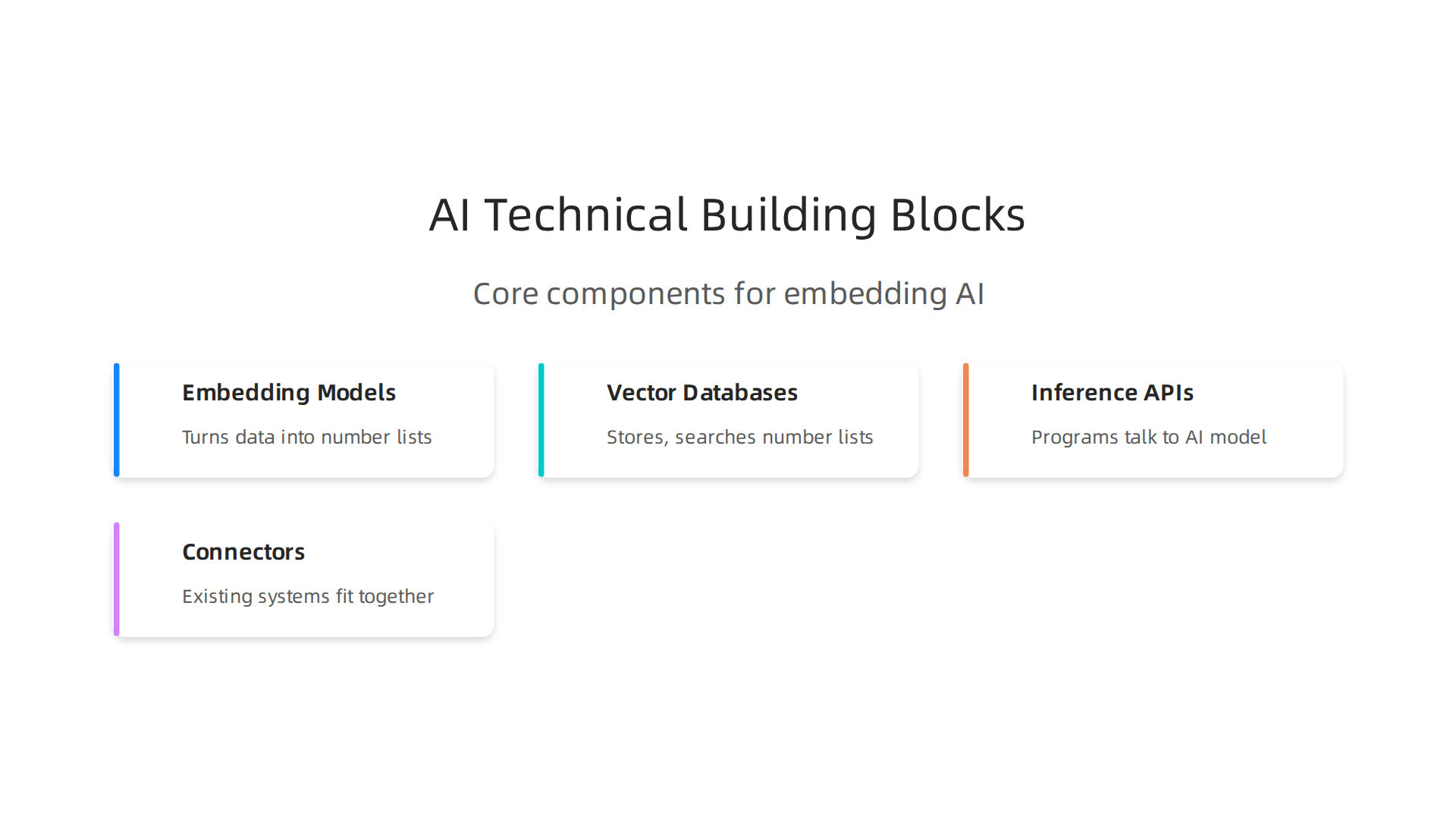
- Embedding Models: Imagine you want to teach a computer about words, pictures, or sounds. Computers don’t understand these things directly. An embedding model is like a special translator that turns words, images, or other data into a list of numbers. These lists of numbers, called "embeddings," capture the meaning and relationships in the data, making it easy for AI to process and compare. For example, if you feed it the word "king" and "queen," their number lists will be very similar in a way that shows they are both royalty, but also have a difference that points to gender.
- Vector Databases (Vector DBs): Once you have all these number lists (embeddings), you need a place to store them. A vector database is a special kind of database built to store and quickly search through these numerical embeddings. It lets AI find similar pieces of information very fast. For instance, if a customer asks a question, the AI turns the question into numbers, then searches the vector database for other stored questions or answers that have similar number patterns. Popular choices in 2026 include Pinecone, Weaviate, and Qdrant, each offering different mixes of speed and features. A look at the Best Vector Databases in 2026: Pricing, Scale & Tradeoffs for RAG AI can show you how they compare. Some databases, like Pinecone, are known for their speed, keeping latency low even with millions of data points, as seen in a 2026 performance analysis Vector Databases in 2026: A Systematic Performance Analysis ….
- Inference APIs: An API (Application Programming Interface) is like a menu that lets different computer programs talk to each other. An inference API is how your business tools can ask an AI model a question and get an answer back. It’s the "brain" part that processes requests and gives responses, whether it’s an outbound AI making predictions or an AI personal assistant drafting an email.
- Connectors and Integration Patterns: These are the ways all the pieces fit together. They help your existing business systems (like your customer service software or sales tools) connect with the AI building blocks. It ensures that data flows smoothly from your systems to the AI and back again.
Important Choices: Latency, Cost, Accuracy, and More
When picking these technical parts for embedding AI, you’ll face some trade-offs. It’s like choosing a car: a fast sports car costs more and uses more gas than a reliable family sedan.
- Latency (Speed): This is how quickly the AI can give you an answer. For things like real-time customer chat, you need very low latency. For tasks that run overnight, speed might not be as critical.
- Cost: Running AI systems can be expensive. You’ll need to think about the cost of the models, the vector database storage, and the computing power needed to make it all work. Comparing different vector databases in 2026, for example, shows a wide range of pricing models, from serverless options to managed services, impacting your overall spending Best Vector Databases: Tested & Compared in 2026 – Mixpeek.
- Accuracy: How correct and reliable are the AI’s answers? For important decisions, high accuracy is a must. For less critical tasks, you might be okay with slightly less perfect answers if it saves money or time.
- Data Privacy: This is about keeping your information safe and private. You need to make sure the AI tools you choose protect sensitive business and customer data.
- Maintainability: How easy is it to keep the AI system running, fix problems, and update it over time? You want a system that’s easy to manage so it doesn’t become a headache later on.
Choosing the right combination of these technical building blocks is crucial for successful AI deployment. To learn more about selecting the right tools, consider how to Choose the Right AI Platforms for Business Growth in 2026.
After you have chosen the right technical pieces for embedding AI into your business, the next big step is to make sure they are actually working well. You need to know if the AI is truly helping your business grow and meet its goals. This means measuring its impact, setting up ways to check its performance, and trying out different approaches to see what works best.
4) Measuring impact: KPIs, instrumentation, and experimentation for embedded AI
When you are embedding AI into your business, it’s like planting a new seed. You want to make sure it grows strong and gives you good fruit. To do this, you need to measure its progress and make sure it’s doing what you hoped. This is where Key Performance Indicators (KPIs), instrumentation, and smart experiments come in handy.
Knowing What to Track: Business and AI Metrics
To see if your AI efforts are working, you need to track important numbers. These numbers can be split into two main groups:
- Business KPIs: These show how the AI is helping your overall business goals. Think about things like:
- More Money: Did the AI help you sell more products or services?
- Less Cost: Did the AI save you money on tasks or operations?
- Happier Customers: Are customers more satisfied because of the AI, like a faster "AI personal assistant" for support?
- Better Productivity: Are your employees getting more done with the help of AI?
Defining these goals clearly helps you understand the true value of your AI. It’s important to set clear goals for what you want your AI to achieve, like reducing costs or making customers happier, and then measure those specific outcomes. Many companies use a mix of numbers to track their progress consistently, as highlighted in "BlueVerse Success Metrics" (LTIMindtree’s proprietary ASPIRE2ADAPT framework) which suggests breaking outcomes into measurable milestones and KPIs.
- Model-Level KPIs: These numbers tell you how well the AI itself is performing its job. For example, if you have an "outbound AI" that sends emails, you might track:
- Accuracy: How correct are the AI’s suggestions or answers?
- Speed (Latency): How fast does the AI give a response?
- Reliability: Does the AI always work without problems?
- Cost: How much does it cost to run the AI model?
Experts suggest evaluating AI systems based on speed, accuracy, trustworthiness, and cost (SATC) to ensure quality and value in the business setting A Framework for Evaluating AI Quality and Value in the Enterprise. Regularly checking these helps you make sure the AI is doing its job right. It’s smart to define the value you expect from your AI right from the start and connect it to specific measurements, from how well the tech performs to how much money it brings in The five-layer AI measurement framework | McKinsey. To learn more about how to check if your AI is making a real difference, check out our article on Smart AI Capabilities Evaluation and Strategic Business Impact.
Setting Up for Success: Instrumentation and Experiments
To measure your AI’s impact, you need to set up ways to collect data. This is called "instrumentation." It means adding tools and codes to your systems so they can automatically record how your AI features are being used and how they are performing.
Once you have your measurements ready, you can start running experiments. This is key for proving that your "embedding AI" efforts are truly working and for making them even better.
- A/B Testing: This is like trying two different recipes for a cake. You give one group of customers the old system and another group the new AI-powered system. Then you compare the results to see which one works better.
- Canary Rollouts: Imagine sending a small bird (a "canary") into a mine to check for danger first. With AI, you roll out a new feature to a very small group of users first. If it works well and there are no problems, you then share it with more people.
- Progressive Rollouts: This is like slowly opening a dam. You gradually let more and more users access the new AI feature over time. This helps you catch any issues early and make changes as needed. Building measurement into these rollout strategies from the beginning is crucial for getting results you can trust The five-layer AI measurement framework | McKinsey. This way, you can keep track of what’s happening and make sure your AI features, like a new "ai analysis tool," are truly helping. Businesses in 2026 are finding that giving their teams room to experiment helps them fine-tune their AI solutions AI in 2026: The AI-native enterprise.
By carefully tracking these numbers and running smart experiments, you can be sure that your AI investments are paying off and helping your business grow.
Stay on top of the latest AI advancements and industry insights to make informed decisions for your business.
The AI Newsletter Worth Reading
By carefully tracking these numbers and running smart experiments, you can be sure that your AI investments are paying off and helping your business grow. But for AI to truly help your business in the long run, it’s not just about the technology and numbers. It’s also about your people and your company’s rules. This means getting your organization ready, managing how people use new AI tools, and setting up clear guidelines for everything.
5) Organizational readiness: teams, change management, and governance
Bringing AI into your business is a big change. For this change to work well, your company needs to be set up in the right way. This includes having the right teams, helping everyone get used to new ways of working, and making sure strong rules are in place for how AI is used. This is all part of making your organization truly ready for "embedding AI".
How to Build Your AI Teams
When you decide to start "embedding AI" more deeply, one big question is how to organize your teams. There are a few main ways to do this:
- Centralized AI Teams: Imagine one main group of AI experts who work together and help all parts of your company. This is good because everyone shares knowledge and tools. It helps keep things consistent and makes sure AI projects follow the same high standards. For companies that want to grow their AI use across many areas, having a clear framework for how AI is used and scaled is very helpful, as some companies like Avnet have shown by scaling enterprise AI for their differentiation goals How Avnet Is Scaling Enterprise AI for Differentiation.
- Federated AI Teams: This is like having smaller AI teams spread out in different departments. For example, the marketing team might have its own AI experts working on an "outbound AI" for emails, and the customer service team might have people working on an "ai personal assistant". This way, each team can focus on their specific needs and make AI work best for them.
- Feature Ownership: No matter how your teams are set up, it’s important to know who is in charge of each AI feature. This means someone needs to "own" the results and make sure the AI tool, like an "ai analysis tool", keeps working well and meeting its goals. Being ready as an organization is key for evaluating new ideas and making sure they help your business, as highlighted in a framework for prioritizing AI use cases AI use case prioritization framework for enterprise ROI.
Making smart choices about your team structure helps your business grow with AI. If you want to learn more about setting up your company for AI success, you can read about designing a global AI strategy for enterprise growth in 2026.
Helping People Adapt: Change Management
Even the best AI tools won’t help if your employees don’t know how to use them or are afraid of them. This is where change management comes in. It’s about helping everyone in your company understand what AI means for their jobs and how to work with these new tools.

- Clear Communication: Explain why your company is using AI and how it will help.
- Training: Give your employees the right training so they feel comfortable and skilled in using AI.
- Support: Make sure there’s a place for people to ask questions and get help.
When AI is designed to be easy for people to use, and when companies help their staff adjust, everyone benefits. It’s about making sure technology works for humans. Learning about designing human-centered AI can help with this.
Rules and Safety: Governance, Security, and Compliance
"Embedding AI" also means having clear rules. These rules protect your company, your customers, and ensure AI is used fairly and safely. This is called governance, security, and compliance.
- Governance: This means setting clear guidelines for how AI is developed, used, and watched over. It includes deciding who makes decisions about AI and how to make sure AI is fair and responsible. Having a framework to make decisions about AI helps businesses make the most of its value An AI decision‐making framework for business value maximization.
- Security: You need to protect your AI systems and the data they use from hacks or mistakes. This means strong cybersecurity measures for all your AI tools.
- Compliance: This is about making sure your AI follows all laws and company rules, especially around data privacy and ethical behavior. For example, if your AI deals with customer information, it must protect that information. It’s important to build AI that is both ethical and transparent for everyone how to build ethical and transparent AI for humans. Companies need to manage risks and set up strong controls when bringing AI into their products and processes Phase 3: Risk & Governance.
By setting up your teams well, helping your employees adapt, and creating strong rules, you make sure your "embedding AI" journey is smooth and successful in 2026 and beyond.
After all the hard work of getting your company ready for AI, setting up your teams, and making rules, the journey isn’t over. You need to make sure your AI tools keep working well, don’t cost too much, and get even better over time. This is about making sure your investment in "embedding AI" truly lasts and keeps bringing value.
6) Scaling and sustaining value: maintenance, cost control, and continuous improvement
Making sure AI continues to help your business means looking after it day-to-day and helping it grow. This involves an ongoing plan for monitoring, updating, keeping costs low, and always making your AI products better.
Operational Playbook: Monitoring and Retraining
Just like a car needs oil changes, AI models need regular check-ups. This is called monitoring. You watch how your AI is performing to catch problems early. For example, an "ai analysis tool" might show that your AI is slowly getting less accurate because the world around it changes. This is known as "model drift." When this happens, you need to retrain your AI with new data to make it smart again. This ensures your AI stays useful and accurate in a changing business world.
Keeping Costs in Check: Cost Control
Keeping costs down is a big part of successful "embedding AI". AI systems, especially those that handle a lot of information, can be expensive. For instance, technologies like vector databases, which help AI quickly find and understand large amounts of data, have different costs and performance levels. In 2026, many options exist, from fully managed services like Pinecone to self-managed ones, each with varying pricing models and performance for different scales of use Best Vector Databases in 2026: Pricing, Scale & Tradeoffs for RAG AI.
Some vector database systems offer lower speed with higher costs, while others focus on saving money for production tasks Vector Databases in 2026: A Systematic Performance Analysis …. It is important to compare these choices carefully, because some companies have found their vector database bills to be much higher than expected Vector DB Bills Exposed: 2.5-4x Over Budget – LeanOps. Making smart choices means looking at how fast an AI tool needs to work versus how much you can spend Best Vector Databases 2026 Compared – Internative.
Continuous Improvement and Learning Loops
To truly benefit from "embedding AI", you need to set up ways for your company to keep learning and getting better. This means creating "learning loops." When your AI tools, like an "ai personal assistant" or an "outbound ai" for sales, show something new or unexpected, your teams should review it. What worked? What didn’t? Why? This helps improve the AI and also teaches your team members. This constant learning prevents mistakes from happening again and helps your AI features get stronger.
You also need "guardrails," which are like safety fences. These rules stop AI from doing things it shouldn’t, making sure it stays fair and reliable. For ongoing success, it’s helpful to understand the Top tech 2026 blueprint for AI growth, which often includes continuous improvement as a core principle. By watching your AI, keeping costs in check, and always finding ways to make things better, your company can keep growing strong with AI. This ongoing effort is key to getting the most out of your AI investments and staying ahead in 2026.
Ready to dive deeper into the world of AI? Get clear daily AI updates by subscribing to The AI Newsletter Worth Reading.
Summary
Embedding AI means moving beyond isolated pilots to make AI a core, repeatable part of how your company runs. This article explains what embedding AI is, why many early projects fail to deliver lasting value, and how leaders can change that by prioritizing high-impact use cases, choosing the right technical building blocks (embeddings, vector DBs, inference APIs), and balancing latency, cost, and accuracy. It walks through a practical framework to find where AI will move the needle—using frequency, scale, and decision value—then covers how to instrument and measure results with KPIs, A/B tests, and progressive rollouts. You’ll also learn organizational best practices for team structure, change management, governance, and security, plus operational advice for monitoring, retraining, and cost control. After reading, leaders will be able to identify promising embedding opportunities, pick the right tools and metrics, set up experiments that prove ROI, and plan governance and scaling to sustain long-term value.