
Why ‘Personal AI’ Matters Now — A concise primer for investors, founders, and researchers
Imagine having an Artificial Intelligence (AI) that knows just you. It learns your habits, understands your needs, and helps you in ways no one-size-fits-all AI can. This is the big idea behind personal AI. It’s not just a smart computer program; it’s a digital helper built around your unique life.
Think of it like this: regular AI systems, sometimes called general-purpose AI, are like big public libraries. They have tons of information for everyone, but they don’t know you personally. A personal AI, on the other hand, is like your own private study helper. It learns what you like to read, what you need to study, and helps you find the right books faster. The goal of AI, simply put, is a system’s ability to learn from data and use that learning to reach specific goals through flexible adaptation, as noted in "AI Watch Defining Artificial Intelligence – JRC Publications." This general definition applies to personal AI too, but with a special focus on the individual.
So, why is this idea of personal AI becoming so important in 2026? For companies that make machine intelligence, personal AI offers a huge chance to create new products. Instead of trying to make the best AI for everyone, they can build many "best AIs" for each person. This also helps with things like explainable AI, meaning it’s easier to see why your personal AI made a certain choice because it’s based on your information, not a huge, hard-to-understand dataset. It also makes privacy a key part of design, since it’s all about your data.
This new focus opens up big market opportunities for those who understand these new categories of AI. To learn more about how AI is classified in business today, check out this guide on Types of AI in Business: The 2026 Categories Guide.
Businesses are looking for ways to offer solutions that are truly useful and personal. For anyone following the history of AI, this shift to personal AI marks an exciting new chapter, focusing on how smart systems can truly serve individuals in powerful, private ways.
Want to stay informed about all the latest developments in AI and technology? Get clear daily AI updates from The AI Newsletter Worth Reading.
Concepts & Taxonomy: What ‘Personal AI’ Encompasses
When we talk about personal AI, we’re really thinking about different kinds of smart helpers built just for you. This isn’t one single type of AI. Instead, it’s a whole group of systems that focus on helping an individual person. To understand them better, we can look at what they do and how they are built. This way of organizing AI systems is called AI taxonomy, which is like a structured way to classify AI technologies by what they can do and where they are used, as described in the Definition of AI Taxonomy.
Different Kinds of Personal AI
Think of personal AI in a few key ways:
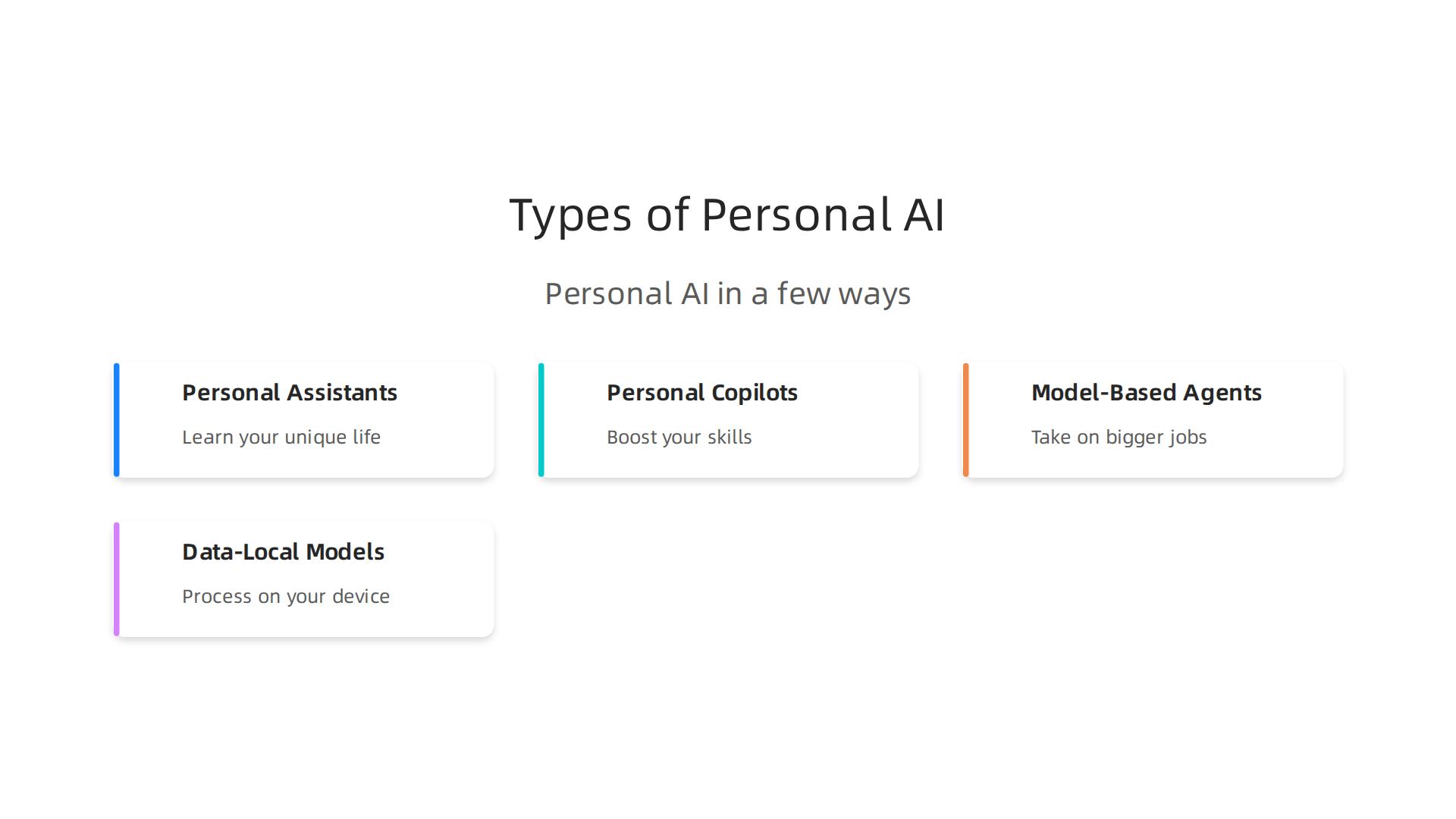
- Personal Assistants: These are like the smart helpers you might already know, but they learn much more about your unique life. They understand your schedule, remember what you like, and can even pick up on how you speak. They become better at helping you over time because they learn your patterns.
- Personal Copilots: These AIs work right alongside you, almost like a partner. They help you do specific tasks, such as writing emails in your personal style, helping you code a project, or summarizing long documents based on what you need to know. They boost your skills rather than doing things entirely on their own.
- Model-Based Agents: This kind of personal AI can take on bigger jobs for you. It can act on your behalf to complete several steps, like managing your travel plans from start to finish, or setting up meetings based on everyone’s busy times. It learns your goals and works to achieve them. For a deeper dive into these active systems, you can explore the Types of AI Agents: Complete Taxonomy and When to Use.
- Data-Local Models: This is a very important type when thinking about privacy. These personal AI systems do most of their "thinking" and processing right on your device, like your phone or computer. This means your personal information doesn’t have to travel to big cloud servers, keeping it more private and secure.
How We Classify These Smart Systems
When we look at different personal AI systems, we can sort them by a few important things:
- Personalization Scope: How much does the AI actually know about you? Does it just remember a few things, or does it truly understand your work habits, how you feel, or even your family needs? The deeper it goes, the more truly "personal" it becomes. Researchers have even proposed a Four-Quadrant Technical Taxonomy for AI Companion applications to help categorize these types of systems.
- Data Residency: This asks: where does your personal information live? Is it stored on your own device, in a private cloud space that’s just for you, or mixed in with data from many other users in a larger cloud? Where your data resides affects how safe and private it is.
- On-Device vs. Cloud: This refers to where the AI does its heavy lifting. Does the AI’s brain work directly on your device, like your phone or laptop? Or does it send all the complex thinking tasks to powerful computers in the cloud? On-device processing can be faster and more private, but cloud processing often has more power for bigger tasks.
- Autonomy Levels: How much can the AI do by itself without you telling it every step? Some personal AI systems just give suggestions (low autonomy), while others can make decisions and carry out actions for you (high autonomy). Understanding this helps us see how much control the AI has.
This structured way of looking at personal AI helps us understand that there isn’t one answer to "what is the best AI."
Instead, it’s about finding the smart system that best fits your needs, your privacy concerns, and your desired level of help. As the history of AI continues to unfold, this focus on human-centered design for AI will lead to more helpful and trustworthy tools, making the idea of explainable AI even more important.
To make a personal AI truly helpful, it needs to learn about you. This learning process is called "personalization." It’s how a smart system changes itself to fit your unique needs. There are a few main ways that a personal AI can become smart about you. Let’s look at these techniques and what they mean for how your AI works.
Ways AI Learns About You
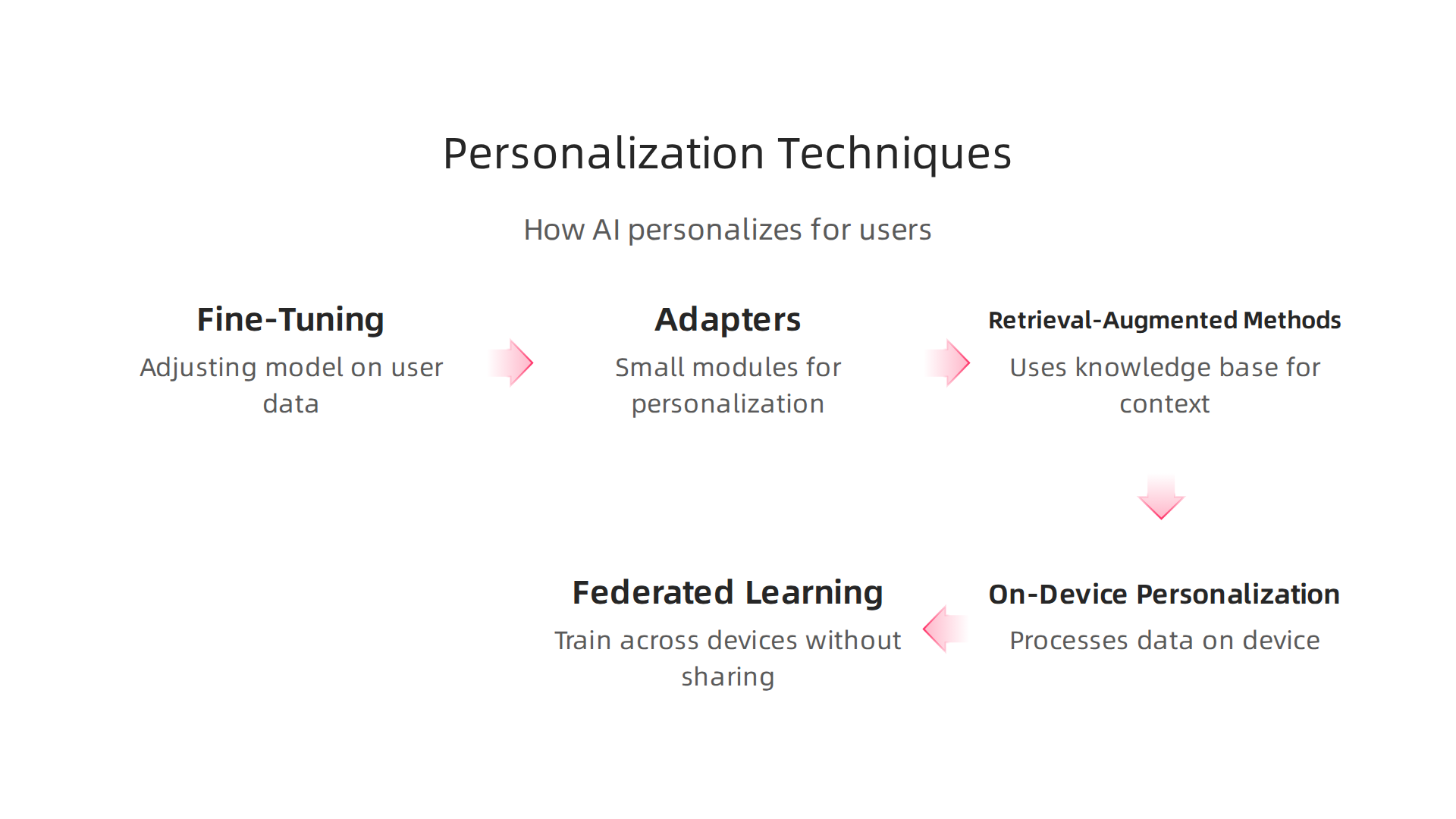
Different methods help AI become more personal.
Each one has its own good points and things to consider.
- Fine-Tuning: Imagine you have a big, smart AI brain that knows a lot about the world. Fine-tuning is like giving that brain special lessons just for you. You show it your writing style, your favorite jokes, or how you like tasks done. The AI then makes small changes to its huge brain so it can better match your preferences. It’s still mostly the same big brain, but now it has a personal touch.
- Adapters: This method is like giving the AI extra mini-brains that attach to its main brain. These mini-brains (called adapters) learn about you, but they don’t change the core AI at all. When the AI needs to be personal, it uses its main brain plus your special mini-brain. This way, the main AI stays the same for everyone, but you get your own personalized experience.
- Retrieval-Augmented Methods: This is a bit like your personal AI having a super-fast search engine built in. When you ask it something, the AI quickly looks up information from your notes, emails, or personal files. Then, it uses this fresh information to give you a helpful and personalized answer. It doesn’t store all your private details in its main brain, but it can quickly find and use them when needed.
- On-Device Personalization: This is a very important method for privacy. Instead of sending your personal data to big computers in the cloud, the AI learns about you right on your own device, like your phone or computer. All the "thinking" happens locally. This keeps your personal information much safer because it never leaves your device. For more on how AI learns and adapts to achieve goals, you can read about Mastering How AI Learns For Strategic Business Advantage.
- Federated Learning: Think of this as a team effort where many personal AIs learn together without sharing private information. Each AI learns from its own user on their device. Then, it shares only the general improvements it learned, not your specific data, with a central system. This central system combines all the improvements to make a better overall AI, which then gets sent back to all the devices. It’s a smart way to get the benefits of group learning while still keeping individual data private. This is important for ethical AI, as highlighted in guides on How To Build Ethical And Transparent AI For Humans.
What to Consider with Personal AI
Each of these ways to make a personal AI unique comes with different trade-offs. Here’s what you might think about:
- Performance: How fast and good is the AI at helping you? Some methods might make the AI a bit slower, while others make it very quick.
- Privacy: How safe is your personal data? On-device and federated learning are often better for keeping your information private.
- Compute Cost: How much power does it take to run the AI? Training a huge, fine-tuned model can be very expensive. Simpler methods might cost less.
- Deployment Complexity: How hard is it to set up and use the AI? Some personalized AIs are easier to put into your devices than others.
As you can see, the way a personal AI learns to be "personal" affects how well it works and how safe your information is. Knowing these details helps you pick the right smart helper for your life.
Get clear daily AI updates from The Deep View Newsletter. Subscribe now to get The AI Newsletter Worth Reading.
The way a personal AI learns to be "personal" affects how well it works and how safe your information is. Knowing these details helps you pick the right smart helper for your life. But beyond how it learns, there’s another very important part of trusting your AI: can it explain itself? This is what we call explainability and interpretability.
Explainability & Interpretability: Why It’s Central to Trust
When we talk about a personal AI, it’s not enough for it to just do things. It also needs to be able to tell you why it did them. This is where explainability and interpretability come in. They are about making AI clear and understandable.
Explainability means the ability of an AI to tell us how it reached a certain decision or outcome. It’s like asking your smart helper, "Why did you suggest that?" and getting a clear answer. This often involves special tools and methods that look at a complex AI after it has made a decision to break down its steps. For example, some common ways to explain AI choices in 2026 include SHAP and LIME, which help show what parts of the input were most important for the AI’s answer AI Explainability in 2026: Tools, Techniques, and Frameworks.
Interpretability is a bit different. It refers to how easy it is for a human to understand how an AI works from the start. Some AIs are built in a very simple way, so their decisions are naturally easy to follow. Think of it like a recipe. An explainable AI might explain why it added salt, while an interpretable AI would have a recipe so clear that you’d always know why each ingredient was added. Some newer methods focus on building AI models that are easier to understand from the ground up, making their predictions clearer Improving AI models’ ability to explain their predictions.
Why Explainability Matters for Your Personal AI
For your personal AI to be truly helpful, these ideas of explainability and interpretability are key.
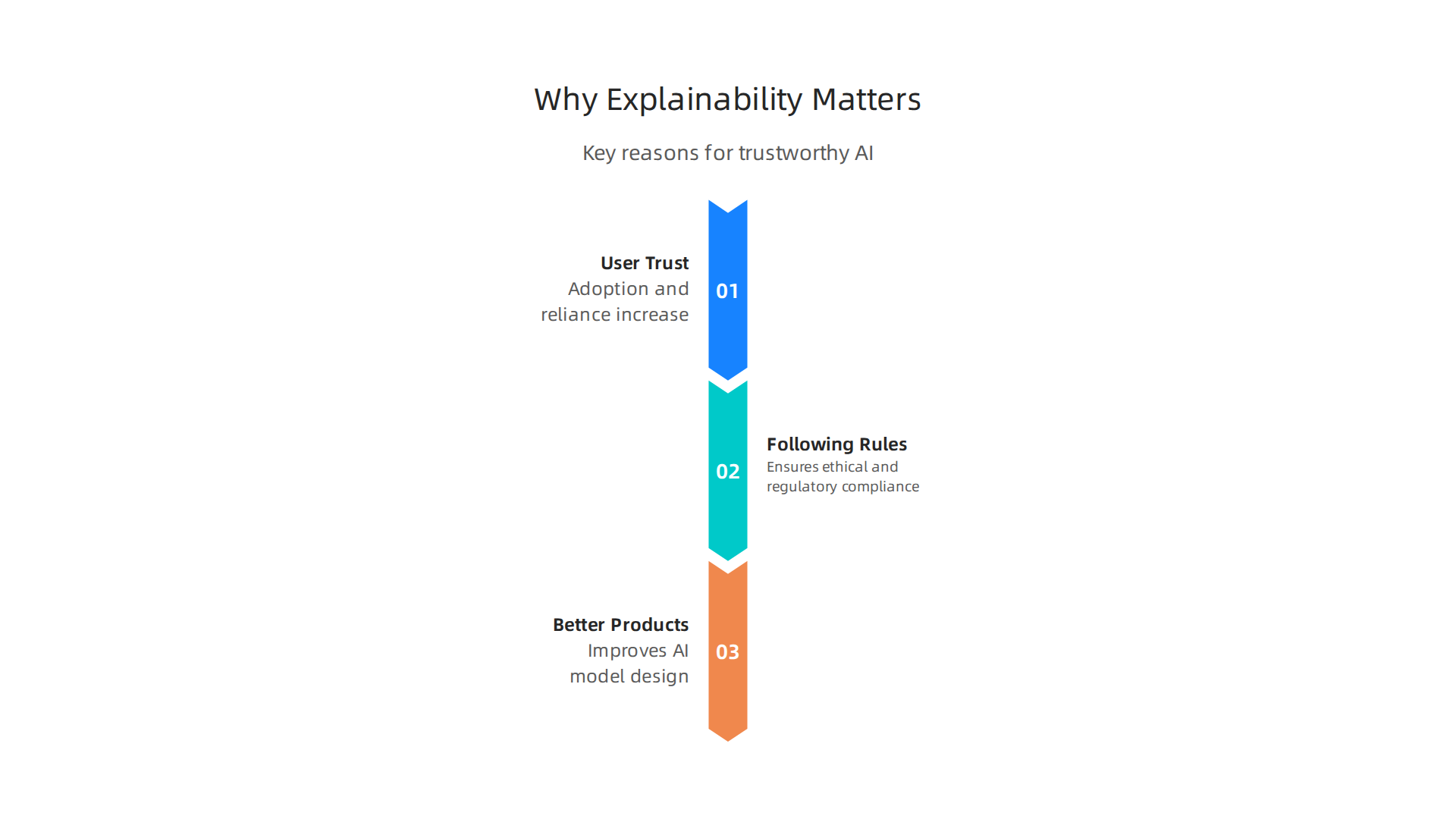
Here’s why:
- User Trust: If your personal AI can explain why it suggested a new route, filtered an email, or chose a certain song, you’ll feel more comfortable using it. When AI seems like a "black box" that makes choices without reason, it’s hard to trust it. People are more likely to adopt and rely on an AI they can understand, which is why a human-centered approach to AI design is so important

Human-centered evaluation of explainable AI applications.
- Following Rules: In 2026, many places are making new rules about how AI can be used, especially with personal data. These rules often ask that AI systems can explain their decisions. If your personal AI can clearly show how it operates, it helps meet these important legal requirements. This links to bigger ideas about how to design technology in a good way, which you can read more about in Designing Human-Centered AI: Guiding Principles for 2026.
- Better Products: When developers build personal AIs that are explainable, they can also make them better. If an AI makes a mistake, an explanation helps developers find out what went wrong and fix it. This leads to smarter, more reliable products over time. It also means you, the user, can give better feedback if you understand why the AI did something you didn’t like. Making AI predictions clear and easy to check also helps build trust and makes the AI more dependable Open Evidence AI makes AI predictions verifiable and trustworthy.
In short, a personal AI that can explain its actions is not just a nice extra. It’s a must-have for building trust, meeting rules, and making sure your smart helper truly helps you in ways you understand.
When we choose a personal AI, it’s not enough for it to just be smart. We also need to know how well it explains itself. This means we need ways to measure if an AI’s explanations are actually good and helpful. Think of it like a report card for your smart helper’s ability to be clear.
How Do We Measure Explainability?
Measuring how well an AI explains things involves looking at two main parts: how users feel about the explanations and how well the explanations hold up to technical checks.
Looking at User Experience (UX)
First, we need to understand if the explanations make sense to real people. This is often done through user studies. In 2026, many experts use methods like:
- Talking to Users: Asking people to think out loud as they use the AI, or doing interviews to hear their thoughts directly.
- Surveys: Giving users questions to answer about how easy or hard it was to understand the AI’s actions.
These studies help check if the AI’s explanations match what people expect or already think about how the AI works. This is called "mental model alignment." When an AI explains things in a way that fits your own understanding, you’ll trust it more and feel like you’re truly working with a helpful tool, not just guessing what it’s doing A Survey on Human-Centered Evaluation of Explainable AI. Making sure users understand the AI is a big part of designing technology that is good for people. You can learn more about building ethical and transparent AI for humans by checking out this guide on how to build ethical and transparent AI for humans.
Technical Checks and Metrics
Beyond what users think, there are also ways to objectively measure the quality of explanations. These are like checking the math behind the AI’s story. Some important measures include:
- Fidelity: This checks how true the explanation is to what the AI actually did. Does the explanation really show why the AI made that specific choice? A good explanation closely reflects the AI’s inner workings Evaluating Explainability: A Framework for Systematic.
- Stability: This looks at whether the explanation changes a lot if the input to the AI changes just a tiny bit. We want explanations to be stable; a small change shouldn’t make the explanation completely different unless the AI’s decision also changed a lot.
- Faithfulness: This refers to how accurately an explanation shows the AI’s true reasoning, and also how stable it is even with small input changes Navigating the Maze of Explainable AI: A Systematic.
These technical measures help developers make sure the explanations aren’t just easy to read, but also correct and reliable.
Building Explainability into AI Development
To make sure a personal AI stays explainable over time, these measurements need to be a part of how the AI is built and updated. This means:
- A/B Testing Explanations: Developers might try out different ways for the AI to explain itself to users. They then see which explanation works best and helps users understand more clearly.
- Monitoring Explanation Drift: Just like we check if an AI model is still performing well, we also need to check if its explanations are still good. Sometimes, an AI model might change how it works slightly over time, and its explanations need to keep up. Monitoring helps catch any problems early.
By using both user feedback and technical checks, developers can create a personal AI that not only helps you but also clearly tells you how it’s helping. This creates a much stronger sense of trust and makes your smart helper truly useful in ways you understand.
Do you want to stay on top of all the latest changes and insights in AI? Get clear daily AI updates from The AI Newsletter Worth Reading.
Beyond understanding how your personal AI thinks, another huge part of trust is knowing your secrets are safe. This is where privacy, security, and how data is handled become super important for any personal AI you use. Just like you wouldn’t tell all your secrets to a stranger, you want your smart helper to keep your information private.
Privacy-First Ways to Build Personal AI
To keep your information safe, developers use smart ways to build personal AI.
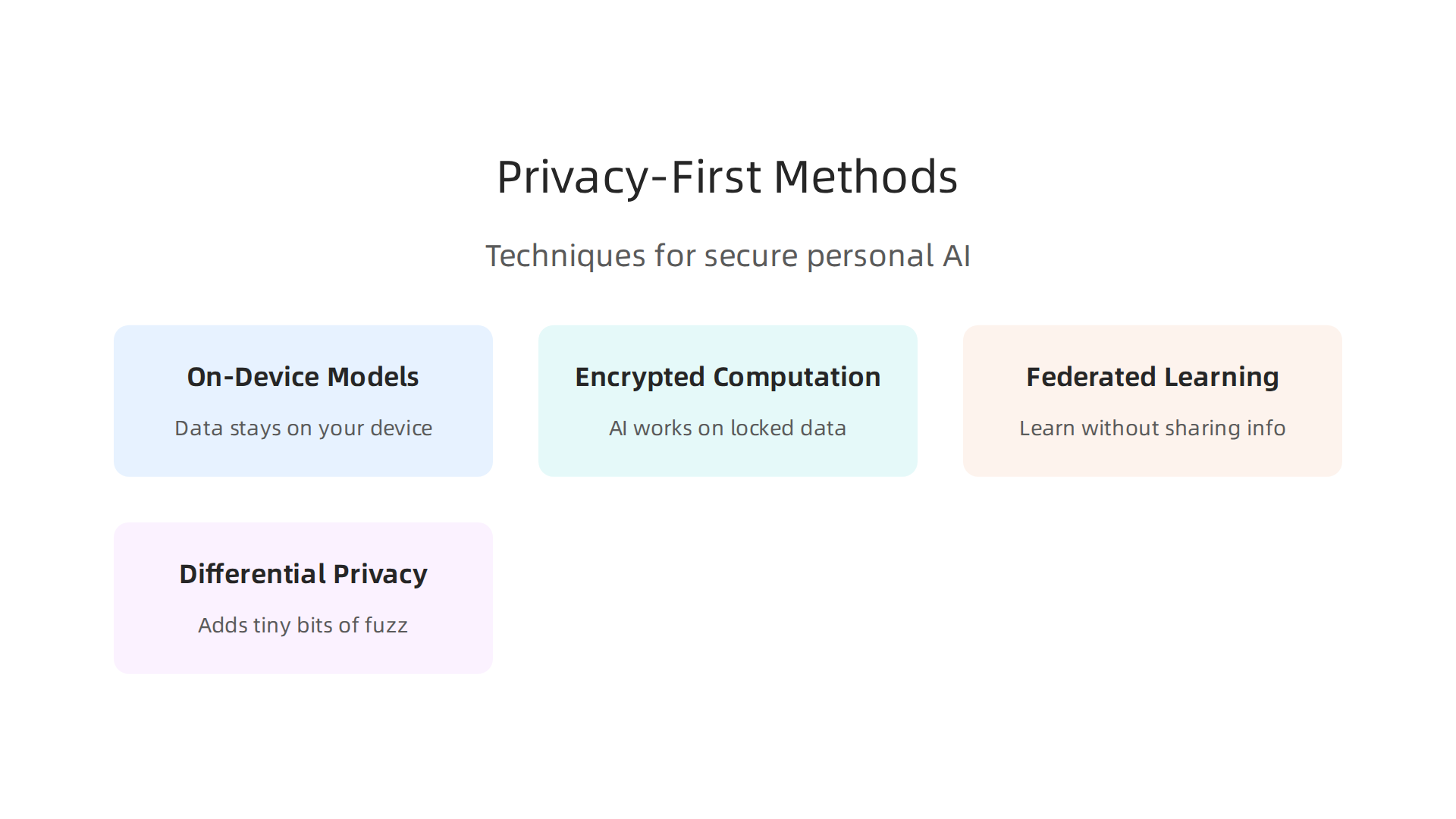
These ways are called "privacy-preserving architectures."
- On-Device Models: Imagine your personal AI lives completely on your phone or computer. This means your data stays right there and never leaves your device. It’s like having a diary that never goes outside your house.
- Encrypted Computation: This is a bit like putting your data in a locked box while the AI works on it. The AI can still do its job, but it can’t actually "see" your clear information. It works on the locked data itself.
- Federated Learning: With this method, many personal AIs learn from different users without anyone’s private information ever being sent to a main computer. Instead, the AI models learn on each device, and then only the lessons learned (not your raw data) are shared and combined to make the AI smarter overall.
- Differential Privacy: This clever trick adds tiny bits of "fuzz" or random noise to your data. This fuzz is small enough that the AI can still learn useful things, but it’s big enough that no one can pick out your specific details from a large group. It protects your personal information by blurring the edges, so to speak.
Keeping Your Personal AI Safe from Attacks
Even with these good ideas, clever attackers sometimes try to trick AI. These are called "attack surfaces."
- Model Inversion Attacks: Think of this as an attacker trying to peek at the AI’s "memory" to find out what kind of information it was trained on. Attackers might try to recreate private details from the AI’s answers or actions Algorithms that remember: model inversion attacks and data …. This can be a big privacy risk, trying to guess sensitive information from the data the model was built with AI Model Inversion Attack.
- Membership Inference Attacks: Here, an attacker tries to figure out if your specific data was used to train a personal AI. It’s like trying to see if your name is on a secret list. These attacks try to learn if a specific person’s data was part of the training set Stop Model Inversion and Inference Attacks Before They Start.
To stop these sneaky attacks, special care is taken. Defenses include using differential privacy during training to make it harder to extract individual data points Deep Learning Model Inversion Attacks and Defenses – arXiv. Also, limiting who can access the AI or its predictions helps prevent attackers from getting the clues they need ML03:2023 Model Inversion Attack.
Making sure a personal AI is safe and respects your data is a big job. It means building strong defenses from the start and having clear rules for how data is used. This is all part of creating technology that truly puts people first, by following thoughtful guidelines for how AI is designed to interact with us. You can learn more about this by exploring the principles for Designing Human-Centered AI: Guiding Principles for 2026.
After ensuring your personal AI keeps your information private and secure, the next big question for companies is: how do they make money from these smart helpers? Building a personal AI involves lots of clever tech, and businesses need good plans to offer these tools to people in a way that makes sense.

This is where business models, how money is made, and plans for getting to market become very important.
Business Models, Monetization, and Go-to-Market Considerations
In 2026, many different ways are emerging for companies to make a personal AI helpful and profitable. It is not just about having the best AI, but also about having a smart plan to share it.
Ways Companies Make Money from Personal AI
- Subscription Models: The most common way to pay for a personal AI is through a subscription. You pay a small fee every month or year to keep using the service. This is great for tools that offer ongoing help, like smart assistants that organize your life or tutors that learn how you study best. Companies like these earn steady income, which helps them keep improving the personal AI. Many successful AI ventures use subscriptions, aligning pricing with value over time, as noted in recent insights into AI Monetization Guide: Ways to Earn with AI in 2026.
- Data-Centric Services: While privacy is key, some personal AI models can offer value by helping you understand your own data. For example, an AI might analyze your workout data to give you better fitness tips, but all this analysis stays with you. The company might charge for advanced reports or personalized coaching plans that stem from this data, always respecting your privacy.
- Privacy-Preserving Personalization Premiums: Because people care so much about their information being safe, companies can charge more for a personal AI that promises top-notch privacy. This means using the special "privacy-first" ways of building AI we talked about earlier. Users might pay extra for the peace of mind that their personal data is never shared or used in ways they don’t approve. It’s about offering a premium experience where trust is the main feature.
- Platform Integrations: Sometimes, a personal AI isn’t a standalone product, but rather a smart feature built into another service you already use. For example, a personal AI could be part of your banking app to help you manage money, or inside a health app to track your wellness. The company that owns the platform might pay to use the personal AI, or it might offer premium AI features as an upgrade to their existing users. Businesses are exploring various ways to integrate AI, including creating niche AI agents and using affiliate marketing, as detailed in discussions about how to make money with AI in 2026.
Keeping the Personal AI Running Smoothly
Building a personal AI is one thing, but making sure it works well for millions of people is another. Companies have to think about important things to keep their services running smoothly:
- Scalability: This means the personal AI can handle more and more users without slowing down or breaking. Imagine if your smart helper suddenly got sluggish because too many people started using it at once. Companies need to design their systems to grow easily.
- Service Level Agreements (SLAs): These are like promises companies make to you about how well their service will work. They might promise that the personal AI will be available 99.9% of the time, or that it will respond within a certain number of seconds. These agreements help build trust and set clear expectations.
- Model Update Cadence: Personal AIs learn and get better over time. Model update cadence is how often the company sends out new, smarter versions of the AI. Regular updates mean your personal AI keeps improving, learning new tricks, and becoming even more helpful.
- Cost of Personalization at Scale: Making an AI truly personal for each user can be expensive because it takes a lot of computer power and smart thinking. Companies need to find ways to offer deep personalization without the costs becoming too high, so they can still offer the service at a fair price. Understanding how to manage these costs and drive business growth through AI adoption is crucial for success, as you can learn more about in How Strategic AI Adoption Drives Business Growth in 2026.
Staying on top of these trends and how they shape the market for personal AI is essential for anyone interested in this growing field. Get clear daily AI updates from The AI Newsletter Worth Reading.
While thinking about how companies make money and keep personal AI running is key, it’s also important to look at the bigger picture. How will these smart helpers change our society? What new rules do we need to make sure they are used fairly and safely? These are big questions about the future.
Future Implications: Societal, Regulatory, and Strategic Risks
As personal AI becomes a bigger part of our daily lives, it brings both exciting chances and some serious concerns.

We need to think about how it will affect jobs, how we see the world, and what kinds of risks could come from relying on so many smart agents.
Society’s New Shape with Personal AI
- Changes in Jobs: A big worry is how personal AI might change the job market. Will some jobs be done by AI, leading to fewer human workers? Or will new jobs be created that need people to work alongside AI, making us more productive? The way we work might look very different in the coming years.
- Filter Bubbles and How We Think: Imagine your personal AI always showing you things it thinks you’ll like. Over time, you might only see one side of things, creating a "filter bubble." This could make it harder for people to understand different viewpoints, which isn’t good for a healthy society.
- Big Risks from Many AIs: If everyone has a personal AI helping them make choices, what happens if many of them act in similar ways, or if there’s a problem with the AI’s design? This could lead to bigger, "systemic" risks that affect many people all at once. For instance, if many personal AIs recommend the same financial move, it could cause big changes in the economy.
New Rules and Good Practices for Personal AI
To handle these changes, new rules and ethical guidelines are becoming very important for personal AI. Governments and experts around the world are already working on this.
- The Right to an Explanation: When a personal AI makes a big decision for you, like whether you get a loan or what medical advice you receive, you should have the right to know how it came to that answer. This idea is called explainable AI, and it means the AI’s choices shouldn’t be a mystery.
- Moving Your Data Around: Just like you can move your phone number to a new carrier, you might want to move your personal AI’s data from one service to another. This is called data portability, and it gives you more control over your own information.
- Checking the Algorithms: We need ways to check and make sure the "algorithms" (the rules personal AIs follow) are fair and don’t lead to bad outcomes. This is "algorithmic oversight." Countries are setting up frameworks to do this. For example, the European Union has its AI Act, which is a comprehensive set of laws for AI. In the United States, the White House has also put out a National Policy Framework for Artificial Intelligence to guide lawmakers. These efforts aim to make sure AI systems are accountable and transparent, which also includes pushing for stronger transparency when it comes to data and automated decisions, as highlighted in some working papers on AI accountability.
Building personal AI that truly helps us means not just focusing on technology, but also on how it fits into our lives in a good and fair way. Understanding these challenges helps us design humane technology principles for ethical AI governance that benefit everyone.
Summary
This article explains the rise of personal AI — intelligent systems built around an individual’s data, goals, and preferences — and why they matter for investors, founders, and researchers in 2026. It lays out a practical taxonomy (assistants, copilots, model-based agents, data-local models), describes how personalization is implemented (fine-tuning, adapters, retrieval, on‑device, federated learning), and walks through the trade-offs between performance, privacy, cost, and deployment complexity. The piece also stresses why explainability and interpretability are essential for user trust and regulatory compliance, shows how to measure explanation quality with UX studies and technical metrics (fidelity, stability, faithfulness), and summarizes privacy-preserving architectures plus common attack surfaces. Finally, it covers go-to-market considerations and monetization paths (subscriptions, privacy-premiums, integrations) and highlights broader societal and regulatory implications for designing humane, accountable personal AI. After reading this, you’ll understand how to evaluate, build, or invest in personal AI with an emphasis on trust, privacy, and sustainable business models.