
Why AI Ethics and Bias Matter Now
Imagine a world where smart computers, called AI, help make big decisions about your life.

This could be about getting a loan, finding a job, or even how you receive healthcare. This is our world in 2026. AI is everywhere, and it’s changing how things work. But what if these smart computers are not fair? This is why we need to talk about AI ethics and what is AI bias.
When we talk about AI bias, we mean that the AI system makes choices that are unfair to certain groups of people. This happens because the AI learns from data, and if that data is old or incomplete, the AI can learn bad habits. For example, if an AI is trained mostly on pictures of one type of person, it might not recognize others as well. This can lead to unfairness in many important areas of life. A study points out that bias can be thought of as "pervasive simplifications or distortions in judgment and reasoning that systematically affect human decision making" and this applies to AI too Biases in AI: acknowledging and addressing the inevitable.

So, why is AI bad if it has bias? Well, if AI makes unfair decisions, it can hurt people, make businesses lose trust, and even cause legal problems. Companies that use AI need to be very careful. AI without restrictions or careful checking can cause more harm than good. It’s a big risk for everyone involved.
This article is here to help you understand all about AI bias. We will give you clear definitions of what it is and show you how to find it using methods like how does AI detection software work. We will also talk about ways to fix these biases and give advice on how to set up good rules for AI, especially for those who make important choices. It is vital for leaders and investors to understand the elements of AI for strategic decisions.
To stay on top of the latest developments in AI and machine intelligence, we recommend subscribing to The AI Newsletter Worth Reading.

What Is AI Bias? Definitions and Types
When we say "what is AI bias," we’re talking about more than just a single problem. It’s a tricky thing because bias can sneak into AI in many ways. Think of it like a puzzle with different kinds of pieces. To really understand why AI can be unfair, we need to look at these different pieces. Experts have even made ways to sort these biases into groups to help us fix them better, like in a taxonomy of bias in machine learning.
Let’s break down the main types of bias you might find in AI systems:
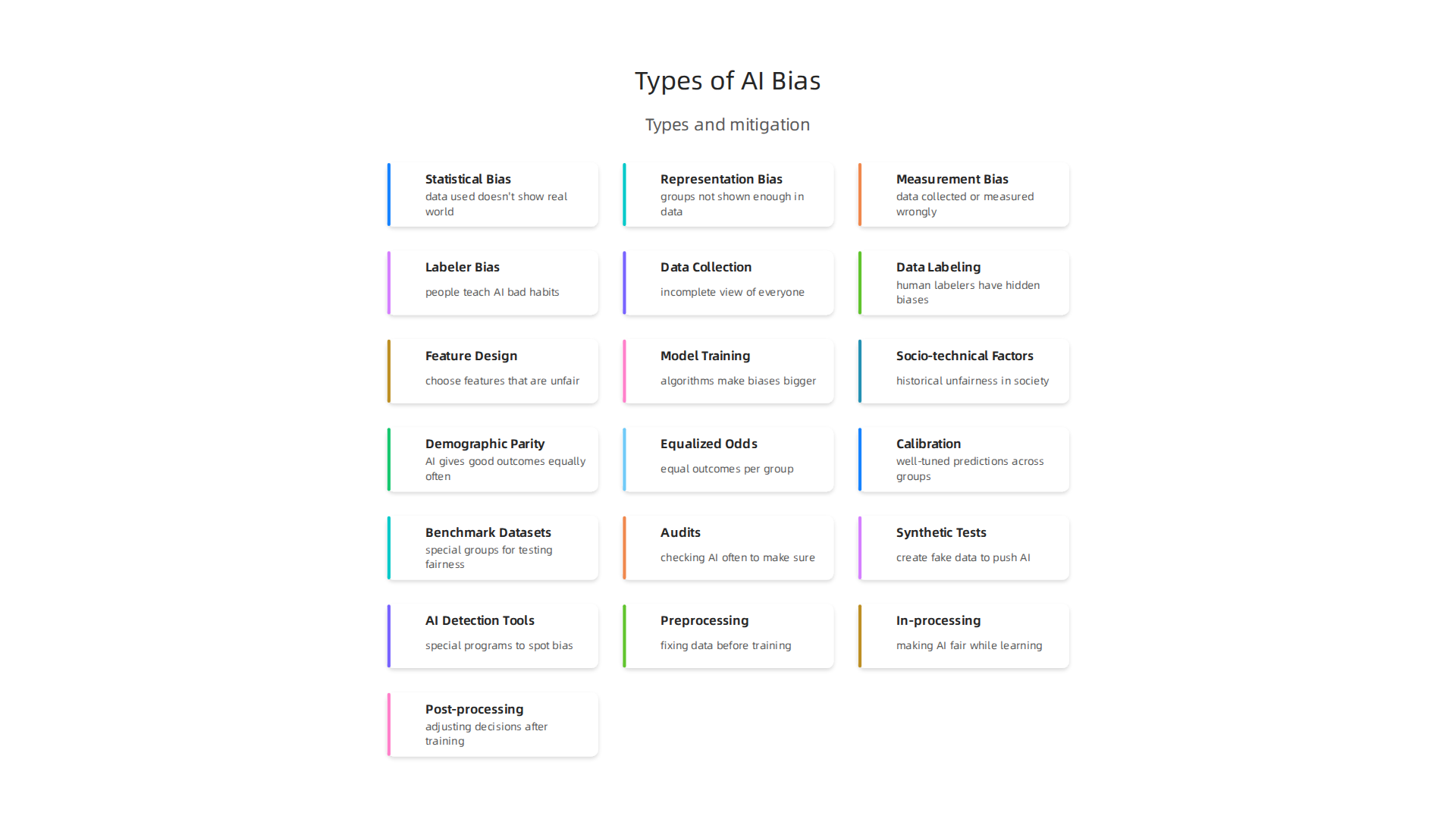
- Statistical Bias: This happens when the data used to teach the AI doesn’t correctly show the real world. Imagine you want an AI to predict traffic in a big city, but you only give it data from a small village. The AI will learn wrong things because the information it got was not right for the job. This can make an AI without restrictions give very bad advice.
- Representation Bias: This is when certain groups of people are not shown enough, or are shown wrongly, in the data the AI learns from. For example, if an AI that helps with job applications only sees résumés from one kind of person, it might unfairly ignore résumés from other groups. A study points out how important it is to deal with how data is chosen, or "sampling bias," because it can make a dataset not truly show what it should Biases in AI Systems: A survey for practitioners.
- Measurement Bias: This type of bias comes from how the data itself is collected or measured. If you’re building an AI to check how healthy people are, but the tools you use work better for some skin tones than others, that’s measurement bias. The information collected will be wrong for certain people, and the AI will learn from that wrong information.
- Human or Labeler Bias: Sometimes, people teach the AI bad habits without meaning to. When humans label data (like telling the AI "this is a cat" or "this is a good answer"), their own unfair ideas can get mixed in. If a person always labels pictures of leaders as men, the AI will learn that leaders are usually men, which is not fair.
These types of bias often start long before the AI even makes a decision. They can come from the choices people make when designing the AI system or from how they get and prepare the data. These "data pipelines" are like a long path where bias can easily enter. Understanding these different kinds of bias is super important because it helps us figure out exactly why is AI bad in certain cases. When we know the specific type of bias, we can then use better tools and methods, sometimes even special how does AI detection software work tools, to find and fix the problem. It’s all about making AI fair for everyone. To build AI effectively, it helps to understand mastering how AI learns for strategic business advantage.
Where Bias Enters: Data, Models, and Human Processes
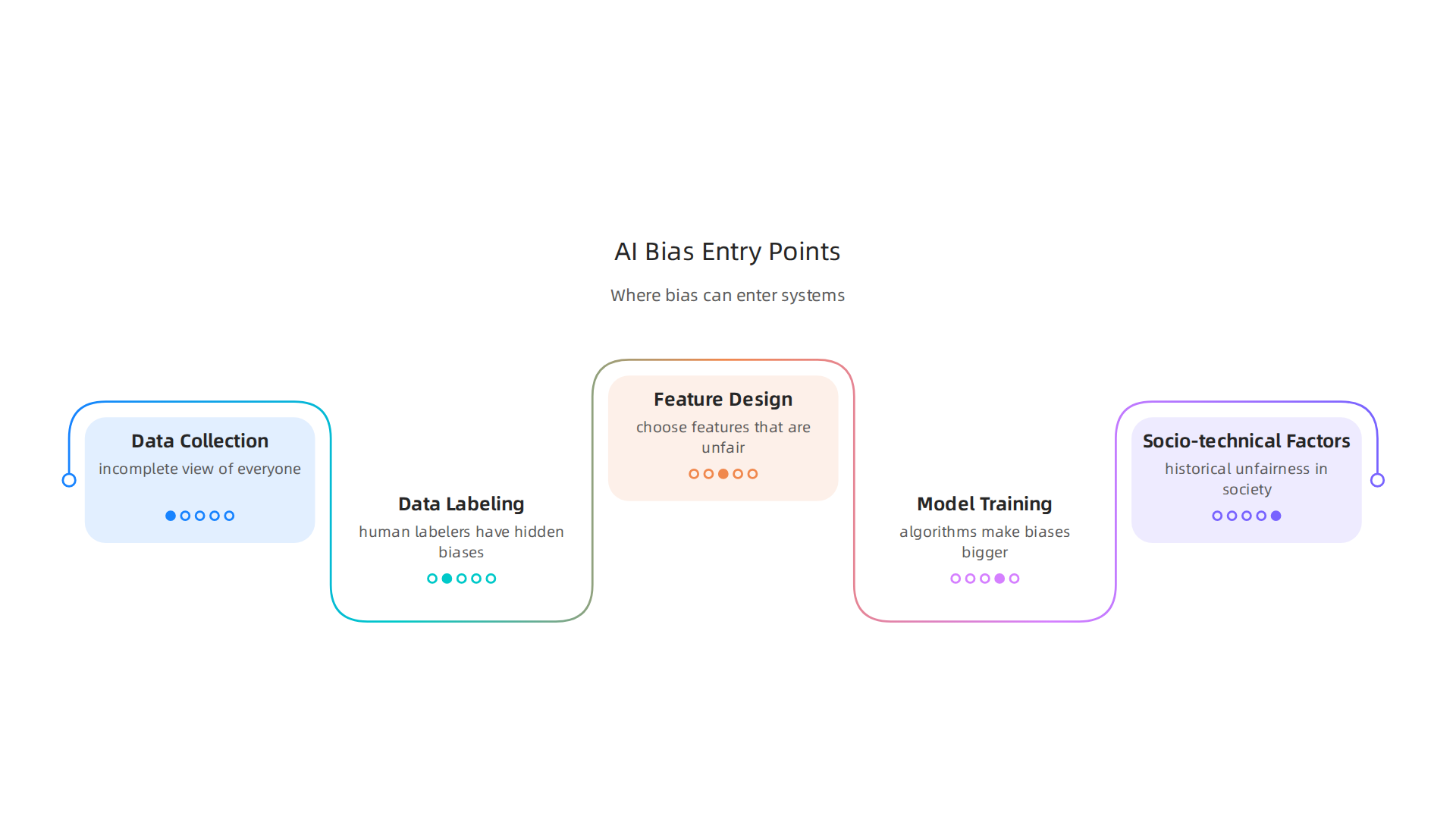
We just learned about the different kinds of AI bias, like when the data is wrong or unfair. But where does this bias actually begin its journey into an AI system? It’s not usually one big mistake. Instead, bias can sneak in at many points along the way, from the very start of a project to how the AI is used in the real world. Thinking about "what is AI bias" means looking at these common entry points.
Here’s how bias can become a part of AI:
-
Data Collection: This is often the first place bias can enter. If the people gathering data don’t get a true picture of everyone or everything, the AI will learn from this incomplete view. For example, if you’re building an AI for healthcare but mostly collect data from one age group or background, it won’t work well for others. This can make an AI without restrictions less helpful, or even harmful. Sometimes, historical unfairness in society means that certain data was never collected properly for some groups, leading to what’s known as historical bias. Experts have pointed out how bias can come from the very origins of the data Bias in AI Models: Origins, Impact, and Mitigation Strategies.
-
Data Labeling: After data is collected, humans often "label" it. This means they tell the AI what something is or what it means. For instance, labeling photos as "person A" or "person B." If the human labelers have their own hidden biases, they might label things in a way that is unfair to certain groups. Imagine if they always label older images of doctors as men, the AI will then learn that doctors are mostly men, even if that’s not true in 2026. This human bias in labeling is a major concern.
-
Feature Design: When creating an AI, we choose what "features" it should pay attention to. Features are like clues the AI uses to make decisions. If we choose features that are already unfair or that indirectly point to sensitive groups (like zip codes that mostly contain one type of person), the AI can become biased. The way we design these features can bake unfairness right into the system.
-
Model Training: Even if the data and features seem okay, bias can still happen when the AI "learns" during its training phase. The math rules or algorithms that help the AI learn might accidentally make existing small biases in the data bigger. Or, the way the AI is told to reach a goal might lead it to find the easiest, but most unfair, path. Thinking about how to make sure AI learns fairly is a big part of building ethical systems.
-
Socio-technical Factors: It’s important to remember that AI doesn’t exist in a bubble. It’s built by people, used by people, and affects people. So, outside factors play a huge role. Things like historical unfairness in society, how companies pay people to label data, or even the purpose for which the AI is used can all make bias worse. This means understanding why is AI bad in certain situations often needs us to look at the bigger picture, beyond just the code and data. Addressing these deep-seated issues is part of what it means to build ethical and transparent AI for humans. Understanding the blend of formal methods and societal context is key to tackling AI bias effectively Bias in AI systems: integrating formal and socio-technical ….
By understanding these many places where bias can enter, we can be more careful in each step of building and using AI.

This helps us work towards a future where AI is fair for everyone.
Now that we know how bias can get into AI systems, the next big step is to find it and measure it. It’s like checking a recipe; you need to taste it to know if it’s right. For AI, we use special tools and ways to see if it’s treating everyone fairly. This helps us understand what is AI bias in action.
What are Fairness Metrics?
Fairness metrics are like special rulers that help us measure fairness in AI. They look at how an AI acts for different groups of people. For example, does an AI work just as well for men as it does for women? Or for people of all ages? Here are some common ways we measure fairness:
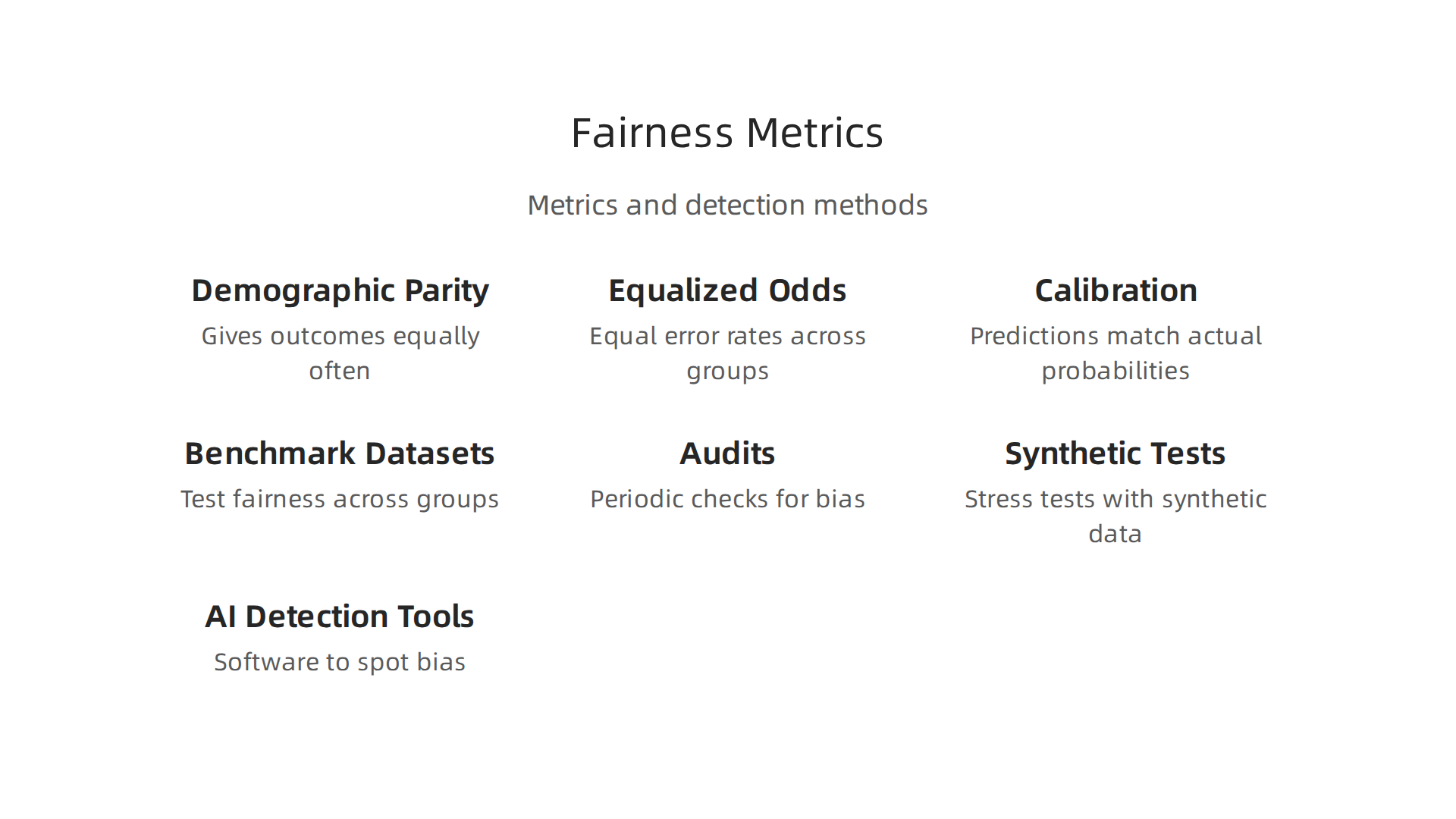
- Demographic Parity: This metric asks if the AI gives good outcomes equally often to all groups. It does not look at true facts, just the AI’s choices. For example, if an AI is deciding who gets a loan, demographic parity would check if the same percentage of people from different groups get loans. This is often an important check for bias AI fairness metrics.
- Equalized Odds: This metric is a bit more detailed. It looks at how well the AI makes correct choices and how many wrong choices it makes for each group. For instance, in healthcare, it would check if the AI correctly spots a disease in older patients as often as it does in younger patients. It also checks if the AI wrongly flags healthy people from one group more than another Key Fairness Metrics.
- Calibration: This metric checks if the AI’s predictions are well-tuned. If an AI says there’s an 80% chance of something happening, then that "something" should happen about 80% of the time. This should be true for all groups. Experts suggest that metrics like calibration are very important in real-world uses like medical applications Navigating Fairness in AI-based Prediction Models.
Each of these metrics has its own good points and tricky parts. What works best can depend on what the AI is used for. Sometimes, trying to be perfectly fair by one metric might make the AI less fair by another. It’s a balance.
Finding and Tracking AI Bias
Measuring bias is not a one-time thing. It needs to be checked often. Think of it like a car check-up. Here’s how we find and keep an eye on AI bias:
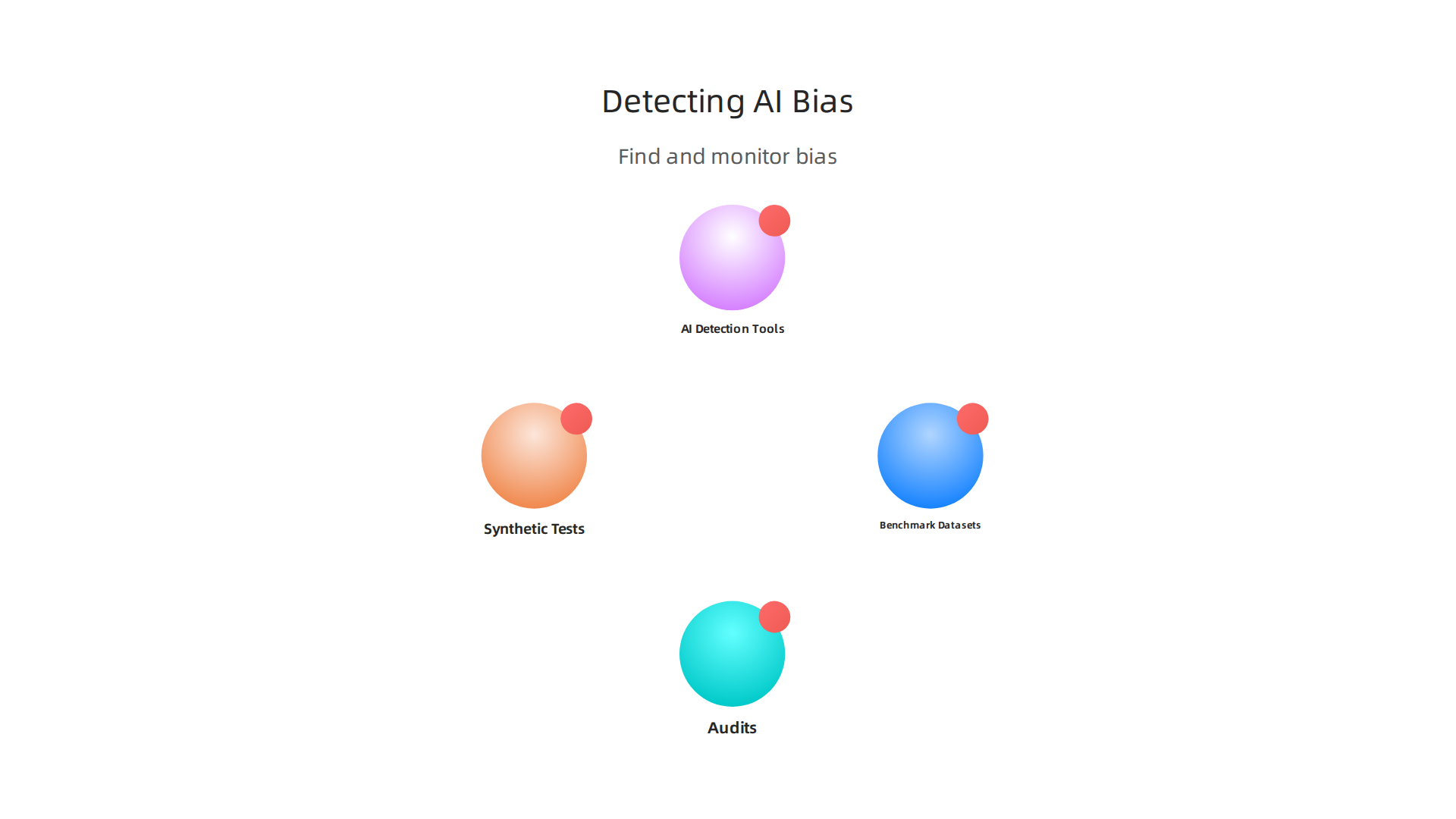
- Benchmark Datasets: These are special groups of information made just for testing AI for fairness. They are created to be very diverse so that we can see if the AI performs differently for certain groups. Using these datasets helps us find out early if an AI has learned unfair habits.
- Audits: Just like a business might have a financial audit, AI systems need regular "fairness audits." This means checking the AI often to make sure it’s still fair as it’s used in the real world. Regular audits are key to making sure AI stays fair over time Fairness and Bias in Machine Learning: Mitigation Strategies.
- Synthetic Tests: Sometimes, people create fake data or scenarios to really push the AI and see if it behaves unfairly in tricky situations. This helps find hidden biases that might not show up in normal use.
- AI Detection Tools: There are special computer programs and tools made to help spot AI bias. These tools can use the metrics we talked about to scan an AI model and its data. They help answer questions like, "how does AI detection software work?" by pointing out where the AI might be unfair. Many software toolkits are available to assess fairness in AI models, such as AIF360 and FairLearn A Review of Fairness and a Practical Guide to Selecting ….
By using these methods, we can better understand why is AI bad in some cases and prevent an AI without restrictions from causing harm. It’s all about making sure AI helps everyone equally.
Stay informed about the fast-moving world of AI. Get clear daily AI updates to help you make sense of it all.
The AI Newsletter Worth Reading
To make sure AI helps everyone equally, we need strong rules and good ideas about what is right. This is where laws, government rules, and ethical guides come in. These frameworks help stop unfairness from creeping into AI systems and make sure companies use AI responsibly.
Legal and Rule-Based Ways
Governments around the world are creating new laws and rules for AI. They want to make sure that AI is fair and does not cause harm.
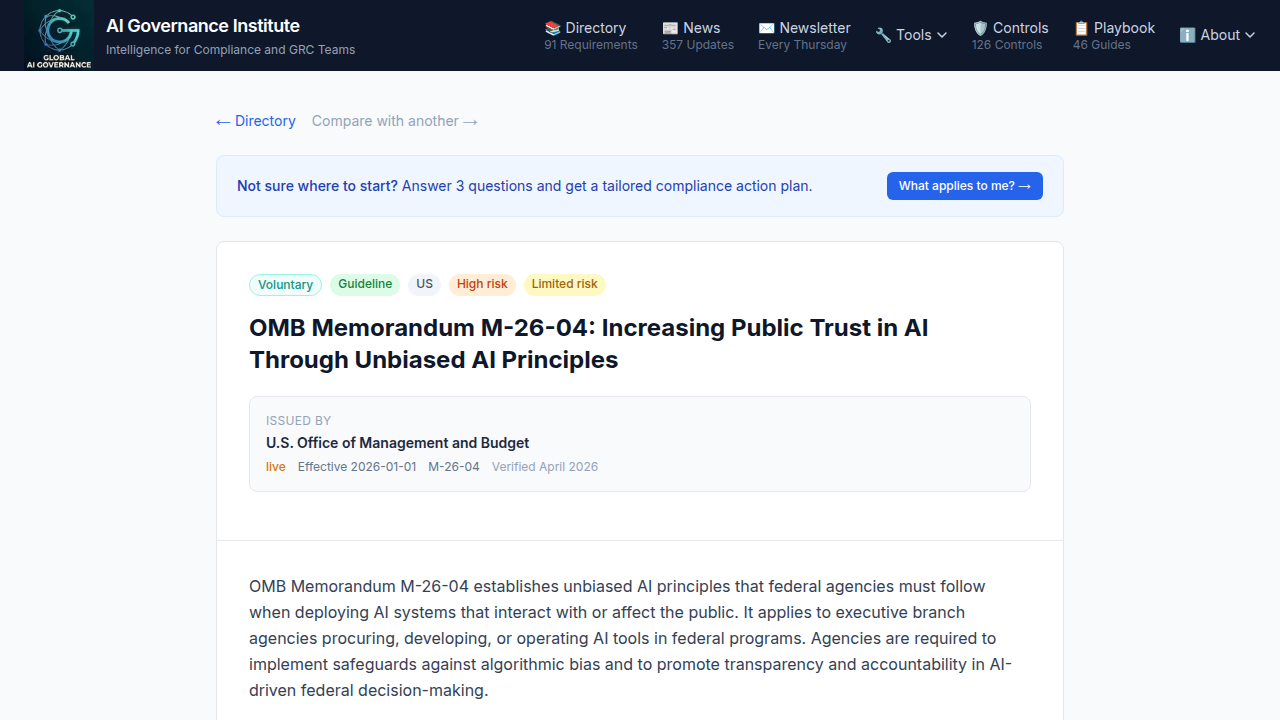
- United States Efforts: In the U.S. in 2026, there are new steps being taken. For example, the "Eliminating Bias in Algorithmic Systems Act of 2026" aims to make sure federal agencies have civil rights offices that look at AI bias problems [S.3680 – Eliminating Bias in Algorithmic Systems Act of 2026]. The government also has memos, like one from the Office of Management and Budget (OMB Memorandum M-26-04), that ask federal groups to use "unbiased AI principles" to build public trust in AI [Increasing Public Trust in AI Through Unbiased AI Principles].
Beyond federal rules, states are also making their own laws. For example, New Jersey issued guidance on algorithmic discrimination to help stop unfairness in how AI is used [Attorney General Platkin and Division on Civil Rights Announce]. Many states have their own rules now, as highlighted in a 2026 guide to [US AI regulations 2026].
- Global Rules: Other countries are also putting rules in place. The UK, for instance, has its own laws like the Data (Use and Access) Act 2026, which impacts how AI uses personal information [Guidance on AI and data protection | ICO]. Around the world, different countries have different approaches to AI regulations, but many focus on stopping bias and making AI accountable [AI Regulations Around the World: A 2026 Guide].
Companies need to pay close attention to these new laws and rules. If they do not, they could face big problems or fines. This is a major area of legal and compliance risk. It is all about making sure that an AI without restrictions does not accidentally cause harm or unfairness.
Ethical Guides and Standards
Beyond what the law says, there are also ethical rules that guide how AI should be built and used.

These are like moral compasses that help people make good choices, even when a law might not directly tell them what to do.
- Key Ethical Principles: Some main ideas for ethical AI include:
- Fairness: Making sure AI treats all people fairly, without bias.
- Transparency: Being open about how AI works and how it makes decisions. People should be able to understand why AI does what it does.
- Accountability: Having someone or a group responsible when AI makes mistakes or causes problems.
- Privacy: Protecting people’s personal information when AI uses data.
- Human Oversight: Ensuring that humans can still guide and control AI, so it does not make important decisions completely on its own.
These principles influence many of the laws and rules we see today. They also help companies think about how to [how to build ethical and transparent AI for humans] and create new tools and processes. Making sure AI follows these ideas is important because it builds trust. It helps people feel safe using AI and shows that we are thinking about [humane technology principles for ethical AI governance].
Even when a specific law does not exist for every possible AI use, ethical frameworks help answer questions like "why is AI bad" if it is left unchecked. They push developers and companies to create AI that benefits everyone, not just some. These guides help us build AI in a way that is good for society and less likely to have hidden biases.
Beyond legal frameworks and ethical guides, the real work of stopping unfairness in AI happens through practical steps. We need to actively build AI systems that are fair from the very start. This means using special methods that address what is AI bias at different stages, from when we first gather data to when the AI is making decisions in the real world. If we don’t, an AI without restrictions can easily spread unfairness.
There are three main times we can step in to fix or prevent bias in AI:
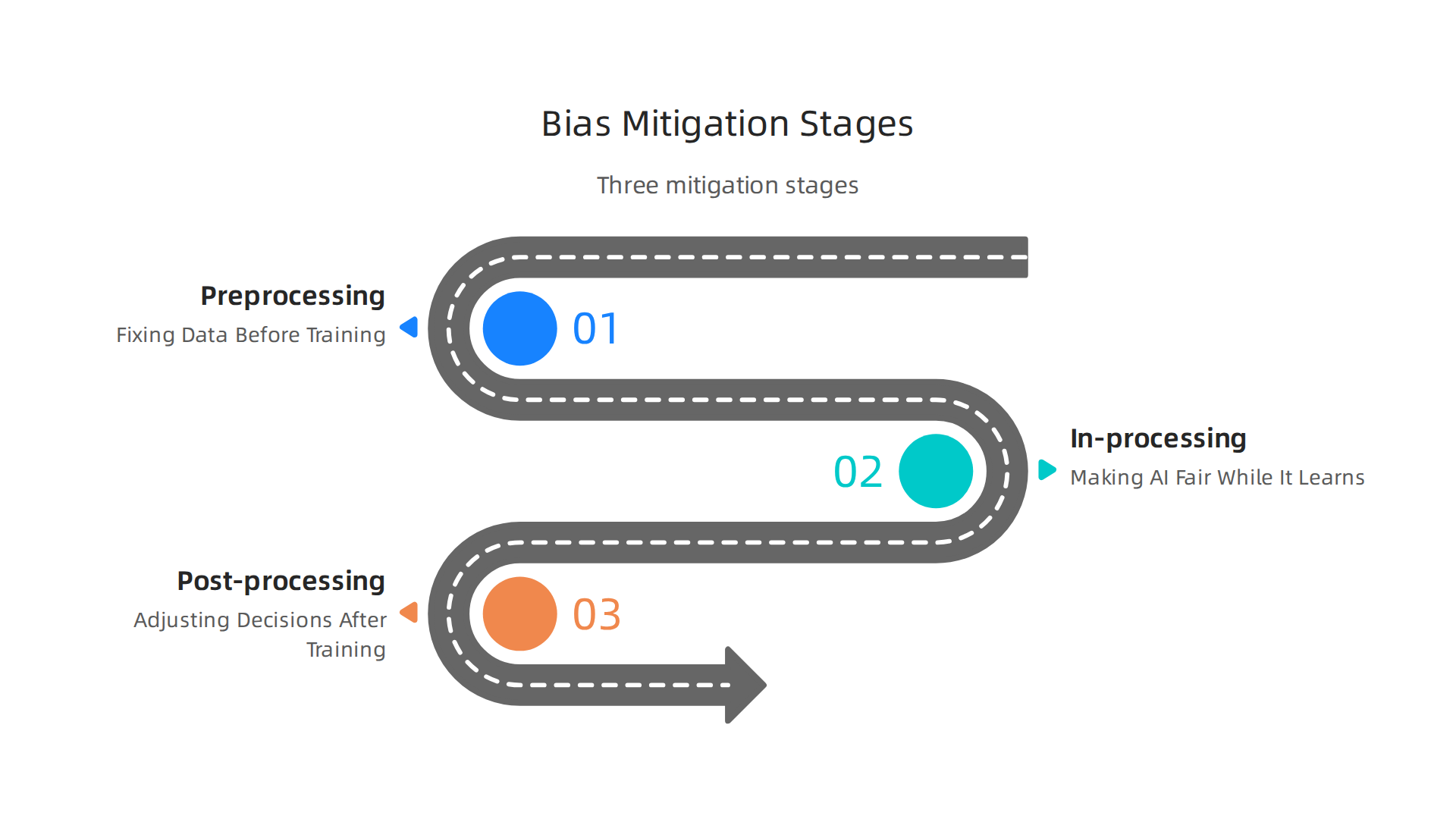
1. Preprocessing: Fixing Data Before Training
This step happens before we even start to teach the AI model anything. It’s all about making sure the data the AI learns from is as fair and balanced as possible. Think of it like making sure all the ingredients for a cake are perfect before you start baking.
- Data Augmentation: This means getting more data for groups that are not well-represented, or making existing data more diverse. For example, if an AI is meant to recognize faces, but it has mostly learned from pictures of one group of people, we would add more pictures of other groups. This helps prevent the AI from being biased against those underrepresented groups.
- Reweighting: Sometimes, we can give different importance to certain parts of the data. If some groups are seen less often in the data, we might tell the AI to pay more attention to them during training. This helps balance things out.
These methods are good for fixing bias right at the source, but they can take a lot of time and effort to do right. They also might not catch every type of bias.
2. In-processing: Making AI Fair While It Learns
This stage happens during the AI’s training process. Here, we change how the AI actually learns, making fairness a key part of its goals. Instead of just learning to be accurate, the AI also learns to be fair at the same time.
- Fairness-Aware Training: This involves special algorithms that try to reduce bias while the AI is learning. These algorithms might try to make sure the AI’s predictions are equally good for all different groups, not just the overall average. This is like teaching the AI to not just get the right answers, but to get them right for everyone.
The challenge here is that making an AI fairer during training can sometimes make it a little less accurate overall. Developers need to find a good balance between fairness and how well the AI works.
3. Post-processing: Adjusting Decisions After Training
This is the final stage, after the AI has already been trained and is ready to be used. Here, we adjust the AI’s decisions or outputs to make them fairer without changing the main AI model itself. This is especially useful for older AI systems or when you need a quick fix.
- Post-hoc Correction: This means adjusting the AI’s final decisions. For example, if an AI is making predictions, and we see it’s consistently unfair to one group, we might add a rule to slightly change its prediction for that group. This helps fix issues that weren’t caught earlier.
- Explanation Tools: To avoid asking "why is AI bad" if it makes unfair decisions, tools that explain how an AI made a decision are very important. They help people understand why the AI came up with a particular result, which can reveal hidden biases. These tools can show, for example, which data points or features most influenced a decision.
These methods are often easier to implement quickly, but they might not address the core problem if the bias is deeply rooted in the data or the AI’s learning process.
Evaluating Fairness
No matter which methods you use, it’s crucial to check if they actually work. This is where fairness metrics come in. These are ways to measure if an AI is treating different groups fairly AI Fairness Metrics: Which to Use for Model Selection. Some common metrics look at things like:
- Demographic Parity: Does the AI give positive outcomes to different groups at the same rate?
- Equalized Odds: Does the AI make mistakes (like false positives or false negatives) at the same rate for different groups?
There are many software tools available today in 2026, like AIF360 and FairLearn, that help assess the fairness of AI models using these metrics A Review of Fairness and a Practical Guide to Selecting …. Regularly checking and auditing AI models for bias is a key part of making sure they are fair and responsible Fairness and Bias in Machine Learning: Mitigation Strategies.
Using a mix of these strategies usually works best. It’s important for companies to commit resources and skilled people to these tasks, otherwise an AI without restrictions might cause more harm than good. To stay informed on how these and other cutting-edge AI developments impact the industry, you need reliable, daily insights.
The Deep View Newsletter provides daily, in-depth insights into AI and broader technology trends.
The AI Newsletter Worth Reading
The work of making AI fair doesn’t stop with just fixing data or training models. For companies, it’s about building a system that keeps AI fair all the time. This system is called AI governance. It means setting up clear rules, roles, and ways to check AI, ensuring that no AI is left "ai without restrictions."
Setting Up AI Governance
AI governance is like having a set of guidelines and a steering committee for all your AI projects. It helps make sure that the AI you build and use is not only smart but also safe and fair. Good governance helps stop issues like "what is AI bias" before they become big problems and prevents situations where people might ask "why is AI bad."
Organizations in 2026 often set up special groups or roles to lead this effort. This might include an AI Ethics Board or a Chief AI Officer. These groups define the guiding principles for how AI should be used and developed, focusing on values like fairness and transparency Responsible AI Governance Frameworks.
Many different teams need to work together for this to succeed. People from legal, human resources, data engineering, and product teams all have a part to play Responsible AI Governance: A Practical Framework for Organizations. In fact, new laws like the "Eliminating Bias in Algorithmic Systems Act of 2026" even require federal agencies to have civil rights offices focused on algorithmic bias. Also, the U.S. Office of Management and Budget has released guidance for federal agencies on increasing public trust through unbiased AI principles OMB Memorandum M-26-04: Increasing Public Trust in AI Through Unbiased AI Principles.
Managing Risks and Watching AI
A big part of AI governance is figuring out where things can go wrong and having a plan. This means doing regular risk assessments before AI systems are put into use. It’s about asking, "What if this AI is unfair?" and planning for it. Regular bias audits, often done by outside experts, are crucial to check if an AI system is acting fairly, especially in important areas like hiring.
Once an AI system is running, you need to keep a close eye on it. This is called monitoring. It means watching the AI’s decisions over time to catch any signs of bias or unexpected behavior. If something does go wrong, like the AI starts making unfair choices, companies need a plan for incident response. This plan helps them quickly figure out what happened, fix the problem, and make sure it doesn’t happen again.
Keeping good records is also very important. This includes documenting how an AI was built, what data it learned from, how it was tested for bias, and any changes made to it. Good documentation helps understand how an AI reached its decisions and can show if issues like "what is AI bias" are present. It also helps explain things to people if they ask "why is AI bad" after seeing an unfair result. For more on creating AI that works for people, explore designing human-centered AI guiding principles for 2026.
Working Together for Responsible AI
Making AI responsible is not a job for just one person or one team. It requires everyone in a company to work together. Engineers build the AI, but legal teams make sure it follows laws. Business leaders need to understand the ethical sides of AI, and even sales teams need to know how to explain the AI’s fairness to customers. This kind of teamwork, called cross-functional coordination, is key to developing and using AI that truly benefits everyone. It ensures that an "ai without restrictions" isn’t allowed to harm anyone.
Summary
This article explains why AI ethics and bias are urgent issues in 2026 and shows how unfair outcomes arise, where they enter AI systems, and what to do about them. It defines major bias types—statistical, representation, measurement, and human labeler bias—and traces entry points across data collection, labeling, feature design, model training, and socio-technical factors. The piece then walks through detection and monitoring techniques, including benchmark datasets, audits, synthetic tests, and fairness metrics like demographic parity, equalized odds, and calibration. It outlines three practical mitigation stages—preprocessing, in-processing, and post-processing—and describes how legal rules, ethical principles, and organizational governance (roles, audits, incident plans) reduce harm. Readers will come away able to spot common sources of bias, choose appropriate fairness checks and tools, and design governance and monitoring to keep AI fair and accountable.