
Introduction
Picture this: you sit down to research artificial intelligence for your next big project or investment. Within minutes you stumble across terms like narrow AI, machine learning, deep learning, generative AI, AGI, and ASI. Each article seems to use the words a little differently. Before long you feel more confused than when you started.

You are not alone. The AI landscape in 2026 is overflowing with buzzwords, overlapping categories, and new paradigms that appear almost weekly. Executives, investors, and analysts all face the same problem. Without a clear picture of what each term really means, it becomes almost impossible to make smart decisions about where to put time, money, and resources.
That is why understanding the different types of artificial intelligence matters more than ever. A solid taxonomy helps you separate hype from reality. It lets you spot which technologies are ready today, which are still theoretical, and what to expect next. It also keeps you from investing in solutions that sound impressive but are just old automation dressed up in new language.
A quick look at where we have been
Artificial intelligence is not brand new. If you have ever wondered how long has AI been around, the answer goes back to the 1950s when researchers first dreamed of machines that could think. The field has gone through many ups and downs since then. What feels different today is how fast the technology is moving and how deeply it touches almost every industry.
Why a clear framework helps
This guide gives you a structured way to understand AI by capability, by function, and by paradigm. We start with the three big categories you hear most often: narrow AI, general AI, and superintelligence. Then we unpack the subfields inside each one, like machine learning and deep learning. We also explore important guiding ideas like the Google AI principles that help developers build responsible systems.
Whether you want to study AI for your career, evaluate tools for your business, or just keep up with the conversation, having a clear framework makes everything easier. It also helps you pick the right AI learning tools when you are ready to go deeper.
Backed by trusted sources
The definitions in this guide come from authoritative organizations and research teams. For example, the latest Stanford Emerging Technology Review explains how AI includes computer vision, machine learning, and natural language processing, and that the boundaries between them are often fluid.

That kind of clarity is exactly what we need.
Where this article fits into your learning
This introduction sets the stage. In the sections ahead we will walk through each type of AI in plain language. You will learn how they relate to one another, what they can actually do, and what is still science fiction. Along the way we will point you to deeper resources so you can keep building your knowledge.
For a more detailed comparison of how AI, machine learning, and deep learning nest inside each other, check out our guide on AI vs machine learning vs deep learning differences. It is a great next step after you finish this article.
Stay informed as the field evolves
The AI world changes fast. New models, new companies, and new breakthroughs appear every day. To keep up without drowning in noise, consider subscribing to a trusted daily briefing. The AI Newsletter Worth Reading delivers clear, curated updates straight to your inbox so you never miss what matters.
Now let us dive into the first category: the types of AI by capability.
The Foundational Framework: AI, Machine Learning, and Deep Learning
Now that we have set the stage, let us clear up one of the biggest sources of confusion in the AI world today. You have probably heard the terms artificial intelligence, machine learning, and deep learning used almost interchangeably by different people. But they are not the same thing. They form a neat hierarchy, and understanding that hierarchy is the first step to making sense of the types of artificial intelligence you encounter.
Think of artificial intelligence as the biggest, broadest umbrella. Underneath that umbrella sits machine learning. And inside machine learning sits deep learning. Each layer gets more specialized and more powerful.
Artificial intelligence is the big umbrella
Artificial intelligence, or AI, is any system that performs tasks we normally associate with human intelligence. That includes things like understanding language, recognizing images, making decisions, and generating new content. The key point is that AI does not have to learn from data. Some AI systems, like old-school expert systems, work by following fixed rules programmed by humans.
As one clear 2026 guide explains, AI is software that produces useful outputs like predictions, recommendations, decisions, or content from the information it receives.

That definition is broad on purpose. It covers everything from a simple spam filter to a cutting-edge chatbot.
Machine learning is how AI learns from data
Machine learning, or ML, is a subset of AI. The difference is that ML systems do not rely on hand coded rules. Instead they learn patterns from data. You feed the system examples, and it figures out the rules on its own.
For instance, if you want a system to tell the difference between pictures of cats and dogs, you do not list out every feature. You show it thousands of labeled cat and dog photos, and the ML model learns the patterns by itself.
Inside machine learning, there are several ways to train a model. The three main categories are easy to remember.
Supervised learning means you train the model with labeled data. You already know the right answer for each example, and the model learns to predict that answer for new data. This works well for tasks like classifying emails as spam or not spam.
Unsupervised learning means the model gets data with no labels. It has to find hidden patterns or groups on its own. Businesses use this for customer segmentation, where the model discovers clusters of similar buyers without being told what to look for.
Reinforcement learning is different. The model learns by interacting with an environment and getting rewards or penalties for its actions. This is how game AIs and self-driving cars improve over time by trial and error.
These three approaches cover most real world ML applications today. The IBM guide on types of machine learning does a great job explaining each one in more detail if you want to go deeper.
Deep learning takes machine learning further
Deep learning is a specialized subset of machine learning. It uses artificial neural networks with many layers, usually three or more. These layers allow the system to handle very complex and messy data, like raw images, audio files, and natural language.
Deep learning is what powers the big breakthroughs you hear about in the news. Things like facial recognition, voice assistants like Siri and Alexa, and generative AI tools that create realistic images and text all rely on deep learning neural networks.
The reason deep learning is so powerful is that it can automatically discover the features it needs to learn, without a human hand picking them. That makes it ideal for tasks where the important patterns are too subtle for people to describe.
How they all fit together
Here is the simplest way to picture it. Imagine three circles nested inside each other. The biggest circle is artificial intelligence. Inside that is machine learning. And right in the middle is deep learning.
Not every AI system uses machine learning. A simple thermostat that turns on at a certain temperature is AI in a very basic sense but it does not learn. And not every ML system uses deep learning. A straightforward decision tree that predicts customer churn works fine without multiple neural network layers.
But in 2026, most of the exciting progress is happening in the deep learning layer. That is where you find large language models like ChatGPT and Claude, image generators like Midjourney, and advanced robotics systems.
Why this framework matters for you
When you hear a company say they use AI, now you can ask: are they using basic rule based systems, or are they using machine learning? And if they use machine learning, are they using deep learning? This simple framework helps you separate genuine innovation from buzzword marketing.
If you want to build your skills further, check out our guide on how to learn AI for success in 2026. It gives you a step by step path from these foundational concepts to practical expertise.
Understanding this hierarchy is the key to all the types of artificial intelligence we will explore next. In the following sections we will look at AI by capability, by function, and by paradigm. But you now have the solid base you need to follow along.
Levels of AI: Narrow, General, and Superintelligence
Now that you understand the difference between AI, machine learning, and deep learning, let us look at AI by its capability. There are three levels of AI that experts talk about. Only one of them exists today. The other two are still ideas for the future.
The first level is called Artificial Narrow Intelligence, or ANI. Some people call it weak AI. But do not let the word "weak" fool you. ANI is incredibly powerful at the one thing it does. It just cannot do anything else.
Think about the AI tools you use every day. Your email spam filter, your voice assistant, your navigation app. These are all examples of ANI. A tool like Google Translate can translate dozens of languages. But it cannot write a poem or play chess. That is what narrow means. ANI focuses on a single task or a small set of tasks and does them better than humans in many cases.
According to a detailed guide from IRI, ANI is the most common form of AI today. It is designed to excel at a specific job. It cannot learn new things on its own outside of what it was trained for.
Every commercial AI system you have ever used is ANI. From Netflix recommendations to facial recognition on your phone. That is all we have right now.
The second level is Artificial General Intelligence, or AGI. This is the big dream. AGI would be a machine that can think, learn, and reason just like a human. It would not be stuck doing one task. It could switch from writing a story to solving a math problem to planning a vacation, all without needing to be retrained.
As the Wikipedia entry on AGI explains, AGI is a hypothetical type of AI that matches or surpasses human capabilities across almost all cognitive tasks.
It would have true understanding. It could transfer skills from one area to another.
Here is the honest truth. AGI does not exist. Not in 2026. Researchers have been working on it for decades, and most experts think it is still years or even decades away. A 2026 analysis from Kanerika notes that 50% of AI researchers expect high-level machine intelligence by 2061. So we have some waiting to do.
The third level is Artificial Superintelligence, or ASI. This is where things get really interesting. ASI would be an AI that is smarter than the smartest human in every possible way. It would be better at science, art, emotions, decision making, everything.
ASI is completely hypothetical. No one has built anything close to it. But many people talk about it because it raises big questions. If a machine is much smarter than us, what happens next? Some people see this as an amazing future. Others see risks.
To stay up to date on where AI is heading and what it means for you, check out The AI Newsletter Worth Reading. It gives you clear daily updates on all these developments.
For a deeper look at current trends, read our piece on AI trends in 2026 and how to separate signal from noise. It will help you make sense of all the headlines about AGI and ASI.
So to sum up the levels: ANI is here and working. AGI is the next big goal. ASI is a future idea.
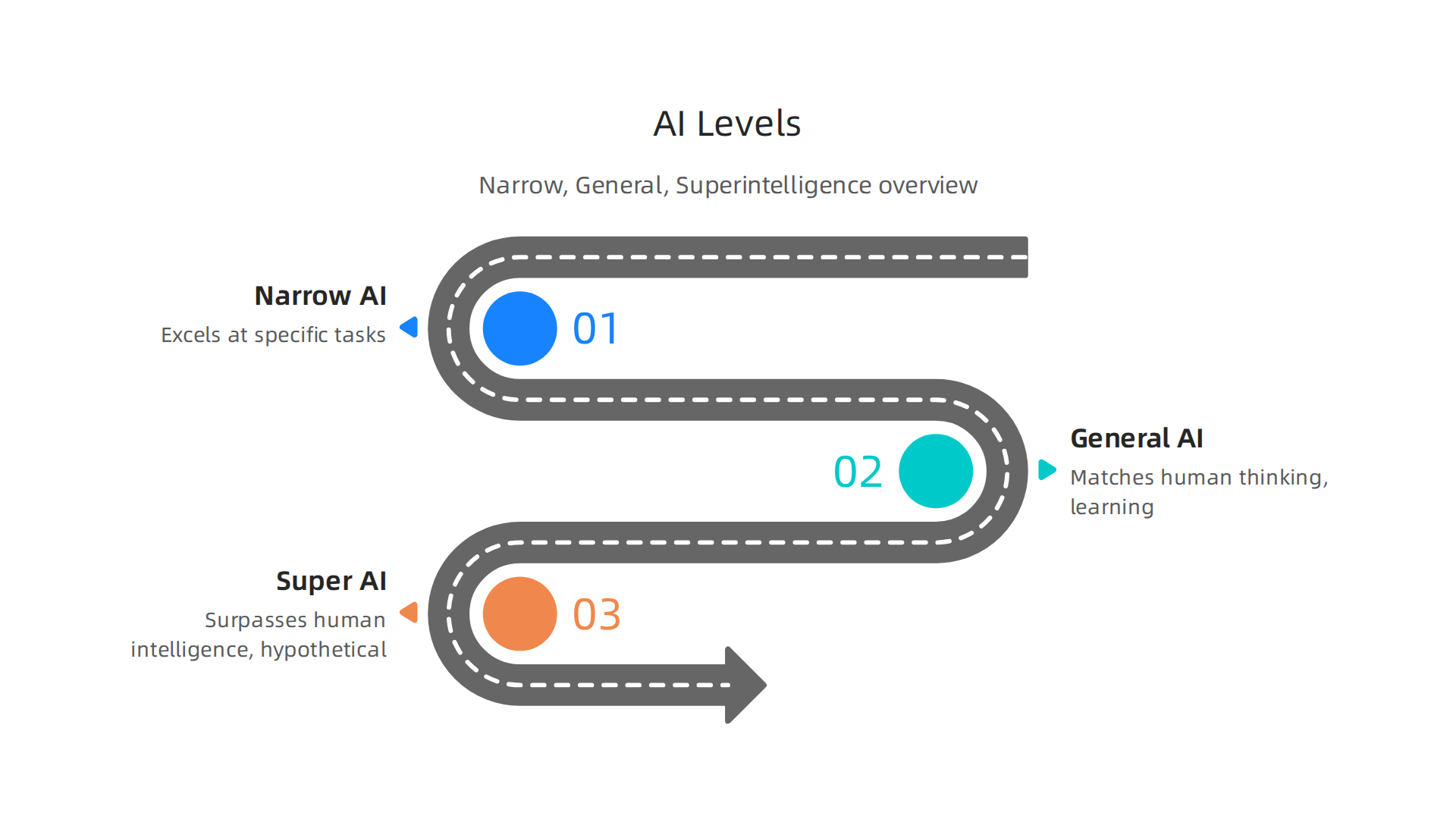
Understanding these three levels of the types of artificial intelligence helps you see where we really are versus what is still science fiction.
The Four Major AI Types by Capability: Reactive, Limited Memory, Theory of Mind, and Self-Aware
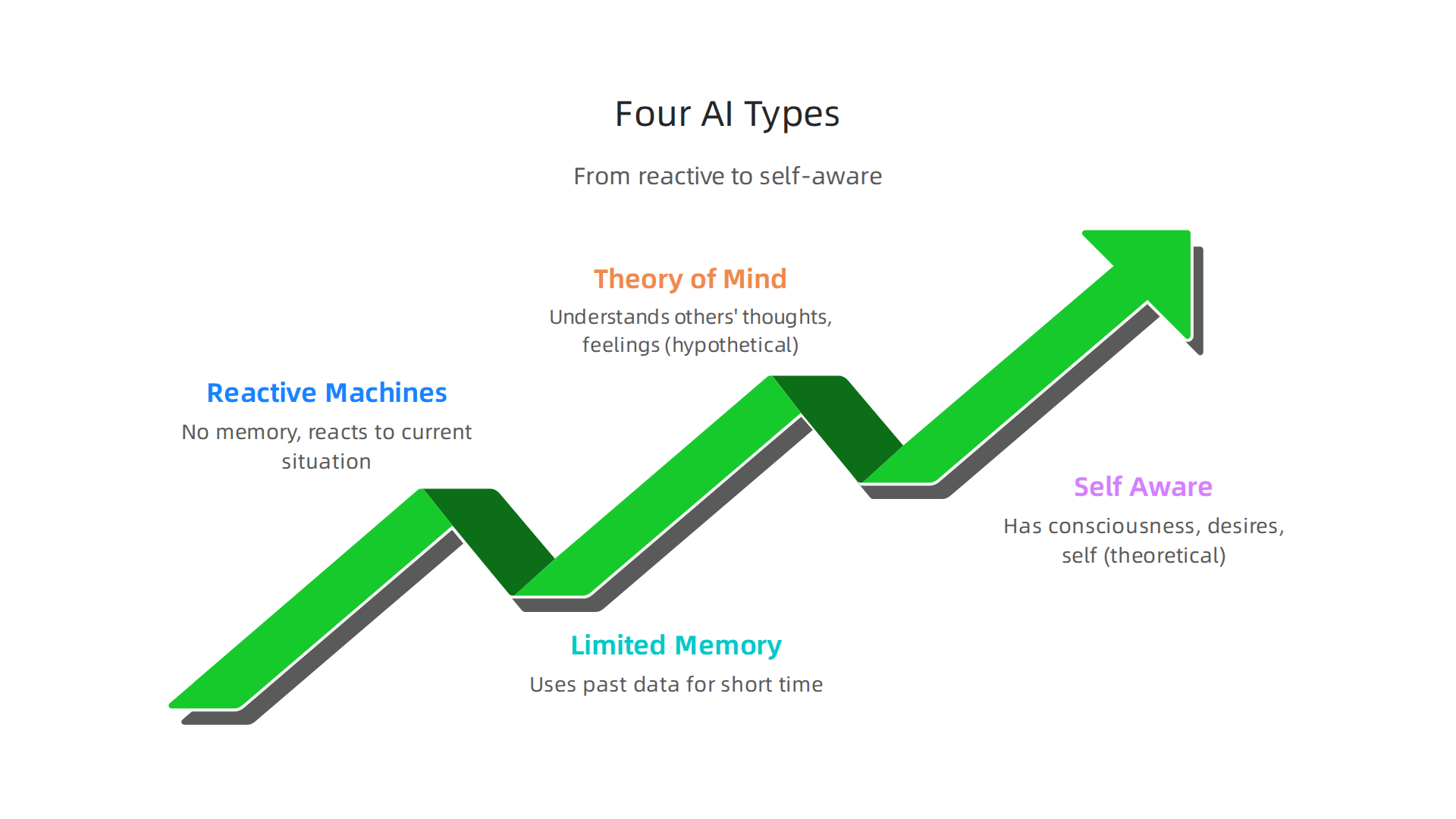
There is another useful way to sort the types of artificial intelligence. Instead of grouping them by how broad their abilities are (narrow, general, super), you can group them by what they can do right now. This classification comes from a computer science professor at Michigan State University. It gives us four categories that build on each other.
1. Reactive Machines
A reactive machine is the simplest kind of AI. It has no memory. It cannot learn from past experiences. It just looks at the current situation and reacts based on rules it was given.
The most famous example is Deep Blue, the IBM computer that beat chess champion Garry Kasparov in 1997. Deep Blue did not remember previous games. It did not get better over time. It just calculated the best move from the current board position. That is all.
Most early AI systems were reactive. They are predictable and reliable. But they cannot adapt. As visla’s 2026 guide to AI types explains, even simple AI can do amazing things as long as you stay inside its narrow lane.
Reactive machines still exist today in things like factory robots and spam filters. They get the job done, but they do not grow.
2. Limited Memory
This is where most modern AI lives. Limited memory systems can look at past data for a short time to make better decisions.
Self-driving cars are a perfect example. A self-driving car uses sensors to track nearby cars. It remembers where those cars were a few seconds ago. That short memory helps it predict where they will go next. Without it, the car would react too late.
Limited memory systems use machine learning and deep learning to improve. They train on huge datasets and then use recent experience to adjust in real time. Your streaming service recommendations work the same way. They remember what you watched last week and suggest something new.
If you want to see how this compares with other AI building blocks, check out our deep dive on AI vs machine learning vs deep learning differences explained. It shows how limited memory connects to the tools developers use today.
3. Theory of Mind
This is the first hypothetical level. A theory of mind AI would understand that other beings have thoughts, feelings, and beliefs separate from its own. It could predict what you need or want based on your mental state.
No AI has achieved this in 2026. Researchers are working on it, especially in robotics and social AI. But machines still do not truly understand emotions. They can mimic empathy, but they do not feel it. Theory of mind would be a huge leap. It would make AI much more humanlike.
4. Self-Aware
This is the most advanced and most futuristic type. A self-aware AI would have its own consciousness. It would know that it exists. It would have desires, goals, and a sense of self.
We are not even close to this. It is purely theoretical. Some philosophers argue it might never be possible for a machine. But if it ever happens, it would change everything.
What This Means for You
Right now, every AI system you interact with is either reactive or limited memory. Theory of mind and self-aware AI are still ideas for the future. Understanding these four types helps you see how far AI has come and where it might go.
If you want to study AI more deeply, start by learning about limited memory systems since that is what powers all the tools you use today. It is a practical way to begin.
AI by Function: Supervised, Unsupervised, Reinforcement Learning, and Generative Models
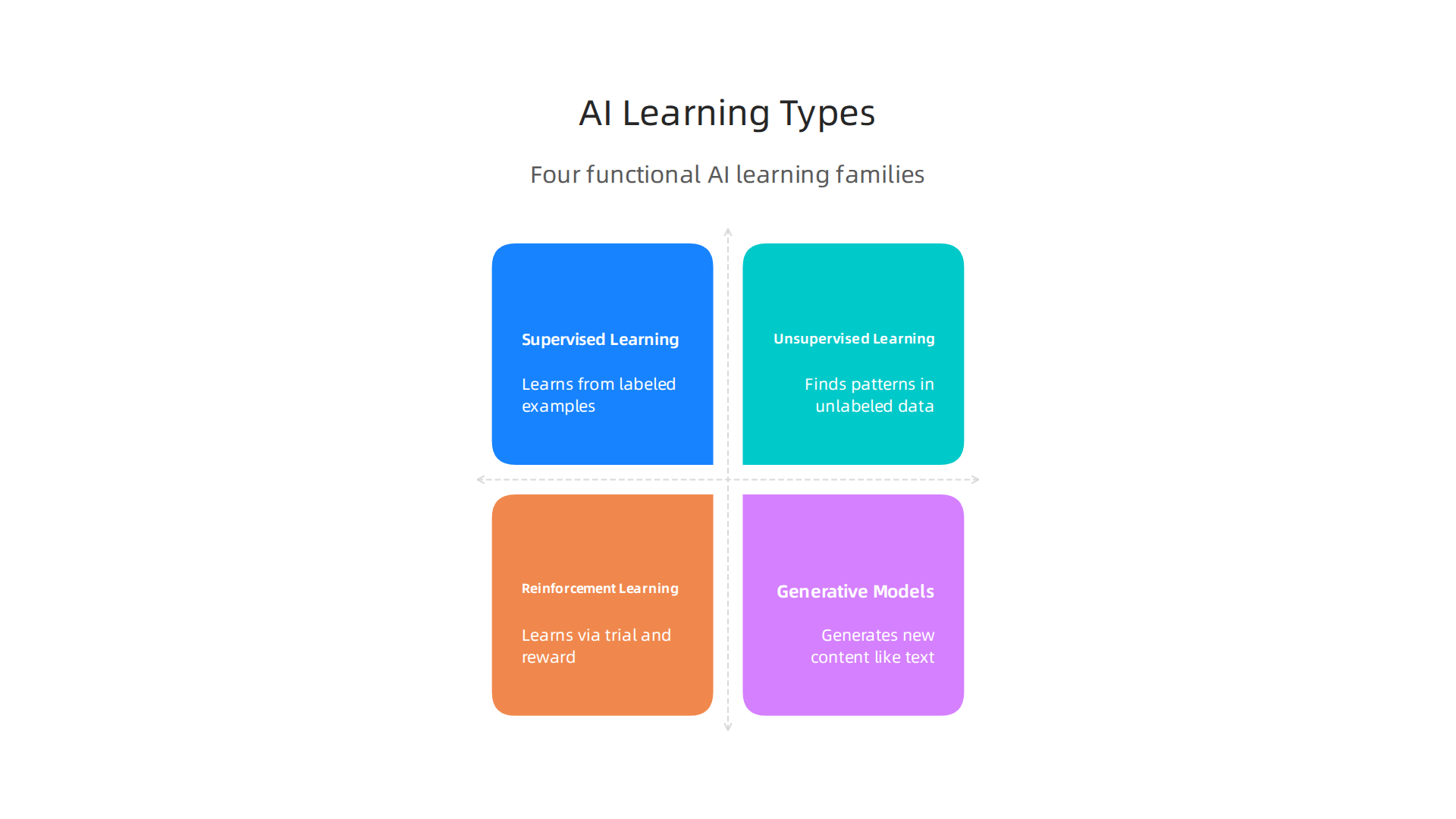
In addition to sorting the types of artificial intelligence by what they can do, you can also sort them by how they learn. This is a very practical way to look at AI because it maps directly to real world problems. Almost every modern AI system fits into one of four learning families: supervised, unsupervised, reinforcement, or generative.
Supervised Learning (Learning from Examples)
Supervised learning is the most common type today. You give the algorithm a bunch of labeled data. Each data point has a correct answer attached to it. The algorithm studies these examples and learns to predict the answer for new, unseen data.
Think of it like studying for a test with an answer key. You practice on problems where you already know the right answer. Then you take the test and apply what you learned. Spam filters use supervised learning. They train on thousands of emails labeled "spam" or "not spam." Once trained, they can flag new spam emails automatically. According to a detailed breakdown of Supervised vs Unsupervised vs Reinforcement Learning, supervised learning works best for classification and regression tasks like predicting stock prices or diagnosing diseases from medical images.
Unsupervised Learning (Learning from Patterns)
Unsupervised learning has no labels. You give the algorithm a pile of raw data and let it find patterns on its own. It groups similar items together, discovers hidden relationships, or compresses data into simpler forms.
A great example is customer segmentation. A store has purchase histories for thousands of customers. The algorithm notices that certain customers buy baby products and organic food, while others buy electronics and energy drinks. It creates groups automatically. The store can then target each group with different ads. Unsupervised learning is also used for anomaly detection, like spotting unusual transactions that might be fraud.
Reinforcement Learning (Learning from Trial and Error)
Reinforcement learning takes a different approach. The algorithm interacts with an environment. It tries actions and gets rewards or punishments. Over time, it learns which actions lead to the most reward. This is how a robot learns to walk or how an AI masters a video game.
Reinforcement learning is powerful in dynamic situations where there is no single correct answer. Self-driving cars use it to learn how to navigate traffic. The car tries steering, braking, and accelerating, and gets positive feedback when it stays safe and reaches its destination. It is the same method behind DeepMind’s AlphaGo, which beat the world champion at the complex board game Go.
Generative Models (Learning to Create)
Generative models are a bit different. They learn the patterns in a dataset and then create new data that looks like it came from the same set. This includes generating images, text, music, and video.
Two big examples are GANs (generative adversarial networks) and diffusion models. GANs pit two networks against each other: one creates fake images, and the other tries to tell if they are real. Over time, the fakes become incredibly realistic. Diffusion models, used in tools like Midjourney and DALL-E, start with random noise and gradually shape it into a clear image based on a text prompt. Generative models have driven the explosion of creative AI tools in 2026.
What This Means for Your Learning Path
Each functional type of AI solves different kinds of problems. Supervised learning predicts outcomes. Unsupervised learning finds hidden structure. Reinforcement learning masters complex environments. Generative models produce new content. Understanding these differences helps you choose the right tool for your project.

If you want to dive deeper into how to study these concepts effectively, check out our strategic guide to learn AI for success in 2026. And if you want to stay current with all the rapid changes in AI, consider subscribing to The Deep View Newsletter for daily news and analysis that cuts through the noise.
Emerging AI Paradigms: Generative AI, Agentic AI, and Multimodal Models
Now that we have covered the four major learning families, let us look at three emerging paradigms that are reshaping the AI landscape in 2026. These new types of artificial intelligence build on the foundations we just discussed but push into entirely new territory.
Generative AI: Creating New Content
Generative AI is already a dominant force. These systems produce novel content like text, images, code, audio, and video by learning patterns from huge datasets. Models like GPT-5 and Claude 4 are prime examples. When you ask them to write an email, create a picture, or summarize a document, they generate something new based on what they have learned.
Generative AI differs from earlier types of artificial intelligence because it does not just predict or classify. It creates. This has led to an explosion of creative tools for writers, designers, and developers. The best creative AI tools in 2026 include many that rely on generative models for video, music, design, and code.
Agentic AI: Systems That Take Action
Agentic AI is the next big shift. Instead of just creating content, these systems act autonomously. They set goals, make decisions, and execute multi-step tasks with very little human help. For example, an agentic AI could book your travel by researching flights, comparing prices, and making reservations without you guiding every step.
The key difference between agentic AI and generative AI comes down to purpose. As explained in a detailed comparison of agentic AI vs generative AI differences, generative AI produces content while agentic AI takes actions. Most modern agentic systems use large language models as their reasoning engine but go beyond simple content creation to actually do things in the real world.
This makes agentic AI the dominant frontier of AI development in 2026. Every major vendor is investing heavily in this category.
Multimodal Models: Understanding Multiple Data Types
Multimodal AI is a third emerging paradigm. These systems can understand and reason across many types of data at once, including text, images, audio, video, and sensor signals. Instead of working with just one type of input, they combine everything into a unified understanding.
As explained in a comprehensive multimodal AI guide, multimodal AI focuses on understanding and reasoning while generative AI focuses on creating. A multimodal system can look at a photo, read the caption, listen to the audio, and grasp the full story. This enables much richer interactions, like a virtual assistant that can see your screen, hear your voice, and read your documents all at once.
What This Means in Practice
These three paradigms often overlap. A single AI system might use generative AI to create responses, agentic AI to plan actions, and multimodal processing to understand complex inputs. But each serves a different purpose. Generative AI creates. Agentic AI acts. Multimodal AI understands.
If you want to stay ahead of these fast-moving developments, check out our detailed overview of AI trends 2026 to see how each paradigm is evolving.
Why These Distinctions Matter for Business Strategy and Investment Decisions
Understanding the different types of artificial intelligence is not just an academic exercise. It has real consequences for how you spend money, build products, and grow a company in 2026.

For investors, the payoff is clear. Knowing the difference between generative AI and predictive ML helps you spot the sub-sectors growing fastest. Right now, venture capitalists are pouring money into three main areas: infrastructure, generative AI and language models, and industry-specific applications. According to the latest breakdown of the 2026 AI investment thesis, AI companies attracted around €213.3 billion in 2025 alone, making up 48% of all venture funding. If you cannot tell the difference between a multimodal model and a simple classifier, you might invest in the wrong category entirely.
For executives, aligning technology choices with business goals starts with matching functional AI types to actual use cases. Do you need a system that creates content? That is generative AI. Do you need one that takes actions on its own? That is agentic AI. Do you need something that understands text and images together? That is multimodal AI. Picking the wrong type wastes time and money. A solid grasp of these distinctions helps you ask the right questions before signing a contract. To explore this further, check out our practical guide on how strategic AI adoption drives business growth in 2026.
Perhaps the most important benefit is avoiding hype. The AI world is full of noise. Startups slap "AI" on their pitch decks, but not all AI is created equal. Misclassifying a basic automation tool as agentic AI can lead to bad due diligence and poor product roadmaps. In 2026, investors require proof of real technology, not thin wrappers on public LLMs. Understanding the types of artificial intelligence is your best defense against AI-washing.
As the landscape shifts fast, staying informed is a competitive advantage. The best way to keep up without drowning in noise is to get clear daily AI updates from The Deep View Newsletter. It cuts through the hype and delivers the signals that matter for your next decision.
Summary
This article explains the many ways to classify artificial intelligence so you can separate hype from real capability and make smarter decisions. It starts with the hierarchy—AI as an umbrella, machine learning as the data-driven subset, and deep learning as the neural-network core—and then maps AI by capability (ANI, AGI, ASI), by cognitive types (reactive through self-aware), and by function (supervised, unsupervised, reinforcement, generative). The guide also covers fast-evolving paradigms like generative, agentic, and multimodal models, and shows why those distinctions matter for learning, product choices, and investment. Throughout it points to practical examples (self-driving cars, chatbots, image generators) and clarifies what exists in 2026 versus what remains hypothetical. After reading, you’ll be able to ask sharper vendor questions, pick the right AI approach for a use case, and prioritize which skills or tools to learn next.