
Why understanding how AI learns matters for investors, founders, and operators
In 2026, artificial intelligence (AI) is changing our world faster than ever before. Every day, it seems like a new AI tool or update comes out. This fast pace creates big chances for businesses to grow, but it also brings risks. For people who make important choices in business, like investors, company founders, and those who run daily operations, it can be hard to tell what’s truly good and what’s just hype.

It’s tough to know which AI models are really strong and which claims about new data or features are true. You might wonder, "How does AI learn, anyway?" Without knowing the basics, it’s like trying to pick the best fruit in a market when you don’t know how to tell if it’s ripe. You need to understand what makes a good AI tick to apply AI in smart ways.
This article will help you understand the core ideas behind how AI learns. We will look at different ways AI systems pick up new skills, like supervised, unsupervised, and reinforcement learning, which are key ways these computer systems learn from data and feedback alike [Sustainable Catalyst.com]. We will talk about the good parts and the tough choices that come with using AI. Most importantly, we’ll show you how to use this knowledge to make better plans for your investments and products, helping you build a smart future.
To truly succeed with AI, you need a guide. This means learning how AI works from the ground up, so you can make informed decisions and stay ahead in the rapidly changing tech world.

If you’re looking for a clear path to understanding AI for your business, consider reading The strategic guide: how to learn AI for success in 2026.
Keeping up with all the new AI trends can feel like a full-time job. To make it easier, you can get daily updates directly to your inbox.
The AI Newsletter Worth Reading
Core learning paradigms: supervised, unsupervised, self-supervised, and reinforcement learning
So, how does AI learn to do all these amazing things? It really comes down to different ways it processes information and gets smarter. To truly understand how AI works, we need to look at four main types of learning: supervised, unsupervised, self-supervised, and reinforcement learning.
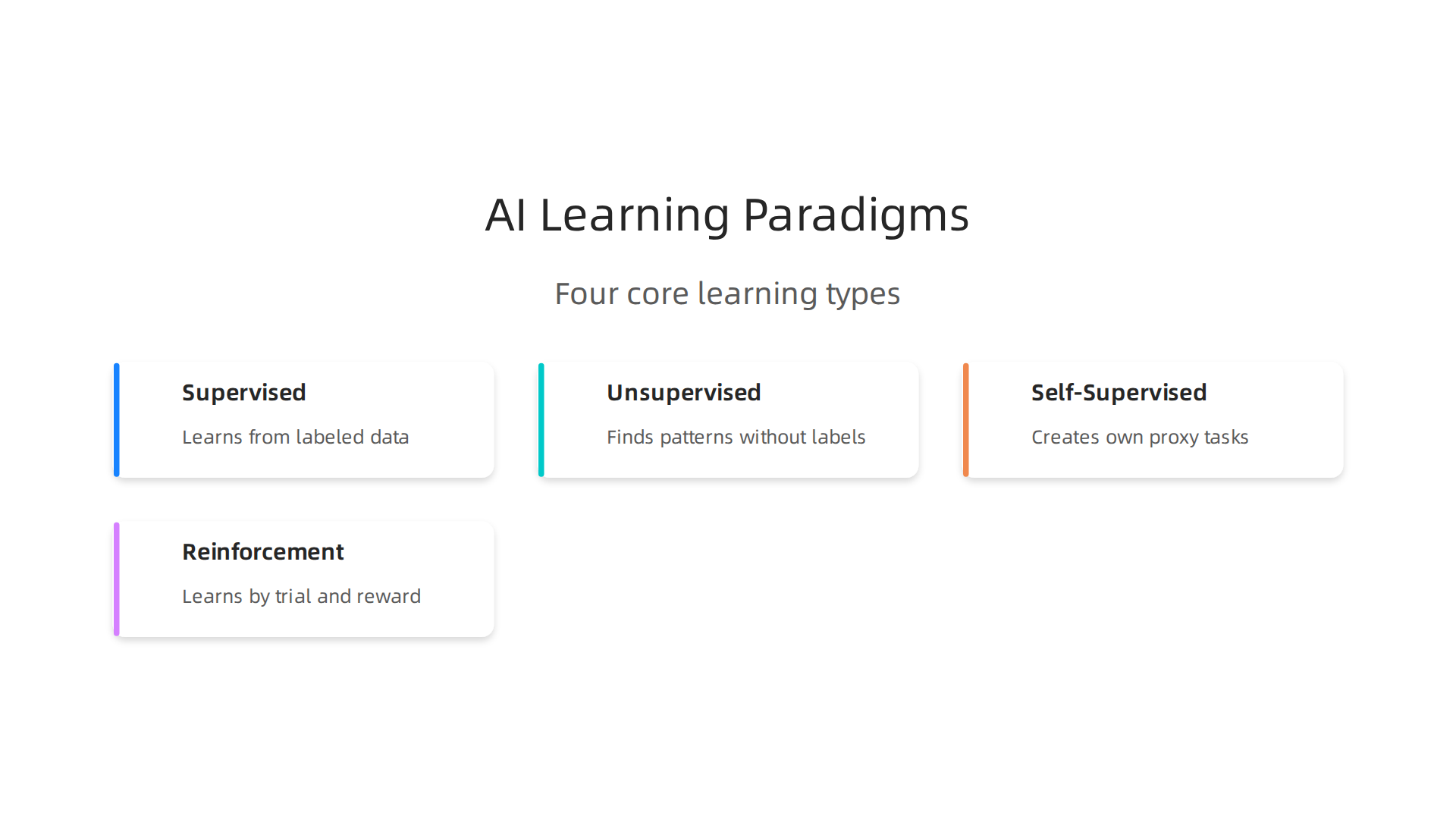
Each has its own way of using data and feedback to improve.
Supervised Learning
Imagine teaching a child to tell the difference between apples and oranges. You show them a picture of an apple and say, "This is an apple." Then you show an orange and say, "This is an orange." You do this many times. This is how supervised learning works for AI.
In supervised learning, the AI system gets "labeled data." This means each piece of information comes with the correct answer or tag. For example, if you feed it pictures of cats and dogs, each picture is already marked as "cat" or "dog" Types of Machine Learning: Supervised, Unsupervised, Semi ….
The AI learns by finding the patterns that connect the pictures to their labels. Its goal is to predict the right label for new, unseen pictures. This is great for tasks like telling spam emails from good ones or guessing house prices. The strong point here is that it can be very accurate, especially when you have a lot of good, labeled data. The tricky part is that getting all that labeled data can be really hard and costly. It takes a lot of human effort.
Unsupervised Learning
Now, what if you showed the child many pictures of fruits but didn’t tell them which was which? You just asked them to sort them. They might put all the round, red ones together, and all the oval, orange ones together. They’d find groups on their own. This is unsupervised learning.
With unsupervised learning, the AI gets data without any labels. It has to find its own patterns, groups, or hidden meanings in the data. It’s like finding a needle in a haystack without knowing what a needle looks like, but still being able to group all the shiny objects together. This method is useful for things like grouping customers based on their shopping habits or finding unusual activity in computer networks Difference Between Supervised, Unsupervised, & Reinforcement …. Since it doesn’t need labels, it can work with huge amounts of raw data. The big strength is that you don’t need expensive labeled data. It can also find surprising new patterns that people might miss. But it can be harder to know exactly what the AI found or why it grouped things a certain way. It’s less direct. If you want to dive deeper into the basics, you can read more about the types of artificial intelligence a clear framework for understanding AI categories and capabilities in 2026.
Self-supervised Learning
Self-supervised learning is a newer and very clever way for AI to learn. Think of it like a child learning to read by looking at a book with some words covered up. The child tries to guess the missing words based on the words they can see. The book itself becomes the teacher.
In self-supervised learning, the AI creates its own learning tasks from the data it already has. For example, it might take a sentence, hide some words, and then try to guess what those words are. The "answer" comes from the original, full sentence. This way, it makes its own labels from existing, unlabeled data. This is how many of the powerful large language models work today What Is Self-Supervised Learning?.
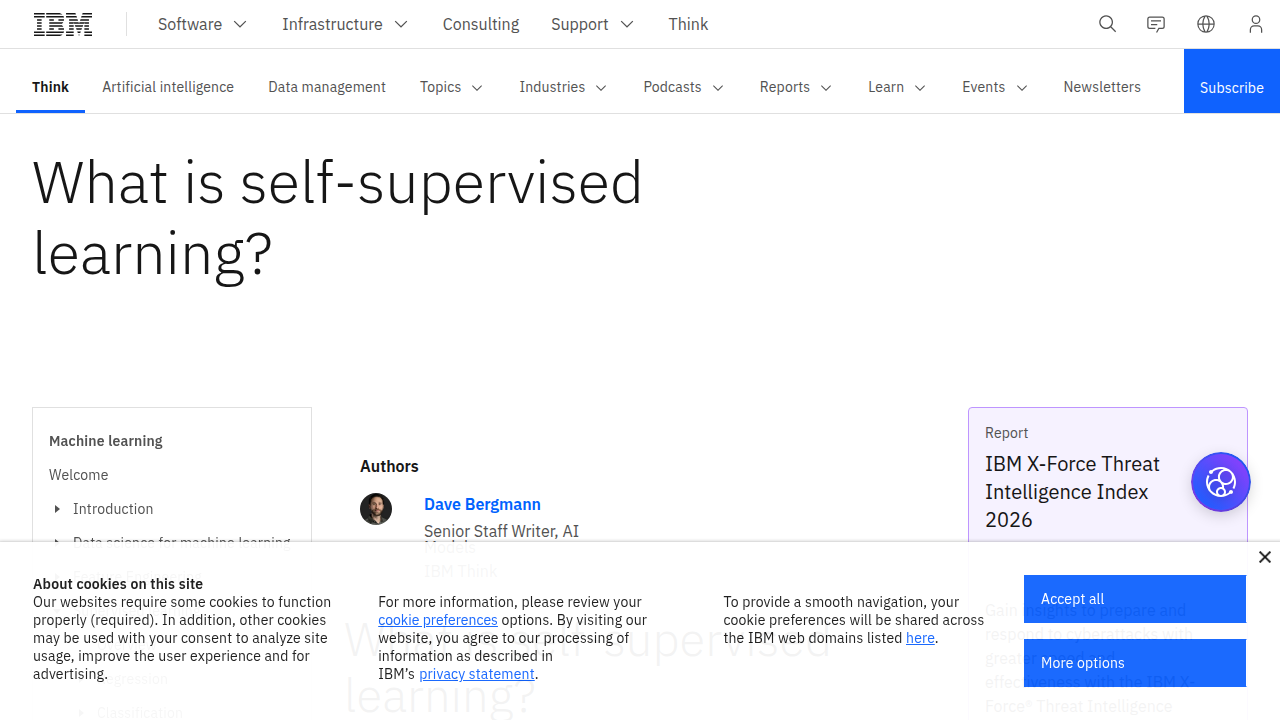
They learn deep understandings of language without needing humans to label billions of sentences. Its main advantage is that it can use vast amounts of unlabeled data very effectively, which is much cheaper and easier to get than labeled data. This lets AI models become very powerful at understanding complex things like language or images. The challenge is designing the right "self-supervised" tasks.
Reinforcement Learning
Finally, imagine teaching a dog new tricks. When the dog does something right, you give it a treat. If it does something wrong, you might say "no" or just not give a treat. The dog learns through trial and error, aiming for the treats. This is reinforcement learning.
In reinforcement learning, the AI, called an "agent," learns by trying actions in an environment. It gets "rewards" for good actions and "penalties" for bad ones. Over time, it learns which actions lead to the most rewards. This is how AI learns to play complex games better than humans or controls robots Supervised vs Unsupervised vs Reinforcement Learning Explained. It doesn’t need data beforehand, but rather learns from experience. The big benefit is that it can solve very complex problems where it’s hard to define all the steps ahead of time. However, training can take a very long time, and it’s sometimes hard to make sure the AI learns exactly what you want it to, especially with real-world applications. To understand how these approaches fit into the bigger picture, explore the AI vs machine learning vs deep learning differences explained.
Understanding these different ways AI learns helps you see where to apply AI best. If your business has lots of organized, labeled data, supervised learning might be your path. If you have tons of raw data and want to find hidden trends, unsupervised or self-supervised learning could be key. And for complex control or decision-making, reinforcement learning shines. Knowing these basics is crucial to building a smart future with AI, guiding your product decisions, and evaluating investment risks.
Data, labeling, and pipelines: the practical foundation of learning
Understanding the different ways AI learns is a great start. But knowing how does AI learn effectively in the real world goes beyond just the learning types. It dives into the nitty-gritty details of data itself: how good it is, how it’s prepared, and how it flows through the AI system.

Think of it like cooking. You can have the best recipe (the learning type), but if your ingredients are bad or you don’t prepare them right, the meal won’t taste good. In AI, the "ingredients" are data, and the "preparation" involves labeling and setting up pipelines.
Data Quality Over Quantity
In the past, many thought that more data was always better. Just throw everything at the AI and it will figure it out. However, in 2026, we know better. The focus has shifted from simply collecting huge amounts of data to making sure that data is really good. It’s about having high-quality, clear data instead of just a lot of messy data. This means using methods like "data pruning," where you remove bad or useless information, and "deduplication," which gets rid of exact copies AI Data Labeling in 2026: Best Practices, Tools, and Emerging …. If the data is bad, even the smartest AI model will struggle to learn well, making it hard to apply AI to real problems.
The Art of Data Labeling
For supervised learning, where the AI needs "answers" with its data, labeling is super important. This is where humans often come in, adding tags or notes to images, text, or sounds. For example, marking all the cats in a picture or identifying the emotion in a voice clip. Getting these labels right is key to how does AI learn accurate patterns.
The best way to do this involves careful planning and quality checks. Companies often use multiple people to label the same data and compare their answers, which is called "consensus labeling" Data Labeling in 2026: Everything You Need to Know. They also use "gold standard examples," which are items with known correct labels, to check if the labelers are doing a good job. These steps help make sure the labels are accurate and consistent, which leads to much better AI performance. Keeping track of who labeled what and when, known as "data provenance," is also a top practice in 2026 to ensure trust and correctness Data Annotation Trends 2026: Forecast & Best Practice.
Building Smart Data Pipelines
A "data pipeline" is like an assembly line for data. It’s a set of steps that takes raw data, cleans it, labels it, and then gets it ready for the AI model to use.
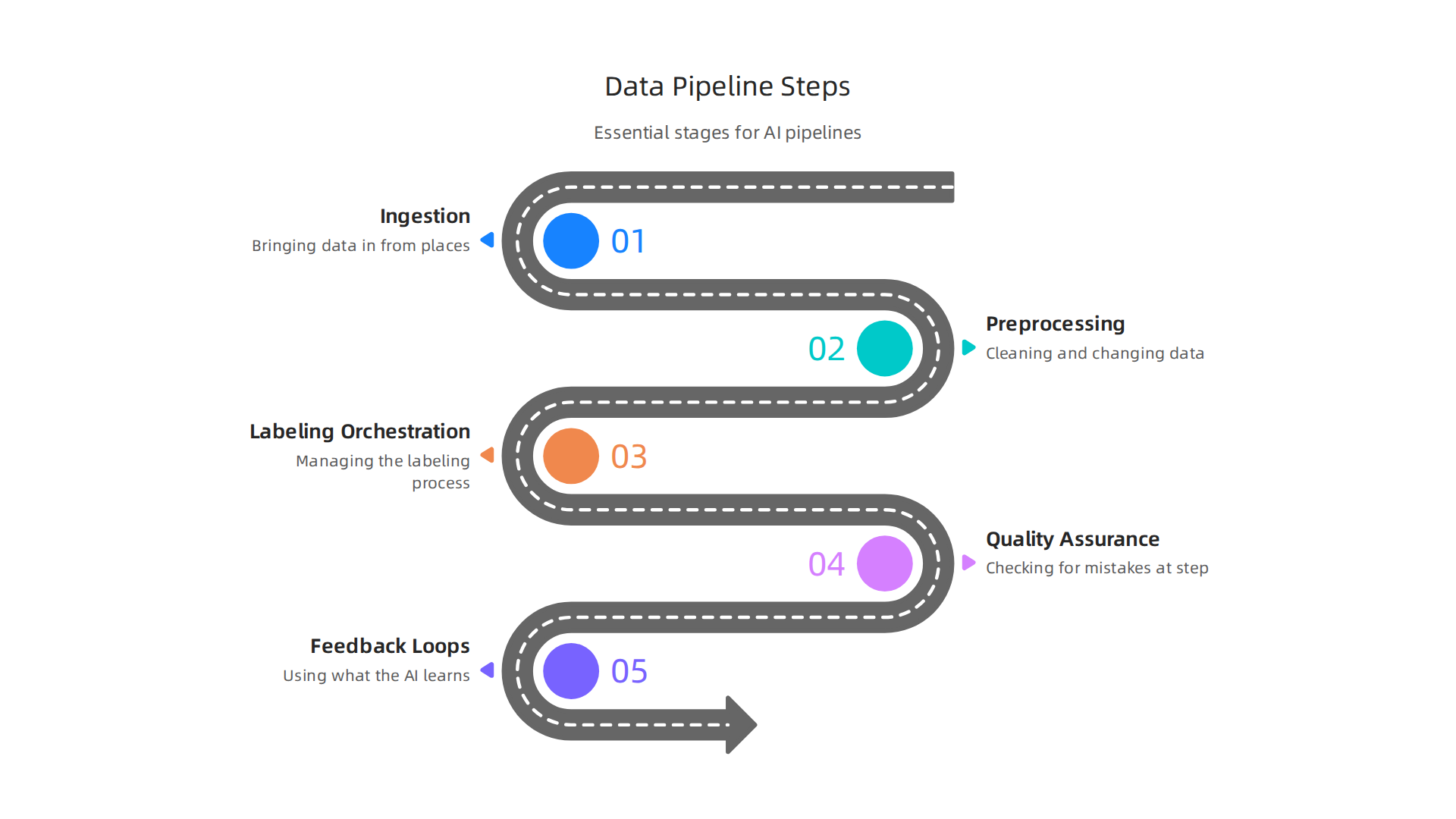
For a smart future with AI, these pipelines need to be well-designed and often automated. This includes things like:
- Ingestion: Bringing data in from different places.
- Preprocessing: Cleaning and changing data so it’s in the right format.
- Labeling Orchestration: Managing the labeling process, whether it’s done by humans, AI, or both.
- Quality Assurance (QA): Checking for mistakes at every step.
- Feedback Loops: Using what the AI learns to make the data and labeling even better over time Best Practices for Automating Data Labeling Pipelines in 2026.
Modern AI pipelines use methods like "active learning," where the AI itself picks out the data it’s most unsure about and sends only those tricky bits to humans for labeling. This makes the whole process faster and cheaper Data Annotation Pipelines for 2026 AI Models Explained.

Costs and Choices
Putting all this together involves trade-offs. You might choose to have a smaller set of perfectly labeled data, or a very large set that’s only "weakly" labeled (meaning the labels might not be as precise). Both choices have different costs and benefits. Managing data pipelines and labeling correctly can be expensive and complex, but it’s crucial for building AI that truly works.
If you’re interested in keeping up with the latest developments in AI and machine intelligence, you’ll want to stay informed. Get clear daily AI updates from The AI Newsletter Worth Reading.
When thinking about how does AI learn, it’s not just about the data you feed it. It’s also about the "brain" or design of the AI model itself. This design is called an "architecture." Just like a house can be a small cottage or a big skyscraper, AI models come in different shapes and sizes. Each shape is best for different kinds of jobs.
What is Inductive Bias?
Think of "inductive bias" as the AI’s natural way of looking at the world. It’s like how you might be better at finding differences in pictures than finding words in a puzzle. The AI’s architecture gives it certain "shortcuts" or assumptions that help it learn faster for specific tasks. But these shortcuts can also make it struggle with tasks they weren’t designed for. Knowing how an AI model is built helps us designing human-centered AI that is both powerful and easy to understand.
Different AI Brains for Different Jobs
In 2026, we see a few main types of these AI "brains":
- Convolutional Neural Networks (CNNs): These are like the super-scouts for images. They are very good at seeing patterns in pictures, like finding edges or shapes. CNNs have strong inductive biases that make them great for image tasks. These biases help them learn well even with less data because they expect images to have certain qualities, like patterns repeating in different places The Inductive Bias of Convolutional Neural Networks.
- Recurrent Neural Networks (RNNs): Imagine an AI that remembers what it just saw or heard. RNNs are good for things that happen in a sequence, like understanding sentences or predicting the next word. They have a bias towards recent information.
- Transformers: These are the new kids on the block, and they’ve become very popular for many tasks, especially understanding language. Transformers are known for having weaker inductive biases compared to CNNs. This means they don’t have as many built-in assumptions, making them more flexible. But because they don’t have these strong shortcuts, they often need a lot more data to learn well Transformers vs CNNs in Medical Imaging: Challenges & ….
- Graph Neural Networks (GNNs): These are for data that looks like networks, like how friends are connected on social media or how molecules are structured. They help AI learn patterns in these complex connections.
How Architecture Impacts Learning
The choice of architecture deeply affects how does AI learn and how well it works.
- Generalization: This is how well an AI can do its job on new data it has never seen before. CNNs generalize very well on image tasks because their biases match how images are structured Vision Transformers vs CNNs: The 2026 Architecture …. Transformers, with their weaker biases, can be more general for a wider range of tasks, and sometimes even perform better than humans in certain complex situations arXiv:2303.12669v1 [cs.CV] 22 Mar 2023.
- Failure Modes: When an AI fails, its architecture can play a big role in why. For example, CNNs might struggle if an image is very different from what they expect. Transformers can sometimes make "human-like errors" because they learn patterns in a broader way Study of human inductive biases in CNNs and Transformers..
For a truly smart future, choosing the right AI architecture is just as important as having good data. It’s about matching the tool to the task, so the AI can learn efficiently and apply AI solutions effectively. If you want to dive deeper into the different kinds of AI, you can explore the various types of artificial intelligence that exist today.
After an AI model is built with its own special brain, or architecture, how does it get really good at its job? It learns by trying, making mistakes, and then adjusting itself. This is where "optimization," "loss functions," and smart "training strategies" come in. They are like the coach, the scoreboard, and the practice plan that truly shape how does AI learn to act.
How AI Gets Better: Optimization and Loss Functions
Imagine an AI trying to guess what’s in a picture. If it guesses wrong, it needs to know how wrong it was so it can get closer next time.
- Loss Functions: This is the AI’s scoreboard. A "loss function" measures how far off the AI’s answer is from the correct answer. If the AI is way off, the "loss" is high. If it’s very close, the "loss" is low. The goal for the AI is always to make this loss as small as possible. Different problems need different ways to measure "loss."
- Optimization Algorithms: These are the coaches. Once the AI knows its score (the loss), an "optimization algorithm" tells it how to change its internal settings to do better next time. It’s like a coach giving advice: "Try moving this way," or "Adjust that setting a little bit." These algorithms help the AI find the best settings much faster, improving its stability and speed during training A state-of-the-art survey of advanced optimization methods in …. Common coaches you might hear about are "Gradient Descent" (GD), "Stochastic Gradient Descent" (SGD), and "Adam." These methods carefully change the AI’s parts to make the loss lower MATHEMATICAL ANALYSIS OF CONVERGENCE FOR OPTIMIZATION ALGORITHMS IN NEURAL NETWORK TRAINING.. Researchers are always looking for lightweight ways to make this process even better Lightweight Optimization Techniques for Neural Network Training ….
Training Strategies for a Smart Future
It’s not just about getting better; it’s about getting better in a smart way. AI training also involves clever strategies:
- Regularization Techniques: Sometimes, an AI can "memorize" all the training examples perfectly but then fails on new things it hasn’t seen. This is like a student who only studies for one specific test and can’t use the knowledge anywhere else. Regularization techniques are like rules that stop the AI from memorizing too much. They force the AI to learn general rules instead, which helps it apply AI knowledge to new situations. For example, some methods strategically improve weight patterns without changing the network’s structure to boost efficiency WISCA: A Lightweight Model Transition Method to Improve ….
- Curriculum Learning: Just like how kids learn math by starting with easy addition before moving to harder calculus, AI can learn better with "curriculum learning." This means showing the AI easier examples first, and then slowly introducing harder ones. It helps the AI build its understanding step by step.
- Pretraining and Fine-tuning: Many of the best AI models today, especially for language, are trained in two main steps. First, they "pretrain" on a huge amount of general data (like all the text on the internet). This gives them a broad understanding. Then, they are "fine-tuned" on a smaller, more specific dataset to learn a particular task, like writing summaries or answering questions. This two-step process makes them very powerful.
- Compute Budgets: Training large AI models takes a lot of computing power and time. A "compute budget" is simply how much of these resources are available. Deciding how to use this budget wisely is a big part of training AI effectively. The goal is to get the best learning outcomes without wasting energy or time.
The right mix of these methods helps AI models truly understand and perform tasks, leading to a truly strategic guide how to learn AI for success in 2026. If you’re keen to stay updated on the latest breakthroughs in AI and how these complex training methods are evolving, a trusted source is key.
Get clear daily AI updates from The AI Newsletter Worth Reading.
After an AI learns new things using smart training steps, how do we know if it truly got better? It’s like a student who studied for a test. You need to check their answers to see what they really understood. For AI, this means "evaluation," "generalization," and "robustness." These words simply mean checking if the AI can do its job well, even in new and tricky situations.
Measuring What Matters for AI Performance
How does AI learn that it’s good enough? We look at a few things:
- Evaluation Metrics: These are like scorecards. They tell us how accurate the AI’s answers are. For example, if an AI sorts pictures of cats and dogs, a metric might count how many it got right. We use different scorecards for different tasks. This helps us see if the AI is ready to do its job.
- Benchmark Limitations: Sometimes, an AI does great on special tests called "benchmarks" in a lab. But in the real world, things are often messier. The real world has "distribution shifts," which means the data it sees might be a little different from what it learned on. So, an AI might look like a "top AI" on paper but struggle when it needs to apply AI knowledge outside the lab. By 2026, researchers are keenly aware that models, especially Vision Transformers (ViTs), have surpassed older types like CNNs on many common tests Vision Transformers vs CNNs: The 2026 Architecture ….
- Real-World Robustness: This is super important. A robust AI is one that still works well even if things are not perfect or if the input changes a little bit. It’s like a strong bridge that can handle different weather conditions. Older AI types like Convolutional Neural Networks (CNNs) have a built-in "inductive bias" that helps them understand pictures by focusing on small, local details, which makes them efficient. However, this bias can sometimes make them less flexible when facing very new kinds of images The Inductive Bias of Convolutional Neural Networks. Newer models like Transformers, while needing more data to train, can sometimes be better at understanding things in a more general way, especially when the data shifts unexpectedly Delving Deep into the Generalization of Vision Transformers under Distribution Shifts.
Stress-Testing Models for a Smart Future
To make sure AI is truly ready for a smart future, we put it through tough tests:
- Adversarial Testing: Imagine someone trying to trick the AI on purpose. This is "adversarial testing." People make tiny, almost invisible changes to inputs, like an image, to try and make the AI guess wrong. This helps us find weaknesses and make the AI stronger against tricky attacks. Even the most advanced Transformers can still face challenges in keeping their performance high after these tests [PDF] arXiv:2303.12669v1 [cs.CV] 22 Mar 2023).
- Distribution Shift Evaluation: This test checks if the AI can handle data that is slightly different from what it was trained on. For example, if an AI learned about cars in sunny weather, how well does it do when it sees cars in the rain or snow? This is a key part of making sure AI can really apply AI knowledge in diverse situations.
- Safety Checks: Beyond just working correctly, AI must also be safe and fair. This means checking that it doesn’t make harmful mistakes, treat people unfairly, or do things it shouldn’t. Building ethical and transparent AI is a big focus for a responsible future. Researchers are working on new ways to measure if AI can keep learning safely without forgetting old lessons or causing problems A Survey of Continual Learning and Self-Iteration in Large ….
Learning how to properly test and evaluate these complex systems is as important as the training itself. If you’re looking to delve deeper into these methods, understanding how to compare different AI tools is essential. Learn more about how to evaluate AI tools in 2026 using the Covers AI benchmark.
After an AI has been tested and we know it performs well in different situations, the next big step is to make it useful in the real world.

This means taking it out of the lab and putting it into action. This journey involves making AI models bigger, teaching them to learn from past lessons, and then making sure they work smoothly for everyone.
Moving AI from the Lab to Real Life
Getting AI from a testing ground to a working product involves a few important ideas:
- Scaling Laws: This simply means that if you make AI models much bigger and give them lots more data to learn from, they often get much better at their tasks. It’s like giving a student more books and more time to study for a test. Bigger AI models can understand more complex patterns and apply AI knowledge in deeper ways. This push for scale is why we see such powerful AI tools in 2026.
- Transfer Learning: Imagine you learned to ride a bike. When you try a scooter, it’s easier because you already know about balancing. Transfer learning is similar for AI. An AI model that learned to recognize different animals, for example, can use that basic knowledge to quickly learn a new task, like recognizing different types of cars. It "transfers" its old learning to a new, but related, problem. This makes building new AI much faster and more efficient.
- Practical Deployment: This is about putting the AI to work. When an AI model is used by many people or systems, we need to think about how fast it gives answers (this is called "latency"). No one wants to wait a long time for a response. We also need to keep a close eye on it to make sure it keeps working correctly over time (this is "monitoring"). Sometimes, the AI needs updates, just like your phone apps get updates, to make it even better or fix any small issues.
How Companies Manage AI: MLOps and Data Pipelines
For businesses to really use AI in a smart future, they need good ways to manage everything. This is where "MLOps" comes in. MLOps is like a playbook for how teams work with AI models, from the moment they are made to when they are used and updated.
- Data Pipelines: AI models need a constant flow of good, clean data to learn and stay smart. Data pipelines are like carefully built roads that bring this data to the AI. These pipelines help gather, clean, and prepare data. By 2026, companies know that good data quality is more important than just having a huge amount of data. This means focusing on getting high-quality, clear data AI Data Labeling in 2026: Best Practices, Tools, and Emerging …. Teams automate these steps to make sure the AI always has the best fuel. You can learn more about automating data labeling pipelines.
- Governance and Monitoring: Just like there are rules for driving on roads, there are rules for AI. "Governance" means having clear plans for how AI is used, who is in charge, and how to make sure it’s fair and safe. Good MLOps practices also mean constantly watching the AI in action to catch any problems early. This includes checking its accuracy and how it performs in the real world MLOps Best Practices: Deploying ML Models at Scale in 2026. This careful watching helps make sure the AI keeps doing its job well and stays a top AI tool. Many companies are now looking for ways to choose the right AI platforms for business growth in 2026.
Making AI work well in the real world is a continuous effort. It requires smart ways to manage data, constant checks, and clear rules.
Get clear daily AI updates from The AI Newsletter Worth Reading.
Summary
This article explains how AI learns and why that understanding matters for investors, founders, and operators trying to separate signal from hype. It walks through the four core paradigms—supervised, unsupervised, self‑supervised, and reinforcement learning—and shows how each fits different business problems. The piece also covers practical foundations: data quality, consensus labeling, data pipelines, and active learning to reduce cost and improve outcomes. It compares architectures (CNNs, RNNs, Transformers, GNNs), explains inductive bias, and outlines optimization and training tactics like loss functions, regularization, curriculum learning, and pretraining/fine‑tuning. You’ll learn how to evaluate models for generalization, robustness, and adversarial risks, and how to move from lab experiments to production with scaling laws, transfer learning, and MLOps. After reading, business leaders will be able to match problems to the right learning approach, judge data and engineering readiness, and make more informed product and investment decisions.