

Why ‘Smart AI’ Matters Now
In 2026, it seems like everyone is talking about "smart AI." You hear the term used for all sorts of different computer programs and tools. The problem is, there’s no clear way to tell what really makes an AI "smart." So many new kinds of AI are coming out that it can be confusing to understand what each one actually does. This can be tricky, especially when different types of AI, like those used in various AI domains, have unique abilities.
This confusion means that important people, like investors looking for the next big thing, company founders planning new products, and market analysts trying to understand trends, often don’t have a clear map.

They need to know what different AI systems can truly do, what signs to look for that an AI is truly advanced, and how to properly measure its power. In fact, many experts agree that there isn’t a widely accepted way to classify AI capabilities today, which makes it harder for everyone to compare different systems fairly International AI Safety Report 2026.
That’s where a clear understanding of smart AI comes in. This guide will help you cut through all the noise. We will show you how to truly understand the elements of AI for strategic decisions, so you can see the real power behind the latest technologies.

Knowing the difference helps you make better choices, whether you are investing, building, or just trying to keep up with the fast-moving AI revolution. By learning how to spot real intelligence in AI, you will be better prepared to navigate this exciting future.
To keep up with daily, in-depth insights into AI and broader technology trends, consider subscribing.
The AI Newsletter Worth Reading
What is Smart AI? Core definitions and a proposed taxonomy
So, what exactly makes an AI "smart"? It is more than just a computer program that can do cool things. In 2026, smart AI refers to systems that show advanced abilities beyond simple tasks. These abilities often include understanding, learning, and making decisions in ways that seem much like how a human brain works. This is different from basic automation, which just follows a set of rules without any real understanding.
To really get what smart AI means, it helps to look at its core abilities. Experts are still working on the best ways to describe these, but many agree on a few key areas. For example, some researchers have proposed new ways to sort out AI abilities by how they work and what they can achieve From Isolated Tasks to Structured Capabilities: A Multilayer Taxonomy for Large Language Models. A good way to think about smart AI is through a capability-based taxonomy. This means we look at what the AI can do.
Here are some important capabilities that often make an AI system "smart":
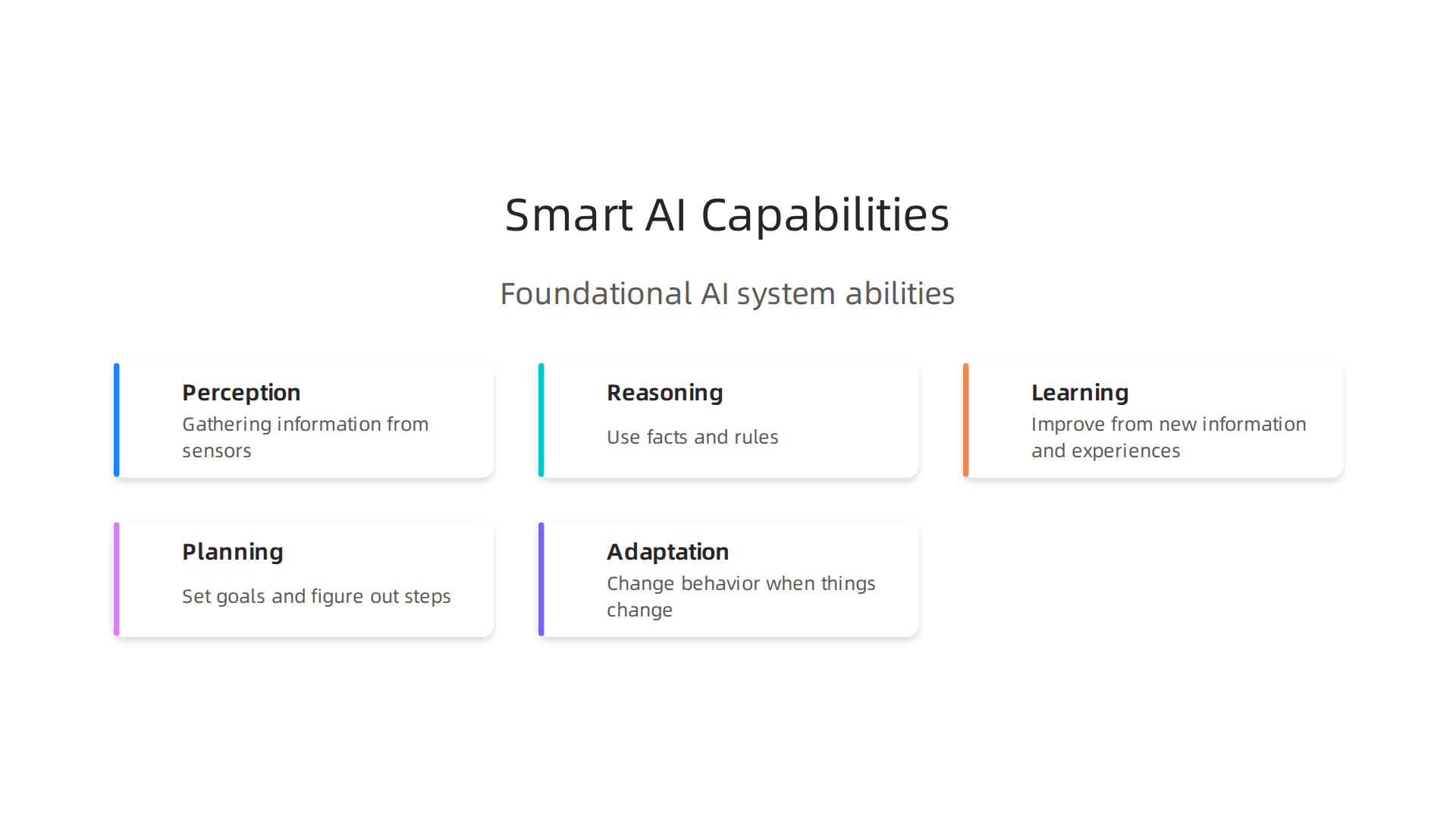
- Perception: This is an AI’s ability to "see" and "hear" its world. It means gathering information from sensors, like cameras or microphones, and making sense of it. Think of facial recognition or understanding spoken words.
- Reasoning: A smart AI can use facts and rules to make smart guesses or decisions. It can solve problems by thinking through different options, not just by following a script.
- Learning: This is super important. Smart AI can learn from new information and past experiences without being told exactly what to do. It can get better over time, just like we do. This is a key difference from simpler programs. If you want to dive deeper into how different AI forms learn, you can explore the differences between AI, machine learning, and deep learning.
- Planning: A truly smart AI can set goals and figure out the steps needed to reach those goals. It can even change its plan if new things happen.
- Adaptation: This means the AI can change its behavior when things around it change. It is flexible and can handle new situations it has not seen before. Some advanced AI systems, especially those in healthcare, are being evaluated using such detailed taxonomies to understand their adaptive capabilities Agentic AI in Healthcare & Medicine: A Seven-Dimensional … – arXiv.
When we talk about smart AI, it is important to know what it is not. It is not just simple automation, like a robot arm that always does the same motion. That is useful, but it is not smart in the way we mean. Smart AI can learn and think for itself within its programmed limits. It is also not "general intelligence" like a human mind, which can do everything we can do. Today’s smart AI is often very good at specific tasks, even if it can learn and adapt within those tasks. It excels at things like finding patterns in huge amounts of data, creating new content, or helping with tasks in certain areas Current AI Capabilities and Limitations (2026) – The Strategy Stack.
This way of looking at AI by its capabilities helps us understand its real power and where it can be most helpful. It gives us a clearer picture of what a machine can truly achieve in 2026.
When we talk about smart AI, we’re really looking at specific skills it has. These skills are what let it do more than just follow simple orders. They make the AI seem "smart" because it can handle new things and learn over time. Let’s dig a little deeper into these core abilities.
Perception: Seeing and Hearing the World
Perception is like an AI’s senses. It’s how a smart AI gathers information from the world around it. This involves:
- Seeing: Using cameras to understand images and videos. Think of AI that can tell the difference between a cat and a dog, or recognize faces in a crowd. This uses methods like computer vision.
- Hearing: Using microphones to listen to sounds and spoken words. This is how virtual assistants understand what you say. It involves things like speech recognition and understanding language.
- Other Senses: Some AI can also feel changes in temperature, pressure, or movement using special sensors.
Making sense of all this sensory data is key. It helps the AI build a picture of its environment, which is the first step toward smart action.
Reasoning: Thinking and Solving Problems
After perceiving information, a smart AI needs to think about it. Reasoning is the AI’s ability to use what it knows to make good decisions and solve problems. This isn’t just about following fixed rules. It can involve:
- Logical Thinking: Using facts to draw conclusions, much like solving a puzzle. For example, if A is true and B is true when A is true, then B must be true.
- Making Inferences: Coming up with new ideas or understandings based on limited information.
- Planning Steps: Figuring out the best way to reach a goal. An AI in a self-driving car reasons about traffic, road signs, and other cars to decide where to go and how to get there safely. This ability to make smart decisions is why many businesses are investing heavily in AI today, looking to gain an edge in their respective AI domains.
Effective reasoning helps AI systems tackle harder tasks and respond well to changes. More advanced reasoning capabilities are crucial for the ongoing Advancing decision-making: A comprehensive review of intelligent systems, applications, and challenges.
Learning: Getting Smarter Over Time
Learning is perhaps the most exciting part of smart AI. It means the AI can improve its performance without needing a person to reprogram it every time. It learns from data and experiences.
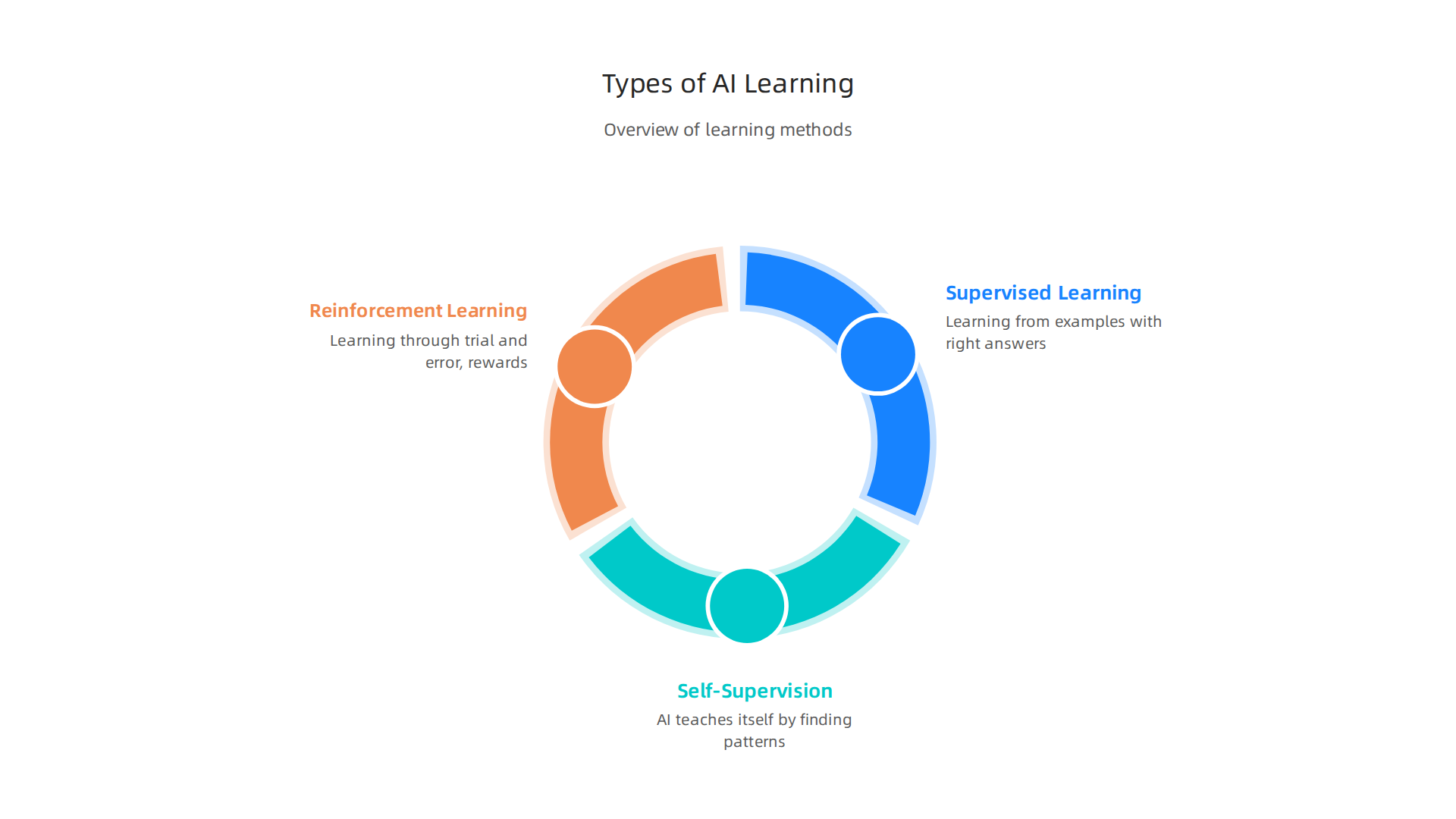
- Supervised Learning: This is like a student learning from a teacher. The AI sees many examples with the right answers and learns to find patterns. For example, it sees many pictures labeled "cat" and "dog" until it can tell them apart on its own.
- Self-Supervision: Here, the AI teaches itself by finding patterns in unlabeled data. It can guess missing parts of information and learn from its own predictions. This helps AI understand language better by predicting the next word in a sentence.
- Reinforcement Learning: This is like learning through trial and error, with rewards for good actions and penalties for bad ones. It’s how AI learns to play games or control robots.
This ability to learn makes smart AI very flexible and powerful, driving much of the current AI revolution. To dive deeper into the different ways AI learns, you can read about mastering how AI learns for strategic business advantage.
Context-Awareness: Understanding the Situation
Context-awareness means the AI understands the situation it’s in. It doesn’t just process information; it understands why that information is important at that moment.
- Multimodal Understanding: This is when an AI combines information from different senses, like seeing an object and hearing its sound, to get a fuller picture.
- Continual Learning: A context-aware AI can keep learning and updating its understanding as new situations arise, rather than being stuck with old knowledge.
- Sensor Fusion: This is how AI blends data from many different sensors (cameras, microphones, GPS) to get a more complete and accurate view of its environment. This helps it understand the context of what’s happening. For instance, an AI might combine visual cues with location data to understand if it’s in a busy city or a quiet park.
When all these capabilities work together, a smart AI can perceive its world, reason about what it sees and hears, learn from its experiences, and act in ways that make sense for the situation. This combined power is what makes smart AI so impactful in 2026.
After learning about the amazing skills smart AI has, like seeing, thinking, and learning, the big question is: How do we actually know if an AI is truly smart? We need good ways to check its performance and make sure it works as expected. This is where benchmarks, metrics, and special tests come in.
How Smart AI is Evaluated: Benchmarks, Metrics, and Validation Strategies
To really understand how good a smart AI is, we use special tests called benchmarks. Think of a benchmark as a test that helps us measure what an AI can do. There are many different kinds of benchmarks, designed to test different skills like understanding language, seeing pictures, or solving problems.
For example, some benchmarks test how well a generative AI model can create new text or images. In early 2026, models like Gemini 3 Pro, GPT 5.2, and Clause Opus 4.5 were seen as top performers in these kinds of general tests Best generative AI models at the beginning of 2026. Other benchmarks, like HELM or Chatbot Arena, help us see how well an AI understands and uses language Top 50 AI Model Evals: Full Benchmark List (July 2026).
Why a Single Score Isn’t Enough
Sometimes, you might see an AI described with just one number, like a "score of 90%." But actually, relying on a single number can be tricky. It’s like saying a student is smart just because they got a good grade in one subject. That student might be great at math but struggle with writing. The same is true for AI. An AI might score very high on one specific test but not be very useful in a real-world setting.
Experts warn that we need to look beyond simple scores to truly understand AI performance AI Benchmarks 2026: Top Evaluations and Their Limits. We need to ask deeper questions about what the AI can really do.
Checking AI in Real Life: Practical Tests
For businesses and people who invest in smart AI, it’s super important to test AI in ways that show how it will work every day. Here are some key ways to check an AI’s real value:
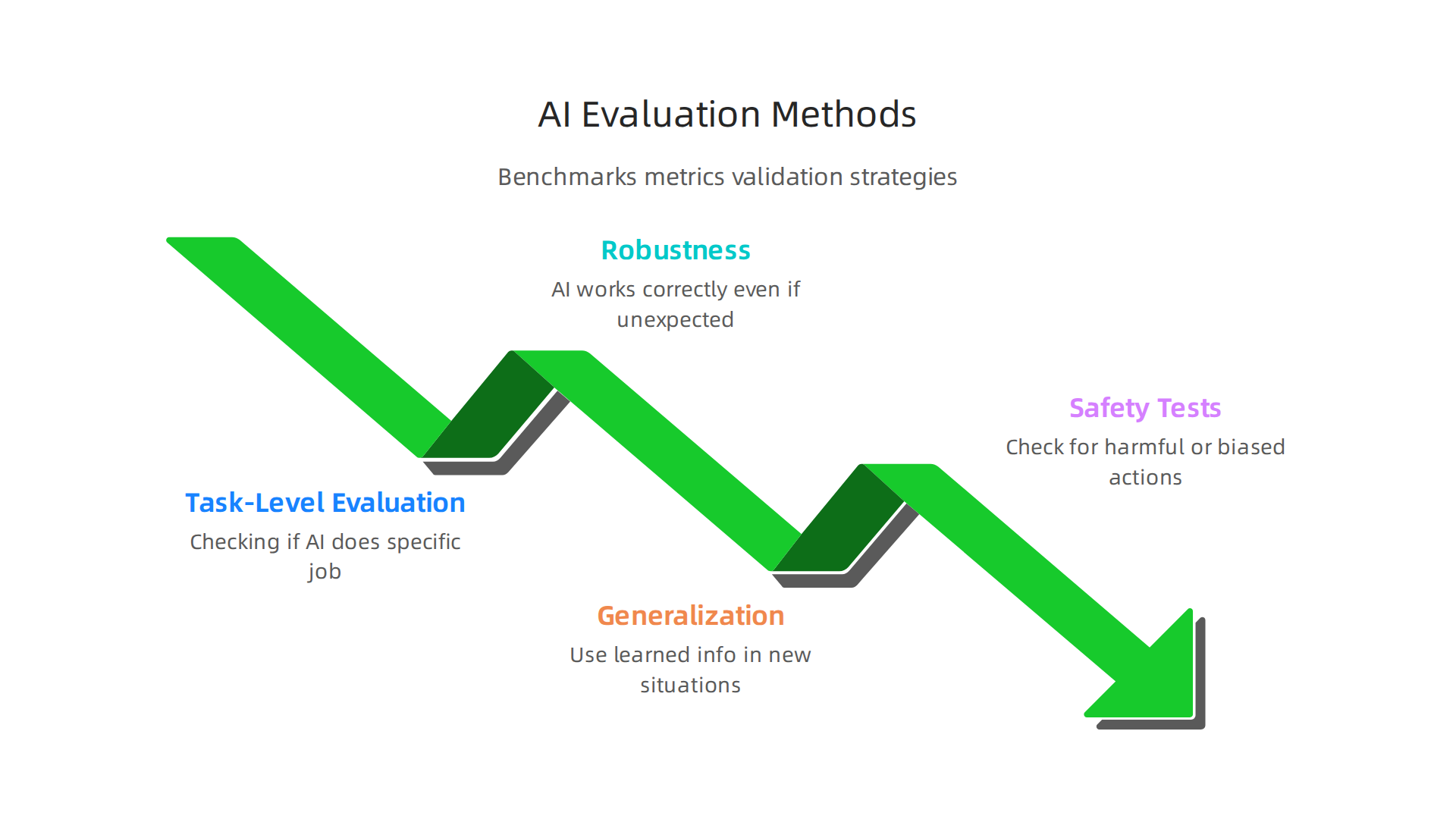
- Task-Level Evaluation: This means checking if the AI can do the specific job you need it for. If you need an AI to answer customer questions, you’d test it with many different kinds of customer questions to see how well it helps.
- Robustness: An AI needs to be strong and reliable. Robustness tests see if the AI still works correctly even if things are a little different or unexpected. For example, if you change a few words in a sentence, does the AI still understand? Or if an image is a bit blurry, can it still recognize the object? This is a big area of study, especially for large language models Evaluating Robustness and Generalization in LLMs under …. There are even specific benchmarks, like RobustBench, just for checking this RobustBench: a standardized adversarial robustness benchmark ….
- Generalization: This skill is about whether an AI can use what it learned in one situation to handle totally new situations. If an AI learns to spot cats in photos, can it also spot them in videos it’s never seen before? Good generalization means the AI isn’t just memorizing; it truly understands. Newer benchmarks are always coming out to test this important ability Benchmarking the Future: Unpacking the Latest Breakthroughs ….
- Safety Tests: It’s vital that smart AI doesn’t create harmful content or act in biased ways. Safety tests check for these problems to make sure the AI is fair and helpful.
To truly understand an AI’s capabilities, we have to look at how it performs across many different situations and tests. This helps us know if an AI is not just good at one thing, but genuinely smart and useful in the real world. For a deeper look into evaluating AI tools, you can read about how to evaluate AI tools in 2026 using the COVERS AI benchmark.
Want to stay informed about the rapidly changing world of AI?
Get clear daily AI updates from The AI Newsletter Worth Reading.
Now that we know how to tell if an AI is truly smart and useful, let’s talk about where this smart AI is making a big splash in the real world.

Smart AI is changing many parts of our lives, from how businesses work to how we interact with technology every day. This is really about the ai revolution that helps companies make more money, save time, and do new things they couldn’t before.
Where Smart AI Helps Most
Smart AI uses its many skills, like understanding language or seeing patterns, to help in different industries. Here are some of the main places where smart AI brings big value:
-
Banks and Money: In the world of money, smart AI is really good at finding fraud. It can quickly spot strange movements of money that humans might miss. This helps keep our money safe. In 2026, financial companies are seeing a big return on their AI investments, sometimes as much as four times what they put in AI Development Statistics & Industry Trends in 2026. Things like checking contracts and finding important papers also get a big boost from AI, saving a lot of time and effort 50 AI Use Cases by Industry: Real Examples That Drive ROI ….
-
Hospitals and Healthcare: Smart AI helps doctors and nurses in many ways. It can look at medical pictures to help find problems early, or help in finding new medicines. It can also make patient schedules better and help with follow-ups, saving lots of time.
-
Factories and Making Things: In factories, smart AI helps make sure machines keep working. It can predict when a machine might break down, so it can be fixed before it causes a problem. This is called "predictive maintenance." It also helps check the quality of products, making sure everything is made correctly. Many industrial makers are getting great results from AI in this area What industries benefit most from business AI in 2026?.
-
Shops and Buying Things: When you shop online, smart AI helps show you things you might like based on what you’ve looked at before. This makes shopping easier and more fun. It also helps stores guess what people will want to buy, so they always have enough in stock.
-
Phones and Communication: Smart AI helps phone companies manage big networks and offer better service to customers. It can help answer your questions faster and make sure your calls and internet work smoothly.
The Big Wins for Businesses
For leaders and investors, the key is to look at what smart AI does for the business. They care about:
- Efficiency: This means doing things faster and with less effort. AI can automate tasks that used to take many hours, letting people focus on more important work.
- More Money (Revenue Uplift): By helping find new customers, making existing customers happier, or creating new products and services, AI can help businesses earn more money.
- New Capabilities: Smart AI can give businesses totally new powers, like being able to analyze huge amounts of data in seconds or talking to customers in many different languages.
In 2026, many companies are seeing real benefits from using AI. While some companies still struggle to see returns, many are finding that smart AI is a game-changer, especially in areas like financial services, telecom, and retail AI ROI by Industry 2026: Where Returns Concentrate. Learning how to use AI in smart ways can truly help a business grow. For more on how to use AI to help your business, you can explore how strategic AI adoption drives business growth in 2026.
Putting smart AI into action is exciting, but it also comes with its own set of steps and hurdles. We have to think about where the AI lives and how it connects with other systems.
Ways We Use Smart AI
When we talk about using smart AI in real life, there are a few common ways to set it up. These ways are called deployment patterns, and each works best for different needs.
- Cloud AI: This is like using a huge, powerful computer far away on the internet. Your smart AI lives there. It’s great for big jobs that need lots of power, like looking through tons of pictures or understanding complex language. The cloud can handle a lot of work and grow bigger as needed.
- Edge AI: Instead of the cloud, edge AI runs on smaller devices closer to where the action happens. Think of a smart camera that recognizes things right where it is, without sending pictures to the internet first. This is faster and can keep your information more private. It’s becoming very important in many AI domains, from smart homes to busy factories.
- On-Device AI: This is a special kind of edge AI where the smart AI lives completely inside one device, like your smartphone or a robot. It doesn’t need to connect to the internet to do its job. This makes it super fast and very private.
- Hybrid AI: Many businesses mix and match. They might use the cloud for training a smart AI model with lots of data, and then put a smaller, faster version of that AI on edge devices for everyday tasks. This combines the strengths of both.
What Makes Deploying Smart AI Hard
Even with great plans, bringing smart AI into a business can be tricky. Here are some common problems:
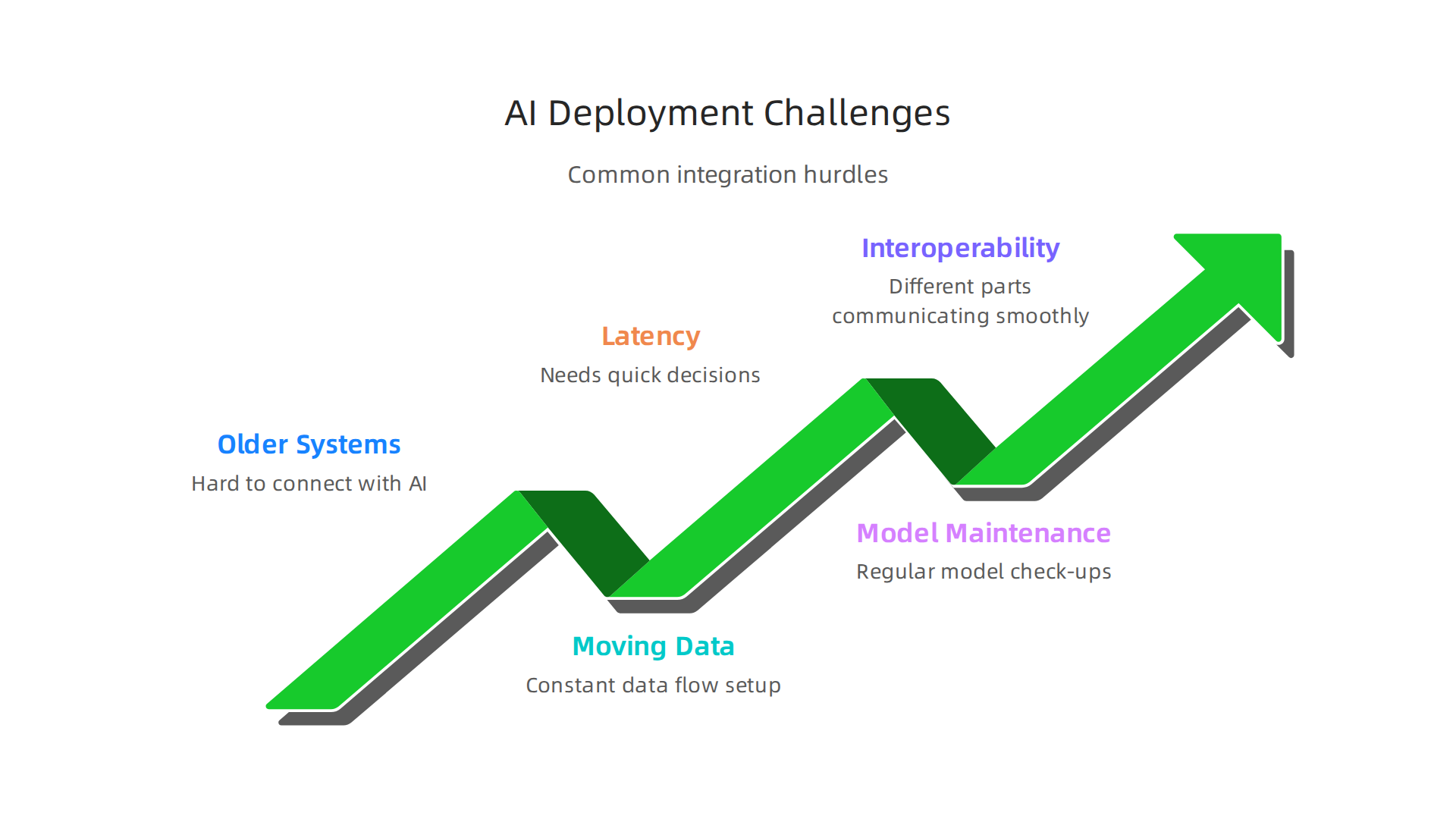
- Older Computer Systems: Many companies still use old computer systems that weren’t made for today’s smart AI. These "legacy systems" can be hard to connect. They might not have the right doors for AI to plug into, or their data might be stored in ways AI can’t easily understand AI Integration with Legacy Systems: Key CTO Challenges. It’s like trying to connect a new smart TV to a very old radio.
- Moving Data: Smart AI needs a constant flow of good, clean information. Setting up these "data pipelines" to get data from different places to the AI model can be a big job. If the data is messy or incomplete, the AI won’t work well.
- Speed (Latency): Sometimes, smart AI needs to make decisions very quickly, like in a self-driving car or a fraud detection system. If there’s a delay, even a small one, it can cause problems. Making sure the AI responds fast enough is a common challenge.
- Keeping AI Models Working: Smart AI models aren’t "set it and forget it." They need regular check-ups, updates, and training with new information to stay accurate and helpful. This "model maintenance" is a continuous effort.
- Making Systems Talk to Each Other: Often, a smart AI needs to work with many other computer programs and systems a company already uses. Getting all these different parts to "talk" to each other smoothly is called interoperability, and it’s a major hurdle. Old systems often have data stored in separate places, making it hard to get a full picture for the AI AI Integration with Legacy Systems: A Practical Guide (2025). According to a 2026 survey, a big challenge for tech leaders is connecting AI with these older systems How to Integrate AI in Legacy IT Systems.
Overcoming these challenges is key to truly benefiting from the power of smart AI in any industry. It requires careful planning and often creative solutions.
Overcoming the challenges of setting up smart AI is a big step, but the work doesn’t stop there. Once your smart AI systems are running, you need to watch them closely. This means making sure they keep working well, safely, and fairly.

We call this monitoring and governance.
Monitoring Smart AI: Keeping a Close Eye
Think of monitoring like giving your smart AI regular check-ups. You want to make sure it’s healthy and doing its job right. Here are some key things to watch:
- Performance Drift: This happens when your smart AI slowly starts to get worse at its job over time. Maybe it was great at spotting fake emails, but then it misses more and more. This can happen because the world changes, and the AI needs new information to stay sharp. Checking the AI’s technical performance often helps catch this early Technical Performance.
- Data Distribution Shift: Imagine you trained your AI on pictures of cats. If it suddenly starts seeing mostly pictures of dogs, it might get confused. This is a data distribution shift. It means the kind of information the AI is getting has changed, and it might need new training to adapt.
- Safety Incidents: Sometimes, smart AI can do unexpected things that lead to problems. This could be giving bad advice, making unfair decisions, or even causing physical harm in some advanced AI domains. Catching these "safety incidents" quickly is very important to prevent bigger issues. Testing how strong and reliable AI models are is a big focus in 2026 Benchmarking the Future: Unpacking the Latest Breakthroughs ….
To keep smart AI working well, companies use special tools to watch these signals. They also test AI models using benchmarks to see how good they are at different tasks and how well they can handle new situations AI Benchmarks 2026: Top Evaluations and Their Limits. It’s all about making sure the AI stays dependable and keeps learning.
Governance and Safety for Smart AI
Beyond just monitoring how smart AI performs, companies also need clear rules and oversight. This is called governance, and it’s about making sure smart AI is used in a responsible and ethical way.
- Setting the Rules: Every business needs a plan for how its smart AI will behave. This includes rules about fairness, privacy, and being open about how the AI makes decisions. These guidelines help prevent problems and build trust. If you’re looking to understand more about setting up these guiding principles, you might find our article on designing human centered AI guiding principles for 2026 helpful.
- Regulatory and Compliance: As the AI revolution grows, governments are creating new laws to control how smart AI is used. Companies must follow these rules to avoid fines and other penalties. This means keeping track of what the AI does and ensuring its decisions are fair and can be explained. Thinking about the big picture, understanding AI trends 2026 the crucial insights for leaders and investors can help you stay ahead.
- Accountability: If a smart AI makes a mistake, who is responsible? Having clear lines of accountability means knowing who to turn to when things go wrong. This helps ensure that issues are fixed quickly and that lessons are learned.
Keeping up with all the changes in smart AI, from new technologies to regulations, can feel like a lot. The best way to stay informed is to get reliable updates.
Get clear daily AI updates from The AI Newsletter Worth Reading.
By watching smart AI closely and having strong rules in place, businesses can make sure these powerful tools are used for good, helping everyone.
Keeping smart AI running well inside your company is one thing, but understanding the bigger picture of the whole AI world is just as important. The world of smart AI changes super fast. New companies pop up, and old ones release new tools and updates almost daily. To make smart choices, businesses need a good way to keep track of all these moving parts. This means knowing how to follow what different vendors are doing, what new products are coming out, and what important signals are showing up.
How to Track Vendors, Releases, and Product Signals Efficiently
Think about it like this: if you want to be good at a sport, you need to watch what other teams are doing. The same is true for businesses and the AI revolution. There’s a lot of information out there, and it’s easy to get lost in the "noise" of it all. The trick is to find the true "signals" that tell you what really matters. This helps leaders make smart strategic decisions.
Here are some key things to watch for:
- New AI Models and Product Releases: Companies that make smart AI are always building new things. They release updated models, software, and new features that can change how businesses work. Keeping an eye on these releases helps you understand the latest capabilities in different AI domains.
- Benchmark Updates: Remember how we talked about checking AI performance? Well, outside groups often test how good different AI models are at certain tasks. These tests are called benchmarks. When new benchmarks come out, they can show which AI tools are the strongest or if there’s a big jump in what smart AI can do.
- Funding and Events: When a new AI company gets a lot of money from investors, it’s often a sign that they’re working on something important. Also, big AI conferences and events often show off the next big ideas. Tracking these can give you clues about where the smart AI world is headed next. Reports on things like AI investment projections for 2026 can be very helpful.
Practical Workflows and Tools
It’s not enough just to know what to look for; you also need to know how to look for it without getting overwhelmed. Many businesses use special ways to gather this information. Some use tools that can automatically collect data about new AI products and updates. These are like having a smart assistant just for tracking the AI market. For example, some companies use AI for continuous supplier risk monitoring to keep tabs on their partners.
Others rely on "curated intelligence." This means they get their information from trusted sources that have already sorted through all the news and picked out the most important bits. This helps cut down on information overload. For leaders and investors, understanding AI trends for 2026 is key.
Our goal at Machine Intelligence Companies is to be that central hub for you. We aim to help you understand the difference between all the talk and the real progress in smart AI, whether it’s understanding the nuances between AI and machine learning or seeing how generative AI is evolving. We help you stay strategically aware and ready for what’s next. To truly separate what’s important from what’s not, check out our guide on AI trends 2026 separating signal from noise.
If you want to stay updated daily on all these fast-moving developments in the AI world, there’s a great way to do it. You can get clear daily AI updates from The AI Newsletter Worth Reading.
Summary
This article explains what people mean by