
Introduction: The AI Evaluation Imperative
You have probably noticed it by now. Every week a new AI tool appears claiming to be the best. From AI applications that write code and draft emails to AI powered homework help that answers student questions, the choices feel endless. And here is the thing. That flood of options creates a real problem: information overload and decision paralysis.

When everything claims to be the best, how do you know which platform actually delivers? The uncomfortable truth is that most teams discover quality issues only after they ship. Chatbots invent facts. Code generators fail on weird edge cases. And that AI problem solver you trusted? It might be quietly giving wrong answers. Without a proper evaluation system, you are essentially guessing.
The gap between how an AI performs in a lab and how it behaves in the real world is bigger than most people realize. Recent research highlighted in the 2026 AI Benchmarks guide shows a 37% gap between benchmark scores and actual deployment performance. Consistent accuracy drops from 60% on a single test run to just 25% when measured across eight consecutive runs. That kind of instability is a serious risk, especially when you are choosing between the best AI platforms for your team.
This is where the "covers AI" benchmark becomes essential. It is a systematic framework that evaluates AI systems across every critical dimension: safety, accuracy, consistency, and real-world reliability.
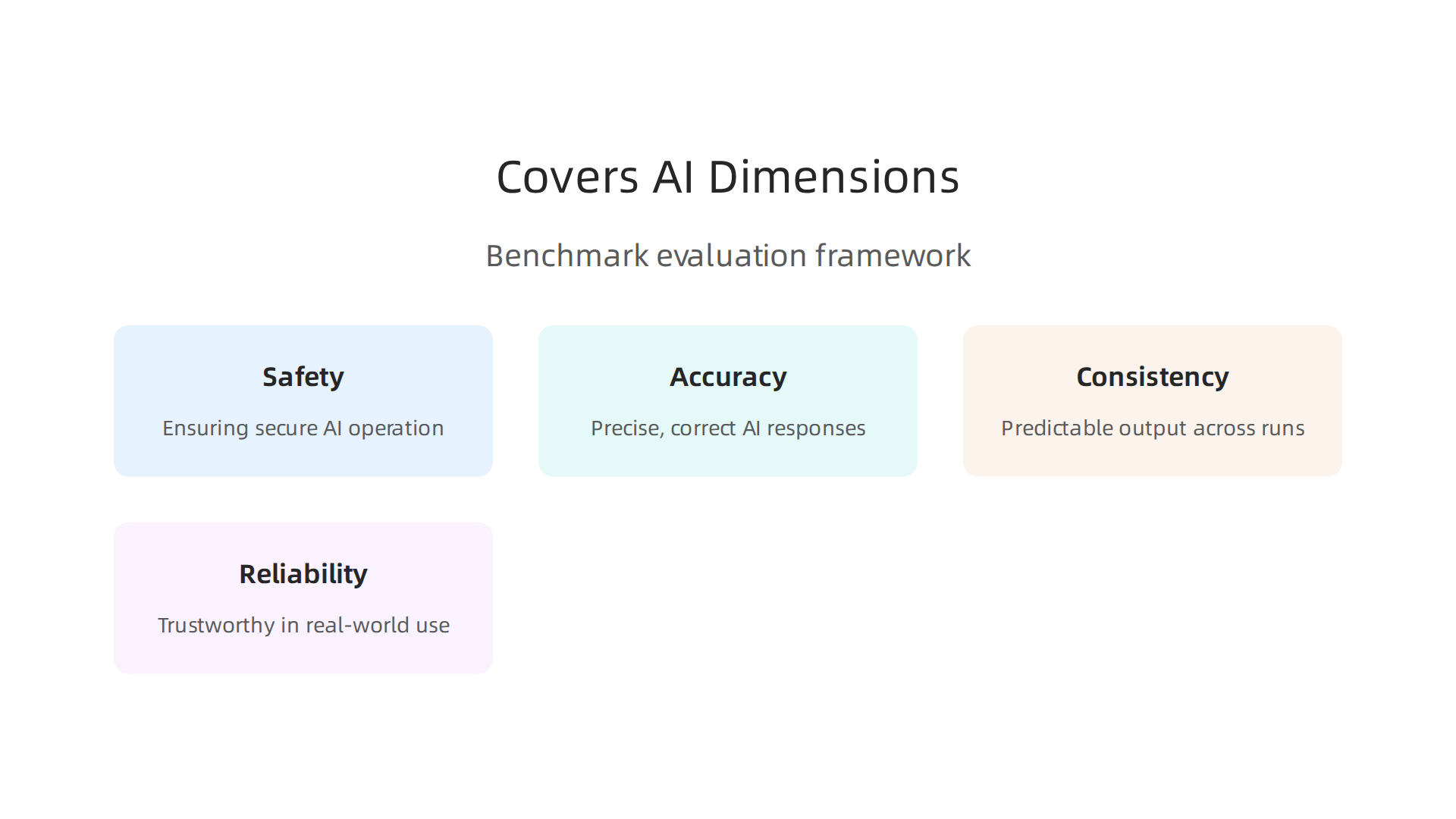
Think of it as a complete checklist for trust. Instead of guessing, you apply the same rigorous standards every time.
In this guide, we will walk you through a step-by-step evaluation process aligned with that benchmark. You will learn how to cut through the noise, avoid common mistakes, and make confident decisions about which AI tools are actually ready for production.
But before we dive deeper, you need a reliable way to stay on top of this fast-moving field. The best decisions come from good information delivered daily. That is why we recommend The AI Newsletter Worth Reading for clear, practical updates on what really matters in AI.
Let us begin by understanding why evaluating AI is harder in 2026 than it has ever been.
Why a Structured Evaluation Framework Matters
Here is the truth about evaluating AI tools without a system. It feels productive, but it is not. You test one chatbot, get excited about its speed, then test a competitor and get distracted by its formatting. By the end of the day, you have opinions about five different platforms and no real way to rank them. That is not evaluation. That is guesswork dressed up as research.
A structured framework changes everything. Instead of relying on gut feelings or first impressions, you apply the same criteria to every AI application you test. That removes the human bias that sneaks in when you favor the tool you tried first or the one with the prettiest dashboard. When you use a consistent checklist, you finally compare apples to apples. The 2026 guide to LLM evaluation tools in 2026 from Future AGI confirms that effective frameworks must deliver granular performance insights while integrating seamlessly into existing AI pipelines. In other words, a good framework does not just help you pick the best AI platforms. It helps you understand exactly why one outperforms another.
But reducing bias is only half the benefit. A structured evaluation also connects directly to your bigger objectives. Maybe your team needs an AI problem solver that handles customer support without inventing facts. Or maybe you need an AI powered homework help tool for educational use that prioritizes safety and accuracy above all else. When you define your criteria upfront, you stop picking tools based on what looks impressive in a demo and start choosing based on what actually moves your business forward. Every evaluation decision becomes a strategic one.
If you want to understand the broader landscape before diving deeper, check out this overview of the types of artificial intelligence framework to see how different AI categories map to real world capabilities.
The framework gives you a repeatable process. You run the same tests. You score the same metrics. You make decisions based on data, not hunches. And that consistency is what separates teams that successfully deploy AI from teams that keep starting over.
Defining Your Requirements: The First Step in AI Tool Selection
Before you start comparing the best AI platforms, you need to know exactly what you are looking for. Jumping straight into demos and feature lists without clear requirements is a recipe for wasted time and bad decisions. It leads to feature bloat, where you pay for capabilities you will never use. It also increases the risk of vendor lock-in, because you chose a tool based on flashy features instead of your actual needs.
So what should your requirements cover? Think in three dimensions. First, the technical side. What covers ai problem solver are you building? Does the platform need to handle large volumes of text? Support image generation? Process voice input? Do you need an ai powered homework help tool that prioritizes accuracy and safety? Second, business requirements. What is your budget? How many users will access the system? Do you need to integrate with existing software like CRM or helpdesk tools? Third, operational requirements. Who will maintain the tool? What training is needed? How do you measure success?
A structured checklist helps you cover all three areas without forgetting anything. According to best practices for AI-generated requirements, you must start with well-scoped context prompts and review every output before publishing. The same principle applies to your own requirement gathering. Write down your needs in a clear, prioritized list. That list becomes your filter for every tool you evaluate.
If you want a broader view of which tools are worth your time, check out this roundup of top AI tools for business in 2026 to see what the market offers.
Once your requirements are solid, you are ready to test tools against them. But do not skip this step. A clear requirements document is the difference between a successful AI deployment and a project that never delivers.

To stay ahead of new capabilities that could reshape your requirements, subscribe to The AI Newsletter Worth Reading. It delivers daily insights so you never miss what matters.
The ‘Covers AI’ Benchmark: Assessing Breadth and Depth of Coverage
Once your requirements are clear, you need a way to compare tools side by side. That is where the "covers AI" benchmark comes in. This benchmark measures two things. First, breadth: does the tool work across different types of AI tasks? A tool that truly covers AI should handle natural language processing, computer vision, and decision-making, not just one area. Second, depth: does the tool offer real flexibility in how you use it? That means customizable models, different deployment options, and the ability to adapt over time.
Many tools look good on paper but fail this test. They might excel at chatbots but offer nothing for image analysis. Or they provide a fixed model with no way to fine-tune it for your specific data. According to the latest analysis of AI evaluation tools for production systems, the best platforms in 2026 include both task-agnostic metrics (like hallucination detection) and task-specific measures tailored to your use case. That kind of flexibility shows real depth.
When you benchmark tools against the "covers AI" standard, you filter out narrow solutions. You stop being impressed by flashy demos and start asking hard questions. Can this tool grow with my needs? Does it support the kind of AI applications my team wants to build? For a deeper look at the frameworks that help you ask these questions, check out this AI innovation guide for strategy and frameworks.
Depth also means deployment flexibility. Can you run the tool on your own servers, in the cloud, or at the edge? Does it let you switch between different foundation models as better ones come out? A tool that locks you into one model or one deployment method does not truly cover AI. You need options.
So when you evaluate tools, use the covers AI benchmark as your filter. If a tool only handles one domain or offers no customization, cross it off your list. You want platforms that give you breadth across AI tasks and depth in how you can configure them. That combination is what separates a real solution from a one-trick pony.
Key Evaluation Criteria: Accuracy, Speed, Scalability, Security
Once you have filtered tools by the covers AI benchmark, the next step is to evaluate them on four practical criteria: accuracy, speed, scalability, and security.
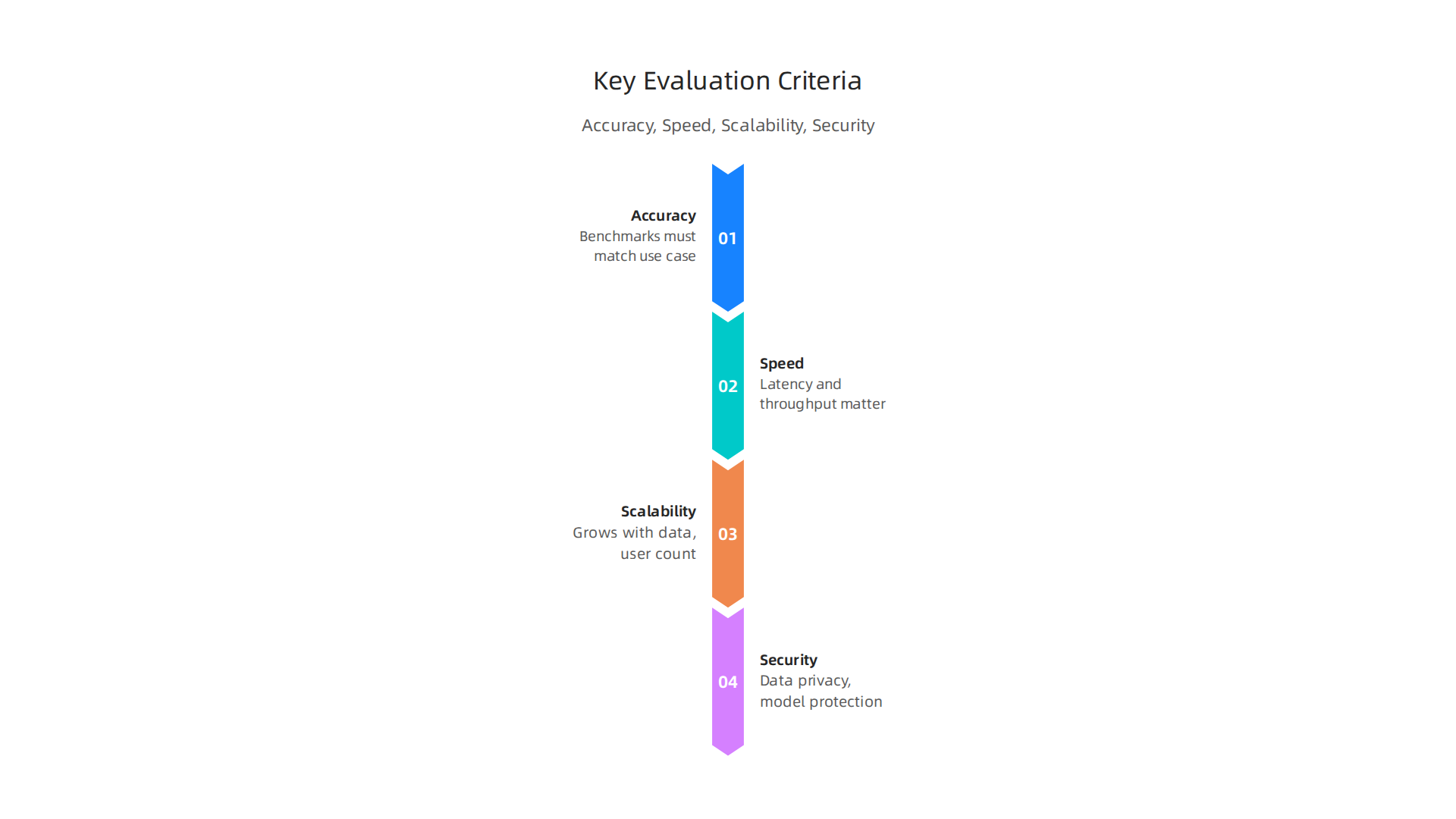
Getting these right makes the difference between a tool that works in a demo and one that works in production.
Accuracy: Benchmarks Must Match Your Use Case
Accuracy scores only matter if the benchmark tests what you actually need. Many popular benchmarks like MMLU are now saturated top models score over 88%, making those numbers meaningless for comparison. A tool that nails generic trivia might still fail at your specific job. For a detailed breakdown of AI benchmarks in 2026 and their limitations, check out this guide.
You need to match the benchmark to your domain. If you work in legal or finance, look for benchmarks like Scale SEAL that use real professional tasks. If you are building a coding assistant, SWE-Bench Verified tests against actual GitHub issues. And remember the key insight from the previous section: any tool that truly covers AI will let you run custom evaluations on your own data. That is how you know accuracy is real for your situation.
Speed: Latency and Throughput Matter at Scale
Speed has two sides. Latency is how fast the tool responds to a single request. Throughput is how many requests it handles at once. For real-time applications like chatbots, live translation, or voice assistants, latency under 500 milliseconds is critical. For batch processing jobs, throughput matters more.
When you compare tools, ask about the trade-off between accuracy and speed. Many platforms let you adjust inference settings to get faster results at the cost of slightly lower accuracy. That flexibility is a sign of a mature tool. The best ones let you set speed thresholds per task, so you can optimize the balance.
Scalability and Security: Built In, Not Bolted On
Scalability means the tool keeps performing well as your data grows and your user count increases. Can it handle a thousand requests per minute today and a million next year without a redesign? A tool that only works on small datasets is not a long-term solution.
Security covers multiple layers. Data privacy: does the tool process your information on its own servers, and is it encrypted at rest and in transit? Model security: can it protect against prompt injection attacks or adversarial inputs? Access control: can you limit who can use the model and what they can do with it?
The top platforms in 2026 embed security into the architecture. They support deployment on your own infrastructure for sensitive workloads and offer role-based access controls. As you evaluate tools, remember the broader context of separating signal from noise in AI trends 2026. That signal includes knowing whether a tool can scale without breaking or leaking data.
Putting it together: Accuracy tells you if the tool is right for your job. Speed tells you if it can keep up with your pace. Scalability tells you if it can grow with you. Security tells you if you can trust it. When a platform checks all four boxes, you have moved past hype into a practical solution.
Getting clear, daily insights on which tools actually deliver across these criteria is exactly why many professionals rely on a trusted source. If you want to stay ahead of the curve, consider subscribing to The AI Newsletter Worth Reading for daily updates on the best AI platforms and frameworks.
Data Sources and Training: Ensuring Trustworthy Information
An AI platform can score high on every benchmark and still fail you in the real world. Why? Because the tool is only as reliable as the data it trained on. If the training data has bias, stale information, or unclear origins, the outputs will reflect those problems. This is the part of evaluation that often gets skipped.
Bias, Recency, and Provenance: The Data Quality Triangle
Three things matter when you look at an AI tool’s data sources.
Bias creeps in when the training data over-represents certain groups, languages, or viewpoints. If a model trained mostly on English text from North America gets asked about healthcare policy in Southeast Asia, the answers will miss important context. You need to ask: what data went into training, and does it match the people and situations you serve?
Recency matters because AI models can fall behind fast. As of early 2026, the top models show a steep drop in accuracy as their training data gets older. Researchers call this the "mathematical death curve" because accuracy falls to near zero as outdated information piles up. The AI technical performance report from Stanford HAI tracks how model accuracy changes over time. A model that knows last week’s news is more useful than one stuck two years ago.
Provenance means knowing where the data came from. Did the training data include copyrighted material? Was it scraped without permission? Are there legal risks to using the outputs? These questions matter for compliance and for trust.
Transparency Signals Quality
The best AI platforms in 2026 publish clear documentation about their data sources. They tell you what datasets were used, how they were filtered, and what steps were taken to reduce bias. When a company hides this information, that is a red flag.
Look for data cards, model cards, or transparency reports on the platform’s website. These documents should answer basic questions: how much data was used, what languages are covered, and how often the model gets updated. A platform that is open about its data is usually one you can trust with your work.
Custom Data: The Ultimate Control
Here is the thing that separates good AI platforms from great ones. The top tools let you integrate your own datasets into the model. This means you can train or fine-tune the AI on your specific documents, customer conversations, or industry standards. Instead of relying on generic internet data, you get a model that understands your world.
If you work in a specialized field like healthcare, legal, or engineering, custom dataset integration is not a luxury. It is a necessity. Generic models miss the terminology, regulations, and edge cases that matter in your domain. Look for platforms that offer this capability and make it easy to use.
For a deeper look at how data choices affect trustworthiness, read our guide on how to build ethical and transparent AI for humans. It covers the practical steps for making sure your AI tools are built on a solid data foundation.
User Experience and Integration Capabilities
You found an AI tool that scores high on every test. The data is clean, the sources are solid, and the training is recent. Then you try to use it, and the interface hits you like a brick wall. Buttons are hidden. Workflows make no sense. And it won’t connect to your existing systems at all.
Here is the hard truth: a powerful AI platform fails if no one can figure out how to use it.
That is why user experience matters just as much as technical specs. The best AI platforms in 2026 invest heavily in clean, simple interfaces. You should be able to open the tool and start getting value within minutes, not hours. If you need a manual just to run a basic query, move on.
Integration Is What Makes AI Useful
A standalone AI tool that lives in its own bubble is not very helpful. You need it to work with your existing data pipelines, project management software, and communication tools. The ability to hook into APIs, connect to databases, and sync with platforms like Jira or Azure DevOps is what turns a toy into a real ai problem solver.
When you evaluate tools, check for native integrations. Can it read from your CRM? Can it push data back into your reporting dashboards? Look for platforms that offer flexible APIs and prebuilt connectors. As one expert review notes, native integration with your development environment is a top criteria when picking an AI requirements tool in 2026.
What a Great User Experience Looks Like
Start with the sandbox environment. The best tools let you test features without committing to a full setup. You can play with prompts, see sample outputs, and judge the speed and quality firsthand.
Documentation quality is another tell. Clear, searchable docs with real examples show that the company cares about your success. Bad documentation often means the tool is hard to use and support is weak.
And speaking of support, look for fast response times and active communities. When you get stuck, you need help fast.
For a practical look at how to pick the right tools for your workflow, check out our roundup of the top AI tools for business in 2026 to boost productivity and save time. It covers real options that balance power with usability.
As you search for a platform that covers AI well across your use cases, remember that the best ai applications only deliver value when people actually use them. An intuitive design and smooth integrations are what make that possible.
Stay ahead of the rapid changes in the AI tool space. Get clear daily updates delivered to your inbox with The AI Newsletter Worth Reading. It helps you track new releases, integration updates, and emerging best practices so you never miss what matters.
Cost-Benefit Analysis: Total Cost of Ownership
You found an AI tool with a cheap monthly price tag. The demo looked great. You signed up. A few months later the bill is three times what you expected. What happened?
You discovered the real cost of AI. The sticker price is just the beginning.
What Total Cost of Ownership Really Means
Total Cost of Ownership (TCO) is the full picture of what an AI platform costs you over time. It is not just the licensing fee. It includes the compute power, the data storage, the training time, the maintenance, and the people needed to run it all.
The AI TCO framework from Phenx breaks this down into eight components. Model licensing or API fees are only the first. You also need to budget for infrastructure like GPU compute, data preparation, personnel salaries, security audits, integration work, and ongoing monitoring. Each piece adds up.
The Free Tier Trap
Many best AI platforms offer a free tier to get you hooked. That is fine for testing. But free tiers often hide long-term costs. You might not see charges for data storage, API call volume, or the compute needed to run models at scale. One day you hit a limit and suddenly your budget blows up.
Before you commit, ask the vendor for a full cost breakdown. What happens when your team grows? What about data egress fees? What does retraining a model cost each year? Get those numbers in writing.
Building an ROI Model to Justify the Spend
To convince your boss or investors that an AI tool is worth the money, you need more than a price list. You need an ROI model.
Start with a concrete business problem. Maybe you want to reduce customer support handling time by 30 percent. Measure your current baseline. Then estimate the hours the tool will save. Multiply those hours by the loaded cost of your team. That gives you the benefit side.
Now subtract the full TCO you calculated earlier. That is your net return.
For a deeper look at how to tie AI decisions to real business outcomes, explore our guide on strategic AI adoption for business growth. It walks through building a business case that stakeholders can get behind.
What a Complete TCO Model Covers
Here is a simple checklist to make sure your TCO covers ai properly:
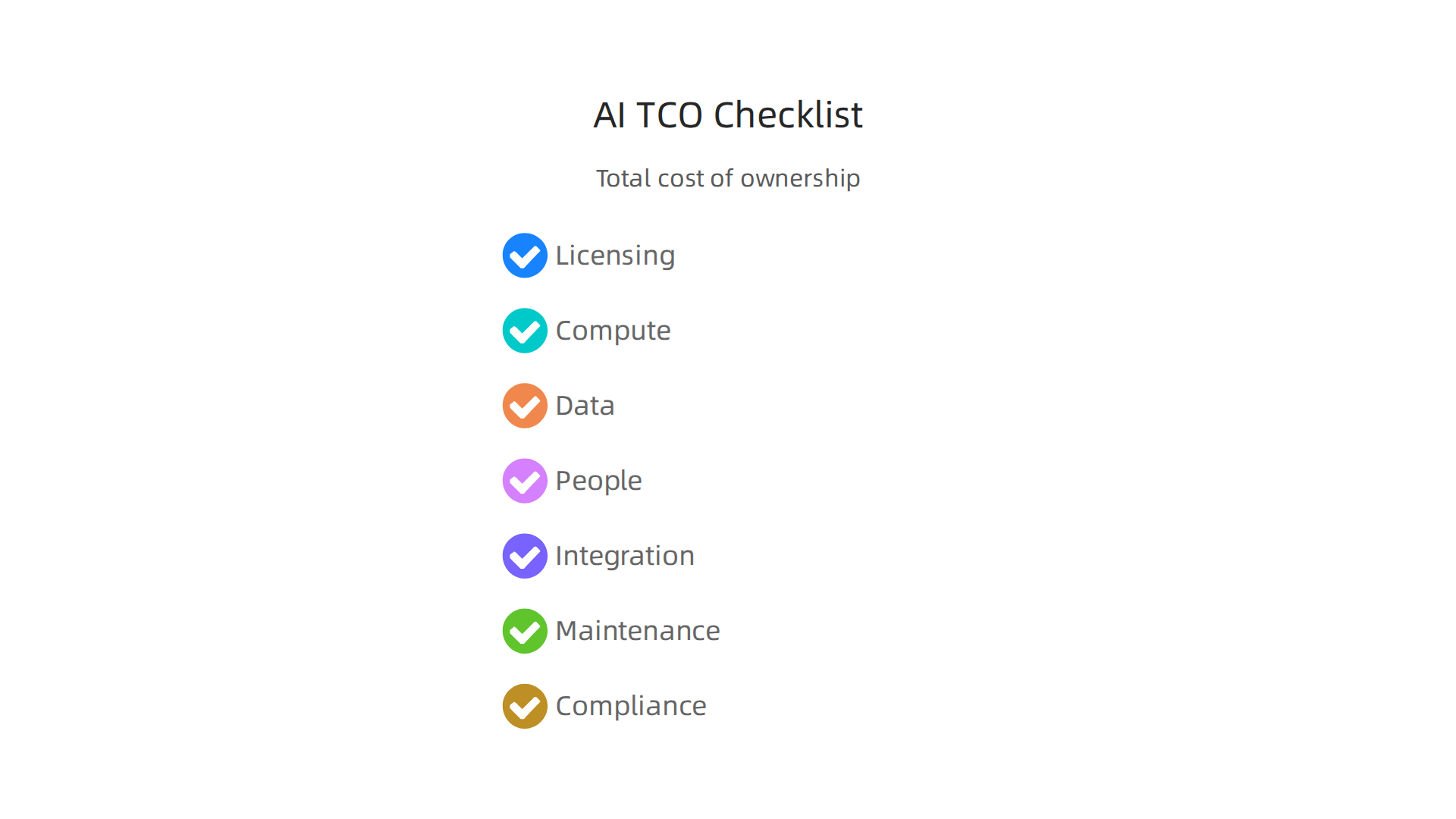
| Category | What It Includes |
|---|---|
| Licensing | API fees, model subscriptions, seat costs |
| Compute | GPU hours, cloud instances, storage |
| Data | Cleaning, labeling, pipeline maintenance |
| People | Engineers, data scientists, project managers |
| Integration | Connecting to CRM, databases, reporting tools |
| Maintenance | Model retraining, monitoring, drift detection |
| Compliance | Audits, bias checks, legal reviews |
Run this checklist against every ai application you evaluate. The numbers might look scary at first. But an honest TCO is better than a surprise bill.
When you find a platform that truly acts as an ai problem solver for your biggest challenges, the investment pays for itself. The key is knowing the full cost before you sign.
Real World Validation and Case Studies
You built a careful TCO model. The spreadsheet shows a solid return. But here is the thing no vendor tells you: your real world is not their demo room.
The only way to know if a platform actually works is to test it where it matters. In your environment. With your data. Under your conditions.
Proof of Concept: Your Safety Net
A proof of concept trial is the smartest money you will spend on AI. It reveals how the tool handles your actual workflows, your messy data, and your unusual edge cases.

Vendor demos always look perfect. Real deployments rarely do.
The detailed breakdown of TCO for agentic AI on Corvair makes a strong case for running a measurement oriented PoC that delivers auditable results in 6 to 12 weeks. The purpose is simple. Validate your assumptions before you commit serious budget. Does the model hit the accuracy you need? Does your data pipeline support it? Do the unit economics actually work at scale?
Run a PoC. It will either confirm your TCO model or save you from a costly mistake.
What Case Studies Actually Tell You
Customer stories are useful but you have to read them with a critical eye. A good case study shows real numbers. Not vague claims about "improved efficiency." Concrete metrics like "reduced handle time by 32 percent in the first quarter."
Look for case studies from companies that match your size and industry. Their challenges will look a lot like yours. And pay attention to the hard parts. Every implementation has bumps. Honest case studies talk about what went wrong and how they fixed it.
Independent Reviews Cut Through the Noise
Vendor case studies are one piece of the puzzle. Third party validation completes the picture. Analyst reports, user reviews on independent platforms, and benchmark comparisons give you a view that is not filtered through a sales lens.
To see how leading platforms stack up against each other this year, check out our comparison of the top AI tools for business in 2026. It breaks down real world performance across different use cases.
Why Validation Matters for Your TCO
Here is the connection back to your cost model. Every piece of real world evidence helps you adjust your assumptions. A PoC might reveal that data preparation costs more than you estimated. A case study might show faster time to value than you projected. Each data point makes your TCO more accurate.
And that accuracy is what lets you present your budget request with confidence.
Staying current on which tools actually deliver in practice requires a steady stream of trustworthy information. The AI Newsletter Worth Reading delivers clear daily AI updates so you always know what is really working out there.
Summary
This article explains a practical, repeatable approach to evaluating AI tools so teams can pick platforms that actually work in production. It introduces the ‘covers AI’ benchmark — a two-part test for breadth across AI tasks and depth in customization and deployment — and shows how to combine that filter with four core criteria: accuracy, speed, scalability, and security. The guide walks you through defining requirements (technical, business, operational), assessing training data quality and provenance, testing user experience and integrations, and building a full total cost of ownership. It emphasizes real‑world validation via proof-of-concept trials and careful case study review to avoid vendor hype and unexpected costs. After reading, you will know how to run consistent evaluations, ask the right questions of vendors, and choose AI tools that reduce risk and deliver measurable value.