

Why understanding the elements of AI matters right now
In 2026, Artificial Intelligence (AI) is changing our world at a very fast pace. It’s in everything, from smart phones to big business plans. Because of this, many people who work with AI, like investors, business owners, and researchers, often feel like they’re drowning in too much information.

There are so many new tools, ideas, and reports about AI every single day. It can be hard to know what’s truly important and what’s just noise.
This huge amount of information makes it tough to make smart choices. You might wonder, "How do I even begin to understand all these new AI ideas?" You need a clear and simple map to guide you. That’s exactly what we aim to provide. We want to help you understand the core elements of AI so you can cut through the clutter.
AI itself is about computers learning and doing things that normally need human brains, like thinking, learning, and solving problems Artificial Intelligence – Stanford Emerging Technology Review. To truly grasp this, we need a way to sort through it all. Experts have even created special systems, called taxonomies, to help classify the many types of AI systems A Unified Taxonomy of 19 AI System Types. This article will be your easy-to-read guide, connecting the basic ideas of AI to how they actually work in the real world. You will learn what makes up AI and how those parts affect your decisions, whether you are investing, building a company, or doing research. Getting a clear technology meaning for AI leaders and investors in 2026 is more important than ever.
To help you keep up with all these changes and get clear, daily AI updates, consider this: The AI Newsletter Worth Reading.
What do we mean by ‘intelligence’ in AI? Key conceptual frameworks
When we talk about Artificial Intelligence, or AI, the biggest word in there is "intelligence." But what does that really mean when we’re talking about machines? It’s not always the same as how we think about human smarts. To truly understand the elements of AI, we need to look at intelligence from different angles.
Different Views of Intelligence in AI
Experts from different fields think about AI’s "intelligence" in slightly different ways:
- The Cognitive View: This way of thinking asks how AI can copy human thinking. It looks at how humans learn, solve problems, understand language, and make decisions. So, when an AI system seems to "think" or "understand" like a person, that’s the cognitive side of intelligence. The goal here is to make AI behave like a human brain.
- The Statistical View: This view focuses on how AI finds patterns in huge amounts of data. It’s less about thinking like a human and more about being super good at spotting trends and making predictions based on what it has seen before. For example, if an AI can predict what you’ll buy next or find hidden links in complex information, that’s statistical intelligence at work. This approach helps create powerful, smart AI systems that excel at analyzing numbers and facts.
- The Engineering View: This perspective is about how useful and effective an AI system is at a specific task. It doesn’t really matter if it thinks like a human or finds complex patterns, as long as it gets the job done very well. An AI that can perfectly sort thousands of photos or quickly route traffic efficiently shows engineering intelligence. It’s all about building AI that works reliably and solves real-world problems.
Actually, the person who first came up with the term "Artificial Intelligence," John McCarthy, back in 1955, defined AI as "the science and engineering of making intelligent machines." He saw intelligence as the ability to learn and perform tasks correctly to solve problems SETR 2026: Artificial Intelligence. So, even the "godfather of AI" had a practical view of machine intelligence.
What AI Capabilities Show Intelligence?
These different ways of seeing intelligence help us define what AI can actually do. When we talk about how smart an AI is, we usually mean its abilities in these areas:
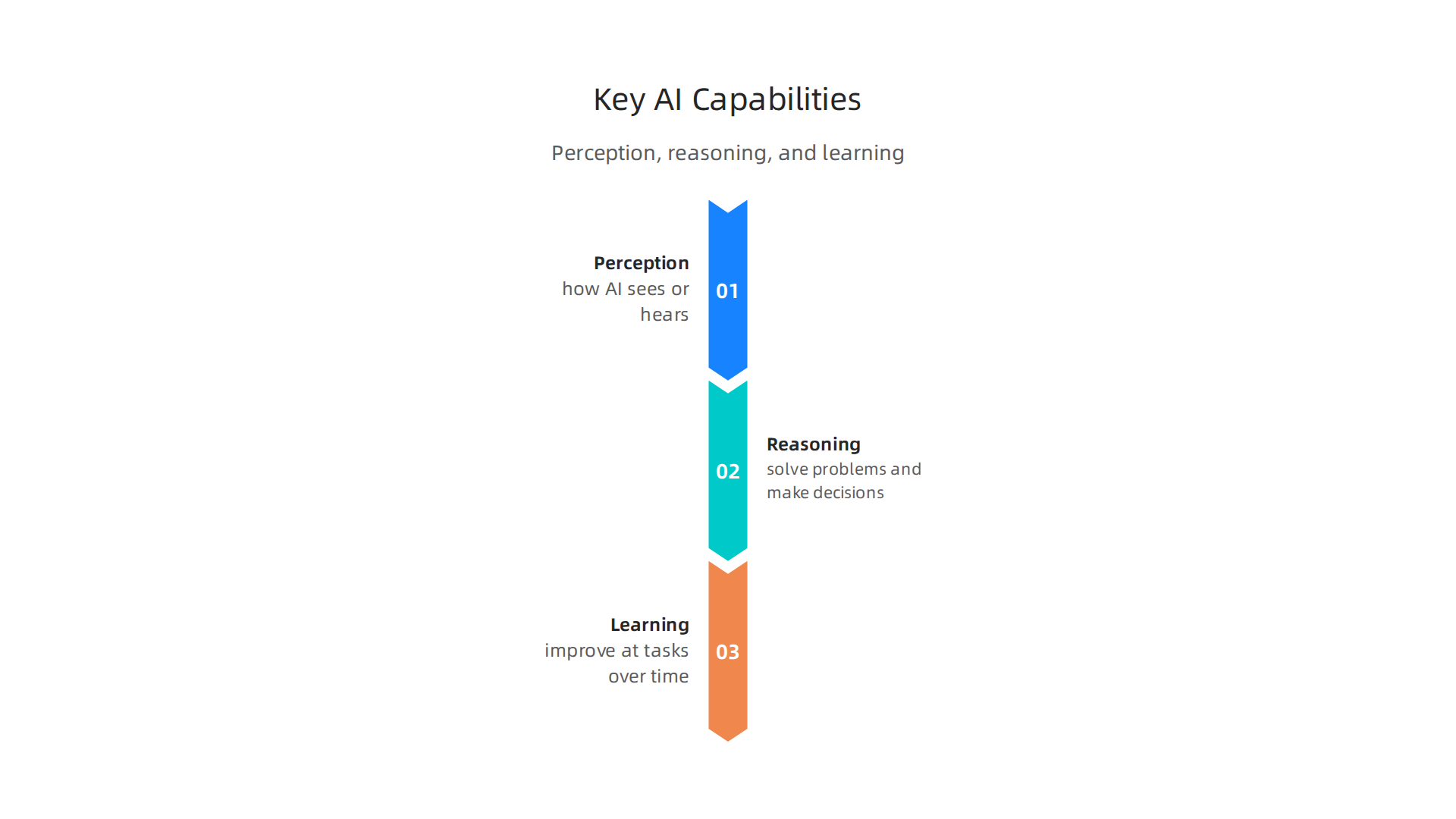
- Perception: This is how AI "sees" or "hears" the world. Think about self-driving cars that use cameras to understand roads, or voice assistants that recognize your commands. This is a basic but important part of how AI collects information from its surroundings. An AI with good perception can better understand its environment, paving the way for more contextual AI interactions.
- Reasoning: This is the AI’s ability to think through problems and make logical choices. It’s like an AI puzzle-solver. It takes information, figures out what it means, and then decides what to do next. This is what helps AI systems make smart decisions.
- Learning: Just like people, AI can learn from experience and data. This means it can get better at tasks over time without being directly programmed for every single step. This is a huge part of what makes modern AI so powerful. You can learn more about this vital aspect in our guide to mastering how AI learns.
Experts often look at how AI systems handle these capabilities to understand their intelligence level A systematic review of AI literacy conceptualization, constructs, and …. So, when you hear about the "smartest AI" or new breakthroughs, they are often about how well AI can perceive, reason, and learn, making these the true core elements of AI.
When we talk about how smart an AI is, we usually mean its abilities in areas like seeing, thinking, and learning. But these smart features don’t just appear on their own. They are built upon some very important parts that work together. Think of these as the main building blocks or core elements of AI. To truly understand any AI system, we need to know about these four main parts: data, models, compute, and objectives.
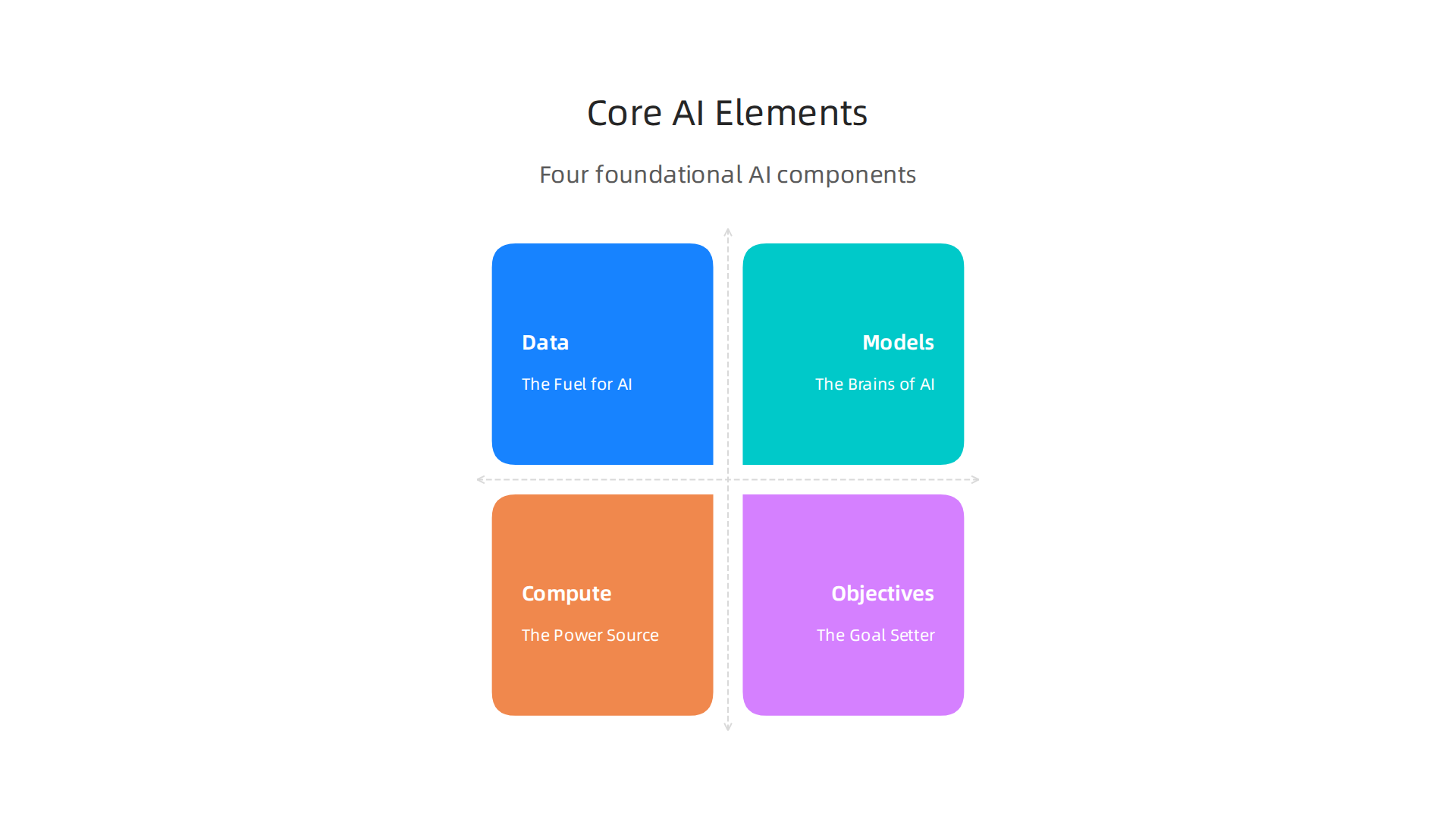
Let’s look at each of these:
Data: The Fuel for AI
Data is like the food for AI. It’s all the information an AI system takes in to learn and make decisions. This can be text, pictures, sounds, numbers, or anything else. Without enough good quality data, an AI can’t learn well. In fact, many experts agree that weak data foundations can stop AI from working reliably, even if the AI model itself is good Modern Data Report 2026: What 500+ Data Experts Say on AI. High-quality data helps AI understand the world and carry out its tasks.
Models: The Brains of AI
An AI model is like the "brain" of the AI system. It’s a special computer program that uses math rules, called algorithms, to find patterns in the data it has learned from. These models are what allow AI to do things like understand language, recognize faces, or predict what might happen next. They are designed to make guesses or inferences from inputs to create outputs, forming the knowledge part of an AI system Defining AI Models and AI Systems.
Compute: The Power Source
"Compute" is just a fancy word for the computer power an AI needs. Training big AI models requires a lot of processing power, often from special computer chips called GPUs. It’s like needing a powerful engine for a fast car. The amount of computer power used for AI has grown a lot. For example, global AI computing capacity has jumped more than three times each year since 2022, increasing 30 times overall since 2021 12 graphs that explain the state of AI in 2026. This power helps AI learn from huge amounts of data and then quickly use what it has learned.
Objectives: The Goal Setter
Every AI system needs clear objectives, or goals. This tells the AI what it should be trying to achieve. Without a clear goal, an AI might just do things randomly or not do them in a helpful way. For example, an AI for a self-driving car has the objective to get you to your destination safely. Setting clear business goals is super important for any AI project.

How These Elements Work Together
These four elements of AI are deeply connected. They rely on each other to make AI work. Good data feeds good models, powerful compute trains those models efficiently, and clear objectives guide the entire process. If one part is weak, the whole system might not work as well. For instance, even the smartest AI models won’t perform well if they are fed bad data, or if there isn’t enough computer power to train them properly. Businesses must think about all these parts when planning to choose the right AI platforms for business growth in 2026. It’s a balance to find the best mix for each AI task.
Now, let’s think about how those "brains" of AI, the models, actually work. They don’t just magically figure things out. They are built on powerful ideas from math. These mathematical tools are the secret sauce that helps AI learn from data and make smart choices. Understanding these foundations helps us see why some AI models are considered the smartest AI in different tasks.
Math Foundations for AI Models
The core ideas that make AI models possible come from different areas of math:
- Probability: This is about understanding chance and uncertainty. AI uses probability to make educated guesses. For example, when an AI tries to recognize a cat in a picture, it uses probability to decide how likely it is that certain pixels look like a cat. This helps the AI deal with messy or incomplete information.
- Optimization: Think of this as finding the best possible answer. AI models learn by trying to get better at their tasks. Optimization is the math tool that guides them to adjust their internal settings until they perform their job as well as they can. This is like a search for the perfect recipe.
- Linear Algebra: This part of math helps AI work with large amounts of data in an organized way. Data for AI, like images or text, can be broken down into numbers. Linear algebra provides the tools to store, move, and change these numbers efficiently. It’s crucial for how AI models process and understand complex information.
- Statistics: Statistics helps AI find patterns and make sense of data. It allows AI to understand what’s normal, what’s unusual, and how different pieces of information relate to each other. When an AI makes a prediction, it often uses statistical methods based on what it learned from past data.
How Algorithms Bring Math to Life
These mathematical ideas are put into action through algorithms. An algorithm is like a step-by-step recipe that tells the computer exactly what to do. For AI, algorithms define how models learn, how they process new information, and how they make decisions.
Different types of AI models use different algorithms and structures, often called architectures. For instance, some architectures are great for understanding language, while others excel at recognizing images. The choices made in these algorithms and architectures directly impact how well an AI model performs. Experts are always working to improve these designs, leading to better and more capable AI systems. The Technical Performance chapter of the 2026 AI Index Report often highlights advances in how these models work and get better over time.
For businesses looking to use AI, understanding these foundations helps in choosing the right tools. When you know how AI models learn and what powers their decision-making, you can better select models that fit your specific needs, whether that’s for understanding customer feedback or automating tasks. It’s about mastering how AI learns for strategic business advantage.
When we talk about the brains of AI models and how they learn, we’re not just talking about fancy math. We’re also looking at a careful set of steps that help build and manage these smart systems. These steps are often called a training pipeline. Think of it like building a car: you need to gather parts, put them together, test them, and then make sure the car runs well on the road.
Training Pipelines for AI
A training pipeline is the full journey an AI model takes from raw information to being ready to help.
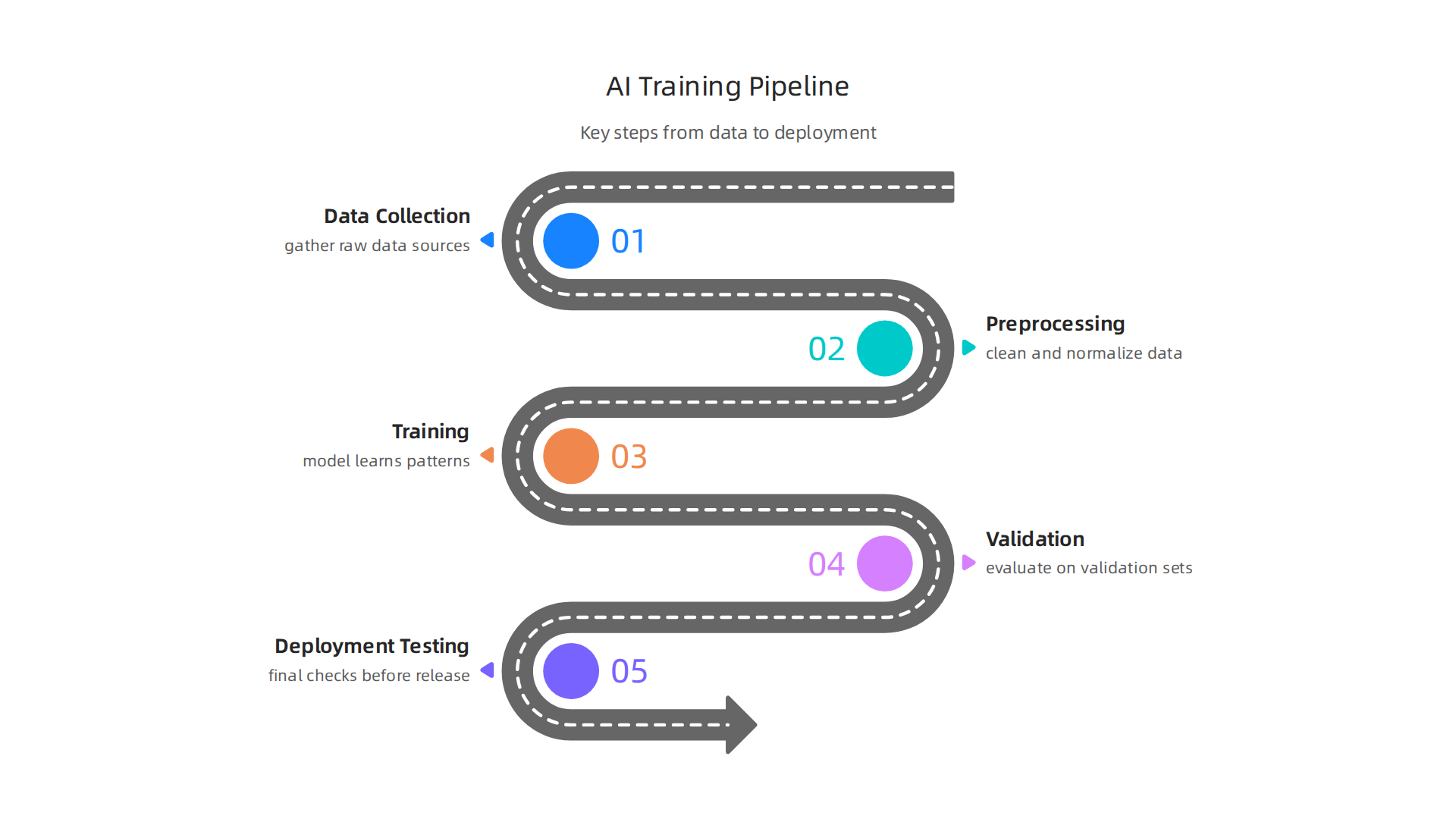
Understanding these elements of AI helps ensure they work correctly. Here are the key parts:
- Data Collection: This is the first step. AI models need lots of information to learn. This data can be pictures, words, sounds, or numbers. For example, a self-driving car AI needs many pictures of roads, cars, and people. Big databases exist to track the details of many AI models and their data.
- Preprocessing: Raw data is often messy. It might have errors, missing parts, or be in a format the AI can’t understand. Preprocessing means cleaning up this data and getting it ready. It’s like sorting your laundry before washing it.
- Training: This is where the AI model actually learns. It looks at the prepared data and tries to find patterns. It uses the math ideas we talked about earlier to get better and better at its job.
- Validation: After training, we need to check if the AI learned well. We use a special part of the data that the AI has never seen before. This helps us see how good the AI is at making decisions on new information.
- Deployment Testing: This is the final check before the AI goes live. We make sure it works properly in a real-world setting. Tools and practices for this are often part of something called MLOps, which helps manage AI in production. A guide like the MLOps & AI Production Operations: The 2026 Guide explains how these systems are built to work well from start to finish.
Common Dataset Types and Evaluation Metrics
The kind of data an AI uses depends on what it needs to do. It could be:
- Images: For recognizing faces or objects.
- Text: For understanding language or writing stories.
- Numbers: For predicting stock prices or customer behavior.
But just having data isn’t enough. We also need to watch out for problems.
- Dataset Shift: Imagine you train an AI to recognize summer clothes, but then you ask it to identify winter clothes. It won’t do well because the new data (winter clothes) is very different from its training data (summer clothes). This change is called dataset shift. It can make even the best AI models confused.
- Metric Misalignment: Sometimes, we measure the wrong thing. We might think an AI is doing great based on one number, but it’s actually not solving the real problem. For example, an AI that guesses "no" for almost everything might look very accurate if "no" is the right answer most of the time, but it won’t be helpful for the few times the answer is "yes." This is why choosing the right way to evaluate AI tools in 2026 is so important.
To avoid these pitfalls, we use evaluation metrics. These are like scorecards that tell us how well an AI is performing. Common metrics include accuracy (how often it’s right), precision (how many of its positive guesses were correct), and recall (how many actual positives it found). By carefully choosing our data, setting up smart pipelines, and picking the right ways to measure success, we can build effective and reliable AI systems.
Staying on top of how AI models are built and tested is vital for anyone involved in technology today. Get clear daily AI updates by signing up for The AI Newsletter Worth Reading.
System architecture and deployment: taking models from lab to product
Getting an AI model ready in the lab is a big step, but it’s not the end. The real challenge comes when you need to use that AI in the real world. This is like taking a powerful new engine from a test track and putting it into a car that everyday people will drive. It needs to work smoothly, all the time, for everyone. This journey from a tested model to a working product is what we call system architecture and deployment.

Making AI Work in the Real World
To get AI models out of the lab and into products, we rely on special ways of working called MLOps. MLOps helps teams build, launch, and manage AI systems reliably. It’s like putting all the steps of building and running an AI model into a well-oiled machine. It makes sure that models work well from start to finish, applying engineering ideas to AI systems, from collecting data to training, deploying, and watching them work, as explained in a look at MLOps in enterprise in 2026.
Here are some important parts of this process:
- Orchestration: Imagine an orchestra where every instrument plays its part at the right time. AI systems are similar. Orchestration means making sure all the different parts of the AI system, like data feeds, processing steps, and the model itself, work together in order. This ensures the entire system runs smoothly.
- Latency and Throughput: These are fancy words for speed and volume.
- Latency is how fast an AI system can respond. For example, a self-driving car needs very low latency to react instantly to sudden changes on the road.
- Throughput is how much work an AI system can do at once. A system that recommends videos to millions of users needs high throughput to handle all those requests at the same time.
Sometimes you have to choose between making the AI super fast for one task or making it able to handle lots of tasks at a normal speed. Finding the right balance is key for any AI system design.
- Monitoring: Once an AI model is live, you can’t just forget about it. You need to constantly watch how it’s doing. Is it still giving good answers? Is it slowing down? This is where monitoring comes in. It’s about checking the AI’s health and performance in real time. This can include looking for things like "logic drift," where an AI starts making decisions that are different from what it learned, according to insights on Agentic Architectures Drive Scalability in MLOps 2026.
- MLOps Practices: These are the best ways to keep AI systems running smoothly. They cover everything from setting up clear rules for how models are built and tested to using smart ways to roll out new versions. For example, a "canary deployment" is a smart way to test new models where only a small number of users get the new version first. This helps catch problems early, as explained in an article about MLOps System Design: Reference Architecture for 2026. These practices are a big part of creating an end-to-end design for production.
How Product Needs Shape AI Design
The choices made when building an AI system aren’t just about the technology. They are also heavily influenced by what the final product needs to do. For example, building a simple AI chatbot for a small business is very different from creating a highly advanced system that powers a global search engine.
Product needs change how we think about the core elements of AI:
- Speed vs. Accuracy: A product that needs quick answers (like a voice assistant) might use a simpler, faster AI, even if it’s slightly less accurate. A medical AI, however, needs to be super accurate, even if it takes a bit longer to give an answer.
- Cost: Running powerful AI models can be expensive. Businesses need to balance the AI’s capabilities with how much it costs to run. This means thinking about how much computing power is needed and how to use it wisely.
- Reliability: For many products, the AI needs to be reliable and always available. A smart AI like a contextual AI that understands what you need, or even what some call the smartest AI, must always work. This means building in backup systems and ways to recover quickly if something goes wrong.
Understanding these trade-offs and how to balance them is key. It helps teams decide where to spend their resources and how to set up their AI platforms. Choosing the right platforms is a big decision for any business, and there are many options to consider for AI platform taxonomy. The way companies deploy AI, for instance, by deciding whether to deploy code or models, also impacts system architecture, as discussed in The AI Architect’s Guide to Multimodal RAG & Enterprise. This makes sure the AI isn’t just smart, but also practical and helpful for the people using it.
Ethics, safety, and governance as foundational elements of responsible AI
When we talk about building smart AI systems, it’s not enough to just make them fast or good at their job. We also have to think about making them safe, fair, and trustworthy. These important aspects, like ethics, safety, and how AI is managed (governance), are not extra add-ons. Instead, they are core elements of AI design that need to be thought about from the very beginning. It’s like building a house and making sure the foundation is strong and safe before you even put up the walls.
In 2026, companies and governments are paying much more attention to how AI impacts people and society. They recognize that even the smartest AI can cause problems if not handled with care. For example, some AI could make unfair decisions or spread false information. This is why having good governance, safety, and ethical design is key to managing risks throughout the AI’s life, from when it’s first thought up to when it’s used every day.
How We Make AI Responsible
To help guide the creation of responsible AI, many groups have developed special rules and guidelines. These are called frameworks, and they give practical ways to make sure AI is safe and fair.
- Risk Management Frameworks: Think of these as checklists that help teams spot possible problems with AI early on. One well-known guide is the NIST AI Risk Management Framework, which helps companies govern, map, measure, and manage AI risks. This framework is voluntary in the US but is widely used as a good starting point for building responsible AI. Many organizations around the world are working on AI safety frameworks to manage risks from advanced AI models, as seen in reports from 2025 and 2026.
- Regulations and Laws: Governments are also stepping in. The EU AI Act, for instance, is a big step towards making clear rules for AI systems in Europe. It started to take effect in 2024 and will be fully in place by August 2026. This act sets standards for how AI is used, especially for systems that have higher risks. The US White House has also released a National Policy Framework for Artificial Intelligence to guide how AI is regulated.
- Company Policies: Big AI companies are also creating their own rules. For example, OpenAI has its Frontier Governance Framework to explain how they handle safety and security for their advanced AI models. These company rules often align with newer laws and help ensure that even a contextual AI or the smartest AI models are built with strong ethical controls.
These frameworks and rules help us put practical controls in place. This includes steps for checking AI models, keeping an eye on how they perform, and making sure that someone is accountable if things go wrong. It’s about designing humane technology principles for ethical AI governance so that AI works for everyone’s good. By making ethics and safety a core part of AI development, we can ensure that these powerful tools truly help us without causing harm.
When we build AI with care, focusing on fairness and safety, the next big question for business leaders and investors is: how do we pick the best AI ideas and products? It’s about turning those good intentions into smart choices for money, plans, and what products we make. Understanding the key elements of AI helps you look closely at what an AI company offers.
In 2026, finding good AI investments means looking beyond just how clever an AI seems. You need to really check under the hood. Investors and business leaders should ask important questions to see if an AI company is truly strong and reliable. This process is called due diligence, and it helps spot risks and real opportunities. For example, knowing how to evaluate AI companies in 2026 is more important than ever.
A Checklist for AI Investments and Product Plans
To make sure your AI decisions are smart, here’s a simple checklist to guide you:

-
Look at the AI’s Brain (Its Models):
- How smart is it? Does the AI solve real problems well, or is it just a fancy trick? You want to find the smartest AI for the job.
- Can it learn and grow? A good AI should be able to get better over time. Look for signs that the model’s performance is stable and reliable, even in real-world settings.
- How much does it cost to run? Training and using AI can be expensive. Think about the costs for making the AI, keeping it running, and how much power it needs.
-
Check the AI’s Backbone (Its Operations):
- How is the AI built and managed? This is where MLOps (Machine Learning Operations) comes in. It’s about automating the full machine learning lifecycle, from gathering data to making sure the AI works well every day. This helps make sure the AI is reliably building, deploying, monitoring, and governing ML systems at scale.
- Can it be updated easily? Good AI systems are easy to change and improve without breaking things. This means checking how they handle deployment and constant improvements.
- Is it watched closely? You want to know that the AI is being monitored for errors and unexpected behavior. This is a key part of MLOps, which focuses on automating the full machine learning lifecycle.
-
Think About Fairness and Safety (As Discussed Before):
- Is it fair? Does the AI treat everyone equally, or could it make biased decisions?
- Is it safe? Does the company have clear rules and ways to handle problems if the AI acts unexpectedly? These are core parts of good AI-readiness due diligence in 2026.
- Who is in charge? Good leadership and strong rules (governance) show that a company takes responsibility for its AI.
-
Examine the Data (The AI’s Food):
- Is the data good? High-quality, clean data is super important for AI to work well.
- Is the data safe and private? How does the company protect the information it uses?
-
Meet the Team (The AI’s Creators):
- Are they experts? Does the team have the right skills and experience to build and manage this kind of AI?
- Can they adapt? The AI world changes fast. You want a team that can keep up. Strong AI startup engineering signals often come from companies that can move from experiments to actual working products.
By asking these questions, investors and leaders can make better choices.

They can see which AI companies are truly building valuable tools that are ready for the real world. This helps ensure that how strategic AI adoption drives business growth in a sustainable and responsible way.
Want to stay on top of the latest AI trends and insights for your strategic decisions? Get clear daily AI updates from The AI Newsletter Worth Reading.
Summary
This article explains why understanding the key elements of AI is essential for leaders, investors, builders, and researchers in 2026. It breaks down what ‘intelligence’ means in machines from cognitive, statistical, and engineering viewpoints, and shows how capabilities like perception, reasoning, and learning emerge from four core components: data, models, compute, and objectives. The piece walks through the math and algorithms that power models, the practical steps in training pipelines, and the system-architecture considerations needed to move models from lab prototypes to reliable products. It also covers MLOps best practices for orchestration, latency, monitoring, and safe deployments, and emphasizes ethics, governance, and regulatory frameworks as foundational design requirements. Finally, the article gives a due-diligence checklist for evaluating AI investments and product choices so readers can make informed, practical decisions about adopting or funding AI technologies.