
Introduction
Have you ever felt lost in the sea of AI buzzwords? Words like "artificial intelligence," "machine learning," and "deep learning" are often used as if they mean the same thing. But they do not. This confusion is common, and it creates real problems for professionals.
The machine intelligence field is full of inconsistent and overlapping terms. Without a clear technology definition, it is hard to make informed investment, strategic, or operational decisions. You might choose the wrong tool or misunderstand what a company actually builds. For example, IBM’s AI vs. Machine Learning vs. Deep Learning page explains how these terms differ.
Clear definitions are essential for technology education and for understanding how classified technologies fit into the bigger picture.

They also help you communicate better with your team and stakeholders. When you know exactly what each term means, you can focus on building AI for humans in practical, ethical ways. For more tips on avoiding confusion, check out our guide to technology synonyms for clear AI communication.
This article provides a curated, evidence-based framework that breaks down the core technology definition concepts in machine intelligence. You will learn how the terms relate to each other and how to use them correctly.
For ongoing, clear updates on AI, consider subscribing to The AI Newsletter Worth Reading. It delivers daily insights straight to your inbox.
Why Core Technology Definitions Matter in the AI Ecosystem
When you hear a company say they use "AI," what do they really mean? The answer can change everything for investors, executives, and strategists. A clear technology definition is not just academic. It is a practical tool for making smart decisions.
Think about the last time you evaluated a startup. Maybe the pitch deck said the product uses "machine learning" to predict customer churn. But is it really machine learning, or is it a simple set of if-then rules? Without a shared technology definition, you could easily confuse the two. That mix-up can lead to flawed competitive analysis, misallocation of capital, and strategic errors.
Industry sources make these distinctions clear. The AI vs. ML vs. Deep Learning differences article from TDWI shows how these terms form a neat hierarchy. AI is the big umbrella that covers all intelligent systems. Machine learning is a subset that learns from data. Deep learning is a subset of machine learning that uses neural networks. Each layer has different capabilities, costs, and risks. Understanding that hierarchy helps you judge which companies are building real differentiation and which are just using buzzwords.
Misunderstandings about classified technologies cause real harm. An executive might allocate millions to build a "deep learning" system, only to find out the team used a much simpler algorithm. A venture capitalist might pass on a great computer vision startup because they did not understand how its machine learning approach differed from traditional AI. In 2026, with AI markets moving at lightning speed, these errors are extremely expensive.
Standardized definitions also improve communication inside organizations. When your engineering team, product team, and board all use the same technology education vocabulary, meetings become faster and decisions get sharper. Everyone knows exactly what capability they are discussing. This is especially important for building AI for humans in a responsible way. You need everyone on the same page to ensure the system is safe, fair, and useful.
To strengthen your own understanding, check out our guide on separating signal from noise in AI trends. It helps you cut through hype and focus on what matters.
Remember: clear definitions are the foundation of clear strategy. Without them, you are navigating the AI ecosystem without a map. Start using precise technology definition terms today, and you will make better bets on the companies and tools that truly matter.
Artificial Intelligence vs. Machine Learning vs. Deep Learning: Core Distinctions
Here is a simple way to picture these three terms. Imagine a set of nesting dolls. The biggest doll is Artificial Intelligence.
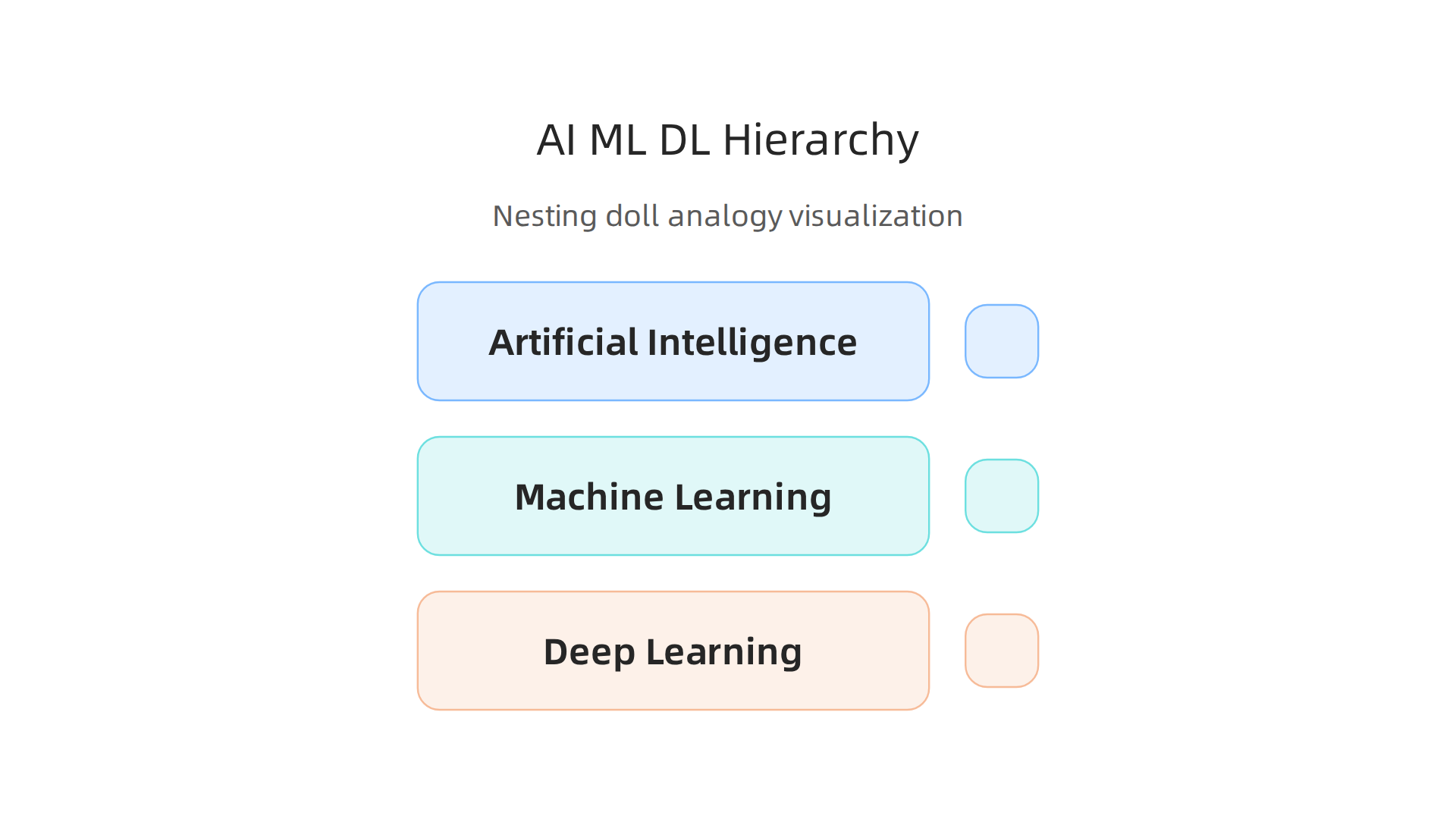
That is the broadest idea. It covers any machine that can do tasks that normally need human smarts. Things like playing chess, recognizing faces, or answering questions all fall under AI.
Inside that big doll is a smaller one: Machine Learning. Machine learning is a specific way to build AI. Instead of giving the computer a long list of rules, you feed it data. The system finds patterns on its own and gets better over time. For example, a spam filter learns what spam looks like by studying thousands of emails. It does not need a person to write rules for every possible spam message.
Inside Machine Learning sits the smallest doll: Deep Learning. Deep learning is a special type of machine learning. It uses artificial neural networks with many layers. These networks mimic how the human brain works. Deep learning is the engine behind self-driving cars, voice assistants, and tools that generate realistic images.
A good way to remember the relationship: all deep learning is machine learning, and all machine learning is AI. But not all AI uses machine learning. Some older AI systems just follow fixed rules. And not all machine learning uses deep learning. Simpler algorithms like decision trees are still machine learning.
Why does this matter for you? Because when a startup says it uses "AI," you need to ask "What kind?" Are they using a simple rule-based system? A basic machine learning model? Or a deep neural network? Each one has very different costs, data needs, and capabilities. As the IBM article on AI vs. ML vs. Deep Learning explains, the depth of the neural network is what separates deep learning from other machine learning methods. That depth also means you need more data and more computing power.
Getting the technology definition right also helps you cut through hype. A startup that says it has "AI" might just be using a simple lookup table. Another might have built a custom deep learning model. Without a clear technology definition, you cannot tell the difference. That confusion leads to bad investments and missed opportunities.
In 2026, the AI market is moving fast. New models and tools appear every week. Having a sharp technology education mindset means you ask the right questions. Do not just accept "AI" as an answer. Push for specifics. Ask about the algorithm, the training data, and the model architecture.
To go deeper on how to spot real innovation, read our guide on understanding technology synonyms for clear machine intelligence communication. It helps you translate vague claims into concrete facts.
Once you know the difference between AI, ML, and deep learning, you can evaluate companies with more confidence. But the field changes fast. To keep up, you need a steady stream of clear, daily updates. That is why I recommend The AI Newsletter Worth Reading. It delivers the most important AI news and analysis straight to your inbox, so you never miss a critical shift.
Key Subfields of Machine Intelligence You Need to Know
You now understand the nesting doll setup: AI is the big umbrella, machine learning sits inside, and deep learning goes even deeper. But that is just the starting point. To really evaluate companies and make smart decisions in 2026, you need to know the major subfields inside that umbrella.
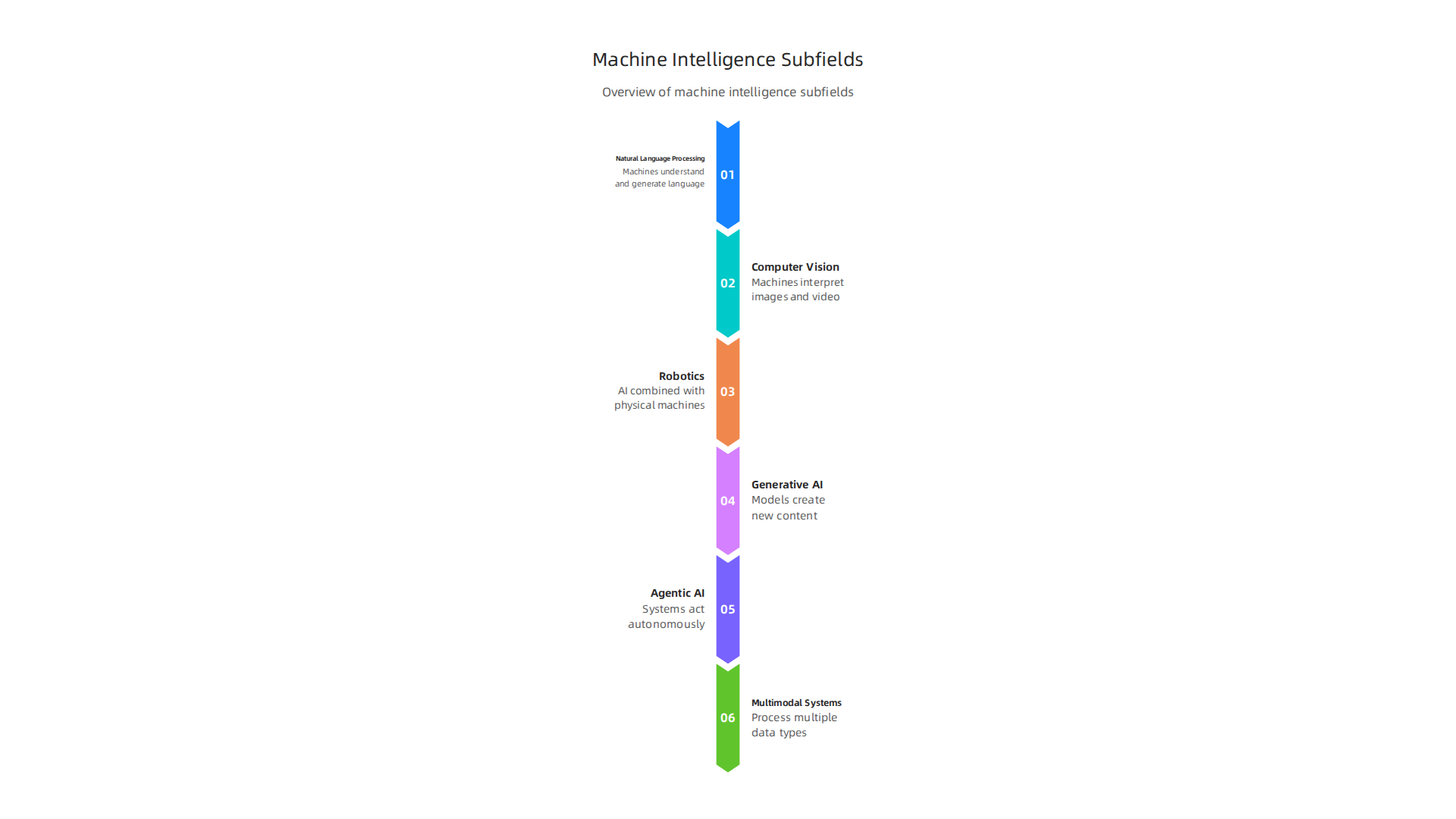
Each one has a clear technology definition with its own methods, data needs, and real-world uses. When a startup says "we use AI," your first follow up question should be: "Which subfield?"
Natural Language Processing (NLP)
NLP is the part of AI that lets machines read, understand, and generate human language. Every time you use a chatbot, translate a webpage, or ask your phone for the weather, NLP is working behind the scenes. These systems learn from massive amounts of text data. They get better at understanding context, tone, and meaning over time. The technology definition here is precise: NLP systems process human language in a way that makes sense to both machines and people. It is one of the most established subfields, but new models keep raising the bar.
Computer Vision
Computer vision trains machines to see and interpret images and video. Self-driving cars use it to spot pedestrians. Doctors use it to find tumors in scans. Factories use it to check product quality. In 2026, companies like Cherry Poet and Metropolis are pushing computer vision into new areas like traffic management and urban mobility. To learn more about the leaders in this space, read our breakdown of leading computer vision companies in 2026.
Robotics
Robotics mixes AI with physical machines. Warehouse robots sort packages. Surgical robots help with delicate procedures. Home robots mop your floor. The hard part is not just building the robot body. It is giving the robot a brain that can process sensor data and make decisions in real time. A good technology education in robotics covers both hardware and the AI software that controls it.
Generative AI
Generative AI is the subfield behind tools like ChatGPT, image generators, and music composers. Instead of just analyzing data, these models create new content. Text, images, video, and code all come from generative models. This subfield got most of the public attention in recent years. But not every generative tool uses deep learning. Some rely on simpler algorithms. The technology definition matters here: is the product using a large language model or a basic pattern matcher? That difference affects cost, quality, and reliability.
The Specialist Trap: Why Real Expertise Matters
Many companies list five subfields on their website. They claim to do NLP, computer vision, robotics, and generative AI all at once. But real expertise in any one subfield takes years of focused work, specialized data, and tuned models. A company that truly leads in computer vision is unlikely to also be a top player in natural language processing. Understanding the specific classified technologies behind each claim helps you separate hype from substance. For a deeper look at how to spot misleading labels, check out our guide on 10 tech synonym pairs that confuse everyone in 2026.
Emerging Subfields in 2026
Two subfields deserve extra attention right now: Agentic AI and Multimodal Systems.
Agentic AI refers to systems that do not just answer questions. They take action. You give them a goal, and they plan steps, use tools, and adapt until the task is done. For example, an AI agent could handle customer refunds, manage inventory, or book travel across multiple websites. This is a major shift from chatbots that only respond to prompts. As MIT Sloan’s overview of agentic AI explains, these systems "perceive, reason, and act on their own." Getting the technology definition right here is crucial because many companies are rebranding simple automation workflows as "agentic."
Multimodal Systems process more than one type of data at once. A model that reads text, looks at images, and listens to audio is multimodal. These systems power the newest virtual assistants that can see your camera feed and hear your voice simultaneously. They represent the cutting edge of ai for humans because they interact with the world in a more natural, human-like way.
Keeping your technology education current means tracking these subfields as they evolve. By understanding the specific technology definition of each area, you can ask better questions, spot real innovation, and avoid getting fooled by vague claims. That is the skill that separates smart investors and decision makers from the rest of the crowd.
Emerging Technology Definitions in 2026: Agentic AI, Edge AI, and Multimodal Models
Now that you know the main subfields, let’s zoom in on three terms that get thrown around the most in 2026. These are all exciting, but their technology definition matters more than ever. Companies love to call their product "agentic" or "multimodal" just because it sounds advanced. Your job is to know what each term actually means, so you can tell genuine innovation from rebranded automation.
Agentic AI: The Precise Definition
Agentic AI is not just a chatbot that can do a few steps. According to a clear breakdown from industry experts, the true technology definition is an autonomous system that receives a goal, plans the steps, uses tools, and adapts based on results, all without human approval at every step. The key word is autonomy over multiple steps. A chatbot answers. An agent does. As the Agentic AI definition for 2026 explains, these systems "pursue goals through autonomous, multi-step action across real systems, with the capacity to reason, use tools and maintain context." If a product asks for your confirmation before every action, it is not truly agentic. It is a UI with a wrapper. Getting the classified technologies right here helps you separate real AI agents from fancy automation scripts.
Edge AI: Intelligence Without the Cloud
Edge AI is one of the most practical emerging definitions to learn. It means running AI models directly on a device, like your phone, a camera, or a factory sensor, instead of sending data to the cloud. This gives you speed, privacy, and offline capability. For example, a smart doorbell that recognizes faces without sending video to a server is using Edge AI. In 2026, more companies are pushing AI to the edge because it cuts latency and keeps user data local. Understanding this technology education point helps you spot products that are truly private and real-time, versus those that still depend on an internet connection.
Multimodal Models: One Brain, Many Senses
You already saw multimodal mentioned as an emerging subfield. Now let’s pin down the technology definition: a multimodal model processes multiple types of data at once. That could be text plus images, or audio plus video, all within a single neural network. These models power the newest virtual assistants that can see your camera feed and hear your voice together. But not every system that claims to be multimodal truly is. Some just glue separate models together. A true multimodal system was trained from the start to understand relationships between different data types. This subtle distinction matters when evaluating a company’s core capabilities.
Why Getting Definitions Right Matters
Every time you hear "AI-powered," ask yourself: which subfield? What is the exact technology definition? Is it truly agentic or just automated? Is it edge or cloud? Is it genuinely multimodal or bolted together? These questions protect you from hype and help you invest, partner, or build with real clarity.
To keep your finger on the pulse of these fast-moving definitions, a daily dose of curated AI news helps enormously. Stay informed without the noise. Subscribe to The Deep View Newsletter for clear daily updates that cut through the marketing and deliver the real signals. And if you want to see how these trends play out across the year, check out our roundup on AI Trends 2026.
How Standards Bodies and Research Institutions Define Technologies
Knowing the right technology definition can save you from falling for buzzwords. But who decides what these terms really mean? It is not just tech bloggers or marketing teams. Some of the most trusted sources come from official standards bodies and research institutions. These organizations take a careful, community-validated approach to defining the classified technologies shaping our world.
NIST: The U.S. Leader in AI Definitions
The National Institute of Standards and Technology (NIST) plays a huge role in setting clear definitions for AI. Its AI Risk Management Framework gives people a shared language to talk about trustworthy AI. NIST defines key outcomes like explainability, transparency, and fairness. When a company says its product is "responsible AI," checking against NIST’s definitions tells you if they mean it. NIST also launched a new AI Agent Standards Initiative in early 2026 to build public confidence in agentic technology. That initiative works to make sure everyone agrees on what an "agent" really is.
ISO: The Global Standard for AI Management
The International Organization for Standardization (ISO) teamed up with the International Electrotechnical Commission (IEC) to create ISO/IEC 42001, the first global standard for an AI Management System. This standard does not just list definitions. It gives organizations a framework for governing AI from start to finish. It requires clear policies, risk assessments, and human oversight. If you are building or buying AI tools, knowing that a product follows ISO/IEC 42001 means the vendor takes definitions and accountability seriously.
IEEE and Academic Voices
The Institute of Electrical and Electronics Engineers (IEEE) also contributes by submitting feedback to government bodies like NIST. Their technical input on agentic AI security helps shape how regulators define safety and autonomy. Meanwhile, academic conferences like NeurIPS and AAAI publish peer-reviewed papers that refine AI terms through research. These community-validated definitions carry weight because experts debate and agree on them before they become common knowledge.
Why This Matters for You
Using official definitions from groups like NIST, ISO, and IEEE removes guesswork. When you communicate with partners, investors, or customers, you can point to a shared standard instead of arguing about words. That builds trust and speeds up decisions. If you want to go deeper into the ethics behind these definitions, our ethical and transparent AI guide shows how principles translate into real products.
Sticking with authoritative sources turns technology education from a guessing game into a reliable skill. And that makes "AI for humans" truly work.
A Practical Framework for Evaluating Technology Definitions
Knowing who defines a technology is a great start. But what happens when you have to compare definitions from a vendor, a researcher, and a government agency? That is where a simple framework saves you. You need a repeatable way to sort good definitions from marketing fluff.
Here is a four-point checklist you can use every time you come across a new technology definition. Ask yourself these questions:
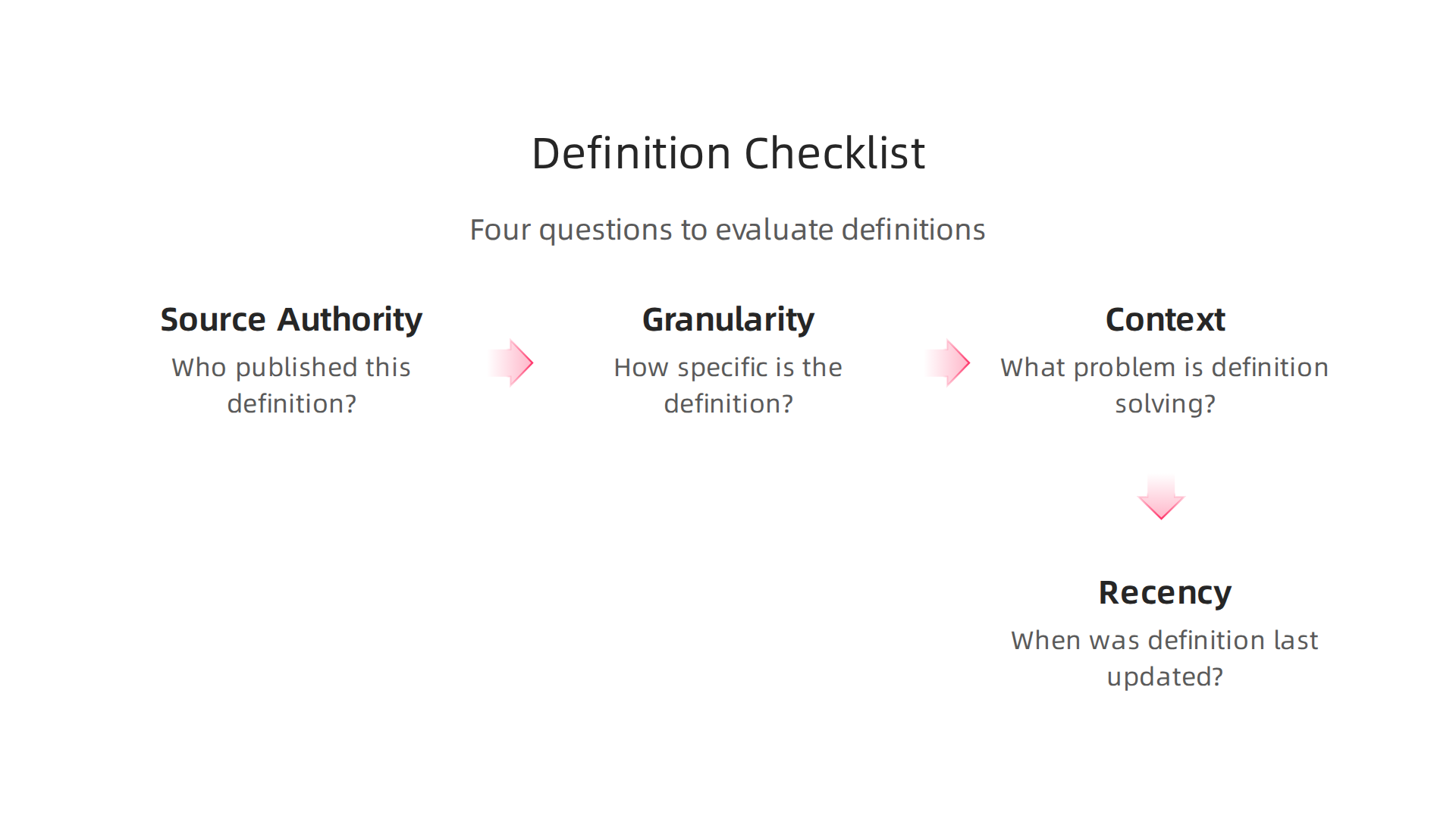
1. Source Authority – Who published this? Is it a standards body like NIST, a peer-reviewed journal, or a company trying to sell something? Authoritative sources carry more weight. For example, definitions from official standards organizations go through years of review. The Technical standards and evaluations framework explains how these shared expectations are built and validated.
2. Granularity – How specific is the definition? A vague definition like "AI that helps people" is not useful. A good definition describes boundaries, capabilities, and limitations. For instance, NIST defines "explainability" as a measurable outcome, not just a feel-good label. Granular definitions are harder to twist into hype.
3. Context – What problem is this definition solving? A definition meant for engineers building a system will look different from one used in a marketing brochure. Match the definition to your use case. If you are evaluating an investment, you need a definition that covers risks and failure modes, not just benefits.
4. Recency – When was this definition last updated? Technology changes fast. A definition from 2020 might miss key developments in agentic AI or large language models. Look for the latest version, preferably from 2025 or 2026. NIST and ISO regularly update their frameworks to stay current.
Using these four criteria helps you cut through noise. You can line up a vendor’s definition next to a researcher’s definition and see where they diverge. That comparison reveals what the vendor might be hiding or exaggerating. It is critical thinking applied to technology language.
This framework turns the act of defining technology into a reliable skill. Instead of trusting every bold claim, you build confidence in your own judgment.

That matters for investors, founders, and anyone making decisions based on what a technology claims to do.
If you want to go further into separating real trends from empty buzzwords, our guide on AI trends 2026 separating signal from noise shows how to apply this thinking at scale.
One more thing: staying updated on the best definitions and frameworks takes daily effort. That is exactly why we recommend The Deep View Newsletter. It delivers clear daily AI updates straight to your inbox, so you never miss a critical shift in how technologies are defined and evaluated.
With a practical framework in your toolkit, you stop guessing and start deciding with clarity. That is the real power of understanding technology definition on your own terms.
The Role of Curated Intelligence in Staying Current with Definitions
You have the framework. But here is the reality. Technology definitions do not stay still. What counted as "agentic AI" in January 2026 might be standard by July. How do you keep up without spending all day reading research papers?
The answer is curated intelligence. Specialized newsletters and market intelligence platforms do the heavy lifting for you.

They scan hundreds of sources, identify the most important updates, and deliver vetted definitions straight to your inbox. That saves you hours every week.
Consider the scale. The Best AI Newsletters 2026 list shows that top publications like The Rundown AI serve over two million subscribers. These newsletters employ editors who understand what a solid technology definition looks like. They filter out vendor hype and surface the definitions that actually matter for professionals.
Think about what this means for your daily workflow. Instead of manually tracking twenty sources, you subscribe to two or three trusted voices. Each morning, you get a sorted list of updates with context. You learn which definitions are being challenged, which are becoming standard, and which were invented by marketers.
This discipline is a competitive advantage. AI professionals who rely on a curated intake of information consistently make better decisions. They spot trend shifts before the crowd. They avoid investing in technologies defined by buzzwords instead of substance.
For example, newsletters like The Batch by Andrew Ng deliver weekly technical syntheses that clarify complex definitions. Superhuman AI focuses on practical tool usage, which reveals how definitions play out in real products. Import AI dives into policy and frontier research, showing how regulatory definitions evolve.
Build your own stack. Pick one daily newsletter for broad scans and one weekly for technical depth. That small habit keeps your technology education current without overwhelming your inbox.
You already have the evaluation framework from earlier. Now pair it with a disciplined intake routine. Together, they make you resistant to hype and confident in your own judgment.
If you want to go deeper on how to choose the right sources, our guide on technology synonyms for clear AI communication shows how precise language separates real progress from marketing spin.
Summary
This article gives a practical, evidence-based framework for defining and evaluating the core technologies in machine intelligence so you can cut through AI marketing and make smarter decisions. It explains the nesting relationship between artificial intelligence, machine learning, and deep learning, then walks through key subfields such as NLP, computer vision, robotics, and generative AI. The piece highlights emerging 2026 terms — agentic AI, edge AI, and multimodal models — and shows why precise definitions matter for cost, capabilities, and risk. You also get guidance on who sets authoritative definitions (NIST, ISO, IEEE), plus a four-point checklist to judge any vendor or research definition. Finally, the article explains how curated newsletters and daily intelligence keep your technology vocabulary current so you can evaluate products, investments, and strategy with confidence.