
Introduction: The New Frontier of Creative Storytelling with AI
Think about the last time you struggled to turn a story idea into words on a page. That blank screen feels heavy.

Now imagine having a writing partner that never gets tired, never judges your first draft, and can help you build entire worlds from a single sentence.
That partner exists in 2026. And it’s changing everything.
The numbers tell the story best. The global AI-Generated Content market reached $18.4 billion in 2025 and is projected to jump to $212.6 billion by 2034. That is a growth rate of 31.4% every single year. The AI story generator tool market alone is growing at 5.8% annually through 2033, with North America expected to control about 40% of that share.
But this isn’t just a numbers game. An AI story writer is transforming how narratives get created across industries. Fiction authors use them to break through writer’s block. Marketing teams use them to produce video scripts in minutes. Educators use writing prompt generators to spark student creativity. And text to video AI tools now let you turn a paragraph into a full animated scene with a single click.
For investors and executives, understanding this landscape is no longer optional. The tools available today can generate long-form novels, refine your prose with an ai rephraser, and help you test a hundred different story angles in the time it used to take to write one.
This guide gives you a curated, evidence-based look at the AI story writer market in 2026. You will learn which tools actually work, how the technology has matured, and where the biggest opportunities are hiding.
If you want to stay ahead of the curve without drowning in daily headlines, The AI Newsletter Worth Reading delivers clear, daily updates straight to your inbox.
The Rise of AI Story Writers: A Market Overview
The numbers we just looked at show the big picture. Now let’s zoom in on the AI story writer market specifically. This segment is growing fast because large language models keep getting better. They can now hold long plots, keep character voices consistent, and handle genres like fantasy or sci-fi with real skill. Multimodal generation is another big driver. An AI story writer today can create both text and images, or even turn a story into a video scene using text to video AI tools.
All this growth has caught the attention of investors. Venture capital is flowing into the space. Big AI companies are buying smaller story-focused startups to build out their creative tools. The market is moving from many small players toward a few strong ones.
Adoption is spreading too. It is no longer just media and marketing teams using AI story writers. Gaming companies use them to build quests and dialogue. Schools use writing prompt generators to spark student ideas. Enterprise training teams create interactive scenarios with AI rephraser tools. The AI Story Generation Tools 2026 guide lists many of the top options available now. For a deeper look at the best tools out there, check out our review of the best AI storytelling generator for this year.
Key Players and Funding Trends
Now let’s look at the companies driving this growth and how they are funded. Leading AI story writer startups like Sudowrite and NovelAI have secured significant funding rounds from top venture firms. These investments fuel product development and market expansion. The broader AI-generated content market is projected to reach $212.6 billion by 2034, attracting serious investor attention.
Mergers and acquisitions are also on the rise. Bigger tech companies are snapping up smaller story-focused startups to strengthen their creative AI offerings, including tools that combine text with text to video AI capabilities. Many of these platforms now include a built-in writing prompt generator and an ai rephraser to help polish drafts.
For a closer look at the top tools available in 2026, read our detailed comparison of the best AI storytelling generator on the market.
If you want to stay ahead of these fast-moving trends, subscribe to The Deep View Newsletter. It delivers clear daily AI updates straight to your inbox, helping you track funding rounds, new entrants, and strategic moves across the machine intelligence landscape.
Adoption Rates Across Industries
Not every industry is adopting AI story writers at the same speed. Marketing and advertising lead the charge.

By the end of 2025, AI-generated or AI-assisted content appeared in over 62% of digital ad campaigns in North America. That number is expected to exceed 85% by 2028, according to the AI-Generated Content Market Research Report 2034.
Entertainment is close behind. Film studios and game developers use AI story writers to draft scripts, build dialogue, and even create branching narratives for interactive media. Many of these teams pair an AI story writer with a text to video AI tool to produce visual storyboards from written scenes.
Training and education are growing fast too. Corporate learning teams use writing prompt generators to create scenario-based modules. They then polish the material with an ai rephraser to ensure clear, consistent language across courses.
Different sectors have different maturity levels. Marketing is the most mature, with entertainment accelerating quickly, and training still in early adoption. For a deeper look at how organizations approach this, read our guide on strategic AI adoption for business growth.
If you want to track which industries are moving fastest, subscribe to The AI Newsletter Worth Reading. It delivers clear daily AI updates straight to your inbox, helping you spot where adoption is accelerating.
How AI Story Writing Works: Technology Behind the Magic
AI story writers don’t just guess the next word. They rely on large foundation models like GPT-4, Claude, and Llama. These models are fine tuned for narrative coherence and creativity. They learn from millions of stories, plot structures, and dialogue patterns.
The real magic comes from a few key techniques. Prompt engineering shapes the AI’s output by giving it clear instructions about genre, tone, and character goals. Retrieval-augmented generation (RAG) lets the AI pull from external knowledge, keeping facts and timelines consistent. And multi-turn story architecture allows the AI to handle long narratives by breaking them into structured scenes, similar to a traditional three-act plot.
Understanding this pipeline helps you judge any tool’s real limits. For a deeper look at how creative writing models are tested, check out the benchmark for creative writing models from the NC Bench study.
If you want to find a tool that fits your workflow, start by understanding how these techniques apply in practice. Read our complete guide on how to choose the best AI chatbot for writing.
Foundation Models and Fine-Tuning
Every ai story writer relies on a foundation model under the hood. Companies like OpenAI, Anthropic, and Meta train these massive language models on billions of words. But raw training is not enough for good storytelling. That is where fine-tuning comes in.
Fine-tuning shapes the base model for narrative tasks. There are three common approaches:
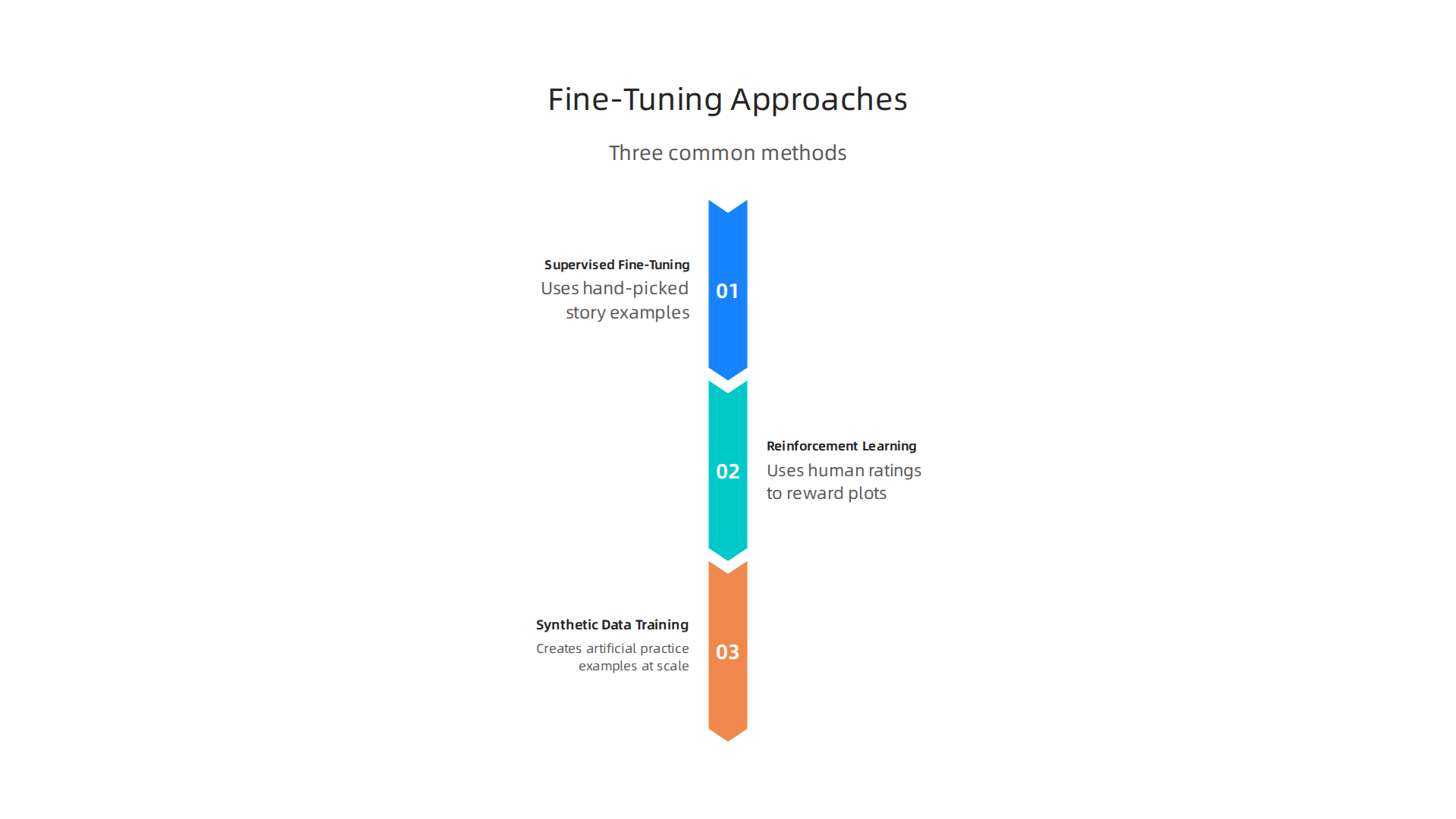
- Supervised fine-tuning uses hand-picked story examples to teach structure and voice.
- Reinforcement learning from human feedback (RLHF) uses human ratings to reward engaging plots and natural dialogue.
- Synthetic data training creates artificial practice examples at scale, helping the model learn faster.
Each method has trade-offs. Larger models usually produce richer stories but cost more to run. Smaller models are cheaper and quicker but may lack depth. Finding the right balance matters for your specific project.
To see how different models compare on creative tasks, check out the NC Bench benchmark for creative writing models. And if you are deciding which tool fits your workflow, our guide on how to choose the best AI chatbot for writing can help you compare options.
Want to stay on top of AI breakthroughs without the noise? Get clear daily AI updates from The Deep View Newsletter.
From Prompt to Plot: Workflow Analysis
Even the best foundation model needs a clear process to turn a spark of an idea into a finished story. The typical ai story writer workflow follows four steps: ideation, drafting, editing, and polishing.
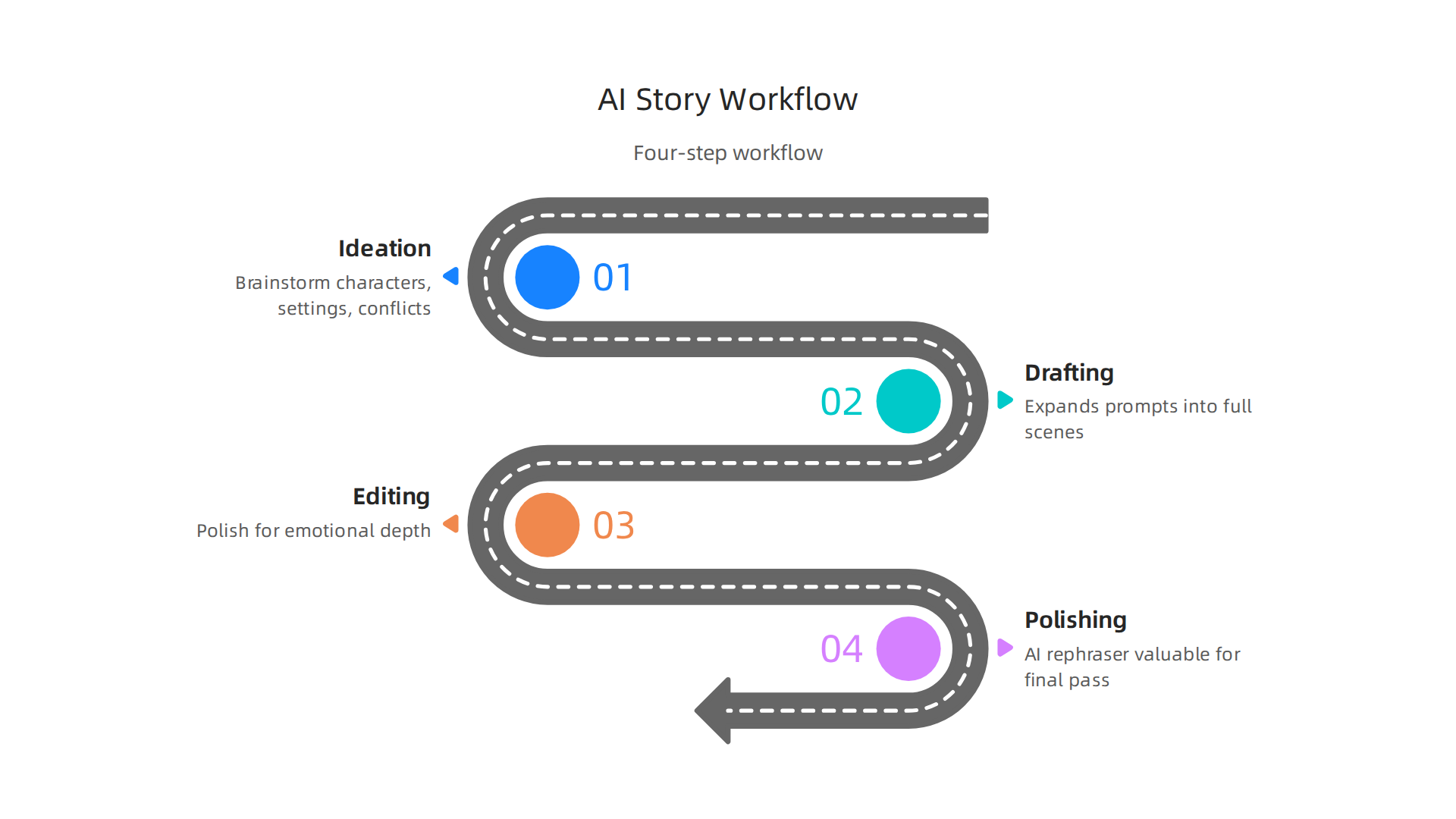
During ideation, a writing prompt generator helps you brainstorm characters, settings, and conflicts. Drafting expands those prompts into full scenes using techniques like prompt chaining, where one output feeds the next. This keeps the narrative consistent across long passages.
Memory and context windows matter a lot here. If the context window is too small, the model forgets earlier details. Good tools use long memory to track plot threads. Tools like the free AI story generator from Squibler streamline this flow by letting you check each draft before moving on.
Compared to human-only writing, the AI workflow is faster for raw output but needs careful oversight. A human might spend days rewriting for voice and logic. An AI can finish a rough draft in minutes, but you still need to polish for emotional depth and subtlety. That trade off makes the ai rephraser valuable for the final pass. To see the best tools for each stage, check out our roundup of the best AI storytelling generator tools for 2026.
Real-World Applications: Case Studies in Creative Storytelling
Beyond individual workflows, ai story writers are already transforming how entire industries create content. Marketing teams use these tools to generate personalized brand narratives at scale, tailoring stories for different customer segments in minutes instead of weeks. For real examples, check out these AI Marketing Case Studies: 10 Real Examples showing how brands boosted engagement with AI-driven storytelling.
Game developers also rely on ai story writers to build dynamic dialogues and branching storylines. Instead of writing every line by hand, they feed the AI character profiles and plot points, and the tool generates varied responses that adapt to player choices. This saves months of development time.
Educational content creators use the same approach to produce engaging stories for learning modules. AI helps turn dry facts into narrative lessons that hold student attention. To see more creative possibilities, explore our list of creative AI tools for 2026.
As AI storytelling evolves, staying current matters. Get clear daily AI updates from The AI Newsletter Worth Reading to keep your skills sharp.
Marketing and Brand Narratives
Marketing teams love using an ai story writer to create ad copy, video scripts, and social media campaigns faster than ever. Instead of spending days drafting content for different channels, they feed a few brand details into the tool and get multiple polished versions in minutes.
The real magic is personalization. An ai story writer can tailor a single message for different audience segments, changing the tone, examples, and even the call to action based on who will see it. This kind of customization used to require a whole creative team.
Global brands now use AI to produce content in multiple languages without losing their voice. They train the tool on brand guidelines and produce campaigns that feel local in every market. For more on how AI is reshaping marketing today, check out this digital marketing insights overview from Adobe.
As these tools keep improving, staying ahead of the trends matters. For a deeper look at the top options available right now, explore our full guide to the best AI storytelling generator tools on the market.
Interactive Fiction and Gaming
Game developers now use an ai story writer to generate non-player character (NPC) dialogue and quest content on the fly. Instead of manually writing every line, they rely on a writing prompt generator to produce varied responses that react to player choices. An ai rephraser can then polish those lines for consistency.
Open-world games benefit from procedural storytelling where the plot adapts to actions. A single ai story writer can craft hundreds of branching narratives, saving countless hours. Many indie studios adopt these tools to compete with bigger budgets, while AAA teams use them to scale content without losing quality. For a look at how AI drives creative storytelling across industries, check out these AI marketing case studies.
To discover more top tools for creative work, explore these best creative AI tools in 2026.
Want to stay updated on the latest AI trends in gaming and beyond? Subscribe to The AI Newsletter Worth Reading for daily insights.
Evaluating AI Story Writers: Criteria for Selection
When you pick an AI story writer, a few things matter most. Start with output quality.

Does the tool produce creative, natural-sounding dialogue and plot lines? Test it using standardized story prompts to see how it handles different genres. A good writing prompt generator helps you get the results you want fast.
Next, look at customization. Can you set character voice, tone, or genre rules? Many tools let you feed in existing stories so the AI learns your style. Speed also counts, especially for game studios that need real-time responses. Compare the cost against the features. Some premium tools run from $9.99 to $99 per month. For a detailed breakdown, check this comparison of the best AI book writing software of 2026 with real pricing data.
Integration matters too. Does the tool offer an API so you can plug it into your game engine or workflow? Enterprise users need security features like data encryption and role-based access. Finally, consider using an AI story writer that combines a strong writing prompt generator with an AI rephraser to polish drafts. For more on top picks, see our guide to the best AI storytelling generator in 2026.
Feature Comparison and Benchmarks
To help you choose, here is a quick look at how top AI story writers stack up on key features and pricing.
This data comes from real tests and user reviews.
| Tool | Best For | Starting Price | Standout Feature |
|---|---|---|---|
| Sudowrite | Fiction authors | $19/month | Story engine with character tools |
| NovelAI | Creative fiction | $10/month | Genre fiction + image generation |
| Claude | Long-form nuance | Free / $20/month | 200K context for deep plot arcs |
| ChatGPT | Versatile drafting | Free / $20/month | Broad writing prompts |
| Rytr | Budget writers | Free / $9/month | Affordable text generation |
For full details, check this AI writing tool comparison with pricing that scores story coherence and creativity.
Enterprise users should prioritize tools with API access and data security. Individual writers often care more about genre support and length control. A strong ai story writer also works well with a writing prompt generator and an ai rephraser to polish drafts. For more creative options, see our roundup of the best creative AI tools in 2026.
Want to stay current on the best writing tools? The AI Newsletter Worth Reading delivers daily updates on trends like text to video AI and AI story generation.
Cost, Scalability, and Integration
Beyond the feature list, you have to look at the full cost picture. Most AI story writer tools run on a subscription model. Some charge by the token or word. Prices range from free tiers all the way up to about $99 per month for premium fiction tools. For a full breakdown, see this AI book writing software pricing comparison.
Scalability also matters. If you plan to produce high volumes of content, you need a tool that can handle long sessions without hitting hard limits. Claude, for example, offers a 200K context window, making it great for longer drafts. For teams, API integration is the real game changer. You want an ai story writer that connects directly to your content management system or workflow. That way your entire process stays smooth and automated.
For more on finding the right tool for your specific needs, check out our guide to the best AI storytelling generator in 2026.
Challenges and Ethical Considerations in AI Storytelling
Using an ai story writer is exciting, but it comes with real legal and moral questions.
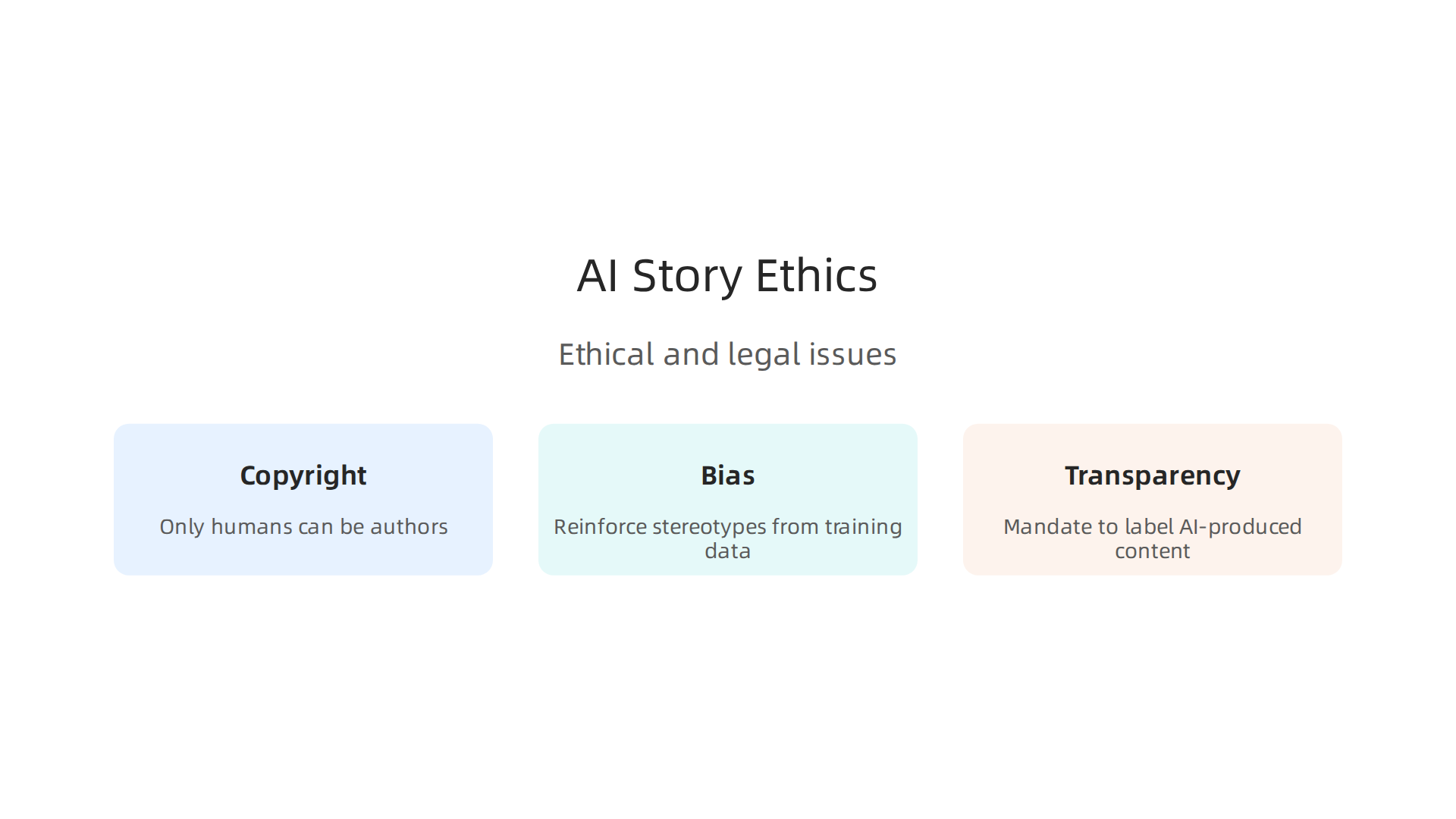
The biggest one? Copyright. If an AI writes a story for you, who owns it? As of 2026, the law is clear in the United States. The Supreme Court declined to hear a major case, leaving the rule that only humans can be authors. Works created entirely by AI cannot be copyrighted. That means anyone could copy and sell what your AI story writer produces. For a full legal breakdown, check this update on the US Supreme Court declines to consider whether AI alone can create copyrighted works.
Another big issue is bias. The data used to train these tools often carries stereotypes and harmful patterns. Without careful checking, your AI story writer might generate characters or plots that reinforce negative ideas. That can damage your reputation and hurt real people.
Transparency is also becoming a legal requirement. Many countries now mandate that you clearly label any content produced by AI. Hiding it could get you in trouble with regulators or your audience.
Navigating these challenges takes thought and care. To learn more about building responsible systems, see this guide on how to build ethical and transparent AI for humans. And if you want to stay on top of all the fast changing rules and tools, consider The AI Newsletter Worth Reading. It delivers clear daily updates straight to your inbox, so you never miss an important development.
Copyright and Originality Concerns
The biggest legal question around any ai story writer is simple: who owns the story? As of 2026, the answer in the United States is clear. The Supreme Court declined to hear the Thaler case, confirming that a machine cannot be an author. Works created purely by AI are not eligible for copyright. The Supreme Court ruling that AI cannot be an author keeps the "human authorship" requirement firmly in place.
That creates real risk. If your ai story writer generates a storyline that accidentally mimics a copyrighted book or film, you could face legal trouble. The output might not be original, and proving it was can be hard.
How do you protect yourself? Look for tool providers that offer strong indemnification and clear licensing terms. That means they cover you if their AI uses someone else’s work without permission. Also, always edit the AI output significantly before publishing. Adding your own creative choices helps you claim copyright over the final result. For a closer look at safe tools, check our list of the best AI storytelling generators in 2026.
Bias and Representation in Generated Content
Beyond copyright, there’s a quieter but just as serious problem: bias. An ai story writer trained on skewed data can quietly reinforce harmful stereotypes. You might see female characters pushed into passive roles or certain races cast only as villains. That’s not just bad storytelling. It can spread real-world harm.
How do tool makers fight this? They use data curation to clean training sets, apply debiasing fine-tuning to adjust model behavior, and run red teaming where testers try to break the system. Many companies also join industry initiatives like the US Copyright Office’s AI policy framework to set shared standards for responsible AI.
You can do your part too. Always review your ai story writer output with fresh eyes. Look for lazy stereotypes and rewrite them. And if you want to stay current on how the industry tackles issues like bias, the The AI Newsletter Worth Reading delivers clear daily updates on AI ethics and trends. For a deeper dive on building fair systems, see our guide on how to build ethical and transparent AI for humans.
Future Outlook: Trends Shaping AI Story Writing in 2026 and Beyond
Looking ahead, the way we use an ai story writer is set to change in big ways. One of the most exciting shifts is multimodal storytelling. Instead of just text, your AI tool will generate images, audio, and even video to match your story. Imagine describing a scene and having a text to video ai create a short clip to go with it. This blend of media makes stories richer and more engaging.
Another trend is personalization. Future tools will act like smart writing prompt generator engines that adapt the story in real time based on what you like. If a reader prefers a faster pace or a different character arc, the narrative can shift automatically. This puts more power in the hands of both writers and their audiences.
Open-source models are also making ai rephraser and story tools available to more people. That’s great for access and creativity. But it also raises new questions about governance and responsible use. Who sets the rules when anyone can run their own model? The industry is still figuring that out.
For a deeper look at where AI is heading, check out the AI trends to watch in 2026 from Microsoft. And if you want to know which tools are leading the charge right now, our guide to the best AI storytelling generator in 2026 breaks down your options.
Predictions from Industry Experts
What do the people building these tools think comes next? Industry experts point to three big breakthroughs for the ai story writer in the near future: longer coherent narratives, true emotional depth, and real-time collaboration.

Right now, most AI stories stall after a few paragraphs. But by the end of 2026, expect models that can hold a novel‑length plot without losing the thread. Experts also believe AI will finally learn to weave in emotion that feels real, not robotic. And real‑time collaboration is coming soon. Picture two writers in different cities working with the same AI partner, each tweaking the story live. This matches the prediction that AI will transform writing, editing and idea generation in 2026.
For investors, the smart bets are on tools that improve narrative memory and emotional understanding. Startups that focus on long‑form coherence or AI that can “read the room” emotionally will likely lead the next wave. If you want to stay ahead of these trends, learn how to choose the best AI chatbot for writing in 2026. And for daily updates that cut through the noise, subscribe to The AI Newsletter Worth Reading for clear, expert‑driven insights.
Strategic Recommendations for Investors
If you are looking at the ai story writer space as an investment opportunity, focus on platforms with proprietary training data or specialized model fine-tuning. Generic models are becoming a commodity fast. Startups that own unique story datasets or that have fine-tuned their models on specific genres will hold the real competitive edge. This matches broader trends in AI story writing tools evolving in 2026.
Here is a quick due diligence checklist. Look for strong narrative coherence across long outputs, clear differentiation from general chatbots, and defensible intellectual property around fine-tuning methods. Ask whether the tool works well with a writing prompt generator or an ai rephraser as part of a larger workflow. Execution speed also matters: a text to video ai integration could be the next growth lever for narrative platforms.
The exit potential is real. Large language model incumbents like OpenAI, Google, and Anthropic may acquire strong narrative specialists to fill gaps in creative storytelling. A startup that masters long-form narrative memory becomes an attractive acquisition target. For a broader view of where the market is heading, check out AI trends 2026 separating signal from noise.
Summary
This guide surveys the 2026 landscape for AI story writers, explaining how these tools work, who’s building them, and why they matter across industries from marketing to gaming and education. It covers market size and funding trends, the foundation models and fine-tuning methods behind narrative generation, and a practical four-step workflow from ideation to polishing. You’ll learn how to evaluate tools—looking at output quality, context windows, APIs, and pricing—and which features matter for teams or individual writers. The article also lays out legal and ethical risks like copyright and bias, and offers strategic recommendations for investors and creators. By the end, readers will know which tools to test, how to integrate AI into creative workflows safely, and what future trends to watch.