
Introduction
Picture this: You are leading a team that needs to build the next big thing in artificial intelligence.

But every week brings a dozen new models, a hundred new startups, and a thousand new claims about what matters most. Where do you even start?
The race to dominate AI does not just depend on who has the best algorithms. It depends on where innovation happens and who builds it. That is where the modern innovation hub comes in. An innovation hub is more than a physical space or a lab. It is a deliberate system where talent, data, and funding come together to create breakthroughs.
The catch? Information overload makes it nearly impossible to identify which hubs are real and which are hype. Rapid change means today’s winning strategy can be obsolete tomorrow. Without a clear framework, decision-makers waste time chasing trends instead of building lasting advantage.
This article cuts through the noise. We define what a true AI innovation hub looks like in 2026. We outline practical strategies for developing a strong tech force that can sustain momentum. We explain how a technology strategy board can keep your efforts focused. And we show how AI development services turn ideas into working products. Whether you are an investor, a founder, or a senior operator, you will leave with actionable insights.
According to the Atlantic Council, AI innovation reshaping global power dynamics is now foundational to economic strength. The stakes have never been higher. The difference between leading and falling behind comes down to how well you build and nurture your own innovation hub.
To navigate this fast-moving landscape, you need a trusted source of daily intelligence. That is why we recommend The AI Newsletter Worth Reading. It delivers clear AI updates straight to your inbox so you never miss a critical shift.

If you want to stay ahead, grab our complete AI innovation guide to strategy measurement and frameworks as your next deep read.
What Defines an Innovation Hub in 2026?
The old picture of an innovation hub was simple. You needed a city with lots of startups, big funding, and a famous university. Think Silicon Valley, Boston, or London. That model still works, but it is no longer the only one.
In 2026, an innovation hub is an ecosystem. It brings together capital, talent, and research in a way that accelerates progress. These elements can be physical, virtual, or a mix of both. Remote work and cloud tools mean a team spread across three continents can act like they share an office.
Here are the key characteristics of a modern AI innovation hub:
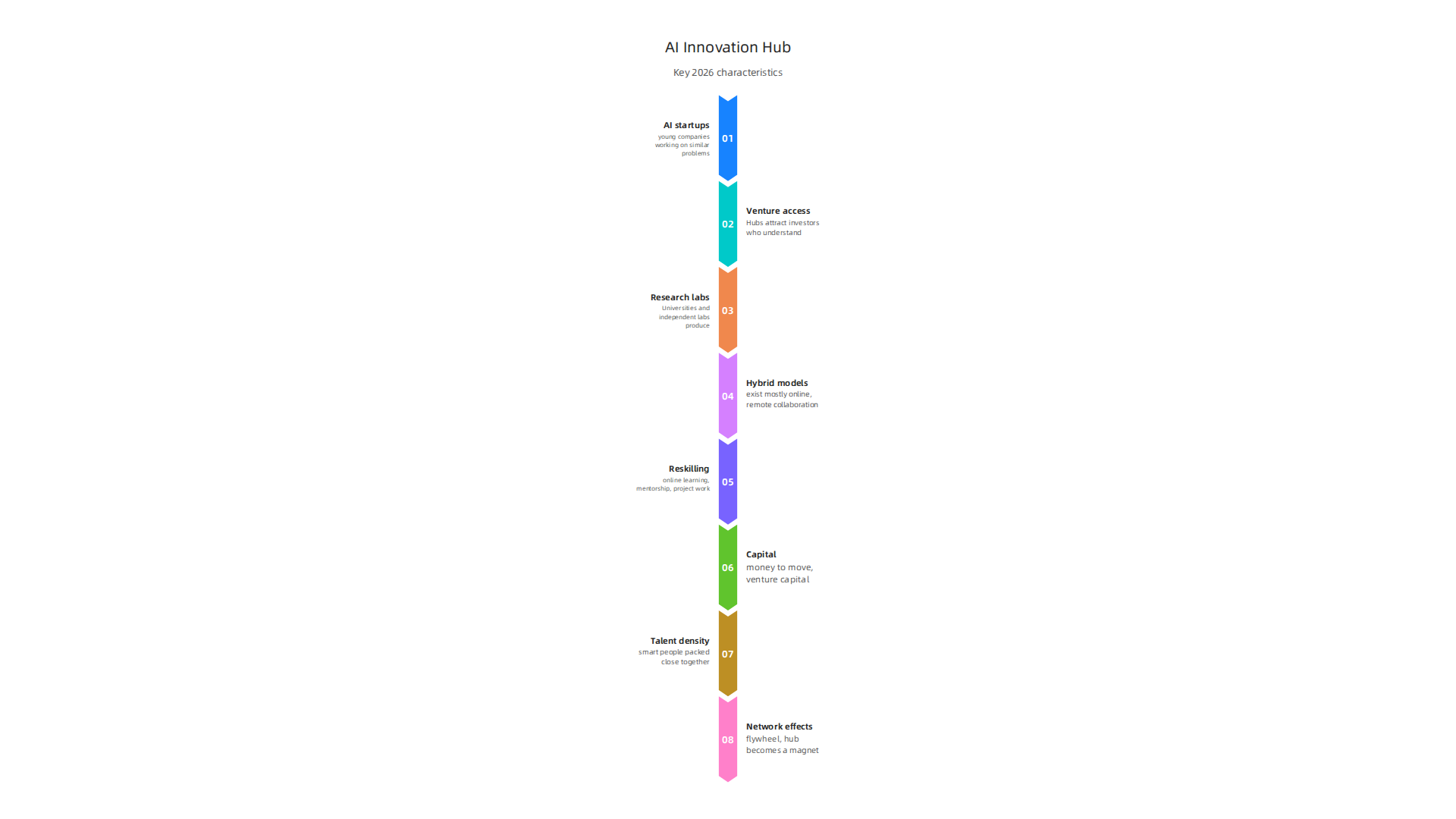
- Density of AI startups. A critical mass of young companies working on similar problems creates spillover. Ideas spread faster. Competition drives quality.
- Access to venture funding. Without patient capital, breakthroughs stay stuck in labs. Hubs attract investors who understand long AI timelines.
- World-class research institutions. Universities and independent labs produce the talent and foundational discoveries that fuel commercial applications.
- Hybrid and virtual structures. Many successful hubs now exist mostly online. Slack communities, shared datasets, and remote collaboration tools replace physical proximity.
The definition has evolved so much that even government agencies are building their own versions. For example, a state AI authority created an AI Learning and Innovation Hub as a safe space where teams can test tools before buying them. That is a far cry from the old idea of a hub as just a geographic cluster.
According to research on factors influencing technology innovation hubs, the success of these ecosystems depends on deliberate design, not just luck. You have to build the connections between people, money, and ideas on purpose.
If you want to create or identify a true innovation hub, start by looking at how the pieces connect. Is there easy movement from research to startup to funding? Are the communication channels open? That is the real test.
To deepen your understanding, explore how to build strategic open innovation networks for tech breakthroughs using proven frameworks.
And if you want to stay on top of where these hubs are forming, The AI Newsletter Worth Reading delivers daily intelligence straight to your inbox.
The Strategic Importance of Tech Force Development
But even the best innovation hub cannot thrive without a skilled workforce. The talent behind the technology determines whether a hub succeeds or stalls. In 2026, that is a big problem.
The numbers are stark. Global demand for AI talent now exceeds supply by more than three to one. According to the latest AI talent shortage statistics, employers across every industry are struggling to find people who can build, deploy, and maintain AI systems. Machine learning engineers, data scientists, and AI product managers are among the hardest roles to fill.
This shortage is the single biggest bottleneck for innovation hub growth. You can have the best labs, the most patient capital, and the smartest strategy board in the world. But without people who can actually do the work, nothing gets built. Hubs that invest in tech force development outpace those that don’t. It is that simple.

What does tech force development look like in practice? It goes beyond traditional hiring. Companies are creating internal reskilling programs. Universities are partnering with startups on practical AI curricula. Governments are funding bootcamps and certification pathways. The goal is to turn a wider pool of people into capable AI practitioners.
Corporate leaders now treat workforce development as a direct competitive advantage. They know that the speed of AI adoption depends on how fast their teams can learn and adapt. A hub that grows its own talent stays ahead. One that waits for the market to deliver talent falls behind.
For anyone building or participating in an innovation hub, understanding how to learn AI for success in 2026 is essential. The hubs that thrive will be the ones that make talent development a core part of their DNA, not an afterthought.
Building Talent Pipelines Through Reskilling
Here is the real challenge. Hiring your way out of the AI talent shortage is almost impossible in 2026. Even if you can find qualified candidates, the competition is brutal and the cost is astronomical. That is why the smartest innovation hubs are flipping the script. Instead of fighting over a tiny pool of external hires, they are building talent pipelines from within.
Internal reskilling does more than fill empty seats. It slashes hiring costs, keeps valuable institutional knowledge inside the company, and boosts employee loyalty. When people feel invested in, they stay. And they bring their hard-earned experience to every new AI project.
What do the best reskilling programs look like? They combine three things.
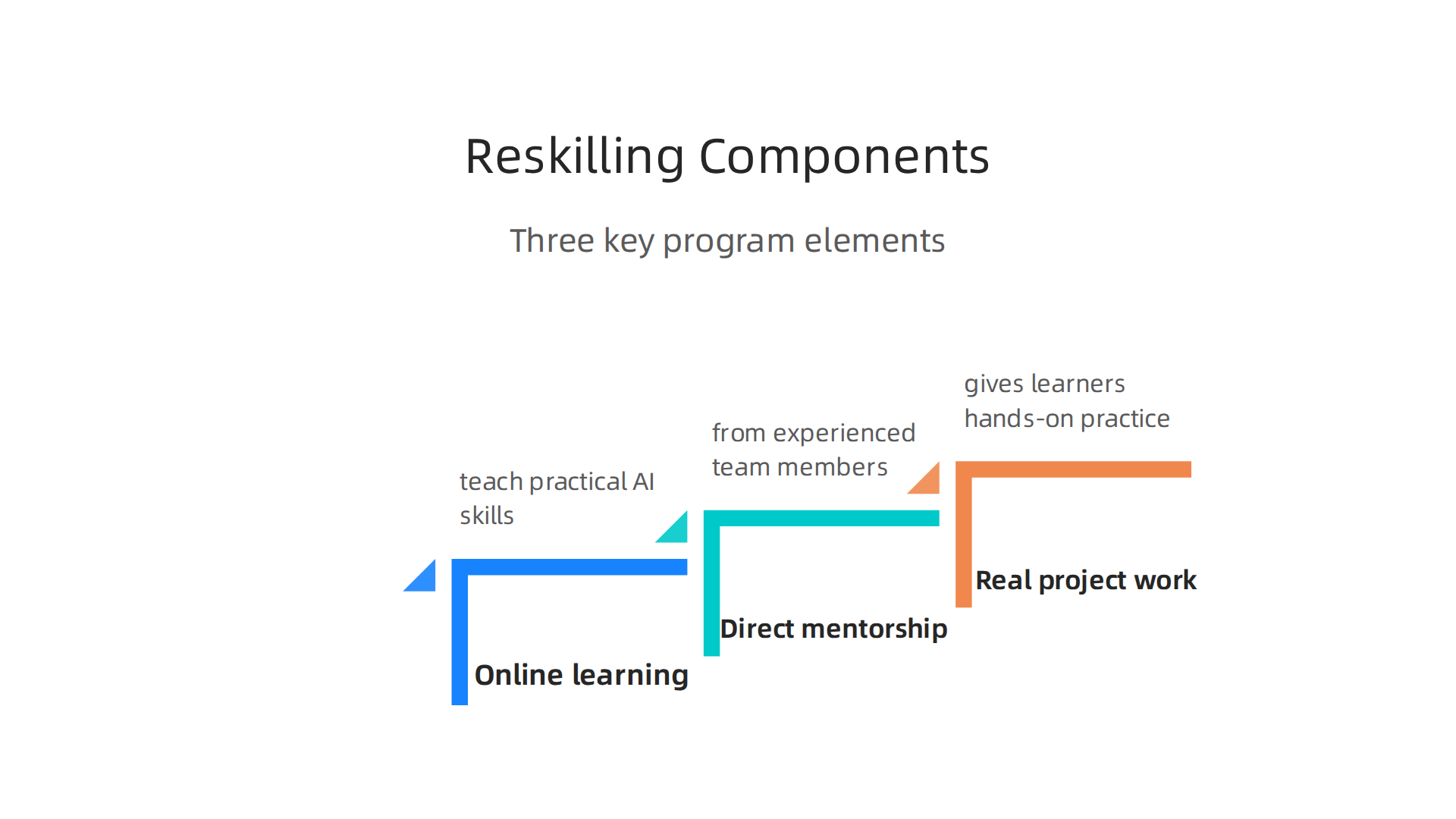
First, online learning platforms that teach practical AI skills. Second, direct mentorship from experienced team members. Third, real project work that gives learners hands-on practice. This mix turns theory into ability faster than any classroom alone. According to recent data, the workforce needs massive upskilling, with an estimated 80% of workers requiring retraining by 2027 as AI reshapes job roles. That is why forward-looking hubs treat reskilling as a continuous process, not a one-time course.
Building this kind of pipeline takes planning. But the payoff is a workforce that can adapt as fast as the technology changes. To stay ahead of these trends, many leaders invest time in learning how AI reshapes research, education, and careers in practical ways.
The teams that commit to growing their own talent will have a lasting edge. If you want to track these developments daily without drowning in noise, The AI Newsletter Worth Reading delivers clear, curated updates straight to your inbox. It is the simplest way to keep your innovation hub informed and ready.
The Role of Universities and Corporate Training
Internal reskilling builds your talent from the ground up. But your innovation hub does not have to do it alone. Strong partnerships with universities and corporate training providers can speed things up dramatically.
University industry partnerships create a direct bridge from research to the market. Academic labs produce cutting edge ideas. Your team turns them into real products. That two way flow keeps your hub at the front of new developments while giving students valuable project experience. A good partnership means you get early access to emerging talent and fresh thinking.
Corporate training platforms like Coursera and Udacity are already widely used. In 2026, many hubs go a step further by launching their own in house AI academies. These academies teach the specific skills your teams need right now. They blend online courses with hands on projects led by your senior engineers. That approach closes the gap faster than any off the shelf program.
Governments are also stepping in. Workforce development grants are increasingly tied to innovation hub formation. If your hub partners with a local university or training provider, you may qualify for funding that covers program costs. That is a smart way to grow your tech force without eating your entire budget.
Building these connections takes effort, but the payoff is a steady pipeline of job ready talent. For a deeper look at how to learn the skills that matter most, check out this practical guide on how to learn AI for success. It covers the exact training paths that align with what innovation hubs need in 2026.
When you combine internal reskilling with outside partnerships, your hub becomes a talent engine that never stops.
Key Components of a Successful Innovation Hub
A talent pipeline is just one piece of the puzzle. To turn your innovation hub into a lasting engine, you need a few other critical pieces in place. Think of these as the pillars that hold everything up.
First up is capital infrastructure. Your hub needs money to move. That means venture capital firms ready to fund early stage startups. It also means government grants for things like R&D and workforce training. Without cash flow, even the best ideas sit on the shelf. Policy support makes a big difference here. Tax incentives for companies that set up in your hub, and immigration rules that make it easy to bring in top global talent, can separate a thriving hub from a struggling one. This is something the research confirms: a study on success factors for technology innovation hubs shows that government policy and funding are major drivers of success.
Next comes talent density. People build things when smart people are packed close together. A successful hub packs engineers, designers, business minds, and researchers into the same physical space. Co-working spaces, labs, and regular meetups create collisions. Those collisions spark ideas that would never happen over a video call. Collaborative spaces are not just nice to have. They are the soil where new products grow.
Finally, the magic ingredient: network effects. The more startups that join the hub, the more investors show up. The more investors show up, the more startups want to join. It is a flywheel. As the density of companies and capital increases, the hub becomes a magnet. Talent wants to move there. Big companies want to acquire the startups. Service providers open offices nearby. Before long, you have a self sustaining system that grows on its own. If you want to understand how to build these kinds of connections between organizations, take a look at how to build strategic open innovation networks for tech breakthroughs.
Putting these components together takes planning. But when you nail the capital, the density, and the network effects, your innovation hub becomes a place where the future gets built every day.
Staying on top of the latest trends in AI and innovation can feel like a full time job. That is why thousands of professionals rely on a daily briefing to cut through the noise. Get clear daily AI updates from The Deep View Newsletter and keep your edge sharp.
Infrastructure and Funding
Building the infrastructure for an innovation hub takes more than a solid plan. You need real money and the right tools. In 2026, the funding game is changing fast.
Venture capital is still the main fuel. But now corporate VC arms and sovereign wealth funds are also writing big checks. Global startup investment hit a record $510 billion in the first half of 2026, according to Crunchbase data. A huge share went to AI companies. That means an innovation hub focused on AI has a serious edge when attracting capital.
Money alone is not enough, though. Hubs also need heavy computing power. High performance computing clusters and massive data sets are now must haves. Startups in your hub need access to cloud GPUs and fast storage to train their models. Without that infrastructure, they fall behind. This is where a AI hardware infrastructure like what Infineon provides becomes a core part of any hub.
Government support remains a key lever for early stage hubs. R&D tax credits and grants lower the risk for founders just getting started. Many successful hubs owe their early momentum to smart policy that unlocked seed funding. A hub with a dedicated grants team can give its startups a big head start.
When you pair strong funding with real computing power and government incentives, your innovation hub becomes a place where the next wave of breakthroughs actually happens.
Collaboration Networks
Funding and hardware get you started. But an innovation hub truly comes alive when people actually work together. A hub without strong collaboration networks is just a building with expensive computers.
The best hubs connect startups, big companies, universities, and government labs in a single ecosystem.

When these groups share ideas, breakthroughs happen faster. One startup might solve a problem a corporate R&D team has been stuck on for years. A university lab might prototype something a government agency needs. That kind of knowledge spillover is what makes a hub more than the sum of its parts.
Co-working spaces and accelerators are the physical glue. They create daily, informal interactions where partnerships form naturally. The European Digital Innovation Hubs network, for example, brings together SMEs and public organizations into active AI experience centers. The recent EDIH Summit 2026 focused on exactly this kind of collaboration across the EU.
Another growing piece is data sharing. Open datasets let everyone train and test models without starting from scratch. Shared benchmarks and data repositories lower the barrier for small teams. For more on building these partnerships, check out this guide on how to build strategic open innovation networks for tech breakthroughs.
The real magic happens when you get the right people in the same room and give them the right reasons to share. Building those connections takes effort, but it is what turns a collection of companies into a real innovation hub.
Want to stay on top of all the latest AI partnerships and ecosystem news? Get clear daily AI updates from The AI Newsletter Worth Reading.
How Machine Intelligence Companies Are Shaping Innovation Hubs
Big AI labs do more than build smart models. They act as anchors that pull the whole ecosystem together. Think about DeepMind or OpenAI. These labs train top researchers, create breakthrough technology, and then those people leave to start their own companies. That talent spin-off is a massive engine for any innovation hub.
When a researcher from a major lab launches a startup, they bring deep knowledge, connections, and a hunger to solve real problems. That startup often stays nearby, forming a cluster. Over time, you get a dense network of AI companies all feeding off each other. For a deeper look at one of these anchor labs, check out this overview of DeepMind’s impact on science and technology.
Corporate innovation labs and venture capital arms also play a big role. Big companies like Google, Microsoft, and Meta set up their own research outposts inside or near these hubs. They invest in startups through corporate venture capital (CVC) to get early access to external R&D. It is a two-way street: startups get funding and mentorship, corporations get fresh ideas and potential acquisition targets.
But here is the big shift happening in 2026. Open-source foundation models are changing the game. Models like Llama and Mistral are freely available. That means you do not need to be in San Francisco or London to build cutting-edge AI. A team in Vienna, Nairobi, or São Paulo can download a powerful model and start innovating. This is decentralizing innovation away from traditional hubs. The recent AI Ecosystems 2026 initiative in Austria shows how regions are building their own AI ecosystems by combining open models with local talent.
The result? Innovation hubs are becoming more distributed. Large machine intelligence companies still anchor the biggest clusters, but the tools to compete are spreading fast. That is a good thing for the tech force everywhere. It means the next breakthrough could come from anywhere, not just the usual spots.
Measuring the Impact of an Innovation Hub
So how do you actually tell if an innovation hub is working? You cannot just rely on hype or good branding. You need real numbers. In 2026, the tech force that runs these hubs tracks a set of clear KPIs. These metrics show whether a hub is healthy, growing, or just coasting on reputation.
The most common leading indicators are startup creation rate, patent filings, talent migration, and funding attracted per square mile. Think about a place like the Bay Area. In Q1 2026 alone, AI startups captured roughly $242 billion in global venture funding, which was about 80% of all VC money flowing in that quarter. That kind of concentration tells you exactly where the capital is clustering. You can check the full breakdown of where that money went in this report on AI Venture Funding 2026: Where the $242B Went.
But funding is just one piece. You also need to look at output metrics like revenue generated by hub companies and job creation. Those are lagging indicators. They tell you whether the early hype turned into real economic value. A hub that attracts tons of funding but produces few jobs or exits is not sustainable. That is why benchmarking against other hubs is essential for continuous improvement. Compare your startup density, patent output, and talent retention rates to top hubs like London, Shenzhen, or Tel Aviv.
For teams that want a structured approach to tracking these metrics, the AI innovation guide to strategy measurement and frameworks provides practical tools to build your own dashboard.
One more thing. Because the landscape changes so fast, staying informed daily is tough. That is why many professionals rely on a curated source of updates. If you want to cut through the noise and get actionable insights straight to your inbox, consider subscribing to The AI Newsletter Worth Reading. It delivers the signal, not the static.
Future Trends: AI, Automation, and the Evolution of Tech Hubs
Looking ahead, the idea of an innovation hub is about to change in big ways. By 2030, automation and AI will reshape the workforce inside these hubs. Routine tasks will be handled by machines, which means people will need continuous reskilling just to keep up. Top hubs are already partnering with local schools and online platforms to offer fast training programs. According to IBM’s future of AI predictions, AI will add trillions to the global economy, but only if workers can adapt quickly. That is why any technology strategy board now puts reskilling at the center of their plans.
At the same time, virtual hubs are rising in importance. Remote collaboration tools are so good in 2026 that a team can build a product without ever meeting in person. This reduces the need for physical proximity. A startup might have its tech force spread across three continents. The hub is no longer a single place but a connected network. That shift opens the door for talent in smaller cities and rural areas to join the action from anywhere.
And here is the big change. New hubs in Asia, Africa, and Latin America are challenging the old leaders. Places like Bangalore, Nairobi, and São Paulo are producing world‑class AI companies. They have lower costs and fast‑growing talent pools. Research on AI research predictions for 2030 shows that these emerging regions will capture a much larger share of global investment. For anyone tracking AI development services, this means the map of innovation is flattening fast.
To stay ahead, you need to watch these trends closely. A great way to keep up is to read the 2026 AI trends report from our own experts. It cuts through the hype and shows you what actually matters for the next wave of innovation hubs.
Summary
This article defines what a modern AI innovation hub looks like in 2026 and gives practical guidance for building and sustaining one. It explains how hubs now operate as ecosystems that combine startups, funding, research institutions, hybrid teams, and shared infrastructure, and why deliberate design—not luck—separates successful hubs from hype. You’ll learn concrete strategies for solving the AI talent shortage by creating internal reskilling pipelines and university partnerships, how to secure capital and high-performance compute, and how to foster collaboration and data sharing across organizations. The piece also outlines the role of anchor labs and open-source models in decentralizing innovation, and recommends the KPIs teams should track to measure real impact. By the end, readers will have a clear framework to evaluate existing hubs, design talent and funding pipelines, and set up metrics and networks that sustain long-term AI innovation.