
Introduction
You see a headline about a new AI code generator every few hours. Some of them promise to write entire apps from a single sentence. Others claim they can fix your bugs before you even find them. The noise is real, and it is getting louder.
In 2026, the share of AI-generated code in production has climbed close to 50%, and the overall AI code tools market size is expected to grow past $9 billion this year alone. Tools that started as simple autocomplete helpers can now generate full functional code, explain complex algorithms, and even write coherent paragraphs that read like a human wrote them.
But speed and volume are not the same as value. Investors, founders, and analysts in the machine intelligence space face a real problem. There is too much information and not enough time to separate the breakthrough tools from the hype.

You need someone to cut through the marketing noise and give you practical, expert-curated insights.
That is exactly what this article is built to do. We look at the current state of AI code generators, how they perform in real-world settings, and what their rapid rise means for your strategy in 2026. Whether you are evaluating a startup, choosing a platform for your team, or just trying to stay ahead, this analysis gives you a clear picture without the fluff.
If you want to keep up with the fast-moving AI landscape without drowning in headlines, check out The AI Newsletter Worth Reading for daily, expert-curated updates straight to your inbox. And for a broader view of where the whole field is heading, our guide on AI trends 2026 can help you separate what matters from what does not.
The Rise of AI Code Generators in 2026
Think back to 2023. Using an AI code generator felt like asking a distracted intern for help. Sometimes you got something useful. Other times you got a broken function and a lot of head scratching. Fast forward to 2026, and that feeling has flipped completely.
Today, these tools are no longer experimental toys. They are production mainstays. The numbers back this up. As of early 2026, the share of AI-generated code in production has climbed to nearly 50%. That is not a pilot program or a side project statistic. That is half of all the code being shipped by real teams every day. According to the latest AI-generated code statistics 2026, adoption curves are steeper than anyone projected just two years ago.
What changed? The short answer is large language models got dramatically better. The long answer involves better training data, bigger context windows, and a lot of fine-tuning on real code repositories. An AI code generator in 2026 can understand your project structure, follow your naming conventions, and even suggest architectural improvements you did not ask for. That is a far cry from the autocomplete widgets of 2023.
The market reflects this shift. The overall AI code tools market size is projected to grow at a compound rate above 25% through 2035. That kind of growth does not happen if the tools are just hype. It happens when enterprises see real productivity gains and decide to bet big.
The major players are locked in a fierce competition right now. GitHub Copilot remains the most recognized name, but it is far from the only option.
Amazon CodeWhisperer and Google Gemini for Code are pushing hard with their own strengths. Each one is racing to improve two things: accuracy and multimodality. Accuracy matters because a buggy suggestion costs more time than it saves. Multimodality matters because developers do not just write code. They also read documentation, review pull requests, and write comments. A good AI code generator in 2026 handles all of that.
For investors and founders watching this space, the key takeaway is simple. The technology has crossed the chasm from experimental to essential. If you are evaluating a startup that builds developer tools, look at how deeply its AI code generator integrates with real workflows. Shallow integration dies fast. Deep integration becomes sticky.
If you want to dig deeper into how to compare these platforms, check out our guide on how to evaluate AI tools in 2026 using the COVERS benchmark. It gives you a repeatable framework for separating genuine capability from marketing spin.
How AI Code Generators Work: Architecture and Data
You type "build a login form" and code appears. Magic? Not really. Behind that simple prompt is a complex system built on years of research. Let’s lift the hood and look at what is actually happening.
Most AI code generators today are built on something called a transformer architecture. This is a type of neural network that learns patterns by studying enormous datasets.
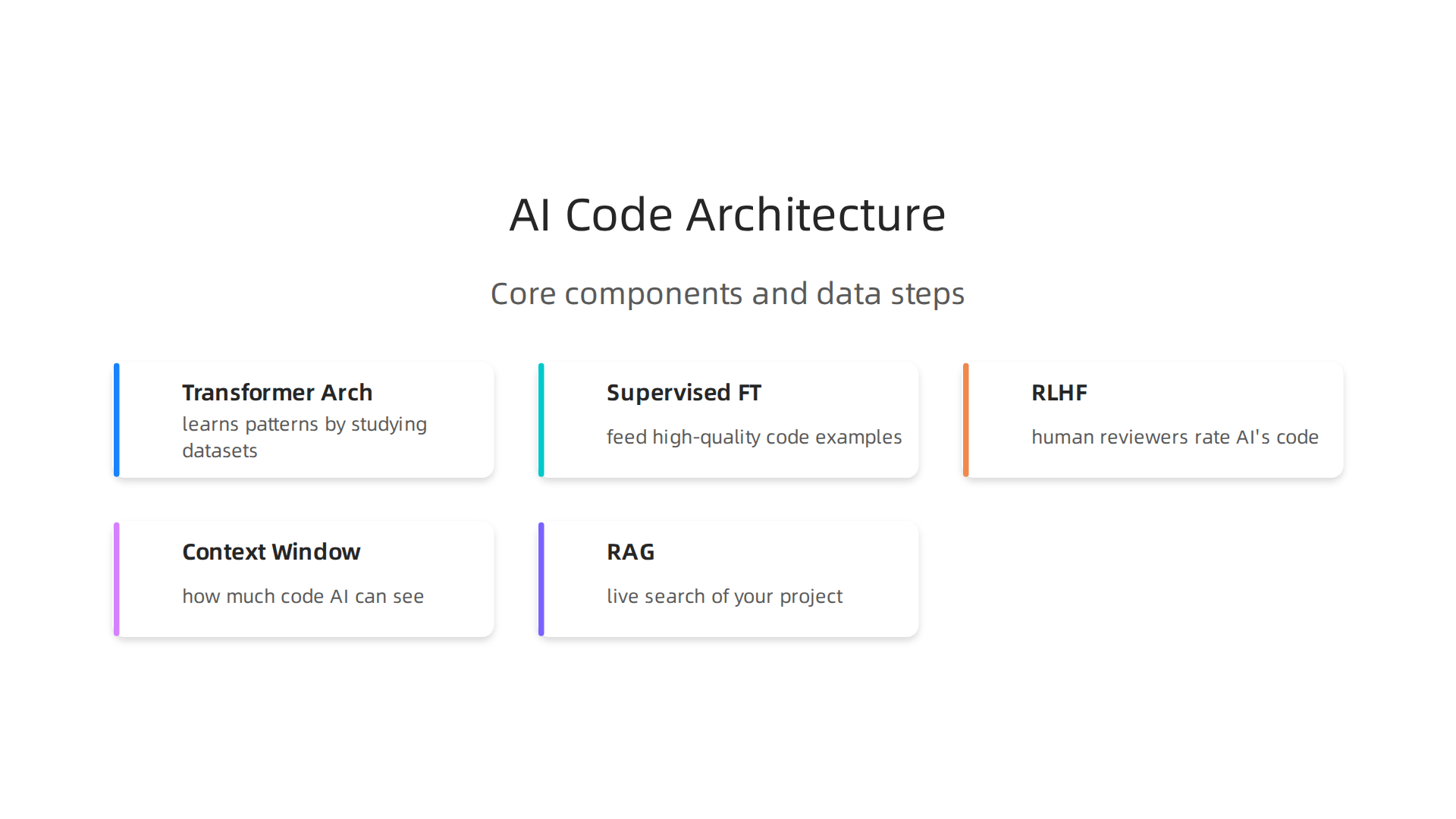
We are talking about billions of lines of public code from GitHub and other sources, mixed with natural language text. The model figures out how code flows, what function names usually mean, and which syntax rules matter most. According to a great overview of AI code generation in 2026 how it works, this training is what gives the model its basic "understanding" of programming.
But raw training alone is not enough. That would be like giving someone every cookbook ever written and expecting them to cook a perfect meal. Developers need to fine-tune the model. They use techniques like supervised fine-tuning, where they feed the model high-quality code examples hand-picked by experts. They also use reinforcement learning from human feedback, or RLHF. In this process, human reviewers rate the AI’s suggested code. Good suggestions get a thumbs up. Bad ones get a thumbs down. Over time, the model learns what "good" looks like. Tools that excel in 2026 have also done code-specific pretraining on curated repositories. This helps the AI understand best practices for specific languages and frameworks. You can read more about these training methods in the latest coverage of AI developer tools in 2026.
Two other pieces of the puzzle matter a lot: context window length and retrieval-augmented generation, or RAG. The context window is how much code the AI can "see" at once before making a suggestion. Bigger is better. A model with a 128,000 token window can read your entire codebase, not just the file you are editing. That means it understands your naming conventions, your imports, and your architecture. RAG takes this further. Instead of guessing from memory, the AI performs a live search of your project and pulls in the most relevant pieces of code or documentation. This is a game changer. It turns an AI code generator from a random guesser into a context-aware teammate. The shift has been called the agentic evolution of these tools. For a deeper look, check out the analysis of AI code generators agentic shift 2026.
Understanding this architecture helps you pick the right tool and use it smarter. If you want to learn more about the broader landscape of AI categories, our guide on types of artificial intelligence in 2026 gives you a clear framework.
And if you want to stay ahead of every update, get clear daily AI updates from the Deep View Newsletter. It cuts through the hype and delivers what actually matters.
Code and Paragraph Generation: A Unified Future
But the AI code generator you just learned about is not limited to writing code. In 2026, the line between code generation and paragraph generation is fading fast. The same models that help you build a login form can also write the documentation for it. They can explain your logic, summarize your project, and even draft release notes.

Think about it. If an AI understands your entire codebase, it can produce clear English descriptions of what each function does. That means automatic code comments that actually make sense. It also means report summaries that save you hours of writing. Many teams now use the same AI tool for both tasks. This shift is possible because of a unified architecture. The model does not see a hard wall between programming languages and human languages. It treats both as patterns.
According to the 2026 guide on choosing the best coding models, many frontier models now handle code and text equally well. You can ask the model to write a Python script and then describe its output in plain English. The same conversation handles both.
If you want to explore tools that focus on the writing side, check out our review of the best AI text generators in 2026. It covers options for paragraph generation that work just like your favorite code assistant.
This unification means less context switching. You write code, generate documentation, and summarize research all in one place. It is a small change that makes a big difference in your daily workflow.
Techniques for High-Quality Paragraph Generation
The same ai code generator that writes your functions can also produce sharp paragraphs. But you need the right techniques.
Start with fine-tuning on domain-specific data. An ai paragraph generator trained on a focused corpus learns the facts and style of that topic. This makes output more accurate and relevant. Teams often fine-tune on internal documents to reduce errors.
Next, use prompt engineering and controlled generation. Clear, specific prompts give better results. Adjust settings like temperature to control creativity. These simple steps augment AI output to match your needs.
Wondering what are ai tools capable of today? Many models handle both code and text well. The 2026 overview of 12 AI models released in one week shows how fast things change.
For writing-focused tools, see how to choose the best AI chatbot for writing.
And to stay updated, subscribe to the The AI Newsletter Worth Reading for daily insights.
Synergies Between Code and Natural Language Models
The same transformer architecture that makes an ai code generator so effective also powers the best ai paragraph generators. This shared foundation creates a powerful synergy.
Because these models learn from both code repositories and text documents, skills transfer between domains. A model that understands logic from code can write clearer, more organized paragraphs. And a model trained on text can better explain what its code does.
This is what allows you to augment ai output across both writing and programming tasks. Many hybrid models now produce executable code alongside natural language explanations in a single response.
For teams choosing their stack, the 2026 guide to choosing coding models breaks down the top options. And if you want to understand how different AI categories work together, read our clear framework for understanding AI categories.
Benchmarking AI Code Generators: What Metrics Matter
So how do you know if an AI code generator is actually good? With so many tools launching in 2026, you need a reliable way to compare them. That is where benchmarks come in.
The industry uses standard tests to measure how well these models write code. HumanEval checks if a model can write correct functions from docstrings. MBPP (Mostly Basic Python Programming) tests on simple programming problems. For data science code, DS-1000 evaluates how well models handle data tasks like pandas or numpy. These benchmarks give you a baseline for accuracy.
But benchmarks only tell part of the story. When you use an AI code generator at work, you care about more than just scoring high on a test. Enterprise buyers look at four main areas:
- Accuracy – Does the code actually run? Does it do what you asked? A model that passes HumanEval might still produce buggy output in real projects.
- Security – Does the generated code introduce vulnerabilities? Unsafe suggestions can slip in, especially with older models.
- Latency – How fast does the tool respond? Waiting ten seconds for a suggestion kills your flow.
- Cost – API calls add up fast. Some models are cheaper per token but need more retries. Others cost more but get it right the first time.
Transparency matters a lot here. The best tools share their evaluation methodology openly. You want to know which version of a benchmark they used and what environment they tested on. Without that info, it is hard to trust the numbers. For a deeper look at how to weigh these factors, check out this guide on evaluating AI tools with the COVERS benchmark.
The field moves fast. Tools that scored well last year may lag behind new models now. Keep an eye on independent leaderboards and real-world tests from developers. And if you want daily updates on AI tools and benchmarks without the noise, subscribe to The AI Newsletter Worth Reading. It gives you clear, no-fluff insights on what matters in machine intelligence.
In the end, the right ai code generator for your team is the one that balances these metrics for your specific use case. Test a few against your own codebase. Benchmarks are a starting point, not the final word.
Strategic Implications for Machine Intelligence Companies
Benchmarks help you choose the right tool for your team. But for machine intelligence companies, the real question is bigger. How can an ai code generator become a strategic advantage?
The numbers show this is more than a trend. The global market for these tools hit $5.8 billion in 2025 and is forecast to grow to $7.2 billion in 2026 with a compound annual growth rate of 24 percent, according to the latest AI-powered code generator market size report. That growth signals real demand, not hype.
Accelerating Product Development and Reducing Technical Debt
For startups and established companies alike, speed matters. Every day you spend writing boilerplate code is a day your competitor moves ahead. AI code generators let developers skip repetitive tasks and focus on the logic that makes your product unique.

The impact on productivity is huge. A recent analysis found that developers save 30 to 60 percent of their time on coding, testing, and documentation when using these tools. You can read more in the AI-generated code statistics 2026 report. That time adds up fast. Less time on busywork means more room for creative problem solving.
These tools also help reduce technical debt. When code is generated consistently and follows best practices, you avoid the messy shortcuts that pile up over time. Your codebase stays cleaner, and your team can ship features faster.
Investors Are Watching Closely
The smartest investors now look at code generation capabilities when picking AI portfolio companies. They know that a team that uses automation wisely can outrun a team that does everything by hand. Many top firms on the Forbes 2026 AI 50 list have built code generation directly into their platforms. That is not an accident. It is a signal that code generation is becoming a core feature, not just a nice bonus.
Partnerships and M&A Are Picking Up
The market is maturing fast. Major partnerships and acquisitions are reshaping the landscape. When big players combine with AI code generator startups, it shows the technology is here to stay. For example, one coding tool reached $2 billion in annual recurring revenue in 2026 faster than any B2B software company in history. That kind of growth attracts attention from every corner of the industry.
If you are building a machine intelligence company, now is the time to think about how these tools fit your roadmap. To stay ahead of the curve, you need a strategy for strategic AI adoption for business growth. The companies that integrate code generation smartly will be the ones that lead in the next wave.
Security, Ethics, and Compliance in AI Code Generation
An AI code generator can write code fast. But can it write safe code? The answer, according to recent research, is not always. A 2026 study found that 45 percent of AI-generated code fails security tests and contains OWASP Top 10 vulnerabilities.

You can see the full findings in the AI-generated code security vulnerability rates 2026 report. That means nearly one in every two code snippets from an AI tool could introduce a security hole.
Why does this happen? AI models learn from public codebases, which include both good and bad practices. They do not reason about security the way a human developer does. They also have no understanding of your specific system context. So while these tools boost productivity, they also create new risks.
Ethical Questions You Cannot Ignore
Beyond security, there are bigger ethical concerns. Many people ask, what are AI tools doing with the data they train on? If a model was trained on someone else’s copyrighted code, who owns the output? And what happens when biased training data leads to biased code? These questions do not have easy answers. That is why companies need to build ethical and transparent AI from the start.
Job displacement is another worry. Some teams see AI as a replacement for junior developers. But the smarter view is that AI augments human work rather than replacing it.
Regulation Is Catching Up
Governments are paying attention. The EU AI Act, for example, is one of the first big regulatory frameworks to address AI-generated content. It sets rules for transparency, risk assessment, and accountability. Companies that use an AI code generator will need to document how they verify the output and who is responsible when something goes wrong.
Stay Informed on These Changes
The landscape around security, ethics, and compliance shifts fast. New vulnerabilities, new laws, and new best practices emerge all the time. To stay ahead, you need a trusted source of daily updates. That is why decision-makers rely on The AI Newsletter Worth Reading to get clear, curated insights every day.
Security Vulnerabilities and Mitigations
Now let us talk about the specific dangers you need to watch for. Across every major 2026 study, the same patterns keep showing up.
Injection flaws top the list. This happens when an AI code generator does not separate user input from executable code. Logic errors come next. The code works for the basic path but crashes on unusual inputs. And insecure dependencies appear often. The AI pulls in outdated libraries without checking for known bugs.
The Top AI Security Vulnerabilities in 2026 report from Cycode lists prompt injection and sensitive data exposure as two of the biggest threats facing enterprises today. These are not minor issues.
How do you fight back? Static analysis tools are your first line of defense. They scan AI-generated code for patterns that match known vulnerabilities. Adversarial testing is another strong option. You deliberately feed tricky inputs to the code and see where it breaks.
Never trust AI output without checking it first. Learn more about how to evaluate AI tools in 2026 with our practical framework.
Ethical Concerns and Regulatory Landscape
Beyond security flaws, deeper questions around fairness and legality now face every developer using an ai code generator. Bias in training data can lead to stereotyped or harmful code suggestions. Models trained on unbalanced datasets may reinforce outdated assumptions without you even noticing.
The copyright and licensing status of that training data remains a messy legal gray area. Many ai code generator tools learned from public code repositories, and the question of fair use versus infringement is far from settled. Regulators are also stepping in. New rules increasingly demand transparency and explainability, meaning you must understand what data your ai paragraph generator or other tools were trained on.
These concerns are not hypothetical. Researchers have flagged the policy implications of AI-generated code as a growing priority. To build responsible workflows, start by learning how to build ethical and transparent AI for your team.
The landscape shifts fast. Stay clear on emerging rules and best practices by subscribing to The AI Newsletter Worth Reading, your daily source for straightforward AI updates.
Future Trends: What to Watch in 2027 and Beyond
The world of the ai code generator is moving fast. By 2027 and into 2028, we’ll see tools that go far beyond what most developers use today. Here are three big shifts to keep on your radar.
First, get ready for multimodal code generators. These tools won’t just read text prompts. They will understand images, screenshots, and even voice commands. Imagine snapping a picture of a whiteboard sketch and having the AI turn it into working code. Or telling your assistant "build a login form like this mockup" and watching it happen. That kind of interaction is already in early testing and will become mainstream soon.
Second, agentic AI coding assistants are coming. Instead of waiting for you to type every command, these agents will plan and execute tasks on their own. You give a high-level goal like "add a payment system to the checkout page," and the AI figures out the steps, writes the code, tests it, and even fixes errors. This changes your role from writing every line to reviewing and directing the work.
Third, expect real-time collaboration to blur the line between you and the tool. The ai paragraph generator already helps with content, but code tools will work alongside you like a pair programmer who never gets tired. You type a few lines, the AI suggests the next block. You accept, tweak, and move forward. The conversation becomes fluid.
The market numbers back up this acceleration. According to recent reports, the AI Code Tool Market is projected to grow at a compound rate of over 23% through 2035. That kind of growth means serious investment and rapid innovation.
How do you stay ahead without drowning in noise? The best way is to follow trusted sources that cut through the hype. Start by subscribing to The AI Newsletter Worth Reading, where you get clear daily updates on what actually matters in AI.
And if you want a deeper look at where all this is headed, check out our breakdown of AI trends 2026 for more signals worth watching.
Summary
This article reviews the rapid rise of AI code generators in 2026, showing how models that once felt experimental are now production tools that write code, documentation, and summaries. It explains the underlying transformer architectures, advances like larger context windows and retrieval-augmented generation, and why fine-tuning and RLHF matter for real-world accuracy. The piece walks through practical benchmarking (HumanEval, MBPP, DS-1000) and the enterprise metrics you should weigh—accuracy, security, latency, and cost—then highlights major security and ethical risks, including the statistic that roughly 45% of AI-generated snippets fail security tests. You’ll get guidance on choosing tools that integrate deeply with workflows, how to verify AI output with static analysis and adversarial testing, and strategic implications for product and investment decisions. Finally, the article previews near-term trends—multimodal inputs, agentic assistants, and tighter human-AI collaboration—so readers can evaluate vendors and adopt safeguards confidently.