
Introduction: Why DeepMind Matters in 2026
Think back to 2010. AI was not a dinner table topic. It was a niche field for scientists and researchers. But a small London startup called DeepMind had a bold mission: solve intelligence and use it to solve everything else. Fast forward to 2026, and that startup has grown into one of the most influential forces in technology.
DeepMind has consistently set the pace for AI breakthroughs. You probably remember AlphaGo beating the world champion at Go in 2016. That was the moment many people realized AI could do more than follow simple rules. Then came AlphaFold, which solved a 50-year-old problem in biology by predicting protein structures. These are not just academic wins. They have real world impact on medicine, energy, and climate science.
Today, the AI landscape is more crowded than ever. We have dozens of top AI companies competing for attention. New names like seamless ai and flawless ai appear weekly. Even BlackSky technology news and other industry sources struggle to keep up. But DeepMind remains a benchmark. Its research and commercial products shape the direction of the entire field.
Why does this matter for you? If you are an investor, an executive, or just someone trying to understand where AI is heading, DeepMind is a key piece of the puzzle.
Its work influences Google products, healthcare tools, and even how we think about artificial general intelligence (AGI). In 2026, you cannot afford to ignore what DeepMind is doing.
This profile gives you a curated deep dive into DeepMind’s history, major achievements, and strategic position. We will look at how it got started, what it has accomplished, and where it is going next. Whether you are researching the AI trends 2026 landscape or evaluating potential investments, understanding DeepMind helps you see the bigger picture.
The story of DeepMind is really the story of modern AI itself. And in 2026, that story is more exciting and more important than ever.
If you want daily AI insights like this delivered straight to your inbox, consider subscribing to The AI Newsletter Worth Reading.
It helps professionals like you stay ahead in this fast moving space.
The Founding and Vision of DeepMind
Every big journey starts with a small group of people who see the world differently. For deepmind ai, that group was three brilliant minds meeting in London in 2010. Demis Hassabis, Shane Legg, and Mustafa Suleyman shared a bold belief: that intelligence could be broken down into its basic parts and rebuilt inside a machine.
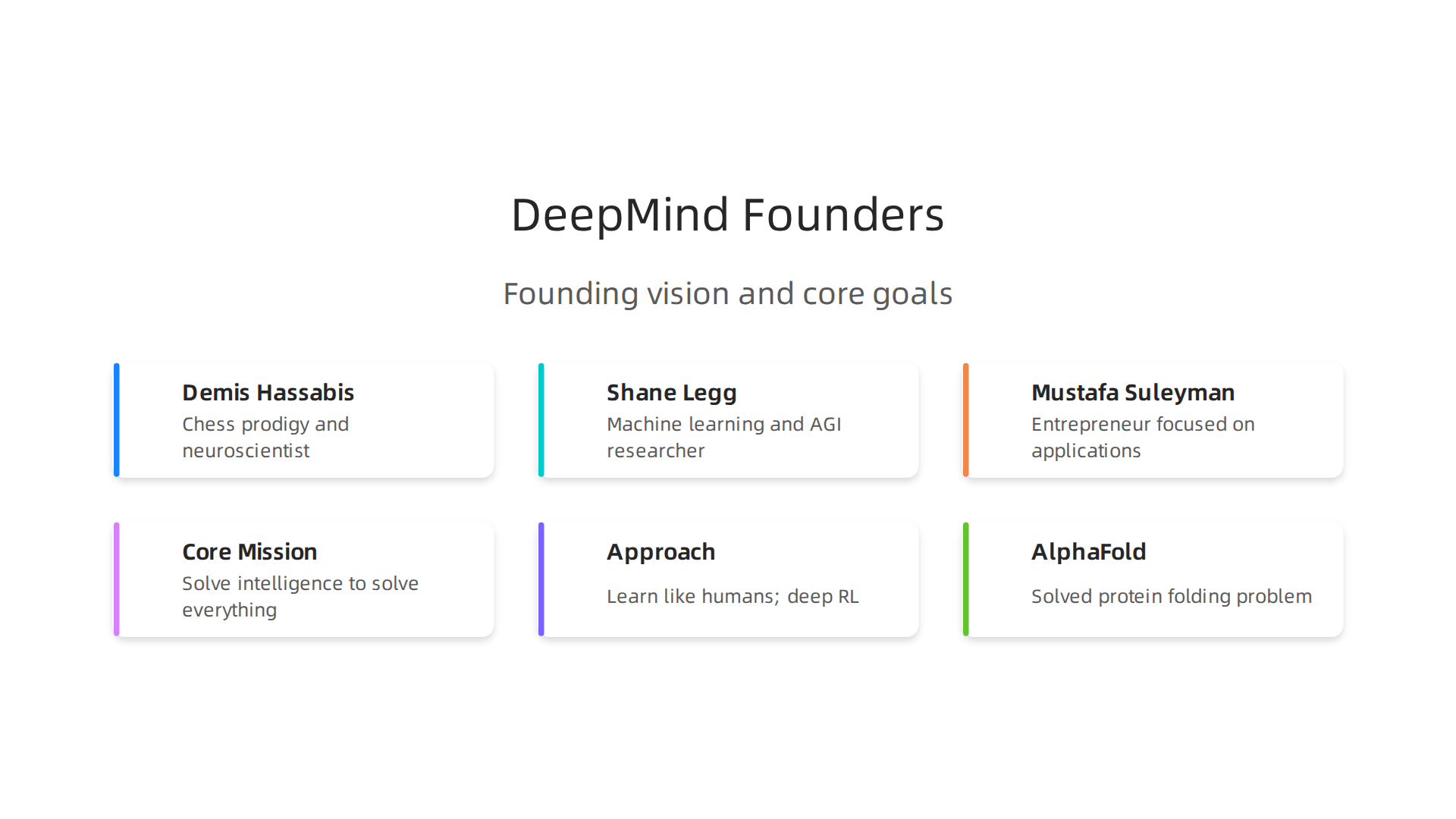
Their mission was simple to say but almost impossible to do: "solve intelligence and use it to solve everything else."
Hassabis brought an unusual mix of talents. He was a chess prodigy as a child, then a video game designer, then a neuroscientist. He understood how the human brain learns and makes decisions. Legg was a machine learning expert focused on the theory of general intelligence. Suleyman brought entrepreneurial drive and a focus on real world applications. Together, they built a team of about 100 top scientists from neuroscience, computer science, and engineering.

The approach they took was different from other labs. Instead of programming AI to follow fixed rules, they wanted it to learn the way humans do. They studied how brain cells fire and how children learn from trial and error. This led them to a method called deep reinforcement learning, which combines neural networks with learning through experience. Early results were stunning. In 2013, the team showed an AI that taught itself to play Atari 2600 games like Pong and Breakout, using only the raw pixels on screen. No code telling it what the game was. It just learned, the way a kid might figure out a new video game by pushing buttons.
This interdisciplinary focus is what set DeepMind apart from many top ai companies in those early years. While others chased narrow applications like search or speech recognition, DeepMind aimed for general intelligence from day one.
Then came the move that changed everything. In January 2014, Google bought DeepMind for around 500 million dollars. At the time the lab had fewer than 100 employees and zero commercial products. Google was not buying revenue. It was buying talent and a shot at the future. As Demis Hassabis later explained, the deal gave DeepMind access to Google’s enormous computing power, which let them speed up their research dramatically. This acquisition turned deepmind ai from a promising startup into a powerhouse with almost unlimited resources.
The purchase also raised questions about independence and ethics. DeepMind had set up an AI ethics board as part of the deal, but skeptics worried about Google’s commercial influence. Over the years those tensions would grow, but in 2014 the deal felt like a win for both sides. Google got a world class research lab. DeepMind got the fuel to chase its grand vision of artificial general intelligence. For a deeper breakdown of the different categories of AI and where DeepMind fits, check out this guide on types of artificial intelligence.
To understand the full story of DeepMind’s founding, the detailed account from Britannica’s history of Google DeepMind covers the founders, their backgrounds, and the early years in excellent depth.
By the time you finished reading this, DeepMind had already pushed its research forward. That is the pace these founders set. And it all started with a simple but audacious question: what if we could actually solve intelligence?
Key Milestones and Breakthroughs: From AlphaGo to AlphaFold and Beyond
With Google’s resources behind it, deepmind ai didn’t waste time. The lab started producing results that stunned the world, one after another. Three milestones stand out in particular: AlphaGo, AlphaFold, and the quieter but equally important work in reinforcement learning and robotics.
AlphaGo: When AI Became a Mind
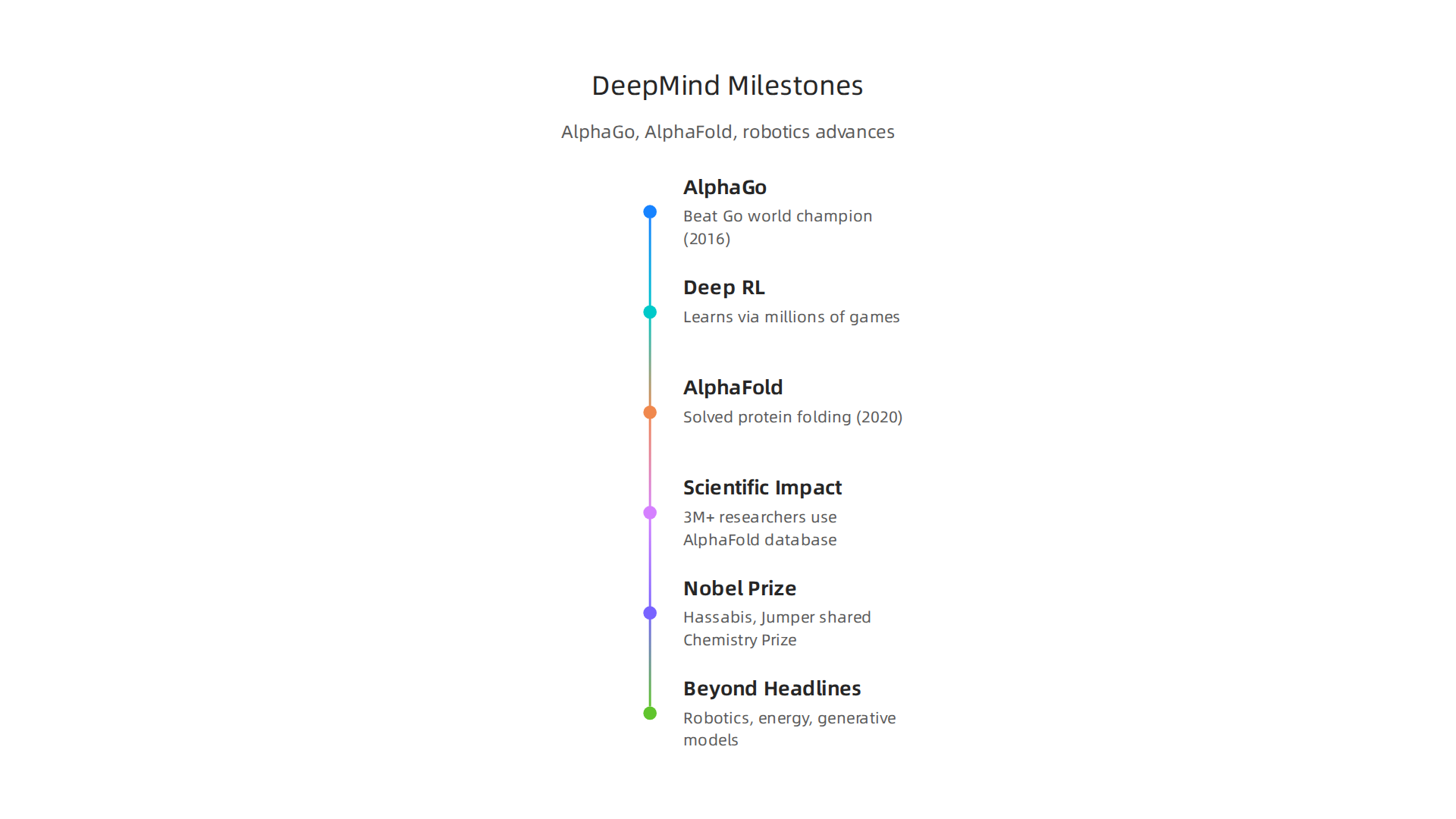
In March 2016, a DeepMind program named AlphaGo faced Lee Sedol, the world champion of the board game Go. Go is far more complex than chess. There are more possible board positions than atoms in the universe. Most experts thought AI was at least a decade away from beating a top professional.
AlphaGo won 4 games to 1. The moment was shocking and beautiful. Lee Sedol later said he felt "speechless." The match was watched by over 200 million people worldwide. For the first time, the general public saw that AI could do something that looked like genuine intuition. It was a watershed moment for AI awareness.

Suddenly, everyone from taxi drivers to politicians was talking about artificial intelligence. Deeper still, AlphaGo showed the power of deep reinforcement learning — a technique where the AI learns by playing millions of games against itself, gradually improving without human guidance. This approach would become a template for later breakthroughs.
AlphaFold: Solving a 50-Year Problem in Biology
If AlphaGo was a headline, AlphaFold was a revolution. In 2020, DeepMind announced that its AlphaFold system had solved protein folding — a grand challenge that had stumped scientists for half a century. Proteins are the machines that run our bodies. Their shape determines what they do. For decades, figuring out a protein’s 3D structure from its sequence of amino acids took months or years of lab work.
AlphaFold changed that. It predicted protein structures with near-experimental accuracy in hours. The team made the code and database freely available. As of 2026, over 3 million researchers from more than 190 countries have used the AlphaFold Protein Structure Database. The system has predicted over 200 million structures — nearly every catalogued protein known to science. This free access has saved researchers potentially millions of dollars and hundreds of millions of years of work.
The scientific impact has been extraordinary. Over 30% of research papers citing AlphaFold focus on understanding disease. It has been cited in more than 35,000 journal articles. In 2024, Demis Hassabis and John Jumper shared the Nobel Prize in Chemistry for their work on AlphaFold. They were recognized alongside David Baker for computational protein design. This was the first time a Nobel Prize was awarded for work done primarily by an AI system. You can read the full details on the AlphaFold program page at Google DeepMind.
AlphaFold has also evolved rapidly. AlphaFold 3, released in 2024, can predict not just protein structures but also how proteins interact with DNA, RNA, small molecules, and ions. This has opened doors for drug discovery and understanding basic biology at a level that was previously impossible.
Beyond the Headlines: Reinforcement Learning and Robotics
DeepMind’s work goes beyond these famous projects. The same deep reinforcement learning methods that powered AlphaGo have been applied to robotics, energy efficiency, and even controlling nuclear fusion reactors. The lab has also pushed into generative models, creating AI that can design new molecules and materials. In robotics, DeepMind has taught robot arms to manipulate objects with increasing skill using simulation and transfer learning. All of this reinforces why deepmind ai continues to rank among the top ai companies driving real scientific and industrial change.
To understand how deep learning differs from other AI techniques like reinforcement learning, check out this clear guide on AI vs machine learning vs deep learning.
The pace of progress is dizzying. Each year brings new versions of AlphaFold, more advanced games, and smarter robots. If you want to stay on top of these rapid developments, get clear daily AI updates from The Deep View Newsletter. Subscribe to The AI Newsletter Worth Reading. It is the easiest way to keep your finger on the pulse of AI breakthroughs without drowning in noise.
DeepMind Under Google: Integration, Independence, and the 2023 Reorganization
After those stunning breakthroughs, a big question loomed. How would DeepMind fit inside Google? The answer came in April 2023. Google merged DeepMind with its own Google Brain team to form a single lab called Google DeepMind. The move was a direct response to the rise of ChatGPT and the need to speed up AI work across the company.
You can read the full details in the Wikipedia article on Google DeepMind. The merger brought together two of the world’s leading AI research groups under one leader: Demis Hassabis.
The goal was simple. Centralize all top AI talent into one powerhouse. No more two teams competing for resources or chasing different priorities. By combining DeepMind’s deep reinforcement learning expertise with Google Brain’s strengths in large language models and TensorFlow, the new lab could move faster.
But the merger also stirred up old worries. From the start, DeepMind’s founders had pushed for independence from Google’s product teams. They wanted to focus on AGI and science, not just making Google Search better or improving ad rankings. The 2023 reorganization seemed to pull them closer into Google’s orbit.
Here is the truth. DeepMind still keeps a distinct culture and operates mostly from its London headquarters. It still publishes research openly. Yet the line between pure research and product delivery has blurred. Today, DeepMind’s models power Google’s Gemini assistant, its search features, and many internal tools. The lab is no longer just a far-away lab. It is a core engine of Google’s product strategy.
This tighter integration brings both speed and tension. On one hand, DeepMind gains access to Google’s enormous computing power and data. On the other hand, some researchers worry that short-term product goals could crowd out long-term scientific exploration.
So where does deepmind ai stand in 2026? It remains one of the top ai companies in the world, but now it wears two hats. It is both a Nobel-winning research lab and a key part of Google’s commercial machine. If you want to understand how this shift from pure research to applied AI plays out across the industry, check out this guide on strategic AI adoption. It shows how companies balance innovation with real-world deployment.
DeepMind’s Impact on AI Research and Industry
DeepMind’s work reaches far beyond Google offices. It changes science, medicine, and even gaming.
No project proves this better than AlphaFold.
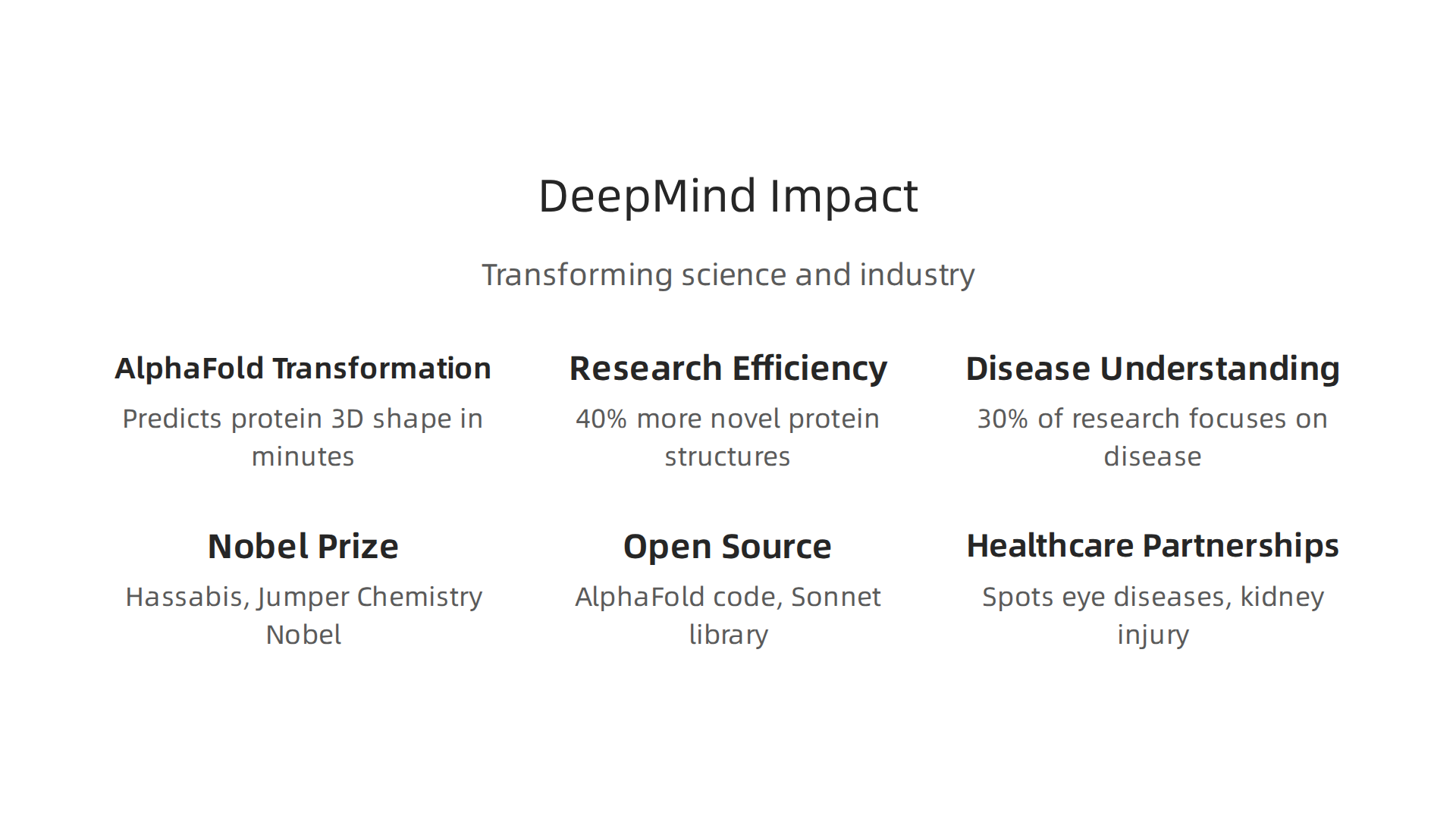
Since 2021, AlphaFold has completely transformed how scientists study proteins. It predicts a protein’s 3D shape from a simple list of amino acids. Before AlphaFold, figuring out one protein structure could take years of expensive lab work. Now it takes minutes. The official AlphaFold page at Google DeepMind shows that over 3 million researchers from more than 190 countries have used the free database. The system has already predicted over 200 million protein structures. That covers nearly every protein known to science.
The real world results are stunning. An independent study found that researchers using AlphaFold 2 submitted over 40% more novel protein structures than those who did not. Their work was also twice as likely to appear in clinical articles. A recent five year impact report reveals that more than 30% of AlphaFold-related research focuses on better understanding disease.
For this breakthrough, DeepMind CEO Demis Hassabis and lead researcher John Jumper won the 2024 Nobel Prize in Chemistry. Nature magazine reported that nearly 40,000 journal articles now cite the original AlphaFold 2 paper. That level of influence is rare in science.
But AlphaFold is just one piece of the story. DeepMind has also shaped the entire AI ecosystem through open source work. The lab released the AlphaFold code freely on GitHub so any scientist could run it. It created Sonnet, a library for building neural networks. And while TensorFlow originally came from Google Brain, DeepMind researchers were among its biggest users and contributors.
This open culture has a human side. A researcher in a low income country with no expensive lab equipment can access the same protein predictions as a Harvard scientist. The AlphaFold Database has already seen over one million users from low and middle income countries.
DeepMind has real world partnerships too. The lab worked with the UK’s National Health Service to build AI that spots eye diseases from retina scans. Another system predicts acute kidney injury hours before it happens. DeepMind also spun off Isomorphic Labs in 2021, a company focused entirely on using AI for drug discovery.
These projects show that deepmind ai can do more than win games. It helps cure diseases, saves doctor time, and opens up research that was once impossible. For a broader look at how these breakthroughs reshape the field, read this analysis of how AI impacts research in 2026.
If you want to stay on top of breakthroughs like these without wasting hours on noise, The AI Newsletter Worth Reading delivers daily updates on what actually matters across the AI landscape.
Comparing DeepMind to Other Leading AI Labs: OpenAI, Anthropic, and Meta AI
DeepMind is one of the most respected names in the field, but it is far from the only big player. To really understand where deepmind ai fits, you need to see how it stacks up against OpenAI, Anthropic, and Meta AI. Each lab runs on a different philosophy, and those differences shape what they build and who they serve.
DeepMind versus OpenAI: Research first versus product first
DeepMind has always been a research lab at heart. It publishes papers, wins science prizes, and dominates benchmarks. OpenAI started the same way but shifted hard toward products. ChatGPT, the GPT API, and a deep partnership with Microsoft turned OpenAI into a consumer and enterprise powerhouse.
In 2026, OpenAI still leads in brand recognition and user numbers. But the gap is closing fast. A detailed comparison of the comparison of OpenAI, Anthropic, and Google DeepMind in 2026 shows that DeepMind’s Gemini 3.1 Pro now tops 13 of 16 major AI benchmarks.
OpenAI still wins on scale with over 500 million users. DeepMind wins on raw technical capability. For anyone evaluating which platform to build on, these tradeoffs matter.
Anthropic: Safety as a core differentiator
Anthropic walks a different path. Founded by former OpenAI researchers, the company makes safety its central mission. Claude, their flagship model, is designed to be helpful, honest, and harmless. That focus has paid off in a huge way. In early 2026, Anthropic’s annualized revenue reached around $30 billion, passing OpenAI for the first time. That is 14x growth in a single year.
For investors and partners who care about responsible AI, Anthropic is a serious contender. You can learn more about Anthropic’s rise as an OpenAI challenger and how it built safer models while building a massive business.
Meta AI: Open research at scale
Meta AI plays a completely different game. Instead of keeping models behind APIs, Meta releases open weights models like Llama for anyone to use and modify. The goal is to democratize AI research and let the community build on top of its work. This makes Meta a favorite among academics, startups, and developers who want full control over their AI stack without vendor lock-in.
What this means for you
Among the top AI companies in 2026, there is no single winner. DeepMind leads in benchmarks and ecosystem integration through Google. OpenAI leads in consumer reach. Anthropic leads in enterprise trust and safety. Meta leads in open access. Understanding who leads where helps you make smarter decisions about partnerships, investments, and which technology to build your next product on.
The Future of DeepMind: Challenges and Opportunities
DeepMind has accomplished incredible things, but the road ahead is far from easy. Even with Google’s resources behind it, the lab faces serious challenges that will shape what it can achieve in the coming years.
Internal pressure from Google
Here is the thing: DeepMind was acquired by Google in 2014, but it has always fought to keep its independence. For years, DeepMind leaders pushed back against Google’s desire to commercialize their research faster. In April 2023, the two finally merged into Google DeepMind, bringing Google Brain and DeepMind together under one roof.
That merger solved some problems but created new ones. DeepMind now has to balance its research-first culture with Google’s need to ship products and compete with OpenAI and Anthropic. In 2026, Google’s capital expenditures are projected to reach up to $185 billion, with a huge chunk going to AI infrastructure. That kind of money brings opportunity, but it also brings expectations. Google expects returns.
To help navigate this, DeepMind recently hired a new chief strategy officer from outside the company. This move signals that leadership is thinking seriously about how to move toward AGI safely while staying competitive.
External competition is only getting fiercer
DeepMind is not the only lab chasing artificial general intelligence. OpenAI has ChatGPT with hundreds of millions of users. Anthropic just passed OpenAI in annual revenue. Meta is giving away its best models for free. Each competitor has a different angle, and DeepMind cannot afford to rest on its laurels.
The race to AGI is also incredibly expensive. Training runs for frontier models could cost over $100 billion by 2030. DeepMind benefits from Google’s deep pockets, but that also means it must deliver results that justify that spending.
Where DeepMind is focusing next
Despite these pressures, DeepMind has clear advantages. Its CEO, Demis Hassabis, believes AI could unlock breakthroughs in medicine and energy that reshape society. AlphaFold already revolutionized biology. The question is what comes next.
Three areas stand out for DeepMind’s future:
- General-purpose AI and AGI. Hassabis has said he believes AGI could arrive by 2030.
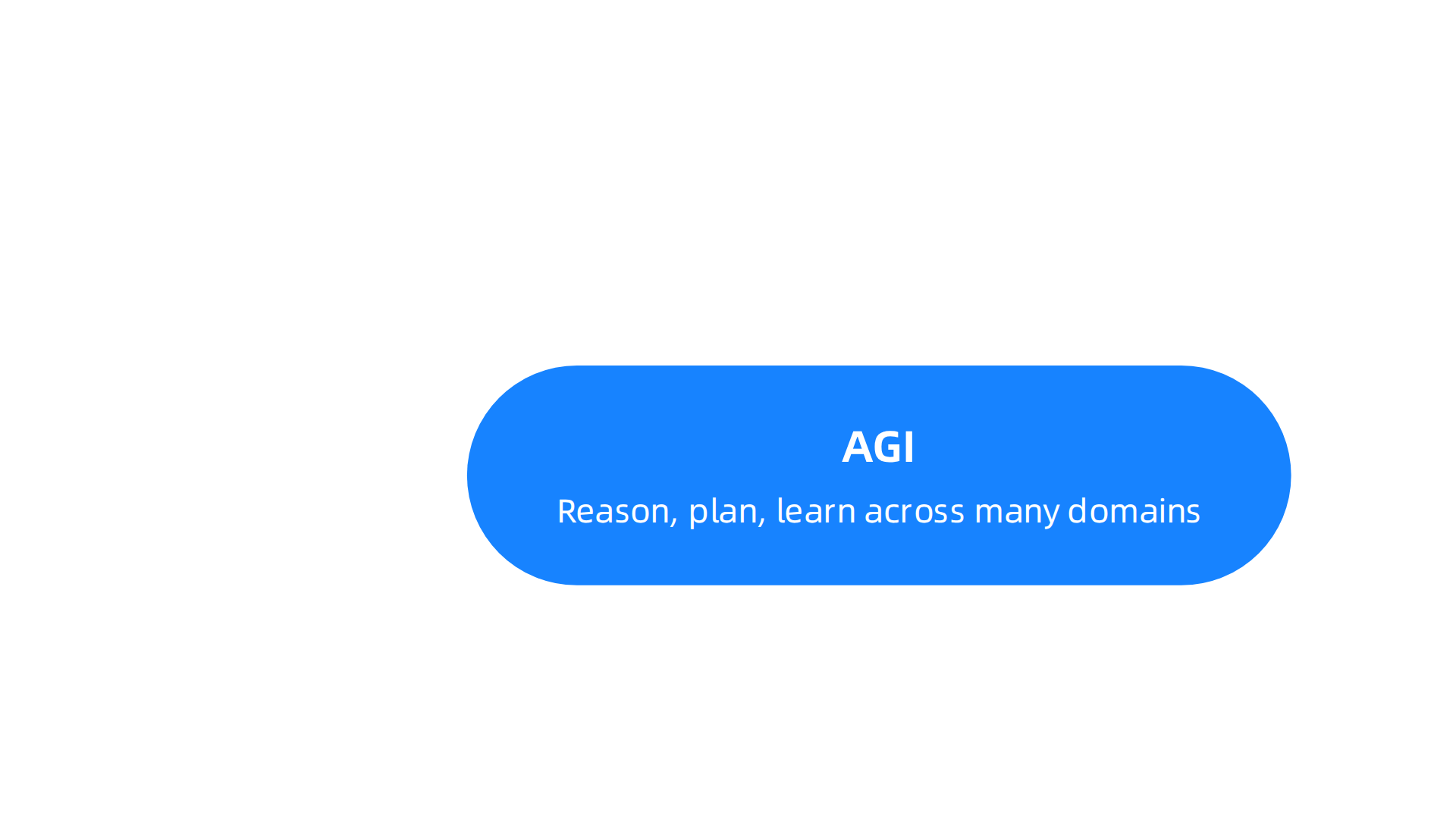
DeepMind is pushing hard to build systems that can reason, plan, and learn across many domains at once.
-
Robotics. DeepMind has been investing heavily in robotics research, training AI to interact with the physical world. This is a natural next step after mastering games and language.
-
AI safety. DeepMind has published detailed safety papers warning about AGI risks. The lab is investing in oversight systems that use AI to monitor other AI, preparing for a world where models are smarter than humans.
If you want to understand how these focus areas fit into the bigger picture, a solid overview of AI trends in 2026 helps separate what matters from the hype.
Talent retention is the wild card
DeepMind’s greatest asset has always been its people. The lab attracted some of the brightest minds in AI research ever since its founding in London. But as competition heats up, keeping those researchers becomes harder. OpenAI and Anthropic offer massive compensation packages. Startups lure talent with equity and freedom.
If DeepMind can hold onto its top researchers and keep investing in long-term science, it will likely remain a leading AI lab for years to come. If talent starts to drift, the story could look different.
For anyone tracking these developments closely, staying informed is half the battle. The AI landscape shifts weekly, not yearly. That is exactly why The Deep View Newsletter exists to deliver clear, daily updates on everything happening across the top AI companies, including DeepMind. It saves you the time of hunting for news across a dozen different sources.
So what is the bottom line?
DeepMind sits at a crossroads. It has the talent, the funding, and the track record to lead the AI revolution. But it also faces internal pressure, external competition, and the immense challenge of building AGI responsibly. How it navigates these next few years will determine whether it becomes the defining AI lab of the decade or just one player in a crowded field.
Conclusion: Why DeepMind Remains a Bellwether for the AI Industry
So here is why DeepMind still matters more than most people realize. It is not just another lab chasing artificial general intelligence. DeepMind is a weather vane for the entire industry. When DeepMind publishes a safety paper, the whole field pays attention. When it hits a breakthrough in protein folding, it changes biology. When it struggles with Google’s internal pressure, that tension shows up at every other corporate AI lab too.
For anyone tracking top AI companies, DeepMind offers a living case study in how to balance pure research with commercial reality. Its journey from an independent London startup to the crown jewel of Google’s AI empire has been messy, brilliant, and full of lessons. The lab proved that fundamental science can coexist with product deadlines, but only if leadership fights for it every day.
The numbers back this up. According to a recent analysis from the team at Epoch AI, the path to AGI by 2030 looks increasingly realistic — but only for labs that can sustain massive compute investments and retain world-class talent. That is exactly where DeepMind’s track record matters. It has both the funding and the research culture to keep pushing the frontier.
If you are a professional trying to make sense of this fast-moving landscape, understanding how to separate real progress from hype is critical. A practical way to build that skill is to learn how to evaluate AI tools in 2026 using frameworks that cut through the noise. DeepMind’s own research is a perfect test case for those frameworks.
At the end of the day, DeepMind remains the clearest signal we have about where artificial intelligence is heading. Its successes and failures will shape the industry for years to come. Whether you are an investor, a founder, or just someone who wants to understand what is coming next, keeping an eye on this lab is one of the smartest things you can do.
Summary
This profile traces DeepMind’s rise from a London startup to a central force in AI by 2026, explaining its founding vision, signature breakthroughs, and strategic role inside Google. The article reviews landmark projects like AlphaGo and AlphaFold, shows how reinforcement learning and robotics extend that work, and details DeepMind’s real-world impact on medicine, energy, and scientific research. It covers the 2014 Google acquisition and the 2023 consolidation with Google Brain, and explains the tradeoffs between research independence and product integration. You’ll also get a practical comparison to rivals such as OpenAI, Anthropic, and Meta, plus an analysis of the lab’s main risks—talent competition, commercial pressure, and safety challenges. After reading, you will understand why DeepMind remains a bellwether for the industry and what the lab’s next strategic priorities mean for investors, executives, and researchers.